
Listen to this Post
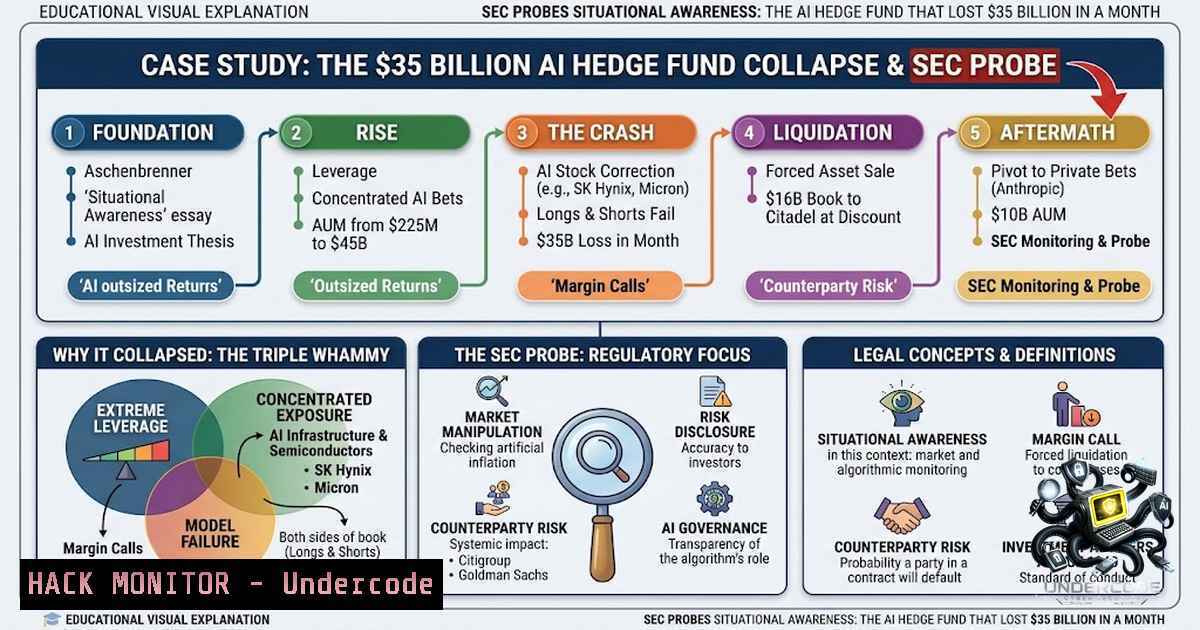
Introduction:
The Securities and Exchange Commission (SEC) has launched an investigation into Situational Awareness, an AI-focused hedge fund that went from managing over $30 billion to near-collapse in a single month. Founded by former OpenAI researcher Leopold Aschenbrenner, the fund employed aggressive leveraged bets on AI chip stocks, reaching up to 400% leverage before a July tech sell-off triggered margin calls and a forced fire sale. This case serves as a critical cybersecurity and IT governance lesson: algorithmic trading systems, AI-driven investment models, and cloud-1ative financial infrastructures require rigorous security, compliance, and risk management frameworks to prevent catastrophic failures.
Learning Objectives & Secrets:
- Objective 1: Understand AI Trading System Vulnerabilities — Learn how algorithmic trading platforms can amplify risk through excessive leverage and concentrated positions, and how to implement circuit breakers and risk limits.
- Objective 2: Master Financial API Security — Secret tip: Secure all API endpoints connecting trading algorithms to prime brokers with mutual TLS (mTLS), OAuth 2.0 with PKCE, and real-time anomaly detection to prevent unauthorized trade execution.
- Objective 3: Implement Cloud Hardening for Financial Workloads — Secret tip: Use infrastructure-as-code (IaC) with policy-as-code (Open Policy Agent) to enforce compliance controls across multi-cloud environments, ensuring that every infrastructure change is audited and approved.
You Should Know:
1. AI Trading System Risk Assessment & Mitigation
Situational Awareness’s downfall stemmed from concentrated positions in SK Hynix and CoreWeave, representing over 56% of its U.S. portfolio. When AI stocks plummeted in July, the fund’s 400% leverage magnified losses from $45 billion to approximately $10 billion. To prevent similar scenarios, financial IT teams must implement:
- Real-time risk monitoring using Value-at-Risk (VaR) models with stress testing
- Automated circuit breakers that halt trading when drawdown thresholds are exceeded
- Portfolio diversification algorithms that rebalance positions based on correlation matrices
Linux Command for Monitoring System Load (Risk Indicator):
 Monitor system load and memory usage as proxy for trading engine stress
watch -1 1 'uptime && free -h && df -h'
Windows PowerShell for Process Monitoring:
 Monitor trading application CPU/memory usage
Get-Process -1ame "trading" | Select-Object Name, CPU, WorkingSet | Format-Table
2. API Security for Financial Trading Systems
The SEC subpoenas focus on trade timing and communications with lenders. This highlights the need for secure, auditable API interactions between hedge funds and prime brokers. Implement:
- mTLS authentication for all broker API calls
- HMAC-based request signing to prevent tampering
- Comprehensive audit logging with immutable storage (e.g., AWS S3 Object Lock)
Example: Securing a REST API with HMAC-SHA256 (Python):
import hmac
import hashlib
import time

def sign_request(secret_key, method, path, body, timestamp):
message = f"{method}{path}{timestamp}{body}".encode()
signature = hmac.new(secret_key.encode(), message, hashlib.sha256).hexdigest()
return signature
3. Cloud Infrastructure Hardening for Financial Workloads
Situational Awareness’s rapid growth to $30 billion AUM required scalable cloud infrastructure. Financial cloud deployments must prioritize:
- Zero-trust architecture with micro-segmentation
- Encryption at rest and in transit (AES-256, TLS 1.3)
- Automated compliance scanning using tools like AWS Config or Azure Policy
Terraform Example: Enforcing Encryption on S3 Buckets:
resource "aws_s3_bucket" "financial_data" {
bucket = "situational-financial-data"
acl = "private"

server_side_encryption_configuration {
rule {
apply_server_side_encryption_by_default {
sse_algorithm = "AES256"
}
}
}
}
4. Vulnerability Exploitation & Mitigation in AI Models
AI trading models are susceptible to adversarial attacks and data poisoning. Mitigation strategies include:
- Input validation and sanitization for all market data feeds
- Model versioning and rollback capabilities
- Regular red-team exercises to test model robustness
Command to Validate Data Integrity (Linux):
 Verify checksums of incoming market data files
sha256sum /data/market_feeds/.csv | tee -a /var/log/data_integrity.log
5. Compliance Automation & Audit Trails
The SEC’s investigation underscores the importance of maintaining comprehensive, tamper-proof audit trails. Implement:
- Centralized logging with ELK Stack or Splunk
- Automated compliance reporting against SEC regulations
- Immutable ledger for all trade executions
Windows Command for Event Log Auditing:
 Enable advanced audit policy for financial transactions
auditpol /set /subcategory:"Detailed Tracking" /success:enable /failure:enable
6. Disaster Recovery & Business Continuity
The fund’s near-collapse required Citadel to step in and purchase the portfolio at a ~10% discount. Financial IT systems must have:
- Multi-region failover capabilities
- Automated backup and restore procedures
- Incident response playbooks for market crashes
Linux Backup Script:
!/bin/bash
 Automated backup of critical trading data
rsync -avz /data/trading/ /backup/trading_$(date +%Y%m%d)/
gpg --encrypt --recipient "[email protected]" /backup/trading_.tar.gz
7. AI Governance & Model Risk Management
Aschenbrenner’s fund was built on an AI-centric thesis, but lacked governance structures to manage model risk. Essential practices include:
- Model validation by independent third parties
- Explainability frameworks (SHAP, LIME) for all trading decisions
- Regular stress testing against historical crash scenarios
What Undercode Say:
- Key Takeaway 1: AI-driven financial innovation must be balanced with robust compliance and risk management frameworks. The Situational Awareness case demonstrates that technological advancement cannot outpace regulatory oversight.
-
Key Takeaway 2: Leverage amplifies both gains and losses. The fund’s 400% leverage turned a market correction into a catastrophic $35 billion loss. Financial IT systems must incorporate dynamic leverage limits based on real-time volatility.
Analysis: The SEC’s investigation into Situational Awareness sends a clear signal to the fintech industry: regulators are watching AI-driven trading platforms closely. The subpoenas to Goldman Sachs, JPMorgan, Citigroup, and Bank of America indicate that oversight will extend beyond the fund itself to the entire ecosystem of prime brokers and lenders. For CISOs and IT directors in financial services, this means prioritizing API security, audit trail integrity, and cloud infrastructure hardening. The fund’s 67% portfolio wipeout also highlights the need for real-time risk monitoring and automated circuit breakers. As AI continues to permeate financial markets, the lines between cybersecurity, compliance, and trading technology will blur — requiring integrated governance models that address all three simultaneously.
Prediction:
- +1 Increased regulatory scrutiny will drive demand for AI governance platforms and compliance automation tools, creating a $5B+ market opportunity by 2028.
-
+1 Hedge funds will adopt zero-trust architectures and mTLS for all broker API communications, reducing attack surfaces and improving audit capabilities.
-
-1 Smaller AI hedge funds without robust compliance infrastructure may face similar investigations, potentially leading to consolidation in the sector.
-
-1 The reputational damage to AI-driven investment strategies may slow institutional adoption, as risk-averse allocators pivot to traditional asset managers.
-
+1 The incident will accelerate development of open-source risk management frameworks for algorithmic trading, similar to OWASP for web security.
-
-1 Increased compliance costs (estimated 15-20% of IT budgets) may stifle innovation in early-stage AI fintech startups.
-
+1 Cloud providers (AWS, Azure, GCP) will enhance their financial services compliance offerings, including pre-built audit trails and automated reporting.
-
-1 The SEC’s focus on trade timing could lead to more stringent reporting requirements, increasing operational overhead for high-frequency trading firms.
-
+1 Insurance products specifically covering AI trading model failures and regulatory fines will emerge as a new asset class.
-
-1 If the investigation uncovers systemic issues, it could trigger a broader market sell-off in AI-related stocks, similar to the July correction that caused the fund’s collapse.
▶️ Related Video (78% Match):
https://www.youtube.com/watch?v=–tTOOyYasc
🎯Let’s Practice For Free:
🎓 Live Courses & Certifications:
Join Undercode Academy for Verified Certifications
🚀 Request a Custom Project:
Secure, high-velocity infrastructure and disruptive technological engineering. Contact our engineering team for high-tier development and proprietary systems:
[email protected]
💎 Smart Architecture | 🛡️ Secure by Design | ⭐ Trusted by Thousands
IT/Security Reporter URL:
Reported By: https://lnkd.in/p/eCina4dx – Hackers Feeds
Extra Hub: Undercode MoN
Basic Verification: Pass ✅


