
Listen to this Post
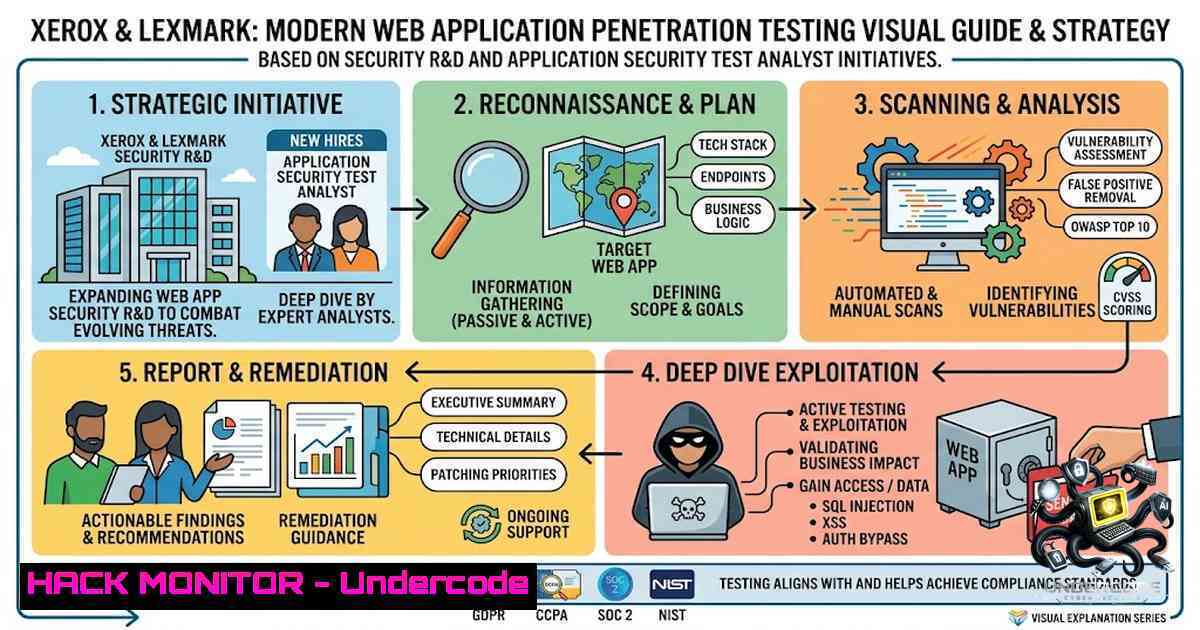
Introduction:
The cybersecurity landscape in 2026 demands a specialized breed of security professionals who can navigate the complex interplay of web applications, APIs, cloud infrastructure, and mobile platforms. Xerox Lexmark’s recent hiring announcement for an Application Security Test Analyst in Kolkata underscores a critical industry trend: organizations are moving beyond compliance-driven security checklists toward proactive, hands-on vulnerability identification and exploitation. The role requires expertise in conducting Web Application Security Assessments, Penetration Testing across multiple platforms, and proficiency with industry-standard tools such as Burp Suite, SQLmap, Nmap, and Wireshark. This article provides a comprehensive technical guide covering the core competencies, tool configurations, and methodologies expected of modern application security testers.
Learning Objectives & Secrets:
- Objective 1: Master Web Application Penetration Testing Methodology – Understand and apply structured testing frameworks including OWASP Testing Guide (WSTG) and NIST SP 800-115. Learn to conduct thorough assessments covering authentication, authorization, session management, data validation, and user management controls.
-
Objective 2 Secret Tip: Automate Vulnerability Discovery with SQLmap – Go beyond manual SQL injection testing by leveraging SQLmap’s advanced features for database enumeration, table and column discovery, and WAF evasion techniques. Use `–batch` flag for non-interactive automated scanning and `–os-shell` for operating system access where permitted.
-
Objective 3 Secret Tip: Combine Network Reconnaissance with Application-Layer Testing – Integrate Nmap network scanning with Burp Suite’s application-layer testing to correlate infrastructure vulnerabilities with application-specific flaws. Use Nmap’s Scripting Engine (NSE) `–script vuln` to detect known CVEs while simultaneously fuzzing application endpoints.
You Should Know:
- Burp Suite: The Swiss Army Knife of Web Application Security Testing
Burp Suite remains the industry-standard integrated platform for web application security testing in 2026. Its comprehensive toolset includes HTTP/S traffic interception, request modification, automated vulnerability scanning, and manual testing workflows.
Step‑by‑Step Guide: Configuring Burp Suite Proxy for HTTPS Interception
- Download and Install Burp Suite – Obtain the latest version (2025.12.5 as of January 2026) from PortSwigger. The Community Edition provides core functionality; Professional adds automated scanning and extended capabilities.
-
Configure Proxy Settings – Set Burp to listen on
127.0.0.1:8080. Configure your browser (using FoxyProxy or manual settings) to route traffic through this proxy. -
Install Burp’s CA Certificate – Navigate to `http://burp` in your browser, download the CA certificate, and install it in your browser’s trusted certificate store to intercept HTTPS traffic.
-
Intercept and Analyze Requests – Enable interception in the Proxy tab. Capture requests, analyze parameters, and forward to Repeater for manual manipulation.
-
Automated Scanning (Professional) – Right-click any request and select “Do an active scan” to launch automated vulnerability detection covering OWASP Top 10 categories including SQL Injection, XSS, and Command Injection.
Linux Command (Terminal Proxy Configuration):
 Set HTTP_PROXY for command-line tools
export HTTP_PROXY=http://127.0.0.1:8080
export HTTPS_PROXY=http://127.0.0.1:8080
 Test with curl
curl -x http://127.0.0.1:8080 https://target.com
Windows Command (PowerShell):
$env:HTTP_PROXY="http://127.0.0.1:8080"
$env:HTTPS_PROXY="http://127.0.0.1:8080"
2. SQLmap: Automated SQL Injection Detection and Exploitation
SQLmap is an open-source penetration testing tool that automates the detection and exploitation of SQL injection vulnerabilities. It supports multiple database management systems including MySQL, Oracle, PostgreSQL, and MSSQL.
Step‑by‑Step Guide: SQLmap Workflow for Database Penetration Testing
- Identify Potential Injection Points – Use Burp Suite to capture requests containing URL parameters, POST data, or cookies.
-
Basic SQLmap Execution – Target a single URL parameter:
sqlmap -u "https://target.com/page?id=1" --batch --dbs
The `–batch` flag uses default answers for non-interactive execution.
-
Enumerate Databases – After identifying the database management system type and version, enumerate available databases:
sqlmap -u "https://target.com/page?id=1" --dbs
-
Extract Table and Column Data – Specify a database and list its tables:
sqlmap -u "https://target.com/page?id=1" -D database_name --tables
Then dump specific columns:
sqlmap -u "https://target.com/page?id=1" -D database_name -T users --dump
- Advanced Exploitation – For operating system access (authorized testing only):
sqlmap -u "https://target.com/page?id=1" --os-shell
Installation (Kali Linux – pre-installed; other distributions):
 Clone from official repository
git clone https://github.com/sqlmapproject/sqlmap.git
cd sqlmap
python sqlmap.py --version
3. Nmap: Network Reconnaissance and Vulnerability Discovery
Nmap remains essential for network discovery, port scanning, and vulnerability detection. The Nmap Scripting Engine (NSE) enables automated vulnerability checks and service enumeration.
Step‑by‑Step Guide: Comprehensive Network Scanning with Nmap
- Basic Host Discovery – Identify live hosts on a network:
nmap -sn 192.168.1.0/24
-
Service Version Detection – Probe open ports for running services and versions:
sudo nmap -sV target.com
-
Aggressive Scan – Combine OS detection, version detection, script scanning, and traceroute:
sudo nmap -sS -sV -O -A -p- 192.168.2.200
-
Vulnerability Scanning with NSE – Run the `vuln` category scripts to detect known vulnerabilities:
nmap -sV --script vuln target.com
-
Specific Vulnerability Testing – Target individual CVEs or service-specific vulnerabilities:
nmap -sV --script http-vuln-cve2017-5638 target.com
nmap -sV --script mysql-vuln,mssql-vuln target.com
4. Wireshark: Network Traffic Analysis for Security Testing
Wireshark remains the reference tool for network packet analysis in 2026, used for both offensive and defensive security operations. It enables detection of port scans, ARP spoofing attacks, and analysis of plaintext data transmission.
Step‑by‑Step Guide: Packet Capture and Analysis
- Capture Live Traffic – Select the appropriate network interface and start capture. Use filters to reduce noise:
tcp.port == 80 or tcp.port == 443
2. Detect Security Issues – Identify:
- Unencrypted HTTP transmission of sensitive data
- Port scan signatures (multiple SYN packets to different ports)
- ARP spoofing indicators
- Deep Packet Inspection – Follow TCP streams to reconstruct and analyze application-layer conversations.
-
Command-Line Analysis with Tshark – For automated and scripted analysis:
tshark -r capture.pcap -Y "http.request.method == GET" -T fields -e http.host -e http.request.uri
-
Filter for Suspicious HTTPS Traffic – Identify anomalous TLS handshakes or certificate mismatches.
-
OWASP Top 10 2026: Prioritizing Web Application Vulnerabilities
The OWASP Top 10 2026 release identifies Broken Access Control as the dominant security risk for the second consecutive release. Understanding these categories is essential for any application security tester.
Key Categories and Testing Approaches:
| OWASP Category | Testing Focus | Key Tools |
|-||–|
| A01: Broken Access Control | IDOR, privilege escalation, path traversal | Burp Suite Repeater, custom scripts |
| A02: Cryptographic Failures | Weak encryption, missing TLS, hardcoded secrets | OpenSSL, Wireshark |
| A03: Injection | SQL, command, LDAP injection | SQLmap, Burp Suite Intruder |
| A04: Security Misconfiguration | Default credentials, unnecessary services | Nmap, Nikto |
| A05: Software Supply Chain Failures | Outdated components, vulnerable dependencies | Retire.js, OWASP Dependency Check |
Step‑by‑Step Guide: OWASP-Aligned Testing Workflow
- Scope Definition – Identify target URLs, subdomains, API endpoints, and authentication states in scope.
-
Information Gathering – Perform passive reconnaissance using OSINT and active enumeration with Nmap.
-
Configuration and Deployment Management Testing – Check for backup files, unreferenced pages, and sensitive data exposure.
-
Authentication and Session Management Testing – Test for broken authentication, session fixation, and insecure session tokens.
-
Data Validation Testing – Probe all input vectors for SQL injection, XSS, command injection, and other injection flaws.
-
Business Logic Testing – Identify flaws in application workflow and authorization controls.
6. Mobile Application Security Testing (iOS/Android/Windows)
The hiring post specifically highlights experience in Mobile Application Security Testing across iOS, Android, and Windows platforms.
Key Testing Areas:
- Static Analysis – Review decompiled code for hardcoded secrets, insecure data storage, and weak cryptography.
- Dynamic Analysis – Intercept mobile traffic using Burp Suite (configure mobile proxy settings), analyze API calls, and test for insecure direct object references.
- Local Storage Assessment – Check SQLite databases, SharedPreferences (Android), and UserDefaults (iOS) for sensitive data exposure.
- Certificate Pinning Bypass – Use tools like Frida or Objection to bypass certificate pinning for testing purposes.
Android Debug Bridge (ADB) Commands:
 List installed packages
adb shell pm list packages
 Extract APK for static analysis
adb pull /data/app/com.target.app/base.apk
 Check for debuggable flag
adb shell getprop ro.debuggable
iOS Commands (with jailbreak):
 Install Frida
pip install frida-tools
 List running processes
frida-ps -U
7. API Security Testing and Cloud Hardening
Modern applications increasingly rely on APIs and cloud infrastructure. Security testing must extend beyond traditional web applications.
API Security Testing Checklist:
- Authentication Testing – Validate OAuth2, JWT, and API key implementations.
- Authorization Testing – Test for IDOR vulnerabilities in API endpoints.
- Rate Limiting – Verify that rate limiting prevents brute force attacks.
- Input Validation – Test for injection vulnerabilities in JSON/XML payloads.
- Security Headers – Verify CORS, CSP, and other security headers are properly configured.
Cloud Security Hardening Commands (AWS CLI Example):
 List S3 buckets with public access
aws s3api list-buckets --query "Buckets[?PublicAccessBlockConfiguration==null]"
 Check IAM policy for overly permissive roles
aws iam list-policies --scope Local --query "Policies[?PolicyName.contains(@,'Admin')]"
What Undercode Say:
- Key Takeaway 1: The Xerox Lexmark Application Security Test Analyst role reflects the industry’s growing demand for professionals who can bridge the gap between development and security operations. The emphasis on both automated tools (Burp Suite, SQLmap) and manual testing skills indicates that organizations value depth over breadth – dedicated tools that excel at specific vulnerability classes remain irreplaceable.
-
Key Takeaway 2: The OWASP Top 10 2026 confirms that Broken Access Control and Injection vulnerabilities continue to dominate the threat landscape. Security testers must develop expertise in identifying and exploiting these vulnerabilities across multiple platforms – web, mobile, API, and cloud. The integration of AI-powered security testing platforms suggests that the future of application security will combine autonomous agents with human expertise, not replace it.
Analysis: The cybersecurity job market in 2026 is increasingly specialized. Organizations are moving away from generic security roles toward positions requiring deep technical proficiency with specific tools and methodologies. Professionals with hands-on experience in Burp Suite, SQLmap, Nmap, and Wireshark – combined with certifications like OSCP or CEH – are positioned for career growth. The shift toward autonomous security agents and AI-powered testing means that tomorrow’s security analysts must not only master current tools but also adapt to AI-augmented workflows. However, the fundamental skills of understanding vulnerabilities, interpreting scan results, and crafting remediation strategies remain uniquely human competencies that automation cannot fully replicate.
Prediction:
- +1 – The demand for Application Security Test Analysts will grow by approximately 25-30% through 2027 as organizations integrate security into DevOps pipelines (DevSecOps), creating sustained career opportunities for skilled penetration testers.
-
+1 – AI-powered security testing platforms will augment – not replace – human analysts, enabling faster vulnerability identification while freeing professionals to focus on complex business logic flaws and architectural security reviews.
-
-1 – Organizations that rely solely on automated scanning tools without investing in manual penetration testing expertise will experience higher breach rates, as automated tools cannot detect complex business logic vulnerabilities or zero-day exploits.
-
-1 – The complexity of cloud-1ative and API-driven architectures will outpace traditional testing methodologies, requiring continuous upskilling and adaptation from security professionals.
-
+1 – The integration of bug bounty programs with enterprise security teams will create hybrid roles combining external researcher perspectives with internal testing capabilities.
-
-1 – The shortage of qualified application security professionals will persist, driving up salary premiums and creating talent acquisition challenges for organizations outside major tech hubs.
-
+1 – Standardization around OWASP frameworks and NIST guidelines will improve the quality and consistency of security assessments across the industry.
-
-1 – Legacy applications and outdated components will remain a significant attack vector, as organizations struggle to remediate vulnerabilities in complex, interdependent systems.
-
+1 – Continuous security training and certification programs (OSCP, CEH, GWAPT) will evolve to include AI-assisted testing methodologies, ensuring professionals remain current with emerging threats.
-
+1 – The convergence of application security with cloud security and supply chain security will create new specializations and career paths for professionals who can navigate all three domains.
▶️ Related Video (66% Match):
https://www.youtube.com/watch?v=0HCc-S8Svrk
🎯Let’s Practice For Free:
🎓 Live Courses & Certifications:
Join Undercode Academy for Verified Certifications
🚀 Request a Custom Project:
Secure, high-velocity infrastructure and disruptive technological engineering. Contact our engineering team for high-tier development and proprietary systems:
[email protected]
💎 Smart Architecture | 🛡️ Secure by Design | ⭐ Trusted by Thousands
IT/Security Reporter URL:
Reported By: https://lnkd.in/p/eG53gxVM – Hackers Feeds
Extra Hub: Undercode MoN
Basic Verification: Pass ✅


