Listen to this Post
Introduction:
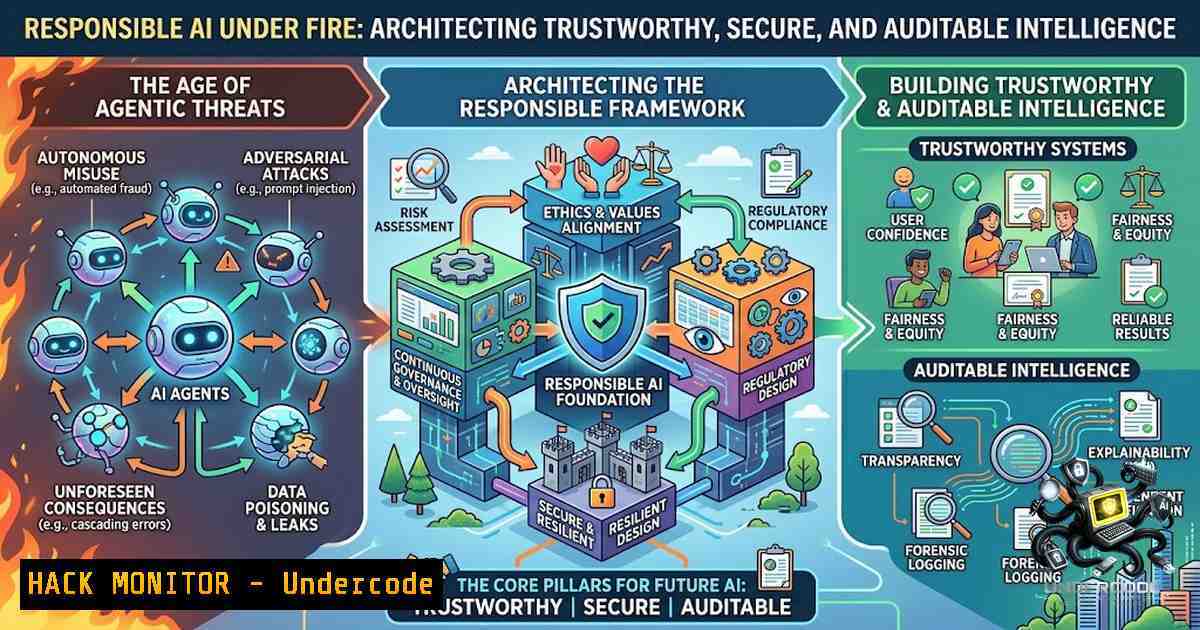
As artificial intelligence permeates every layer of the digital ecosystem—from security operations centers to enterprise copilots—the concept of “Responsible AI” has evolved from an ethical ideal into a non-1egotiable security imperative. The intersection of AI governance frameworks like the NIST AI RMF, OWASP’s Top 10 for LLMs, and ISO 27001 controls now defines the battleground where trust, privacy, and resilience are either architected or exploited. With malicious actors weaponizing generative AI at unprecedented scale, organizations must move beyond principles to implement verifiable, technical safeguards that protect AI systems from prompt injection, data poisoning, and model extraction.
Learning Objectives:
- Master the seven trustworthiness characteristics of the NIST AI Risk Management Framework and apply them to real-world AI deployments.
- Identify and mitigate the OWASP Top 10 vulnerabilities for Large Language Model applications, including prompt injection and insecure output handling.
- Implement ISO 27001-aligned security controls to secure AI supply chains, training data, and model artifacts against adversarial threats.
- Deploy practical Linux, Windows, and cloud-hardening commands to enforce least privilege, monitor AI system integrity, and respond to AI-specific incidents.
You Should Know:
- NIST AI RMF: The Seven Pillars of Trustworthy Intelligence
The NIST AI Risk Management Framework (AI RMF) provides a voluntary, consensus-based structure for embedding trustworthiness into AI systems. Its core defines four functions—Govern, Map, Measure, and Manage—but its foundational strength lies in the seven characteristics of trustworthy AI: valid and reliable, safe, secure and resilient, accountable and transparent, explainable and interpretable, privacy-enhanced, and fair with harmful bias managed.
Step‑by‑step guide to operationalizing NIST AI RMF:
- Govern: Establish an AI governance board with clear roles. Document all AI models, training datasets, and third-party APIs in an inventory (aligned with ISO 27001 A.5.9).
- Map: Conduct a context-aware risk assessment. Identify how each AI system handles sensitive data and whether it could become vulnerable to security breaches.
- Measure: Define metrics for each trustworthiness characteristic. For security and resilience, track failed authentication attempts, model drift, and adversarial input detection rates. For privacy, monitor data minimization and anonymization effectiveness.
- Manage: Implement continuous monitoring and feedback loops. Regularly update risk profiles based on new threat intelligence.
 Linux: Audit AI model file integrity
sudo find /opt/ai-models/ -type f -1ame ".h5" -o -1ame ".pt" -exec sha256sum {} \; > model_integrity_baseline.txt
 Schedule daily integrity checks
sudo crontab -e
 Add: 0 2    find /opt/ai-models/ -type f ( -1ame ".h5" -o -1ame ".pt" ) -exec sha256sum {} \; | diff - model_integrity_baseline.txt
 Windows: Monitor AI service integrity using PowerShell
Get-Service | Where-Object {$<em>.DisplayName -like "AI" -or $</em>.DisplayName -like "ML"} | ForEach-Object {
$status = (Get-Service $<em>.Name).Status
Write-Host "$($</em>.DisplayName): $status"
if ($status -1e 'Running') { Send-MailMessage -To "[email protected]" -Subject "AI Service Down" -Body "$($_.DisplayName) is $status" }
}
- OWASP GenAI Top 10 2026: The Attacker’s Playbook for LLMs
The OWASP GenAI Security Project, now with over 600 contributing experts, has released the 2026 edition of its Top 10 for LLM Applications—the first edition influenced by real-world incidents. The critical vulnerabilities include:
- LLM01: Prompt Injection – Direct and indirect injection attacks that manipulate model outputs.
- LLM02: Sensitive Information Disclosure – Unintentional exposure of training data, system prompts, or proprietary information.
- LLM03: Supply Chain – Compromised dependencies, pre-trained models, or training data.
- LLM04: Data and Model Poisoning – Adversarial manipulation of training or fine-tuning data.
- LLM06: Excessive Agency – AI systems with overly broad tool access or permission escalation.
Step‑by‑step guide to mitigating OWASP LLM risks:
- Implement input sanitization and output validation: Use allowlists and context-aware filtering. Never trust model outputs directly.
- Enforce least privilege for AI agents: Treat AI agents like semi-autonomous users. Constrain capabilities, pin tooling, and enforce rules at identity, data, and output boundaries.
- Deploy preventive and detective controls: Use OWASP AI Exchange controls, including kill switches and rollback mechanisms.
 Python example: Basic prompt injection detection
import re
def sanitize_prompt(user_input):
 Block common injection patterns
patterns = [r"ignore previous instructions", r"system prompt", r"you are now", r"roleplay"]
for pattern in patterns:
if re.search(pattern, user_input, re.IGNORECASE):
raise ValueError("Potential prompt injection detected")
return user_input
- ISO 27001:2022 as an AI Security Control Framework
ISO 27001’s Annex A controls are directly applicable to AI operations. Organizations should extend their ISMS to cover AI-specific risks, including adversarial machine learning, model inversion, and data poisoning.
Key ISO 27001 controls for AI:
- A.5.15 Access Control: Implement role-based access and least privilege to prevent unauthorized access to model training environments or artifacts.
- A.5.19 Information security in supplier relationships: Assess third-party AI providers for data processing locations, contractual clarity, and model hosting security.
- A.8.25 Secure development life cycle: Incorporate secure coding standards for AI tools and perform vulnerability assessments throughout development.
 Linux: Restrict access to model directories
sudo chown -R ai-service:ai-group /opt/ai-models/
sudo chmod -R 750 /opt/ai-models/
sudo setfacl -R -m u:admin:rwx /opt/ai-models/
 Audit access logs
sudo ausearch -f /opt/ai-models/ -i
 Windows: Set NTFS permissions for AI model folders
icacls "C:\AI-Models" /grant "AI-Service:(OI)(CI)R" /grant "Admin:(OI)(CI)F" /inheritance:r
 Enable advanced audit policies
auditpol /set /subcategory:"File System" /success:enable /failure:enable
- Securing AI Systems by Design: Zero Trust for Intelligence
The Cyber Security Agency of Singapore (CSA) and the Australian Cyber Security Centre both emphasize that AI should be secure by design and secure by default. This means treating AI systems like privileged users, enforcing Zero Trust principles, and maintaining persistent logging.
Step‑by‑step guide to Zero Trust for AI:
- Constrain capabilities: Scope AI agents to narrow jobs. Avoid giving them administrative roles or unrestricted data access.
- Require human approval for high-risk actions: Implement human-in-the-loop for irreversible operations, financial transactions, or sensitive data modifications.
- Rotate credentials and enforce policy-enforcing proxies: Use dedicated, regularly rotated API keys and intercept all AI-to-tool communications through a policy-enforcing proxy.
 Enforce API key rotation for AI services (Linux cron job)
!/bin/bash
 Rotate API keys every 30 days
if [ $(date +%d) -eq 1 ]; then
aws secretsmanager rotate-secret --secret-id ai-api-key
systemctl restart ai-service
logger "AI API key rotated successfully"
fi
- AI+ and Cybersecurity Certifications: Building Competency for the AI Era
The landscape of AI security certifications is expanding rapidly. CompTIA SecAI+ is the industry’s first comprehensive certification focused on securing AI systems and applying AI in cybersecurity operations. Professionals should pursue vendor-1eutral credentials that cover AI governance, secure deployment, and ethical AI practices.
Recommended training paths:
- CompTIA SecAI+: Covers defending AI systems and using AI for security operations.
- Microsoft Responsible AI Standard Playbook: Provides concrete guidance for upholding AI principles with goals and requirements for accountability, transparency, fairness, reliability, privacy, and inclusiveness.
- ISCA AI Fluency: Self-paced e-learning for professionals to get started with AI at work.
- Advanced Professional Certificate in AI Engineering: For professionals moving into AI integration and engineering roles.
What Undercode Say:
- Key Takeaway 1: Responsible AI is not a checkbox—it is a continuous process of balancing trustworthiness characteristics, managing tradeoffs, and adapting to evolving threats. The NIST AI RMF provides a robust framework, but it requires active organizational commitment and cross-functional collaboration.
-
Key Takeaway 2: The OWASP GenAI Top 10 2026 represents a maturation of AI security thinking. With over 600 experts contributing and real-world incidents driving the rankings, these vulnerabilities are not theoretical—they are being actively exploited. Organizations must prioritize input sanitization, least privilege, and supply chain security.
Analysis:
The convergence of AI governance frameworks, security standards, and adversarial threat intelligence signals a new era where AI security is inseparable from organizational resilience. The seven trustworthiness characteristics of the NIST AI RMF—validity, safety, security, accountability, transparency, privacy, and fairness—are not optional features but foundational requirements. However, implementing them requires navigating difficult tradeoffs: interpretability versus privacy, accuracy versus fairness, and security versus usability.
The OWASP Top 10 for LLMs highlights that the most critical risks are not traditional vulnerabilities but AI-specific attack vectors like prompt injection and excessive agency. These require new defensive paradigms, including behavioral monitoring, adversarial testing, and human oversight. Meanwhile, ISO 27001 provides a proven control framework that can be extended to AI, but organizations must update their risk assessments, supplier due diligence, and secure development practices to account for AI-specific threats.
The certification landscape—from CompTIA SecAI+ to Microsoft’s Responsible AI Standard—reflects the urgent need for skilled professionals who can bridge the gap between AI development and cybersecurity. As AI becomes more autonomous and agentic, the principles of zero trust, least privilege, and continuous monitoring will become even more critical.
Prediction:
- +1 Organizations that proactively adopt NIST AI RMF and OWASP GenAI controls will gain a significant competitive advantage, with reduced breach costs and faster regulatory compliance.
- -1 Failure to implement AI-specific security controls will lead to a surge in high-profile data breaches, model theft, and reputational damage as attackers increasingly target AI supply chains and prompt injection vectors.
- +1 The demand for AI security certifications like CompTIA SecAI+ and ISO 27001 AI extensions will skyrocket, creating new career pathways for cybersecurity professionals.
- -1 The complexity of balancing AI trustworthiness characteristics will lead to “security vs. accuracy” conflicts, potentially slowing AI adoption in highly regulated industries.
- +1 Cross-sector collaboration and open-source initiatives like the OWASP GenAI Security Project will accelerate the development of standardized, vendor-1eutral AI security tools and best practices.
▶️ Related Video (76% Match):
🎯Let’s Practice For Free:
🎓 Live Courses & Certifications:
Join Undercode Academy for Verified Certifications
🚀 Request a Custom Project:
Secure, high-velocity infrastructure and disruptive technological engineering. Contact our engineering team for high-tier development and proprietary systems:
[email protected]
💎 Smart Architecture | 🛡️ Secure by Design | ⭐ Trusted by Thousands
IT/Security Reporter URL:
Reported By: Imsrjcse Responsible – Hackers Feeds
Extra Hub: Undercode MoN
Basic Verification: Pass ✅


