Listen to this Post
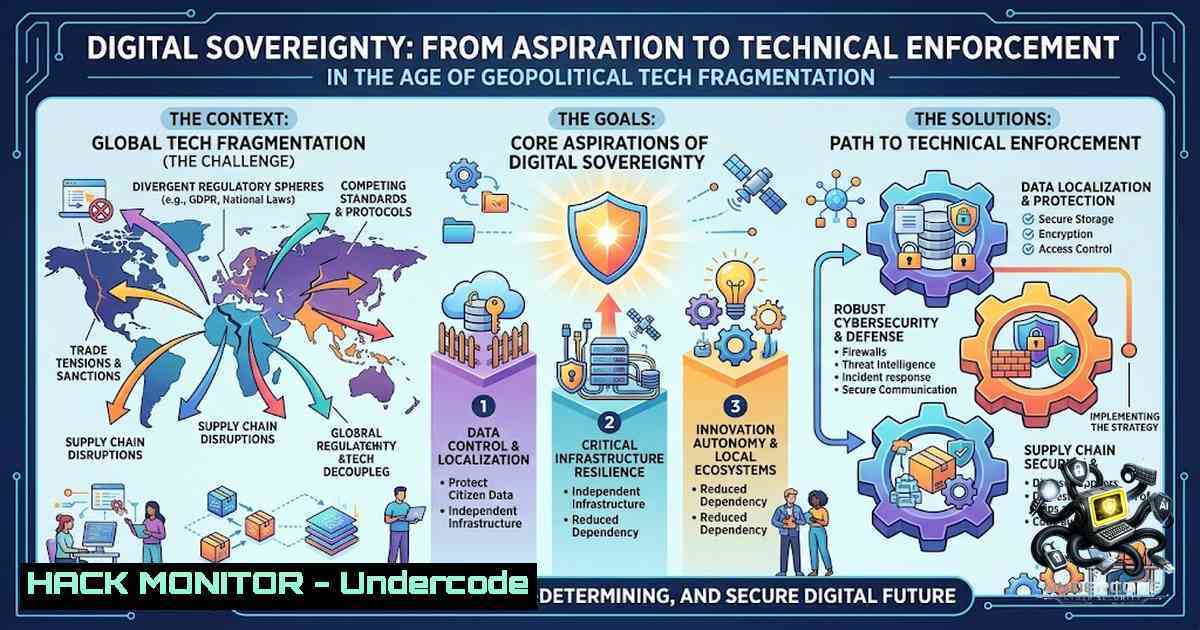
Introduction:
The concept of digital sovereignty has rapidly evolved from a geopolitical abstraction into a pressing technical and operational imperative. As nations and enterprises grapple with dependencies on foreign hardware, operating systems, cloud platforms, and AI models, the core question is no longer about self-sufficiency but about mastering dependencies and maintaining decision-making capacity. True digital sovereignty is not about producing every component internally; it is the ability to control data, secure infrastructure, and maintain operational continuity even when external providers become unavailable or change their rules.
Learning Objectives:
- Understand the five pillars of digital sovereignty (Data, Technology, Infrastructure, Cybersecurity, and AI) and their technical implications.
- Master practical Linux and Windows commands for infrastructure hardening, identity management, and data encryption.
- Learn to implement Zero Trust architectures and decoupled cloud security frameworks to enforce sovereignty.
- Develop skills to audit supply chains, manage cryptographic keys, and deploy sovereign AI models.
- Data Sovereignty: Enforcing Control Through Cryptography and Access Policies
Data sovereignty is the foundation of digital trust and control. It is not merely about where data is stored (data residency) but about who can access it and under which legal jurisdiction it falls. To achieve true data sovereignty, organizations must move beyond contractual assurances and implement technical guarantees that make unauthorized access impossible, not just illegal.
Technical Implementation:
- Encryption Key Custody: Retain exclusive control over encryption keys using Hardware Security Modules (HSMs) certified to standards like FIPS 140-3 Level 4. This ensures that even cloud providers cannot decrypt your data.
- Decoupled Cloud Security (DCS): Implement a framework that separates security enforcement from cloud infrastructure. This allows for policy-driven control over data independent of the underlying cloud platform, mitigating vendor lock-in.
- Confidential Computing: Use secure enclaves (e.g., Intel SGX, AMD SEV) to protect data during processing. This ensures data is encrypted not only at rest and in transit but also in use.
Linux Commands for Data Encryption and Key Management:
 Generate a symmetric key for data encryption
openssl rand -base64 32 > symmetric.key

Encrypt a file using AES-256-CBC with the generated key
openssl enc -aes-256-cbc -salt -in sensitive_data.txt -out sensitive_data.enc -pass file:symmetric.key

Decrypt the file
openssl enc -d -aes-256-cbc -in sensitive_data.enc -out sensitive_data_decrypted.txt -pass file:symmetric.key

Securely delete a file (overwrite with random data)
shred -v -z -1 3 sensitive_data.txt
Windows PowerShell Commands for Encryption:
 Create a new self-signed certificate for file encryption
$cert = New-SelfSignedCertificate -Subject "CN=DataEncryption" -Type DocumentEncryptionCert

Encrypt a file using the certificate (Protect-CmsMessage)
Protect-CmsMessage -To $cert -Path .\sensitive_data.txt -OutFile .\sensitive_data.enc

Decrypt the file (Unprotect-CmsMessage)
Unprotect-CmsMessage -Path .\sensitive_data.enc -OutFile .\sensitive_data_decrypted.txt
Step-by-Step Guide: Implementing a Data Sovereignty Policy
- Classify Data: Inventory and classify data based on sensitivity and regulatory requirements (GDPR, HIPAA, etc.).
- Choose a Key Management Strategy: Decide between Bring Your Own Key (BYOK), Hold Your Own Key (HYOK), or using a cloud provider’s key management service with external key storage.
- Implement Encryption: Apply encryption at the application, database, and file system levels.
- Enforce Access Controls: Implement attribute-based access control (ABAC) and policy-as-code (e.g., Open Policy Agent) to define who can access what data under which conditions.
- Audit and Monitor: Continuously monitor data access patterns and key usage. Enable comprehensive logging and integrate with a Security Information and Event Management (SIEM) system.
-
Technology Sovereignty: Breaking Vendor Lock-in with Open Source and Open Standards
Technology sovereignty is about having the freedom to choose and move across technologies and providers. This requires building resilient digital ecosystems based on open cloud platforms, open AI models, and enterprise-grade cybersecurity frameworks. Heavy reliance on proprietary stacks creates single points of failure and strategic vulnerability.
Technical Implementation:
- Adopt Open Source Alternatives: Migrate from proprietary operating systems and office suites to open-source alternatives like Linux distributions (e.g., NixOS, Ubuntu) and open-source collaboration platforms.
- Use Open Standards: Implement standards like SPIFFE (Secure Production Identity Framework for Everyone) for workload identity and SPIRE (SPIFFE Runtime Environment) to replace brittle IP-based security with cryptographic identity.
- Containerization and Orchestration: Use Kubernetes and container runtimes (e.g., containerd, CRI-O) to abstract applications from the underlying infrastructure, enabling portability across cloud providers.
Linux Commands for Managing Open Source Infrastructure:
 Install Docker on Ubuntu
sudo apt update
sudo apt install docker.io -y
sudo systemctl start docker
sudo systemctl enable docker

Run a container with a specified volume for data persistence
docker run -d --1ame my_app -v /mydata:/app/data nginx:latest

Backup and restore a container
docker commit my_app my_app_backup
docker save -o my_app_backup.tar my_app_backup

Set up a simple firewall with UFW
sudo ufw default deny incoming
sudo ufw default allow outgoing
sudo ufw allow ssh
sudo ufw allow 80/tcp
sudo ufw enable
Step-by-Step Guide: Migrating to an Open Source Stack
- Audit Current Dependencies: Map all proprietary software and hardware dependencies.
- Identify Open Source Alternatives: Research open-source alternatives for each component (e.g., Samba for file services, OpenBao for secrets management).
- Pilot Migration: Run a pilot project with the chosen open-source stack in a sandbox environment.
- Develop In-House Expertise: Train IT staff on the new technologies. Use resources like the Linux Foundation or open-source community documentation.
- Rollout and Monitor: Gradually migrate workloads, continuously monitoring performance and security.
3. Infrastructure Sovereignty: Hardening the Backbone
Infrastructure sovereignty means maintaining control over computing networks, cloud services, and the physical hardware that powers digital operations. This involves ensuring that critical workloads run on resilient, auditable, and geographically appropriate infrastructure.
Technical Implementation:
- Sovereign Cloud Deployments: Utilize sovereign cloud regions offered by major providers (e.g., AWS European Sovereign Cloud) that are designed to meet stringent data residency and operational autonomy requirements.
- Hybrid and Private Cloud: Adopt hybrid cloud architectures that keep sensitive data within jurisdictional boundaries while leveraging public cloud for less critical workloads.
- Hardware Root of Trust: Use hardware-backed attestation (TPM 2.0, TEE) to verify the integrity of servers and VMs before they are granted access to secrets.
Windows Commands for Infrastructure Hardening:
 Check TPM status
Get-Tpm

Enable BitLocker Drive Encryption
Enable-BitLocker -MountPoint "C:" -TpmProtector

Configure Windows Firewall to block all inbound connections by default
Set-1etFirewallProfile -Profile Domain,Public,Private -DefaultInboundAction Block

Enable Windows Defender Real-time Protection
Set-MpPreference -DisableRealtimeMonitoring $false
Step-by-Step Guide: Hardening a Sovereign Cloud VM
- Apply OS Hardening: Disable unnecessary services and ports. Use CIS benchmarks for guidance.
- Implement Attestation: Configure the VM to provide a signed attestation report from the TPM upon boot.
- Enforce Least Privilege: Use Identity and Access Management (IAM) roles and policies to grant only the minimum necessary permissions.
- Enable Comprehensive Logging: Configure audit logs for all system and application activities, storing them in a secure, immutable location.
- Regular Patching: Automate security updates using tools like `unattended-upgrades` on Linux or Windows Update for Business.
4. Cybersecurity Sovereignty: Building Resilient Defenses
Cybersecurity sovereignty is the capacity to detect, respond to, and resist cyberattacks without entirely depending on external actors. This requires building in-house security operations centers (SOCs), implementing Zero Trust architectures, and developing independent threat intelligence capabilities.
Technical Implementation:
- Zero Trust Architecture (ZTA): Implement a Zero Trust model where identity is the new perimeter. Enforce continuous verification of all users and devices, regardless of their location.
- Micro-segmentation: Divide the network into small, isolated segments to limit lateral movement in case of a breach.
- Sovereign Security Tools: Deploy open-source or locally developed security tools (e.g., Wazuh for SIEM, TheHive for incident response) instead of relying solely on foreign vendors.
Linux Commands for Security Monitoring and Hardening:
 Audit open ports and listening services
sudo netstat -tulpn

Set up a basic intrusion detection system with AIDE (Advanced Intrusion Detection Environment)
sudo aideinit
sudo mv /var/lib/aide/aide.db.new.gz /var/lib/aide/aide.db.gz
sudo aide --check

Monitor system logs in real-time
sudo journalctl -f

Set up a simple firewall rule to limit SSH access to a specific IP
sudo ufw allow from 192.168.1.100 to any port 22
Step-by-Step Guide: Implementing a Micro-segmentation Strategy
- Map Workloads: Identify and map all workloads and their communication dependencies.
- Define Security Groups: Create security groups based on workload function and sensitivity.
- Enforce Network Policies: Use Kubernetes Network Policies or cloud provider security groups to define which groups can communicate with each other.
- Implement Service Mesh: Deploy a service mesh (e.g., Istio, Linkerd) to enforce mutual TLS (mTLS) and fine-grained access policies between services.
- Monitor and Iterate: Continuously monitor traffic flows and adjust policies as needed.
5. AI Sovereignty: Governing the Black Box
AI sovereignty is the ability to develop, deploy, and govern AI systems using infrastructure, data, and models that remain entirely under the organization’s control. This is critical as AI models become embedded in every aspect of operations, from customer service to national security.
Technical Implementation:
- Sovereign AI Factories: Deploy dedicated AI infrastructure (compute, storage, networking) that is physically and logically separate from public cloud services.
- Model Governance: Implement a governance framework that covers model development, data provenance, bias testing, and continuous monitoring.
- Secure Collaboration: Ensure that AI systems operating within collaboration platforms (e.g., Slack, Microsoft Teams) do not expose sensitive data to vendor-controlled infrastructure.
Linux Commands for AI Model Management:
 Install Python and virtual environment for AI development
sudo apt install python3-pip python3-venv -y
python3 -m venv ai_env
source ai_env/bin/activate

Install common AI/ML libraries
pip install tensorflow torch transformers scikit-learn

Run a simple model inference (example with a pre-trained model)
python3 -c "from transformers import pipeline; print(pipeline('sentiment-analysis')('I love sovereign AI!'))"

Monitor GPU usage for AI workloads
nvidia-smi
Step-by-Step Guide: Deploying a Sovereign AI Model
- Select a Model: Choose an open-source or locally developed model that fits your use case.
- Set Up Infrastructure: Provision secure, isolated compute resources for training and inference.
- Implement Data Governance: Ensure all training and inference data remains within the sovereign boundary.
- Establish Audit Trails: Log all model inputs, outputs, and decisions for compliance and transparency.
- Deploy and Monitor: Deploy the model and continuously monitor its performance and security, watching for data poisoning or adversarial attacks.
What Undercode Say:
- Mastery of dependencies is more critical than self-sufficiency. The goal is not to produce everything locally but to understand, audit, and control every dependency in the technology stack.
- Technical controls are non-1egotiable. Contractual assurances and legal frameworks are necessary but insufficient; true sovereignty requires cryptographic and architectural guarantees that make unauthorized access technically impossible.
Analysis:
The discussion around digital sovereignty has matured from a political talking point to a concrete engineering challenge. The five pillars—Data, Technology, Infrastructure, Cybersecurity, and AI—are deeply interconnected. A weakness in one area can compromise the entire sovereignty posture. For instance, relying on a foreign cloud provider for AI workloads (AI Sovereignty) undermines data sovereignty (data residency) and infrastructure sovereignty (control over compute). The solution lies in a layered approach that combines open standards, cryptographic enforcement, Zero Trust principles, and in-house expertise. The proliferation of sovereign cloud offerings and open-source tools provides a viable path forward, but it requires a fundamental shift in mindset from “renting” technology to owning and governing it.
Prediction:
- +1 The sovereign cloud market is projected to grow 4.5 times to $169 billion by 2028, driven by regulatory pressures and geopolitical tensions. This will spur massive investment in local data centers and sovereign AI capabilities.
- +1 The adoption of open standards like SPIFFE and SPIRE will accelerate, enabling a new generation of portable, identity-based security architectures that transcend vendor boundaries.
- -1 The fragmentation of the global internet into sovereign digital blocs will increase operational complexity for multinational enterprises, leading to higher costs and potential security gaps as they struggle to manage disparate, region-specific deployments.
- -1 Nations that fail to develop their own AI capabilities and talent pools will become increasingly dependent on a few global AI superpowers, creating a new form of digital colonialism where they are consumers of AI rather than creators.
- +1 The rise of “sovereign AI” will drive innovation in privacy-preserving technologies like federated learning and homomorphic encryption, as organizations seek to train AI models on sensitive data without compromising sovereignty.
▶️ Related Video (80% Match):
🎯Let’s Practice For Free:
🎓 Live Courses & Certifications:
Join Undercode Academy for Verified Certifications
🚀 Request a Custom Project:
Secure, high-velocity infrastructure and disruptive technological engineering. Contact our engineering team for high-tier development and proprietary systems:
[email protected]
💎 Smart Architecture | 🛡️ Secure by Design | ⭐ Trusted by Thousands
IT/Security Reporter URL:
Reported By: Tarik El – Hackers Feeds
Extra Hub: Undercode MoN
Basic Verification: Pass ✅


