Listen to this Post
Introduction:
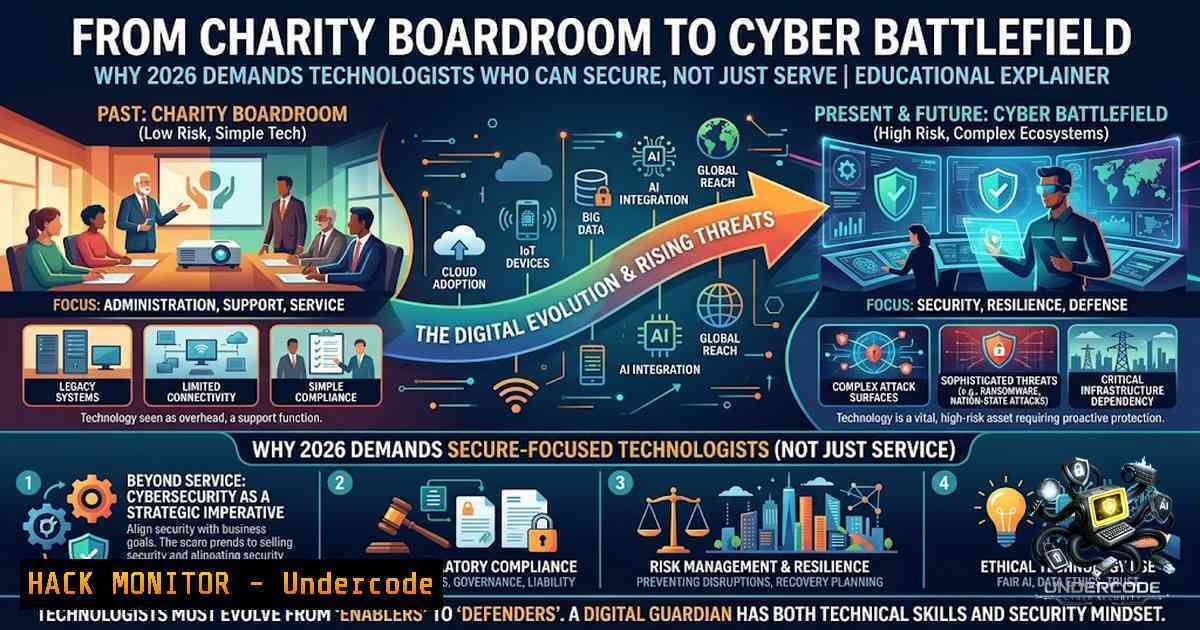
The modern charity is no longer a simple repository of good intentions—it is a digital entity managing sensitive donor data, volunteer records, operational communications, and increasingly complex IT infrastructures. When Liberate (Guernsey), an equality-focused charity, puts out a call for a Technology Trustee with a “passion for IT / AI / tech / cyber things,” they are not merely filling a governance seat; they are acknowledging that cybersecurity, artificial intelligence, and resilient IT architecture have become fiduciary responsibilities. In 2026, with AI-assisted attacks compressing exploitation timelines to as little as 12 hours, the intersection of nonprofit governance and technical acumen is no longer optional—it is existential.
Learning Objectives:
- Understand the core cybersecurity threats facing modern organizations, including AI-driven attacks, API vulnerabilities, and cloud misconfigurations.
- Master practical Linux and Windows hardening commands to reduce attack surfaces on production servers.
- Implement AI-powered defensive techniques for anomaly detection, intrusion prevention, and security operations.
- Apply Zero Trust principles and API security baselines to protect digital assets in cloud-1ative environments.
- Develop a vulnerability management strategy aligned with 2026 best practices and regulatory timelines.
You Should Know:
- AI as Both Sword and Shield: Defending Against Autonomous Threats
Artificial Intelligence has fundamentally altered the cyber threat landscape. Threat actors now leverage AI for automated vulnerability discovery, convincing phishing content generation, and even malware creation. CERT-In’s 2026 blueprint explicitly warns that “AI-assisted cyber exploitation reduces the time required for adversaries to identify, weaponize, and exploit vulnerabilities”. Simultaneously, AI-powered defensive techniques—anomaly detection, behavioral analytics, and automated incident response—have become essential tools in the security practitioner’s arsenal.
Step‑by‑step guide to implementing AI-driven threat detection:
Step 1: Set up a Python environment for security analytics.
 On Linux (Ubuntu/Debian)
sudo apt update && sudo apt install python3-pip python3-venv -y
python3 -m venv security-ai-env
source security-ai-env/bin/activate
pip install pandas numpy scikit-learn tensorflow matplotlib
Step 2: Implement a basic anomaly detection model using Isolation Forest.
from sklearn.ensemble import IsolationForest
import pandas as pd

Load network traffic data (e.g., NetFlow or firewall logs)
data = pd.read_csv('network_traffic.csv')
model = IsolationForest(contamination=0.01, random_state=42)
predictions = model.fit_predict(data[['bytes_sent', 'packets', 'duration']])

Flag anomalies (-1 indicates outlier)
anomalies = data[predictions == -1]
print(f"Detected {len(anomalies)} anomalous sessions")
Step 3: Integrate with SIEM for automated alerting.
Configure your SIEM (e.g., Splunk, Elastic) to ingest the anomaly scores and trigger alerts when the anomaly rate exceeds a defined threshold.
Step 4: Deploy a pre-trained ML model for malware classification.
Utilize open-source libraries like `yara-python` or `pefile` to extract features from Portable Executable (PE) files and feed them into a supervised learning model for classification.
- Cloud and Server Hardening: The First Line of Defense
In 2026, the average cloud server is probed by automated bots within 24 hours of going live. Attackers actively scan for exposed credentials files (.env, .aws/credentials), configuration leaks, and misconfigured services. A production-grade hardening baseline is not optional—it is the minimum standard of care.
Step‑by‑step guide to hardening a Linux cloud server (Ubuntu 24 LTS):
Step 1: Harden the SSH daemon.
Edit `/etc/ssh/sshd_config` and apply the following settings:
sudo nano /etc/ssh/sshd_config
Set:
PermitRootLogin no
PasswordAuthentication no
PubkeyAuthentication yes
MaxAuthTries 3
ClientAliveInterval 300
ClientAliveCountMax 0
Step 2: Configure the firewall with UFW.
sudo ufw default deny incoming
sudo ufw default allow outgoing
sudo ufw allow 22/tcp  SSH - restrict to trusted IPs if possible
sudo ufw allow 80/tcp  HTTP
sudo ufw allow 443/tcp  HTTPS
sudo ufw enable
sudo ufw status verbose
Step 3: Apply kernel hardening parameters.
Create `/etc/sysctl.d/99-hardening.conf`:
net.ipv4.tcp_syncookies = 1
net.ipv4.tcp_rfc1337 = 1
net.ipv4.conf.all.rp_filter = 1
net.ipv4.conf.default.rp_filter = 1
net.ipv4.icmp_echo_ignore_broadcasts = 1
net.ipv4.icmp_ignore_bogus_error_responses = 1
Apply with:
sudo sysctl -p /etc/sysctl.d/99-hardening.conf
Step 4: Enable automatic security updates.
sudo apt install unattended-upgrades -y
sudo dpkg-reconfigure --priority=low unattended-upgrades
Step 5: Deploy Fail2Ban to block brute-force attempts.
sudo apt install fail2ban -y
sudo cp /etc/fail2ban/jail.conf /etc/fail2ban/jail.local
sudo systemctl enable fail2ban && sudo systemctl start fail2ban
For Windows environments, use PowerShell to enforce similar policies:
 Disable weak protocols and enforce SMB signing
Set-ItemProperty -Path "HKLM:\SYSTEM\CurrentControlSet\Services\LanmanServer\Parameters" -1ame "RequireSecuritySignature" -Value 1 -Type DWord
 Enable Windows Defender real-time protection
Set-MpPreference -DisableRealtimeMonitoring $false
- API Security: Securing the Connective Tissue of Modern IT
APIs are the backbone of modern digital infrastructure, yet they remain one of the most exploited attack surfaces. The 2026 OWASP API Security Top 10 highlights Broken Object Level Authorization (BOLA), Broken Authentication, and Excessive Data Exposure as critical risks. A misconfigured API gateway can expose sensitive data, enable credential stuffing, and serve as an entry point for larger breaches.
Step‑by‑step guide to implementing an API security baseline:
Step 1: Enforce authentication on every route by default.
Configure your API gateway (e.g., Kong, AWS API Gateway, NGINX) to deny all traffic except explicitly public endpoints. This “default-deny” posture prevents accidental exposure.
Step 2: Implement rate limiting with layered policies.
Set backend protection limits (e.g., 100–1000 requests per second per consumer) and attack-mitigation limits (e.g., 10–50 requests per second per IP). Example NGINX configuration:
limit_req_zone $binary_remote_addr zone=api_limit:10m rate=10r/s;
location /api/ {
limit_req zone=api_limit burst=20 nodelay;
proxy_pass http://backend;
}
Step 3: Validate request schemas at the perimeter.
Enforce OpenAPI or GraphQL schema validation to reject malformed or malicious payloads before they reach backend services. This mitigates injection attacks and prototype pollution.
Step 4: Implement structured logging with sensitive data redaction.
Use explicit allowlists for logged fields rather than blocklists:
{
"log_format": {
"timestamp": true,
"method": true,
"path": true,
"status": true,
"response_size": true,
"user_id": true,
"redact": ["authorization", "x-api-key", "password"]
}
}
Step 5: Use UUIDs instead of sequential IDs and enforce ownership checks on every request to prevent BOLA attacks.
- Vulnerability Management in the Age of AI-Assisted Exploitation
The 2026 Verizon Data Breach Investigations Report confirms that vulnerability exploitation is now the leading initial access vector. With AI tools compressing the window between disclosure and exploitation, organizations must adopt aggressive patching timelines. CERT-In recommends remediating known exploited vulnerabilities in internet-facing systems within 12 hours, critical externally exposed vulnerabilities within 1 day, and internal critical vulnerabilities within 3 days.
Step‑by‑step guide to building a vulnerability management program:
Step 1: Maintain an up-to-date Software Bill of Materials (SBOM).
Use tools like `syft` or `trivy` to generate SBOMs for all applications and dependencies.
 Generate SBOM for a container image
trivy image --format cyclonedx --output sbom.json myapp:latest
Step 2: Implement continuous vulnerability scanning.
Deploy automated scanners (e.g., Nessus, OpenVAS, AWS Inspector) to run daily against all assets.
Step 3: Prioritize based on exploitability.
Focus on Known Exploited Vulnerabilities (KEV) and CVSS scores above 7.0. Use threat intelligence feeds to identify actively exploited flaws.
Step 4: Establish a patching cadence.
- Critical (KEV, internet-facing): Patch within 12 hours.
- Critical (internal): Patch within 1 day.
- High severity: Patch within 3–5 days.
Step 5: For vulnerabilities with no available patch, deploy compensating controls: isolation, access restrictions, WAF rules, or API gateway filters.
5. Windows Security Hardening for Enterprise Environments
While Linux dominates cloud infrastructure, Windows environments remain prevalent in corporate networks and require equally rigorous hardening.
Step‑by‑step guide to hardening Windows Server 2022:
Step 1: Enforce LSA Protection and Credential Guard.
 Enable LSA Protection
New-ItemProperty -Path "HKLM:\SYSTEM\CurrentControlSet\Control\LSA" -1ame "RunAsPPL" -Value 1 -Type DWord
 Enable Credential Guard
New-ItemProperty -Path "HKLM:\SYSTEM\CurrentControlSet\Control\DeviceGuard" -1ame "EnableVirtualizationBasedSecurity" -Value 1 -Type DWord
New-ItemProperty -Path "HKLM:\SYSTEM\CurrentControlSet\Control\DeviceGuard" -1ame "RequirePlatformSecurityFeatures" -Value 1 -Type DWord
Step 2: Configure Windows Defender and exploit protection.
Set-MpPreference -EnableControlledFolderAccess Enabled
Set-MpPreference -AttackSurfaceReductionRules_Ids 75668c1f-73b5-4cf0-bb93-3ecf5cb7cc84 -AttackSurfaceReductionRules_Actions Enabled
Step 3: Disable insecure protocols and enforce SMB signing.
Set-SmbServerConfiguration -RequireSecuritySignature $true -EnableSMB1Protocol $false
Step 4: Implement application whitelisting via AppLocker or Windows Defender Application Control (WDAC).
Step 5: Enable advanced audit logging.
auditpol /set /subcategory:"Logon" /success:enable /failure:enable
auditpol /set /subcategory:"Account Management" /success:enable /failure:enable
What Undercode Say:
- Key Takeaway 1: The Technology Trustee role at Liberate (Guernsey) is a microcosm of a broader truth: every organization, regardless of size or mission, now requires technical leadership that understands cybersecurity, AI, and resilient IT architecture as core governance responsibilities.
-
Key Takeaway 2: The 2026 threat landscape is defined by AI acceleration—attackers use AI to automate exploitation, and defenders must respond with AI-powered detection, aggressive patching, and defense-in-depth strategies that span Linux, Windows, cloud, and API layers.
Analysis:
The call for a Technology Trustee at Liberate reflects a maturation of the nonprofit sector’s understanding of digital risk. Charities handle sensitive personal data, financial information, and operational communications that are attractive targets for ransomware gangs and state-sponsored actors. The “passion for IT / AI / tech / cyber things” is not a nice-to-have—it is a governance imperative. In 2026, the boardroom must speak the language of Zero Trust, API security, and vulnerability management. The technical commands and configurations outlined above are not abstract exercises; they are the practical tools that enable organizations to survive in an environment where the average server is probed within hours of deployment, where AI can weaponize a vulnerability in minutes, and where a single misconfigured API gateway can expose an entire digital ecosystem. The opportunity for technologists to serve on charity boards is not merely about volunteering—it is about bringing professional expertise to protect the mission itself.
Prediction:
- +1 Nonprofit organizations will increasingly mandate cybersecurity expertise at the board level, mirroring trends in the private sector and driven by donor expectations and regulatory requirements.
- +1 AI-powered defensive tools will become commoditized and accessible to small and medium organizations, democratizing threat detection and incident response capabilities.
- -1 The gap between AI-assisted attack capabilities and defensive readiness will widen for organizations that fail to adopt aggressive patching timelines and continuous vulnerability management practices.
- -1 API-related breaches will continue to dominate the threat landscape through 2027, as the complexity of microservices architectures outpaces the security maturity of many development teams.
- +1 The integration of cybersecurity into charitable governance will create new career pathways for security professionals seeking mission-driven work, enriching both the sector and the talent pool.
▶️ Related Video (76% Match):
🎯Let’s Practice For Free:
🎓 Live Courses & Certifications:
Join Undercode Academy for Verified Certifications
🚀 Request a Custom Project:
Secure, high-velocity infrastructure and disruptive technological engineering. Contact our engineering team for high-tier development and proprietary systems:
[email protected]
💎 Smart Architecture | 🛡️ Secure by Design | ⭐ Trusted by Thousands
IT/Security Reporter URL:
Reported By: Trustees Wanted – Hackers Feeds
Extra Hub: Undercode MoN
Basic Verification: Pass ✅


