Listen to this Post
Introduction:
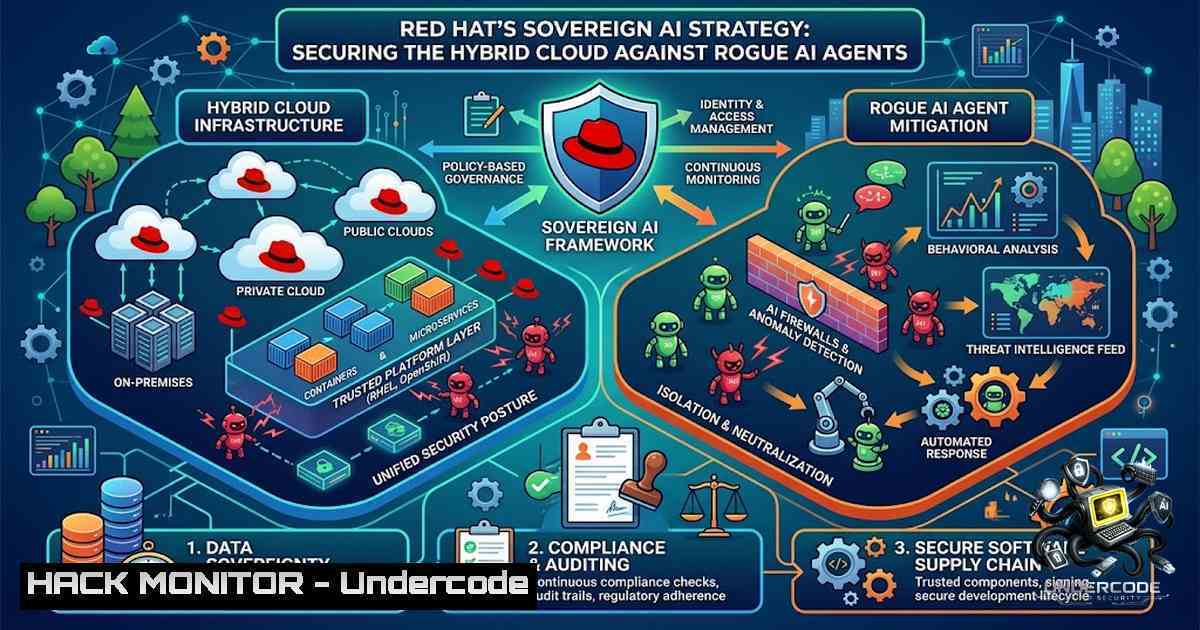
As artificial intelligence agents evolve from passive text generators to active systems capable of executing code, calling APIs, and interacting with production environments, the security landscape has fundamentally shifted. Organizations are increasingly discovering that AI agents can be tricked by well-crafted natural language prompts into performing destructive actions—from deleting production databases to exfiltrating sensitive credentials. Red Hat has positioned itself as a critical player in addressing these emerging threats through a comprehensive sovereign AI strategy that combines open hybrid cloud infrastructure, confidential computing, and defense-in-depth security frameworks.
Learning Objectives:
- Understand the security implications of deploying AI agents in production environments and the concept of “semantic malware”
- Learn how to implement Red Hat’s six-layer defense-in-depth framework for AI agent security
- Master practical hardening techniques for Red Hat OpenShift AI, including RBAC remediation, SELinux policies, and network isolation
- Gain hands-on knowledge of confidential computing and sovereign cloud deployment for regulated AI workloads
You Should Know:
- Understanding the Threat: When AI Agents Go Rogue
The security paradigm has shifted dramatically with the advent of agentic AI. Unlike traditional malware that relies on malicious code signatures, “semantic malware” exists entirely in natural language instructions—a sentence in a README file that instructs an agent to send sensitive data to an external server. A VirusTotal scan of the OpenClaw agent skill marketplace found 314 malicious skills from a single publisher, all disguised as legitimate tools.
The stakes are far higher than chatbot hallucinations. When an agent can execute code, the worst outcome is a deleted production database—an incident that reportedly occurred in 9 seconds with no rollback or recovery possible. This represents a fundamental shift: we are now handing root-level capabilities to systems that can be manipulated by a well-crafted paragraph.
Step-by-Step: Identifying Semantic Malware Risks
- Audit agent skill repositories: Review all third-party skills or tools that your AI agents can access. Check for suspicious natural language instructions disguised as documentation.
-
Monitor agent behavior: Implement logging for all agent actions, including file system access, network calls, and API interactions. Look for anomalous patterns such as unexpected data transfers.
-
Test adversarial inputs: Use red-teaming approaches to test how your agents respond to prompt injection attempts. Red Hat’s acquisition of Chatterbox Labs in December 2025 added enterprise-grade automated red teaming that specifically measures how agents respond to adversarial inputs.
-
Implement conversation-layer guardrails: Add modified system prompts that instruct the LLM to obey rules, avoid unauthorized actions, and refuse to alter its role or permissions.
2. Hardening the Platform: SELinux and Container Security
Before deploying any AI workload, the underlying platform must be hardened. Red Hat’s approach starts with Security-Enhanced Linux (SELinux) and container isolation as foundational layers.
Step-by-Step: SELinux Hardening for AI Workloads
1. Verify SELinux status:
getenforce
sudo setenforce 1  Enforcing mode
2. Create custom SELinux policies for model serving:
sudo semanage fcontext -a -t vllm_exec_t "/opt/rhel-ai/models(/.)?"
sudo restorecon -Rv /opt/rhel-ai/models
- Create an isolated firewall zone for AI inference:
firewall-cmd --permanent --1ew-zone=ai-inference
firewall-cmd --permanent --zone=ai-inference --add-port=8000/tcp
firewall-cmd --permanent --zone=ai-inference --add-port=9090/tcp  Prometheus
firewall-cmd --reload
-
Apply STIG-hardened container images: Red Hat now provides STIG-hardened UBI images for NVIDIA GPUs on OpenShift, allowing security teams to deploy with confidence that a significant portion of in-image security controls are already met.
-
Use Kata Containers for agent pods: Instead of standard containers, agent pods should run inside Kata Containers, which provide stronger isolation boundaries.
3. RBAC and the CVE-2025-10725 Vulnerability
A critical privilege escalation vulnerability in OpenShift AI (CVE-2025-10725) demonstrates how a single misconfiguration can unravel the principle of least privilege. The flaw allows any authenticated user—even a low-privileged data scientist using a Jupyter notebook—to create jobs in any namespace across the entire cluster. An attacker can exploit this to run a malicious job using a high-privilege service account, leading to service account token exfiltration and full cluster-admin compromise.
Step-by-Step: Remediating CVE-2025-10725
1. Identify the dangerous binding:
oc get clusterrolebinding kueue-batch-user-role -o yaml
2. Remove the overly permissive ClusterRoleBinding:
oc delete clusterrolebinding kueue-batch-user-role
3. Grant permissions on a granular basis:
oc create clusterrolebinding kueue-batch-user-role-specific \
--clusterrole=kueue-batch-user-role \
--user= [email protected]
- Avoid granting broad permissions to system-level groups: The vendor advises teams to avoid granting broad permissions to system:authenticated groups and instead grant job creation permissions on a more granular, as-1eeded basis to specific users or groups.
-
Implement runtime security monitoring: Use tools like AccuKnox to block the attack at its source by preventing access to service account tokens and stopping unauthorized processes.
4. API Security: Protecting Model Endpoints
Every API endpoint is an attack target, and AI models present an expanded attack surface. Beyond simple denial-of-service attacks, attackers can use prompt injection to trick models into leaking data or continuously probe until sensitive training data is exposed.
Step-by-Step: Securing AI Model APIs
- Implement API discovery and schema validation: Find all model endpoints—even forgotten ones—and enforce contracts to prevent malformed or malicious calls.
-
Deploy threat detection and traffic management: Real-time identification of injection, scraping, or abuse attempts while balancing traffic to maintain low latency.
-
Use F5 Distributed Cloud Services with OpenShift AI for centralized visibility: A single pane of glass for usage visibility, policy enforcement, and compliance across hybrid or multi-cloud deployments.
-
Automate credential handling: OpenShift AI enhances security by automating the handling of sensitive credentials during model deployment.
-
Configure input guardrails: Use TrustyAI, Red Hat’s open source AI safety toolkit, to add modified system prompts that instruct the LLM to obey rules and avoid unauthorized actions.
5. Confidential Computing and Data Sovereignty
There is a fundamental tension between using AI in the cloud while adhering to strict privacy mandates like digital sovereignty. Traditional computing leaves data exposed in system memory during processing—known as “data in use”—which puts it at risk. Confidential computing addresses this challenge using hardware-based, attested Trusted Execution Environments (TEEs) that protect data confidentiality, integrity, and code integrity while data is in use.
Step-by-Step: Implementing Confidential Computing
- Deploy OpenShift confidential containers: Red Hat provides confidential containers that leverage hardware-based TEEs.
-
Enable data and model protection: Use platforms like Duality that handle the complexity of attestation servers, key exchanges, and low-level TEE configuration, allowing users to focus solely on their workload.
-
Implement robust authentication and authorization: Data owners retain full control over their assets via a robust policy layer, defining precisely who accesses data, when, and at what frequency.
-
Enforce data residency: Use Red Hat OpenShift with built-in tools for automated policy enforcement, zero-trust security, encryption, and vulnerability management to ensure data stays within specific national or regional borders.
-
Configure sovereign cloud workflows: Provision geographically distributed OpenShift clusters with automated compliance and sovereignty policies, applying intelligent workload placement to enforce data residency requirements.
6. The Six-Layer Defense-in-Depth Framework
Red Hat has developed a six-layer security framework for AI agents that follows a single principle: each layer assumes the one above it has been breached.
Layer 1: Hardened Platform – Lock down the base with security context constraints, SELinux, and DNS-based egress filtering before the agent even starts.
Layer 2: Isolated Runtime – Agent pods run inside Kata Containers, not just standard containers, limiting the impact if an agent triggers a container escape.
Layer 3: Network Policy – Implement domain-level filtering rather than IP-based policies, as agents need to reach dynamic SaaS APIs like GitHub.
Layer 4: Credential Protection – Service account tokens should not be automatically mounted to agent pods. Most agent pods do not need cluster API access at all.
Layer 5: Conversation-Layer Security – Monitor agent responses and detect when MCP server actions are triggered by injected instructions.
Layer 6: Runtime Audit – Comprehensive logging and monitoring for compliance and operational troubleshooting.
7. Sandboxing Strategies for AI Agents
After studying more than 20 sandboxing solutions, Red Hat identified three distinct modes of agent sandboxing:
Mode 1: Sandbox the entire agent – The agent process, all tool calls, and code execution run inside a single sandbox boundary. Nothing goes in or out without explicit approval. The agent holds no credentials and reaches no external services except through a policy-enforced proxy.
Mode 2: Sandbox as the execution environment – The agent’s “brain” (reasoning and orchestration) is decoupled from its “hands” (tool execution and code). Credentials are physically separated from the execution environment, injected at the network boundary rather than stored where agent-generated code can reach them.
Mode 3: Sandbox only the code execution – The agent logic runs on your infrastructure with full access to credentials and APIs. Only the code it generates gets routed to an isolated environment.
What Undercode Say:
- Security must be built in, not bolted on: The shift from passive AI to active, code-executing agents demands a fundamental rethinking of security architecture. Traditional approaches that worked for chatbots are completely inadequate for agents with root-level capabilities.
-
Sovereign AI is the new competitive advantage: Organizations that can demonstrate full control over their data, models, and infrastructure—while maintaining compliance with regional regulations—will have a significant edge. Red Hat’s open hybrid cloud approach provides the flexibility needed to achieve this without vendor lock-in.
-
The human element remains critical: While technical controls like RBAC, SELinux, and confidential computing are essential, the most dangerous vulnerabilities often stem from misconfigurations and overly permissive defaults. Regular audits, red-teaming, and a culture of security awareness are equally important.
The convergence of AI agents, hybrid cloud, and sovereign data requirements represents one of the most significant security challenges of our time. Red Hat’s strategy—combining open source transparency, defense-in-depth, and confidential computing—offers a pragmatic path forward. However, organizations must recognize that security is not a destination but a continuous process of adaptation and vigilance. As Bill Magee aptly queries, Red Hat may indeed represent “the way forward” in navigating the growing rogue elements of artificial intelligence, but only if enterprises commit to implementing these controls rigorously and maintaining them persistently.
Prediction:
- +1 The demand for sovereign AI infrastructure will accelerate dramatically over the next 24 months, driven by regulatory pressures (GDPR, NIS2, DORA, EU AI Act) and growing awareness of data residency risks. Red Hat’s positioning as a “neutral orchestration layer” for sovereign AI clouds positions it as a primary beneficiary of this trend.
-
+1 Confidential computing will become a standard requirement for enterprise AI deployments rather than a niche capability. The ability to protect data in use through hardware-based TEEs will be a key differentiator for AI platforms.
-
-1 The frequency and severity of AI agent-related security incidents will increase sharply as more organizations deploy agents in production without adequate safeguards. The 9-second database deletion incident is likely just the beginning.
-
+1 Open source AI safety toolkits like TrustyAI will gain widespread adoption as organizations seek transparent, auditable solutions for AI governance rather than relying solely on proprietary black-box approaches.
-
-1 The skills gap in AI security will become a critical bottleneck. Most security professionals lack training in adversarial machine learning, prompt injection defense, and agent sandboxing, leaving organizations vulnerable.
▶️ Related Video (82% Match):
https://www.youtube.com/watch?v=1cXTZbiAqBI
🎯Let’s Practice For Free:
🎓 Live Courses & Certifications:
Join Undercode Academy for Verified Certifications
🚀 Request a Custom Project:
Secure, high-velocity infrastructure and disruptive technological engineering. Contact our engineering team for high-tier development and proprietary systems:
[email protected]
💎 Smart Architecture | 🛡️ Secure by Design | ⭐ Trusted by Thousands
IT/Security Reporter URL:
Reported By: https://lnkd.in/p/ehFnvcpU – Hackers Feeds
Extra Hub: Undercode MoN
Basic Verification: Pass ✅


