Listen to this Post
Introduction:
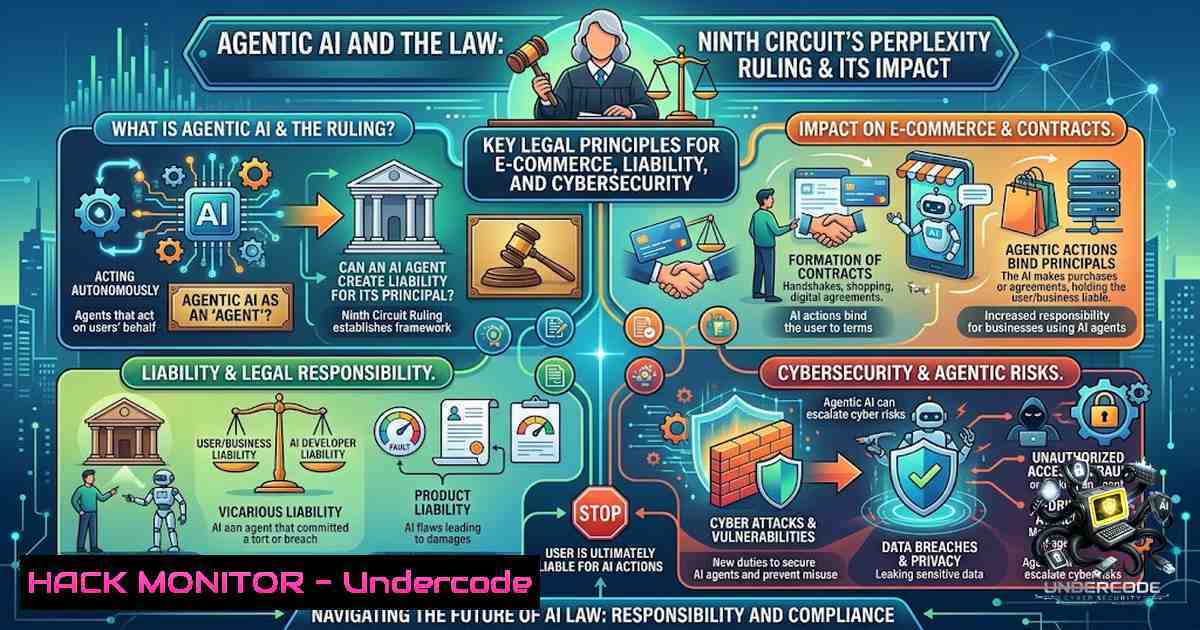
On August 4, 2026, the U.S. Ninth Circuit Court of Appeals vacated a preliminary injunction that had barred Perplexity AI’s agentic shopping tool, Comet, from accessing Amazon’s platform. The court held that the user—not Perplexity—accessed Amazon’s systems, reasoning that the AI agent is “a tool, not a person, for statutory purposes” under the Computer Fraud and Abuse Act (CFAA). This landmark decision establishes that, at least at the preliminary stage, an AI agent’s actions may be treated as an extension of the user’s own mandate rather than as those of an independent digital entity—but it also exposes a significant liability vacuum that enterprises, security teams, and legal professionals must urgently address.
Learning Objectives:
- Understand the Ninth Circuit’s legal reasoning in Amazon v. Perplexity and its implications for CFAA liability and agentic AI
- Identify technical architectures that determine whether an AI agent constitutes “user access” versus “provider access”
- Implement identity, access management, and audit controls to govern AI agents in compliance with emerging regulatory frameworks
- Apply practical commands and configurations for Linux, Windows, and cloud environments to secure agentic AI deployments
You Should Know:
1. The Browser Analogy and Its Technical Foundation
The court’s ruling rests on what legal analysts now call the “browser analogy”: an AI agent is no more Perplexity accessing Amazon than Safari is Apple accessing Amazon. The panel found that because Perplexity’s architecture routed screen information through the user’s device to Perplexity’s servers and returned navigation instructions to the user’s device—rather than relying on a direct connection between Perplexity’s servers and Amazon’s—the user, not Perplexity, accessed Amazon’s computers.
This technical distinction is critical. If an AI agent operates through the customer’s own account and device, CFAA claims become harder to sustain. However, if the agent provider’s servers connect directly to the target platform without user intermediation, the calculus changes.
Step‑by‑step guide: Auditing Your AI Agent’s Access Architecture
- Map the data flow: Document whether your agent processes data server-side (direct platform access) or client-side (through user devices).
- Check for direct API calls: Use network monitoring to identify whether your agent’s backend makes calls to third-party platforms.
– Linux: `sudo tcpdump -i any host api.target.com` or `ss -tunap | grep ESTABLISHED`
– Windows: `netstat -ano | findstr ESTABLISHED` and cross-reference with Task Manager PIDs
3. Review proxy configurations: Ensure that all outbound requests from agent infrastructure are logged and audited.
– Linux (Nginx): Check `/etc/nginx/nginx.conf` for proxy_pass directives
– Windows (IIS): Review Application Request Routing (ARR) settings
4. Implement browser-based architectures: Where possible, design agents to operate through user-authenticated browser sessions rather than server-to-server connections.
5. Document the architecture: Maintain clear records showing that the user’s device intermediates all platform interactions—this was decisive in the Perplexity ruling.
2. Agent Identification and the CFAA Compliance Imperative
The court’s ruling does not give AI agents free rein. Amazon’s trademark, contract, and state-law claims remain active, and the case has been remanded to the district court. Moreover, retailers can enforce terms of service prohibiting automated agents and bot access.
The March 2026 preliminary injunction had found that Perplexity’s AI agent may have violated federal hacking law even though the user expressly authorized the agent to act. This underscores the importance of agent identification: platforms need to distinguish between legitimate user‑assisted agents and unauthorized automated access.
Step‑by‑step guide: Implementing Agent Identification for CFAA Compliance
- Update terms of service: Explicitly prohibit automated agents, bot access, and unauthorized API usage.
- Implement user‑agent detection: Configure your web application firewall (WAF) or load balancer to inspect and log User‑Agent strings.
– Linux (Apache): Add to `.htaccess` or httpd.conf:
SetEnvIf User-Agent "Perplexity|Comet|AI-agent" block_agent
Deny from env=block_agent
– Linux (Nginx):
if ($http_user_agent ~ (Perplexity|Comet|AI-agent)) {
return 403;
}
– Cloudflare WAF: Create a Custom Rule blocking requests with specific User‑Agent patterns
3. Deploy cryptographic agent credentials: Following Mastercard’s Verifiable Intent model, issue each agent a unique cryptographic identity bound to a verified principal.
4. Maintain enforcement records: Document all cease‑and‑desist communications, technical blocking measures, and user consent mechanisms.
5. Monitor for evasion tactics: Perplexity reportedly disguised Comet’s AI bot as a normal Chrome browser. Implement behavioral analytics to detect bot‑like patterns even when User‑Agents are spoofed.
- The Liability Vacuum: Why Identity and Access Management Now Owns AI Security
The court’s ruling effectively outsourced governance of agentic commerce to the private sector. With only 14% of consumers trusting AI to execute purchases without verification, and 42% refusing to trust AI for transactions exceeding $25, the legal framework assumes a level of user agency that does not exist in practice.
In response, regulators have reclassified AI agents as identities. In May 2026, CISA and Five Eyes cybersecurity agencies published guidance treating agentic AI as a new class of identity that can be manipulated through prompt injection and tool misuse—requiring governance mirroring privileged access management. Every agent must carry a unique cryptographically verified identity, and every action must be logged.
Step‑by‑step guide: Hardening IAM for Agentic AI
- Inventory all AI agents: Create a complete register of every autonomous and semi‑autonomous agent operating in your environment.
- Assign unique identities: Use a privileged access management (PAM) solution to issue and manage agent credentials.
– Linux (using HashiCorp Vault):
vault kv put secret/agent/agent01 id=agent-01 policy=shopping-agent
vault read -format=json secret/agent/agent01
– Windows (using Active Directory): Create service accounts specifically for AI agents with constrained delegation
3. Implement least privilege: Grant agents only the minimum permissions required for their mandate.
– AWS IAM Example:
{
"Version": "2012-10-17",
"Statement": [
{
"Effect": "Allow",
"Action": "bedrock:InvokeModel",
"Resource": "arn:aws:bedrock:us-east-1::foundation-model/anthropic.claude-3-sonnet"
}
]
}
4. Enable continuous monitoring: Log every agent action with timestamp, agent ID, action, and outcome.
– Linux (auditd): Configure /etc/audit/rules.d/audit.rules:
-w /var/log/agent/ -p wa -k agent_activity
– Windows (Advanced Audit Policy): Enable “Audit Detailed File Share” and “Audit Process Creation” for agent processes
5. Implement human‑in‑the‑loop controls: Require mandatory human approval for high‑impact or irreversible actions.
4. API Security and Platform Access Controls
The Perplexity case highlights the tension between open web access and platform control. Perplexity argued that AI agents “don’t have eyeballs to see the pervasive advertising Amazon bombards its users with”. Amazon countered that the tool worsened data‑security concerns by routing private account information to Perplexity’s servers.
For enterprises operating e‑commerce platforms, the ruling makes clear that CFAA claims may be harder to sustain where AI agents operate through customer accounts and devices. However, retailers can still enforce terms of service and pursue contract or tort claims.
Step‑by‑step guide: Securing APIs Against Unauthorized Agent Access
- Implement API rate limiting: Prevent excessive requests from any single client.
– Linux (Nginx):
limit_req_zone $binary_remote_addr zone=api:10m rate=10r/s;
location /api/ {
limit_req zone=api burst=20 nodelay;
}
– Cloudflare: Enable Rate Limiting rules with action “Block”
2. Deploy API keys with scope restrictions: Ensure each key has minimal necessary permissions.
– AWS API Gateway: Use usage plans and API keys with stage‑level throttling
3. Validate structured data requirements: AI shopping agents require machine‑readable structured data—JSON‑LD product markup, real‑time inventory APIs, and checkout endpoints. Ensure your APIs expose only what is necessary.
4. Monitor for anomalous patterns: Use SIEM tools to detect unusual access patterns indicative of agent activity.
– Linux (using Elastic Stack): Configure Filebeat to ship API logs to Elasticsearch with custom dashboards
– Windows (using Splunk): Deploy Splunk Universal Forwarder with custom inputs for IIS logs
5. Review Amazon’s Agent Policy: As of March 2026, Amazon requires all AI agents to clearly identify themselves as automated systems and comply with its Agent Policy. Update your platform policies accordingly.
5. Agentic Payments and Authorization Frameworks
When a payment disappears from the screen, responsibility does not disappear from the process. The court’s ruling does not resolve who is liable when an AI agent makes an unauthorized payment or exceeds its mandate. Under the Truth in Lending Act (TILA) and Regulation Z, a transfer is presumed authorized if a consumer furnishes credentials to authorize an agent to make payments—even if the agent acts outside the scope of what the consumer intended.
HM Treasury’s July 2026 Financial Services AI Adoption Plan and the European Commission’s AI Liability Directive both address agentic payments, with the latter placing a rebuttable presumption of fault on the deploying party unless mandate, audit‑trail, and consent evidence is producible.
Step‑by‑step guide: Implementing Agentic Payment Controls
- Define explicit mandates: Document what the agent is authorized to do—spending limits, approved merchants, permitted payment instruments, and substitution rules.
- Implement spending guardrails: Following Cloudflare’s model, configure per‑agent spending allowances, merchant allowlists, and maximum transaction sizes.
- Enable standing authorizations: For appropriately scoped agent‑initiated transactions, implement recurring or standing payment authorizations.
- Maintain audit trails: Record every agentic payment with full context—mandate reference, agent ID, timestamp, merchant, amount, and authorization evidence.
- Implement confirmation thresholds: Require human confirmation for transactions above a defined threshold or for new merchants.
6. Cloud Hardening for Agentic AI Workloads
Agentic AI systems introduce unique cloud security challenges. CISA’s guidance requires narrow role scoping, continuous monitoring, and audit trails for every agent action. Organizations must treat AI agents as privileged identities, not clever software features.
Step‑by‑step guide: Cloud Hardening Commands and Configurations
1. AWS: Implement least‑privilege IAM roles for agents
{
"Version": "2012-10-17",
"Statement": [
{
"Effect": "Deny",
"Action": "",
"Resource": "",
"Condition": {
"StringNotEquals": {
"aws:RequestedRegion": "us-east-1"
}
}
}
]
}
2. Azure: Use Managed Identities with conditional access
- Assign agents to specific resource groups
- Implement Azure Policy to restrict agent actions
3. GCP: Implement VPC Service Controls
- Create a service perimeter for agent workloads
- Restrict data exfiltration to unauthorized networks
4. Kubernetes: Implement network policies
apiVersion: networking.k8s.io/v1
kind: NetworkPolicy
metadata:
name: agent-1etwork-policy
spec:
podSelector:
matchLabels:
app: ai-agent
policyTypes:
- Egress
egress:
- to:
- ipBlock:
cidr: 10.0.0.0/8
5. Enable comprehensive logging:
- AWS CloudTrail: Enable for all agent‑associated IAM roles
- Azure Monitor: Configure diagnostic settings for agent resources
- GCP Cloud Audit Logs: Enable data access logs for agent operations
What Undercode Say:
- Key Takeaway 1: The Ninth Circuit’s ruling establishes that an AI agent is legally a “tool” rather than a “person” under the CFAA—but this creates a liability vacuum that shifts responsibility to users and private-sector infrastructure providers. Enterprises must prepare for a regulatory landscape where AI agents are treated as privileged identities requiring rigorous IAM controls.
-
Key Takeaway 2: Technical architecture determines legal exposure. Agents operating through user devices (client‑side processing) are more defensible under CFAA than those with direct server‑to‑server connections. Organizations should audit their agent architectures and document data flows to establish clear lines of accountability.
Analysis: The Perplexity ruling is narrow but precedent‑setting. It applies specifically to the “access” prong of the CFAA and does not resolve broader questions of liability for agentic payments, platform access rights, or consumer protection. The court itself acknowledged that the “legal treatment of agentic AI will doubtless change”. In the meantime, payment networks (Mastercard’s Agent Pay, Visa’s Trusted Agent Protocol) and infrastructure providers (Cloudflare Wallets) are building private‑sector regulatory frameworks. CISA’s reclassification of AI agents as identities signals that security teams—not just legal departments—now own this problem. Organizations that fail to implement agent identification, least‑privilege access, and comprehensive audit trails face not only legal exposure but also operational risk from prompt injection and agent misuse. The next chapter of e‑commerce will require clear rules for mandates, agent identification, platform access, and liability—and the technical community must lead in building the controls that the law has not yet defined.
Prediction:
- -1 The liability vacuum created by the court’s ruling will lead to a surge in litigation as users, platforms, and agent providers dispute responsibility for unauthorized transactions and data breaches.
-
-1 Regulatory fragmentation will intensify as the U.S., EU, and UK pursue divergent approaches to agentic AI governance, creating compliance complexity for multinational enterprises.
-
+1 Payment networks and infrastructure providers will fill the regulatory gap with cryptographic identity and verification systems, creating a new layer of trust infrastructure for agentic commerce.
-
+1 CISA’s reclassification of AI agents as identities will accelerate enterprise adoption of privileged access management and zero‑trust architectures for AI workloads.
-
-1 Organizations that fail to implement agent identification and audit controls by 2027 will face significant legal and regulatory exposure as agentic AI adoption scales.
▶️ Related Video (74% Match):
https://www.youtube.com/watch?v=_0oX2nv6yUc
🎯Let’s Practice For Free:
🎓 Live Courses & Certifications:
Join Undercode Academy for Verified Certifications
🚀 Request a Custom Project:
Secure, high-velocity infrastructure and disruptive technological engineering. Contact our engineering team for high-tier development and proprietary systems:
[email protected]
💎 Smart Architecture | 🛡️ Secure by Design | ⭐ Trusted by Thousands
IT/Security Reporter URL:
Reported By: https://lnkd.in/p/eAp_7rat – Hackers Feeds
Extra Hub: Undercode MoN
Basic Verification: Pass ✅


