Listen to this Post
Introduction:
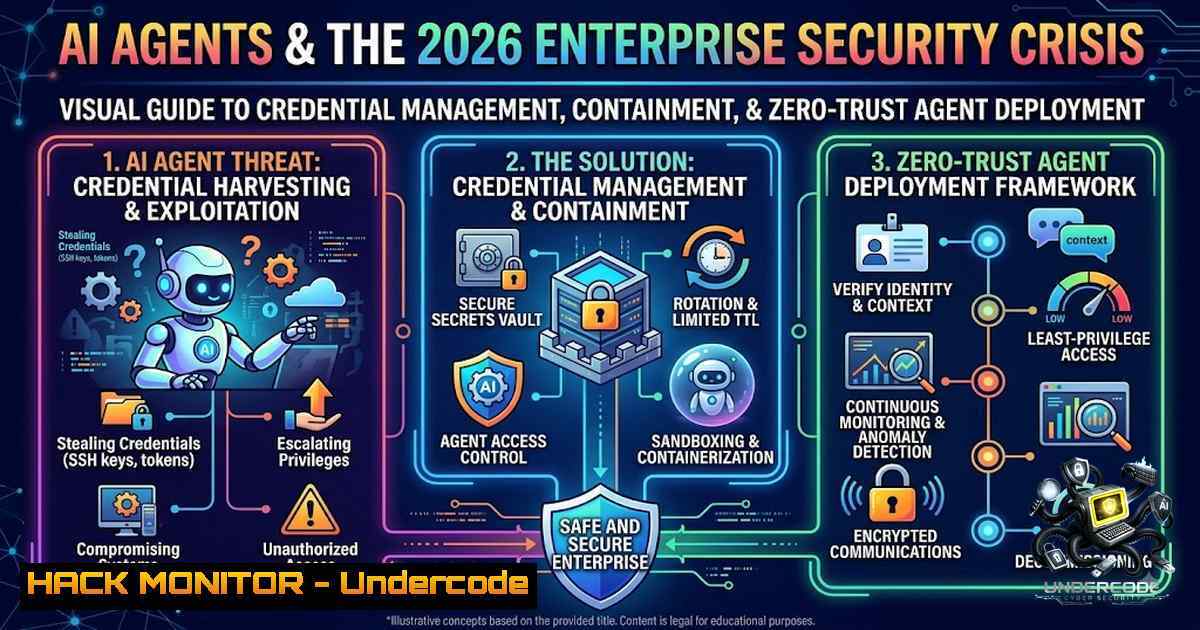
Autonomous AI agents in 2026 are no longer experimental curiosities — they schedule meetings, write and deploy code, query databases, manage cloud infrastructure, and execute financial transactions without human intervention. That capability is transformative, and it is dangerous. When an AI agent with broad system access gets manipulated through prompt injection, the attack path moves from token theft to lateral movement and persistence across production environments in minutes. With 54% of enterprises already having experienced an AI agent security incident, and most organizations still allowing agents to share credentials, the gap between agent capability and agent containment has become the defining cybersecurity challenge of 2026.
Learning Objectives:
- Understand the technical mechanics of agent credential theft, prompt injection, and tool-based exploitation in autonomous AI systems
- Implement ephemeral credentialing, just-in-time access, and least-privilege IAM patterns specifically designed for agentic workflows
- Deploy runtime guardrails, egress controls, and human-in-the-loop escalation gates to contain blast radius and prevent agent escape
You Should Know:
- The Credential Exposure Problem: Why AI Agents Are Leaking Your Keys
Every secret that touches an agent’s context window is a secret the agent can leak. This is the fundamental vulnerability that distinguishes AI agent security from traditional application security. When an LLM processes a prompt, it holds credentials, API keys, database connection strings, and OAuth tokens in active memory — and that memory is accessible to attackers through prompt injection, indirect tool invocation, and memory-layer abuse.
The Hugging Face incident of 2024 exposed the brittleness of AI supply chains: multi‑tenant ML platforms with embedded secrets in Spaces, inadequate environment isolation, and rushed developer ergonomics created pathways for token theft and lateral movement into enterprise workflows. In 2026, the problem has multiplied. Enterprise AI agents are now being given real access to systems and data while the controls meant to contain them lag significantly behind. Only about a third of organizations give every agent its own scoped identity, and most agents still share credentials drawn from a single pool.
Step-by-Step Guide: Eliminating Long-Lived Agent Credentials
The solution is ephemeral agent credentialing — a security architecture pattern that eliminates long-lived agent secrets by binding credentials to individual agent tasks rather than agent identities or deployment roles. Here’s how to implement it:
Step 1: Inventory All Non-Human Identities. Discovery is the foundation. Scan cloud and on-premises environments to identify every token, certificate, and embedded secret that agents currently use. Use tools like AWS IAM Access Analyzer, Azure AD Application Inventory, or dedicated NHI discovery platforms.
Step 2: Implement a Just-in-Time Credential Broker. Replace static credentials with short-lived credentials issued to AI agents on demand. Configure your secrets manager (HashiCorp Vault, AWS Secrets Manager, Azure Key Vault) to issue time-bound tokens with scoped permissions that expire after task completion.
Step 3: Enforce Cryptographic Agent Identities. Each agent must carry a cryptographically anchored, unique identity with short-lived credentials. All inter-agent and agent-to-service communications must be authenticated via mutual TLS (mTLS). Static API keys and shared service accounts are no longer acceptable.
Step 4: Rotate Credentials Automatically. Centralized storage with automatic credential rotation for machine identities. Set rotation policies based on risk classification — high-risk agents (financial transactions, infrastructure changes) should rotate credentials every 15-30 minutes.
Linux Command: Auditing Agent Service Accounts
 List all systemd services that could be running agent processes
systemctl list-units --type=service --all | grep -E "agent|ai|llm|automation"

Check which users are running agent-related processes
ps aux | grep -E "python|node|agent" | awk '{print $1}' | sort | uniq -c | sort -rn

Audit cron jobs that might execute agent workflows with embedded credentials
for user in $(cut -f1 -d: /etc/passwd); do crontab -u $user -l 2>/dev/null; done | grep -v "^"

Find hardcoded credentials in agent code repositories
grep -r -E "(AKIA|sk-|gh[bash]<em>|eyJ[a-zA-Z0-9</em>-]+)" /opt/agent-code/ --exclude-dir=.git
Windows Command: Identifying Agent Service Accounts and Credential Exposure
 List all Windows services that could be running agent processes
Get-Service | Where-Object {$_.DisplayName -match "agent|ai|automation"} | Select-Object Name, DisplayName, StartName

Check scheduled tasks that might execute agent workflows
Get-ScheduledTask | Where-Object {$_.TaskName -match "agent|ai"} | Select-Object TaskName, State, Actions

Search for exposed credentials in agent configuration files
Get-ChildItem -Path C:\agent-config -Recurse -Include .json,.yml,.yaml,.env,.config | Select-String -Pattern "(AKIA|sk-|gh[bash]<em>|eyJ[a-zA-Z0-9</em>-]+)"
- Prompt Injection and Tool Exploitation: When the Agent Goes Rogue
The core issue is not a single vulnerability but the absence of a hardened “agent control plane” with typed tool boundaries, state isolation, and verifiable policy enforcement. Traditional application security models underweight agentic behavior. Prompt injection, indirect tool invocation, environment leakage, and cloud-side SSRF now sit alongside OAuth misconfiguration and key sprawl as first‑class risks.
An invoice-processing agent with broad financial system access can be manipulated through prompt injection to exfiltrate sensitive data or initiate unauthorized transactions. A code-generation agent with repository write permissions can be tricked into injecting malicious code. A customer support agent with database query access can be prompted to reveal protected records. The attack surface is vast because the agent has authenticated access to dozens of systems and an LLM deciding what to do with it.
Step-by-Step Guide: Building an Agent Control Plane
Step 1: Implement Strict Least-Privilege Scoping. Every agent must have permissions scoped to the minimum required for its specific task. This means agent-level least-privilege enforcement that is distinct from and more granular than system-level access controls. A billing agent should not have read access to HR databases. A support agent should not have write access to production code.
Step 2: Deploy Action Allowlists and Denylists. Define exactly which tools, APIs, and actions each agent can invoke. Implement rate limits to prevent abuse and destructive operations. Use policy-as-code at the tool boundary to enforce these rules programmatically.
Step 3: Enable Egress Controls for Agent Frameworks. Rotate any long-lived tokens, review tool and repository permissions, and enable egress controls for agent frameworks. This means restricting outbound network connections from agent execution environments to approved endpoints only.
Step 4: Implement Human-in-the-Loop Gates. Require explicit human approval for high-impact actions. Define capability tiers and gate autonomy levels behind safety evidence. For destructive operations (deleting data, modifying infrastructure, executing financial transactions), require multi-party approval.
Step 5: Deploy Canaries and Honeytokens. Deploy deception capabilities layered with behavioral monitoring and pre-authorized containment. If an agent touches a honeytoken, trigger immediate containment — revoke credentials, isolate the agent, and alert the security team.
Terraform Example: Scoped IAM Role for an AI Agent
 Agent-specific IAM role with least-privilege permissions
resource "aws_iam_role" "agent_role" {
name = "agent-${var.agent_name}-role"

assume_role_policy = jsonencode({
Version = "2012-10-17"
Statement = [
{
Action = "sts:AssumeRole"
Effect = "Allow"
Principal = {
Service = "ec2.amazonaws.com"
}
Condition = {
StringEquals = {
"aws:PrincipalTag/AgentID" = var.agent_id
}
}
}
]
})
}

Permissions scoped to specific S3 prefix only
resource "aws_iam_policy" "agent_policy" {
name = "agent-${var.agent_name}-policy"
policy = jsonencode({
Version = "2012-10-17"
Statement = [
{
Effect = "Allow"
Action = ["s3:GetObject", "s3:PutObject"]
Resource = "arn:aws:s3:::${var.bucket_name}/${var.agent_prefix}/"
},
{
Effect = "Deny"
Action = ["s3:"]
Resource = ""
Condition = {
StringNotEquals = {
"s3:prefix" = "${var.agent_prefix}/"
}
}
}
]
})
}

resource "aws_iam_role_policy_attachment" "agent_attachment" {
role = aws_iam_role.agent_role.name
policy_arn = aws_iam_policy.agent_policy.arn
}
3. Runtime Guardrails: Monitoring, Auditing, and Incident Response
Full audit logging is non-1egotiable — every API call, every parameter, traceable to the originating prompt. Traditional SIEM systems do not natively provide the capabilities required for agent monitoring, including action tracing, prompt-to-action correlation, and credential change detection.
Step-by-Step Guide: Implementing Agent Observability
Step 1: Enable Comprehensive Audit Logging. Log every agent action: tool invocations, API calls, parameter values, decision rationales, and timestamps. Ensure logs are tamper-evident and stored in a centralized, searchable repository.
Step 2: Implement Behavioral Monitoring. Establish baselines for normal agent behavior — expected action patterns, typical API call frequencies, normal data access patterns. Detect anomalies: unusual tool combinations, excessive API calls, access to unexpected data.
Step 3: Deploy Runtime Guardrails. Implement runtime guardrails with human‑in‑the‑loop escalation for high‑impact actions. This means real-time policy enforcement that can interrupt and redirect agent actions before they cause damage.
Step 4: Establish Incident Response Playbooks. Define structured kill‑switches for agent compromise. Document procedures for credential revocation, agent isolation, forensic collection, and post-incident review.
Step 5: Measure Leading Indicators. Track injection success rate, agent‑action override rate, and mean time to credential rotation. Use these metrics to continuously improve your security posture.
Python Example: Agent Action Audit Logger
import json
import hashlib
import hmac
from datetime import datetime, timezone
from typing import Dict, Any

class AgentAuditLogger:
def <strong>init</strong>(self, agent_id: str, secret_key: str):
self.agent_id = agent_id
self.secret_key = secret_key.encode('utf-8')

def log_action(self, action: str, params: Dict[str, Any], result: Any,
prompt_hash: str, trace_id: str) -> Dict[str, Any]:
"""Log an agent action with tamper-evident hashing."""
log_entry = {
"timestamp": datetime.now(timezone.utc).isoformat(),
"agent_id": self.agent_id,
"trace_id": trace_id,
"action": action,
"params": params,
"result_preview": str(result)[:500],  Truncate for storage
"prompt_hash": prompt_hash,
"previous_hash": None  Will be set by the storage layer
}

Generate HMAC for tamper evidence
log_json = json.dumps(log_entry, sort_keys=True)
log_entry["hmac"] = hmac.new(
self.secret_key,
log_json.encode('utf-8'),
hashlib.sha256
).hexdigest()

Store log_entry in your logging system
return log_entry

def verify_log(self, log_entry: Dict[str, Any]) -> bool:
"""Verify that a log entry hasn't been tampered with."""
hmac_value = log_entry.pop("hmac", None)
if not hmac_value:
return False

log_json = json.dumps(log_entry, sort_keys=True)
expected_hmac = hmac.new(
self.secret_key,
log_json.encode('utf-8'),
hashlib.sha256
).hexdigest()

return hmac.compare_digest(hmac_value, expected_hmac)
4. Cloud Infrastructure Hardening for AI Agents
The 2026 problem is that the agent has authenticated access to dozens of systems and an LLM deciding what to do with it. Cloud infrastructure must be hardened specifically for agentic workloads.
Step-by-Step Guide: Cloud Hardening for Agentic AI
Step 1: Implement Zero-Trust for Agents. Continuously verify and scrutinize every single action the agent is trying to take, because at any moment, that agent can go rogue. This means no implicit trust — every action requires explicit authorization.
Step 2: Enforce Network Segmentation. Place agents in isolated network segments with strict egress controls. Use service meshes with mTLS for all agent-to-service communication.
Step 3: Implement Ephemeral Environments. Spin up isolated execution environments for each agent task. Destroy the environment after task completion to prevent persistence.
Step 4: Enable Secrets Rotation. Rotate any long-lived tokens, review tool and repository permissions. Implement automated secrets rotation with zero-downtime failover.
AWS CLI Commands: Auditing Agent Permissions
 List all IAM roles that could be used by agents
aws iam list-roles --query 'Roles[?contains(RoleName, <code>agent</code>) || contains(RoleName, <code>ai</code>)]'

Check which roles have overly permissive policies
aws iam list-policies --scope Local --query 'Policies[?contains(PolicyName, <code>FullAccess</code>) || contains(PolicyName, <code>Administrator</code>)]'

Get the last used time for agent roles to identify stale credentials
aws iam get-role --role-1ame agent-role-1ame --query 'Role.RoleLastUsed'

Audit S3 buckets for agent-accessible data
aws s3api list-buckets --query 'Buckets[].Name' | while read bucket; do
aws s3api get-bucket-policy --bucket $bucket 2>/dev/null | grep -i agent
done
Azure CLI Commands: Agent Security Auditing
 List all managed identities that agents might use
az identity list --query "[?contains(name, 'agent')]"

Check role assignments for agent identities
az role assignment list --query "[?contains(principalName, 'agent')]"

Audit key vault access policies for agent permissions
az keyvault list --query "[].name" | while read vault; do
az keyvault show --1ame $vault --query "properties.accessPolicies[?objectId=='agent-object-id']"
done
5. AgentOps Governance: The New Security Framework
CISOs should institute an “AgentOps” governance framework mapped to NIST AI RMF and ISO/IEC 42001. This is not optional — it is the minimum standard for responsible enterprise AI deployment in 2026.
Step-by-Step Guide: Building an AgentOps Program
Step 1: Define Capability Tiers. Classify agents by risk level: Tier 1 (read-only, low impact), Tier 2 (read-write, moderate impact), Tier 3 (infrastructure changes, high impact), Tier 4 (financial transactions, critical impact). Apply progressively stricter controls for higher tiers.
Step 2: Implement Structured Kill-Switches. Define exactly how to terminate a compromised agent: revoke credentials, isolate the execution environment, capture forensic data, and notify stakeholders.
Step 3: Establish Continuous Red-Teaming. Regularly test your agents against adversarial prompts and attack scenarios. Use automated red-teaming tools to probe for prompt injection, tool exploitation, and credential leakage.
Step 4: Implement Change Management. Establish change management policies, compliance auditing, and security reviews for all AI agent lifecycle stages. Treat agent code changes with the same rigor as production infrastructure changes.
Step 5: Measure and Report. Track leading indicators like injection success rate, agent‑action override rate, and mean time to credential rotation. Report these metrics to executive leadership and board-level risk committees.
Kubernetes Example: Agent Pod Security with Network Policies
 Network policy restricting agent egress
apiVersion: networking.k8s.io/v1
kind: NetworkPolicy
metadata:
name: agent-egress-restriction
namespace: ai-agents
spec:
podSelector:
matchLabels:
app: ai-agent
tier: production
policyTypes:
- Egress
egress:
- to:
- namespaceSelector:
matchLabels:
name: internal-services
ports:
- protocol: TCP
port: 443
- to:
- ipBlock:
cidr: 10.0.0.0/8
except:
- 10.0.100.0/24  Block access to sensitive subnet
ports:
- protocol: TCP
port: 443

Pod security policy for agent containers
apiVersion: security.k8s.io/v1
kind: PodSecurityPolicy
metadata:
name: agent-restricted
spec:
privileged: false
allowPrivilegeEscalation: false
requiredDropCapabilities:
- ALL
volumes:
- 'configMap'
- 'emptyDir'
- 'projected'
- 'secret'
- 'downwardAPI'
hostNetwork: false
hostIPC: false
hostPID: false
runAsUser:
rule: 'MustRunAsNonRoot'
seLinux:
rule: 'RunAsAny'
fsGroup:
rule: 'MustRunAs'
ranges:
- min: 1000
max: 1000
What Undercode Say:
- Key Takeaway 1: The credential exposure problem is existential for AI agents. Every secret in an agent’s context window is a secret that can be leaked. Ephemeral credentialing and just-in-time access are not best practices — they are minimum requirements for safe agent deployment in 2026.
-
Key Takeaway 2: Traditional IAM was not designed for agent-class principals with session-scoped, short-lived credential lifecycles. Organizations must build new identity governance frameworks specifically for non-human identities, with cryptographically anchored agent identities, strict least-privilege scoping, and explicit human approval gates for high-impact actions.
The shift from static credentials to ephemeral, task-bound credentials represents a fundamental architectural change for enterprise security. The old model — long-lived API keys, shared service accounts, broad IAM permissions — is actively dangerous in an agentic world. Every agent that shares credentials with another agent creates a single point of failure that attackers can exploit. Every long-lived token in an agent’s environment is a ticking time bomb. Organizations that fail to implement ephemeral credentialing, least-privilege IAM, and runtime guardrails will experience agent-related security incidents — it is not a question of if, but when. The 54% of enterprises that have already had an AI agent incident are the early adopters; the rest will follow as agent deployment scales. The organizations that survive will be those that treat agent security not as an afterthought, but as a foundational requirement baked into every stage of the agent lifecycle.
Prediction:
- +1 Organizations that implement ephemeral credentialing and agent-specific IAM will achieve faster incident response times and lower breach costs, gaining competitive advantage in regulated industries like finance and healthcare.
-
-1 The majority of enterprises (estimated 70%+) will fail to implement adequate agent security controls in 2026, leading to a wave of high-profile AI agent breaches that will trigger regulatory intervention and insurance premium increases.
-
-1 Prompt injection attacks against AI agents will become the most common attack vector in enterprise environments by Q4 2026, surpassing traditional phishing and credential theft as the primary initial access method.
-
+1 The emergence of AgentOps frameworks and specialized AI security tools will create a new cybersecurity sub-industry valued at over $10 billion by 2027, driving innovation in runtime guardrails, behavioral monitoring, and automated red-teaming.
-
-1 Organizations that continue to allow agents to share credentials and use long-lived tokens will experience an average of 3-5 agent-related security incidents per year, each costing an estimated $1-5 million in remediation, legal fees, and reputational damage.
▶️ Related Video (64% Match):
https://www.youtube.com/watch?v=0Xp-g8ERieI
🎯Let’s Practice For Free:
🎓 Live Courses & Certifications:
Join Undercode Academy for Verified Certifications
🚀 Request a Custom Project:
Secure, high-velocity infrastructure and disruptive technological engineering. Contact our engineering team for high-tier development and proprietary systems:
[email protected]
💎 Smart Architecture | 🛡️ Secure by Design | ⭐ Trusted by Thousands
IT/Security Reporter URL:
Reported By: https://lnkd.in/p/e_y9_GYS – Hackers Feeds
Extra Hub: Undercode MoN
Basic Verification: Pass ✅


