Listen to this Post
Introduction:
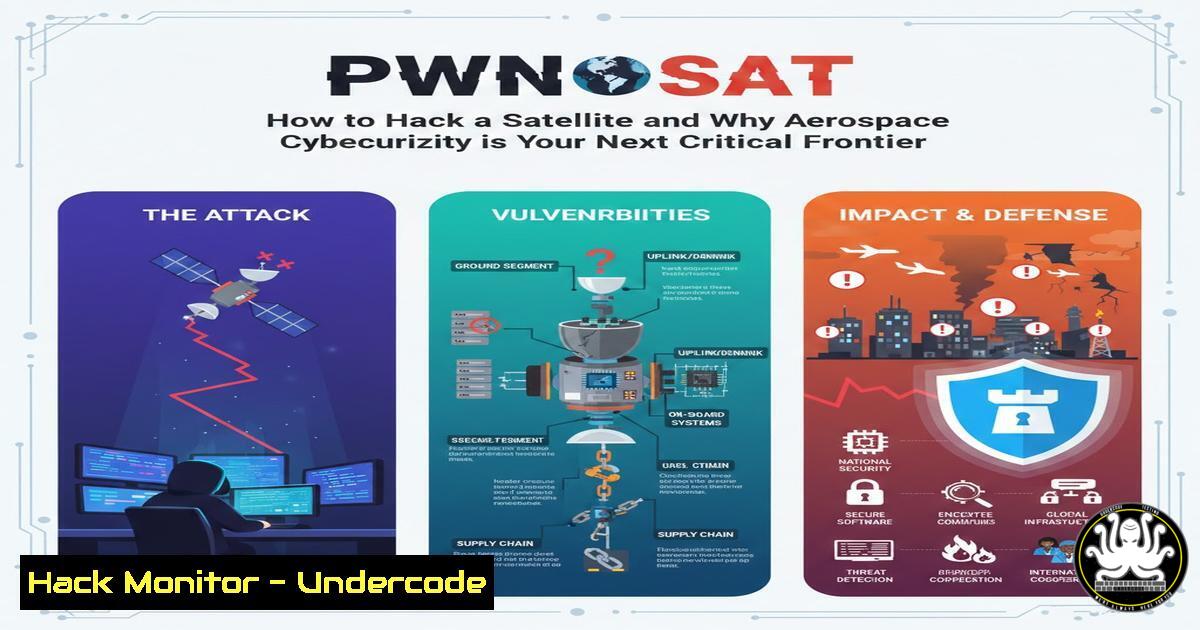
The final frontier is no longer safe from cyber threats. PWNSAT emerges as a groundbreaking, deliberately vulnerable hardware and platform designed to educate security professionals and enthusiasts on the intricacies of satellite and aerospace hacking. This hands-on lab environment replicates real-world satellite systems, providing a sanctioned playground to exploit vulnerabilities that could have catastrophic consequences in orbit. Understanding these attack vectors is becoming paramount as society’s reliance on space-based assets for communication, navigation, and Earth observation continues to grow.
Learning Objectives:
- Understand the core components and communication protocols used in modern satellite systems.
- Learn to intercept, analyze, and manipulate satellite telemetry and command signals using Software-Defined Radio (SDR).
- Develop and execute exploitation techniques against satellite bus systems and payloads to achieve unauthorized control.
You Should Know:
1. The Architecture of a Vulnerable Satellite
PWNSAT is built to mimic a real CubeSat or small satellite, typically comprising a bus (the platform) and a payload (the mission-specific instrument). The bus includes subsystems for power (EPS), attitude control (ACS), communication (COM), and data handling (CDH). The payload could be a camera, sensor, or scientific instrument. By design, these components contain software and configuration vulnerabilities, such as hardcoded credentials, insecure command protocols, and buffer overflows in data handling systems.
Step-by-step guide:
- Step 1: Reconnaissance. The first step is to understand the target. Visit the PWNSAT website (`https://pwnsat.org/`) to access documentation, datasheets, and the platform’s interface. Identify the simulated satellite’s frequency bands, supported protocols (e.g., AX.25, CCSDS), and available endpoints.
- Step 2: Signal Acquisition. Using an SDR dongle (like an RTL-SDR, HackRF, or USRP) and software like Gqrx or SDR, tune to the satellite’s published downlink frequency. Capture the raw In-phase and Quadrature (IQ) data for analysis.
Example: Starting Gqrx to find the signal
gqrx
In Gqrx, set the correct device and sample rate, then tune to the target frequency.
- Step 3: Demodulation and Decoding. The captured signal must be demodulated from its carrier wave (e.g., FM, BPSK) and then decoded from its packet structure. Use tools like `gr-satellites` GNU Radio flowgraphs or SatDump for this purpose.
Using a GNU Radio companion flowgraph from gr-satellites to decode a known satellite signal
python -m gr_satellites.decode --args="rtl=0" --freq 437000000 --samp_rate 1000000 <satellite_name>
2. Exploiting Insecure Command and Control
The command uplink is a primary attack vector. Many legacy and even some modern satellites lack strong encryption and authentication for their command links, relying on “security through obscurity.” PWNSAT allows you to practice crafting and sending malicious commands.
Step-by-step guide:
- Step 1: Reverse Engineering the Protocol. Analyze captured downlink telemetry frames to understand the packet structure. Look for fields like spacecraft ID, packet type, length, and data fields. Tools like Wireshark (with CCSDS dissectors) or custom Python scripts can be used.
- Step 2: Crafting a Malicious Command. Once the protocol is understood, you can craft a command packet. A common vulnerability is a lack of authentication, allowing anyone to send a “system reset” or “payload enable” command.
Example Python script to craft a simple unauthenticated command packet
import struct</li>
</ul>

spacecraft_id = 0x50  PWNSAT's ID
packet_type = 0x01  Command packet
command_code = 0xDEAD  Malicious command to, e.g., drain batteries
data = b""
packet = struct.pack('>BBH', spacecraft_id, packet_type, command_code) + data
 Calculate and add checksum...
print(packet.hex())
– Step 3: Transmitting the Command. Using your SDR in transmit mode (ensure you are using a legal frequency and a shielded/connected setup to avoid interference), send the crafted packet. GNU Radio can be used to modulate the packet onto a carrier wave and transmit it.
 Using a tool like 'sendiq' to transmit a pre-recorded I/Q file containing your command
sendiq -s 1000000 -f 437000000 -t u8 -i malicious_command.iq
3. Attacking the On-Board Data Handling (OBDH) System
The OBDH is the satellite’s computer. It runs the operating system and flight software, which are often based on real-time operating systems (RTOS) like VxWorks or Linux. Vulnerabilities here can lead to full system compromise.
Step-by-step guide:
- Step 1: Gaining Shell Access. Exploit a buffer overflow in a ground command handler to achieve remote code execution. Use a framework like Metasploit to generate a payload for the target architecture (e.g., ARM).
- Step 2: Privilege Escalation. Once you have a user-level shell, look for kernel vulnerabilities or misconfigured file permissions to escalate to root. Check the kernel version and search for known exploits.
On a compromised Linux-based OBDH, check for kernel exploits
uname -a
find / -perm -4000 2>/dev/null  Find SUID binaries
- Step 3: Pivoting to Payload Control. With root access, you can now directly interface with the payload. This might involve writing to memory-mapped I/O registers or sending commands to the payload’s microcontroller over I2C or SPI buses from the compromised OBDH.
4. Telemetry Spoofing and Data Integrity Attacks
An attacker can not only send commands but also forge downlink telemetry to hide their activities or cause ground operators to make catastrophic decisions based on false data.
Step-by-step guide:
- Step 1: Analyze Legitimate Telemetry. Capture and decode normal telemetry to understand the data format for critical systems like battery voltage, attitude, and temperature.
- Step 2: Create Forged Telemetry Packets. Write a script that generates telemetry packets with spoofed data. For example, you could create a packet that reports nominal battery levels even while your attack drains them.
Python code to forge a telemetry packet
spoofed_battery_voltage = 12.6  Nominal voltage
spoofed_temperature = 20.0  Nominal temperature
Pack these values into the correct telemetry packet structure...
forged_packet = create_telemetry_packet(battery=spoofed_battery_voltage, temp=spoofed_temperature)
- Step 3: Inject Spoofed Data. Using the same transmission techniques as for command injection, broadcast your forged telemetry packets with a higher power or at a strategic time to overpower or replace the legitimate signal, fooling the ground station.
5. Hardware-in-the-Loop (HIL) Exploitation
PWNSAT includes physical hardware, allowing for attacks on the interface between digital and physical systems. A compromised OBDH can send malicious instructions to the Attitude Control System (ACS), potentially causing the satellite to tumble or expend all its propellant.
Step-by-step guide:
- Step 1: Identify ACS Actuators. Map the system to find how the OBDH controls reaction wheels or magnetorquers. This is typically done via specific memory addresses or driver commands.
- Step 2: Craft a Destructive Command. Send a continuous spin command to a reaction wheel.
// A C code snippet that might run on the OBDH to max out a reaction wheel
define REACTION_WHEEL_CTRL_REG (volatile uint32_t)0xFFFF0000
REACTION_WHEEL_CTRL_REG = 0xFFFF; // Max PWM duty cycle
- Step 3: Observe Physical Effects. In the PWNSAT lab, you would observe the physical hardware (or a high-fidelity simulation) reacting to your command, demonstrating the direct physical impact of a cyber attack.
What Undercode Say:
- The Space Attack Surface is Real and Accessible. PWNSAT demystifies satellite hacking, proving that the technical barrier, while high, is surmountable with modest hardware and open-source tools. It moves space cybersecurity from a theoretical concern to a practical, hands-on discipline.
- Offensive Security is Foundational for Defense. The only way to build resilient space systems is to first understand how to break them. PWNSAT provides the essential training ground for red and blue teams to develop these critical skills in a safe, ethical environment.
The platform’s existence is a direct response to the historical lack of security in aerospace systems, which often prioritized reliability and weight over cybersecurity. As commercial entities like SpaceX and OneWeb deploy mega-constellations of thousands of satellites, the aggregate attack surface expands exponentially. PWNSAT forces the industry to confront vulnerabilities in command links, ground stations, and supply chain integrity. It highlights that a compromise could lead not just to data theft, but to kinetic outcomes like collision or permanent loss of assets, underscoring the non-negotiable need for robust encryption, secure boot processes, and zero-trust architectures in space.
Prediction:
Within the next 3-5 years, we will witness the first publicly disclosed, successful cyber attack on an operational commercial or government satellite, leading to a temporary loss of service or permanent damage. This event will act as a “Sputnik moment” for global space cybersecurity, triggering a massive influx of investment and regulatory focus. Nations will rapidly establish and enforce cybersecurity standards for all licensed space-bound hardware, and “Satellite Penetration Testing” will become a standard, mandated service, much like security audits for critical terrestrial infrastructure today. The skills developed on platforms like PWNSAT will transition from a niche curiosity to a core competency for national security and commercial space operators.
🎯Let’s Practice For Free:
IT/Security Reporter URL:
Reported By: Enriquelopezpatau Pwnsat – Hackers Feeds
Extra Hub: Undercode MoN
Basic Verification: Pass ✅🔐JOIN OUR CYBER WORLD [ CVE News • HackMonitor • UndercodeNews ]
📢 Follow UndercodeTesting & Stay Tuned:


