Listen to this Post
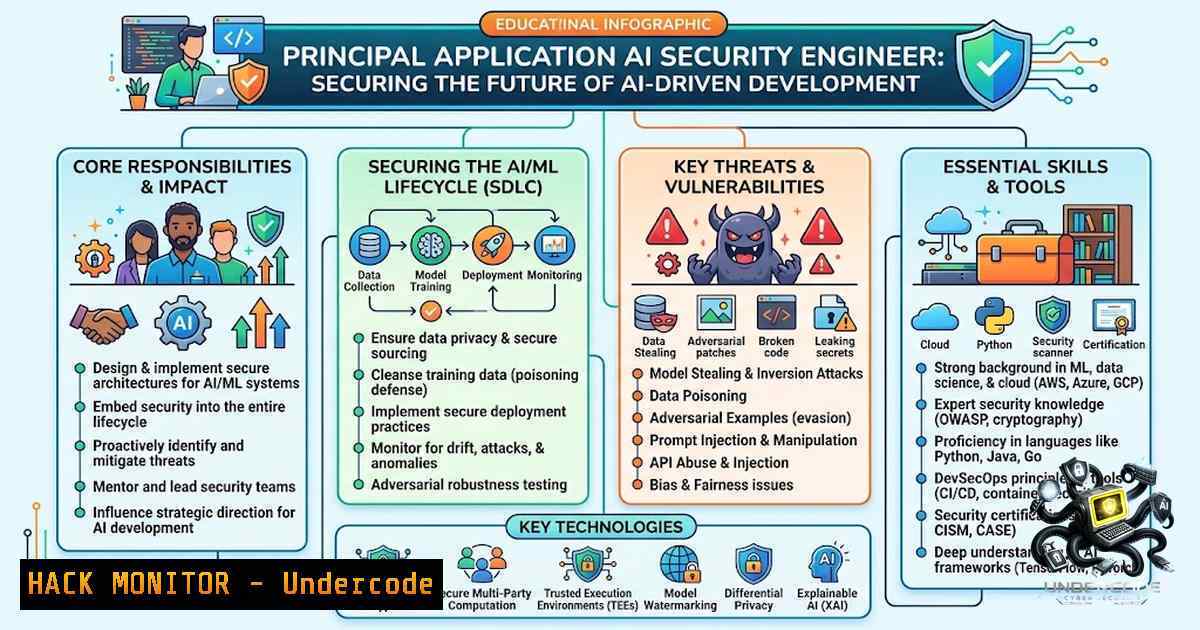
Introduction:
The rapid integration of Artificial Intelligence (AI) into the software development lifecycle (SDLC) has introduced a new frontier of security challenges and opportunities. As AI coding assistants and autonomous agents become ubiquitous, the role of a Principal Application AI Security Engineer has emerged as a critical pillar in safeguarding enterprise applications. This specialized domain requires a unique blend of traditional application security (AppSec) expertise, cloud-1ative architecture knowledge, and a deep understanding of emerging AI threats, as exemplified by professionals with extensive experience in tools like Claude Code, Cursor, and OWASP LLM Top 10.
Learning Objectives & Secrets:
- Objective 1: Master AI-Specific Security Tools. Gain proficiency in security tools designed for the AI development ecosystem, such as Wiz for cloud-1ative security and CodeQL for precise code scanning. The secret tip is to automate these tools within your CI/CD pipeline to provide real-time feedback to developers, preventing vulnerabilities from reaching production.
- Objective 2: Implement Robust DevSecOps Pipelines. Learn to seamlessly integrate security scanning (Snyk, Veracode, SonarQube) and secrets management into GitHub Actions or Azure DevOps. A key secret is to utilize GitHub Advanced Security features like dependency scanning and secret scanning in tandem with CodeQL to achieve near-complete code coverage.
- Objective 3: Secure AI Models and Data. Understand and mitigate risks associated with AI models, including prompt injection, data poisoning, and model theft as outlined in the OWASP LLM Top 10. The secret is to enforce strict RBAC and network isolation for AI model endpoints and use a Zero-Trust approach for all API interactions.
You Should Know:
1. Fortifying the AI Development Environment
The use of AI coding assistants (Claude Code, Cursor, Devin) introduces new risk vectors, such as code suggestion vulnerabilities and data leakage. To secure this, enforce strict API key management with OAuth2/OIDC and implement JWT for authentication between services. Conduct regular secure code reviews using tools like SonarQube and Burp Suite to validate AI-generated code.
Step-by-Step Guide to Secure AI-Generated Code:
- Static Analysis: Run `sonar-scanner -Dsonar.projectKey=my_project` on your repository to detect bugs and vulnerabilities.
- Interactive Testing: Configure OWASP ZAP to perform active scans against your staging endpoints: `zap-cli active-scan -t https://staging-api.example.com`.
– Dependency Scanning: Use `snyk test –severity-threshold=high` to identify vulnerable open-source packages. - Secrets Management: Ensure secrets are not hardcoded. In Linux, use `gitleaks detect –source . -v` to scan for exposed credentials. On Windows, you can use PowerShell with `Select-String -Pattern “password|secret”` for basic auditing.
2. Securing the CI/CD Pipeline with DevSecOps
Integrating security early (Shift-Left) is paramount. This involves automating security tests in the build pipeline, ensuring dependencies are vetted, and enforcing security policies programmatically.
- GitHub Actions Security: Add a step to run CodeQL analysis:
uses: github/codeql-action/analyze@v2. - Container Security: After building a Docker image, run `trivy image myapp:latest` to scan for OS-level vulnerabilities. For Windows containers, ensure you use the appropriate base image from Microsoft’s official registry.
- Cloud Infrastructure Hardening (AWS, Azure, GCP, Oracle Cloud)
With infrastructure defined as code (Terraform), misconfigurations are a primary threat. Use tools like `checkov` to scan Terraform scripts for compliance issues. For instance, ensure S3 buckets are not publicly accessible by enablingblock_public_acls. In Azure, use Privileged Identity Management (PIM) to enforce just-in-time access. On GCP, enforce that service accounts have the least privilege by default.
Command Example for Terraform Security Scanning:
terraform plan -out=tfplan.binary
terraform show -json tfplan.binary > tfplan.json
checkov -f tfplan.json
4. API Security and Threat Modeling
Given the role’s focus on API Security (OAuth2, OIDC, JWT, RBAC), it’s crucial to implement robust security controls. Conduct regular threat modeling sessions using STRIDE and MITRE ATT&CK frameworks to identify potential attack vectors. Tools like Burp Suite should be used for both manual and automated pentesting.
Step-by-Step API Security Test Setup:
- Authentication Testing: Validate OAuth2 flows using `oauth2-proxy` to ensure tokens are not exposed in logs.
- Rate Limiting: Configure rate limiting at the API gateway (e.g., Kong or AWS API Gateway) to prevent brute-force attacks.
- Input Validation: Use OWASP API Top 10 as a checklist. For Java/Spring applications, implement `@Valid` annotations and sanitize all user inputs.
5. Vulnerability Management and Secure SDLC Automation
Automating the SDLC involves orchestrating a suite of security tools to run in parallel. This reduces manual overhead and accelerates release cycles. Implement a Bug Bounty program to leverage external security researchers and enhance vulnerability discovery.
Example of an Automated Remediation Script:
 (Python pseudocode for patching a vulnerability)
def remediate_vulnerability(repo_path):
os.chdir(repo_path)
subprocess.run(["git", "pull"])
 Replace insecure function call
subprocess.run(["sed", "-i", 's/insecure_func/safe_func/g', ".js"])
subprocess.run(["git", "commit", "-am", "fix: security patch"])
subprocess.run(["git", "push"])
6. Understanding the OWASP LLM Top 10
As AI models are increasingly integrated into applications, new vulnerabilities emerge such as Prompt Injection and Supply Chain vulnerabilities. Implement a red-teaming process for your LLM endpoints. Use custom scripts to inject adversarial prompts and monitor output for inappropriate content or data leakage. Educate developers on the OWASP Top 10 for LLMs to ensure they understand these new threats.
What Undercode Say:
- Key Takeaway 1: The “Principal Application AI Security Engineer” role is not an isolated position but a confluence of AppSec, Cloud, and AI expertise. The technical stack listed (Claude Code, Wiz, GitHub Advanced Security) demonstrates a clear evolution towards integrating security into the very fabric of the software factory.
- Key Takeaway 2: The inclusion of OWASP LLM Top 10 and MITRE ATT&CK frameworks signals a critical shift. The industry is moving away from static checklists towards dynamic threat modeling that anticipates how AI can be manipulated. This is a proactive, rather than reactive, security posture.
Prediction:
- +1: Organizations will increasingly require Security Engineers to write security policies as code, using Terraform and GitHub Actions to enforce compliance, leading to a 40% reduction in misconfiguration incidents.
- +1: The demand for certifications like CompTIA Security+ and specialized AI credentials will surge as companies seek to validate security skills in a rapidly evolving landscape.
- -1: There is a significant talent shortage in this niche; a lack of skilled professionals may lead to companies prioritizing speed over security, increasing the risk of AI-specific breaches.
- +1: Bug Bounty programs will evolve to include AI-specific challenges, such as adversarial prompt testing, which will help crowdsource defenses against novel AI threats.
- -1: The sophistication of AI-assisted coding tools will increase attack surfaces, as AI-generated code often contains subtle logic flaws that evade traditional static analysis.
- +1: We will see the emergence of new “ASPM” (Application Security Posture Management) solutions specifically built for AI/ML pipelines, consolidating tools like Snyk, Veracode, and Wiz into a unified security dashboard.
▶️ Related Video (86% Match):
🎯Let’s Practice For Free:
🎓 Live Courses & Certifications:
Join Undercode Academy for Verified Certifications
🚀 Request a Custom Project:
Secure, high-velocity infrastructure and disruptive technological engineering. Contact our engineering team for high-tier development and proprietary systems:
[email protected]
💎 Smart Architecture | 🛡️ Secure by Design | ⭐ Trusted by Thousands
IT/Security Reporter URL:
Reported By: https://lnkd.in/p/eKp4ZYXJ – Hackers Feeds
Extra Hub: Undercode MoN
Basic Verification: Pass ✅


