Listen to this Post
Introduction:
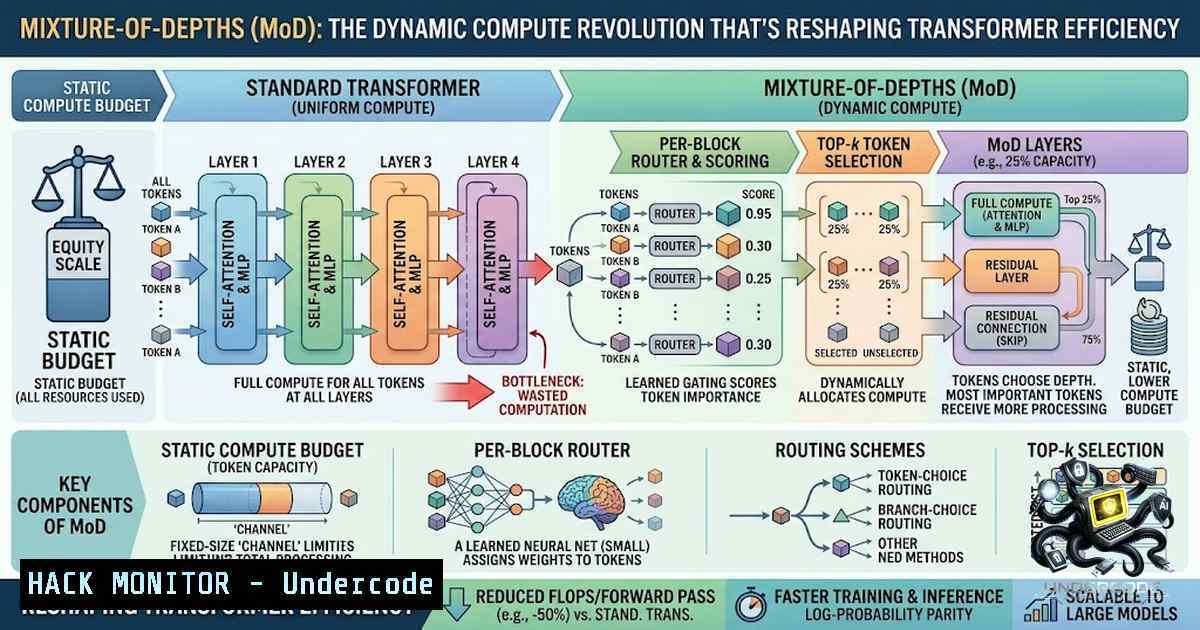
The fundamental inefficiency of standard Transformer architectures lies in their uniform compute allocation: every token, whether a critical reasoning step or a simple punctuation mark, consumes identical FLOPs. Google DeepMind’s Mixture-of-Depths (MoD) fundamentally disrupts this paradigm by introducing dynamic compute allocation—a mechanism where a lightweight router evaluates token importance at each layer and selectively processes only the most information-dense tokens through full attention and MLP computations. This architectural innovation enables models to match or exceed baseline performance while reducing FLOPs by 20-50% and accelerating post-training sampling by up to 50%.
Learning Objectives & Secrets:
- Objective 1: Master MoD’s Top-k Routing Mechanism – Understand how a per-block router scores tokens and selects only the top-k hardest tokens (e.g., 12.5% to 50% of sequence length) for full self-attention and MLP processing. Tokens not selected bypass the layer via residual connections, gliding through in constant time.
-
Objective 2 Secret: Static Budget with Dynamic Routing – Unlike older conditional computation methods with variable tensor shapes, MoD enforces a fixed capacity limit per layer, maintaining static tensor dimensions for peak GPU hardware saturation while enabling token-level dynamic compute allocation.
-
Objective 3 Secret: MoD + MoE Synergy – Combine MoD with Mixture-of-Experts (MoE) to route tokens across both DEPTH (how much to think) and WIDTH (which specialized expert to call), delivering compounded efficiency gains.
You Should Know:
- Installing and Implementing MoD with Hugging Face Transformers
MoD can be integrated into existing Hugging Face models using community implementations. The `astramind-ai/Mixture-of-depths` repository provides a transformers-compatible API.
Step-by-step guide:
 Installation
pip install mixture-of-depth

Both Linux, Windows and MacOS are supported
Python implementation:
from transformers import AutoModelForCausalLM
from MoD import apply_mod_to_hf

Initialize your model from Hugging Face
model = AutoModelForCausalLM.from_pretrained("meta-llama/Llama-2-7b-hf")

Convert the model to include Mixture-of-Depths layers
model = apply_mod_to_hf(model)

Train the model...
 Save the converted model
model.save_pretrained('moD_llama2_7b')

Load the converted model
from MoD import AutoMoDModelForCausalLM
model = AutoMoDModelForCausalLM.from_pretrained('moD_llama2_7b')

Before calling generate(), explicitly use eval()
model.eval()
output = model.generate(input_ids, max_new_tokens=100)
Supported models include: Mistral, Mixtral, LLaMA, LLaMA2, LLaMA3, Gemma, BLOOMZ, BLOOM, DeepSeek, Phi (1.5 & 2), Qwen2, and StarCoder2.
- Building a Minimal MoD Block from Scratch (PyTorch)
For those who want to understand the core mechanics, here’s a minimal MoD block implementation based on the nanoMoD project:
import torch
import torch.nn as nn

class MoDBlock(nn.Module):
def <strong>init</strong>(self, config):
super().<strong>init</strong>()
 Lightweight router: single linear layer
self.router = nn.Linear(config.n_embd, 1, bias=False)
self.block = Block(config)  Standard transformer block
self.capacity = config.capacity  e.g., 0.5  sequence_length

def forward(self, x_BTD):
B, T, D = x_BTD.shape

Router scores each token
router_scores_BT = self.router(x_BTD).squeeze(2)  (B, T)

Select top-k tokens by score
top_rvals_BK, top_ridxs_BK = torch.topk(
router_scores_BT, self.capacity, dim=1
)  (B, K)

Gather selected tokens
batch_indices_BK = torch.arange(B).unsqueeze(1).expand(B, self.capacity)
x_BKD = x_BTD[batch_indices_BK, top_ridxs_BK]  (B, K, D)

Process only selected tokens through the block
 Residual connection: output = block(x) + x
x_BKD = top_rvals_BK[..., None]  self.block(x_BKD)[bash] + x_BKD

Scatter back to original positions
out_BTD = x_BTD.scatter(1, top_ridxs_BK[..., None].expand(-1, -1, D), x_BKD)
return out_BTD
Usage example with nanoGPT:
python train.py config/train_shakespeare_char.py
3. Configuring MoD Hyperparameters for Optimal Performance
The capacity factor determines what percentage of tokens per layer receive full computation:
from mixture_of_depths.main import MoD

model = MoD(
seq_len=1000,
dim=512,
capacity_factor=0.12,  Process only 12% of tokens per layer
vocab_size=10000,
transformer_depth=8,
)

x = torch.randn(1, 1000, 512)
out = model(x)
Key insight: Research shows that processing as few as 12.5% of tokens per block can lead to improved performance while dramatically reducing compute. The router learns to select tokens that benefit most from full processing without explicit supervision.
4. Predictive Routing for Autoregressive Generation
A critical challenge: MoD’s routing during training uses bidirectional information (non-causal). For autoregressive generation, DeepMind developed a predictive router that achieves over 95% accuracy in matching the non-causal router’s decisions.
Implementation approach:
class PredictiveMoDRouter(nn.Module):
def <strong>init</strong>(self, hidden_dim):
super().<strong>init</strong>()
self.predictor = nn.Sequential(
nn.Linear(hidden_dim, hidden_dim // 2),
nn.ReLU(),
nn.Linear(hidden_dim // 2, 1)
)

def forward(self, hidden_states, causal_mask=None):
 Predict token importance using only past context
scores = self.predictor(hidden_states).squeeze(-1)
if causal_mask is not None:
scores = scores.masked_fill(~causal_mask, float('-inf'))
return scores
5. MoD + MoE: The MoDE Variant
Combining MoD with Mixture-of-Experts (MoE) creates the MoDE variant, where tokens are routed across both depth and width dimensions:
MoD: Routes tokens to different DEPTHS (skip vs. process)
MoE: Routes tokens to different WIDTHS (which expert FFN)
MoDE: Routes tokens across BOTH dimensions simultaneously
Benefits: Additive efficiency gains—tokens can choose simpler paths while maintaining model quality. Research shows this combination provides better performance and faster inference speed.
6. Benchmarking MoD Performance
Key metrics from DeepMind’s research:
| Metric | Vanilla Transformer | MoD (12.5% capacity) |
|–||-|
| FLOPs per forward pass | 100% | 50-80% |
| Post-training sampling speed | Baseline | Up to 50% faster |
| Performance (loss) | Baseline | Lower or equal |
| Tokens processed per layer | 100% | As low as 12.5% |
IsoFLOP analysis: Under fixed compute budgets, optimal MoD transformers achieve lower loss with the same or fewer FLOPs compared to baseline models, especially with more parameters.
What Undercode Say:
- Key Takeaway 1: Compute Efficiency is the New Scaling Law – MoD demonstrates that the future of AI isn’t just about adding more parameters—it’s about using existing compute more intelligently. By dynamically allocating resources based on token importance, MoD achieves better performance with fewer FLOPs, challenging the brute-force scaling paradigm.
-
Key Takeaway 2: Static Graphs with Dynamic Behavior – MoD’s genius lies in maintaining a static computation graph (for hardware efficiency) while enabling dynamic, context-sensitive token-level routing. This hybrid approach solves the tensor shape variability problem that plagued earlier conditional computation methods.
-
Analysis: For developers running local AI agents on consumer hardware (as the original post’s author noted as a 16-year-old developer), MoD represents a paradigm shift. The ability to run large-parameter models efficiently on constrained hardware opens possibilities for edge AI, local reasoning agents, and privacy-preserving AI that doesn’t rely on cloud APIs. The MoD + MoE combination (MoDE) further amplifies these gains, potentially enabling 70B-parameter models to run at 30-40 tokens/second on consumer GPUs. However, challenges remain—routing algorithm accuracy, autoregressive sampling without future token information, and the complexity of dynamic compute allocation require continued research. The predictive router achieving 95%+ accuracy is a promising step toward production-ready deployment.
Prediction:
-
+1 MoD will become the standard architecture for on-device LLMs within 12-18 months, enabling sophisticated AI agents to run locally on laptops and smartphones without cloud dependence.
-
+1 The MoD + MoE combination (MoDE) will unlock a new class of ultra-efficient models that match GPT-4-class performance at 30-50% of the compute cost, democratizing access to frontier AI capabilities.
-
-1 Static Transformer architectures may become legacy sooner than expected, but the transition will require significant retooling of existing training pipelines and hardware optimization frameworks.
-
+1 Predictive routing improvements will eliminate the causal/non-causal gap entirely, making MoD seamlessly deployable for production autoregressive generation.
-
-1 The increased architectural complexity may slow adoption in risk-averse enterprise environments, where simplicity and predictability are valued over efficiency gains.
-
+1 Open-source MoD implementations (already supporting 10+ model families) will accelerate community innovation, with fine-tuned MoD models outperforming their vanilla counterparts across benchmarks within 6 months.
References: DeepMind & McGill University, “Mixture-of-Depths: Dynamically allocating compute in transformer-based language models” (arXiv:2404.02258)
▶️ Related Video (88% Match):
🎯Let’s Practice For Free:
🎓 Live Courses & Certifications:
Join Undercode Academy for Verified Certifications
🚀 Request a Custom Project:
Secure, high-velocity infrastructure and disruptive technological engineering. Contact our engineering team for high-tier development and proprietary systems:
[email protected]
💎 Smart Architecture | 🛡️ Secure by Design | ⭐ Trusted by Thousands
IT/Security Reporter URL:
Reported By: https://lnkd.in/p/e6WsfFrU – Hackers Feeds
Extra Hub: Undercode MoN
Basic Verification: Pass ✅


