Listen to this Post
Introduction
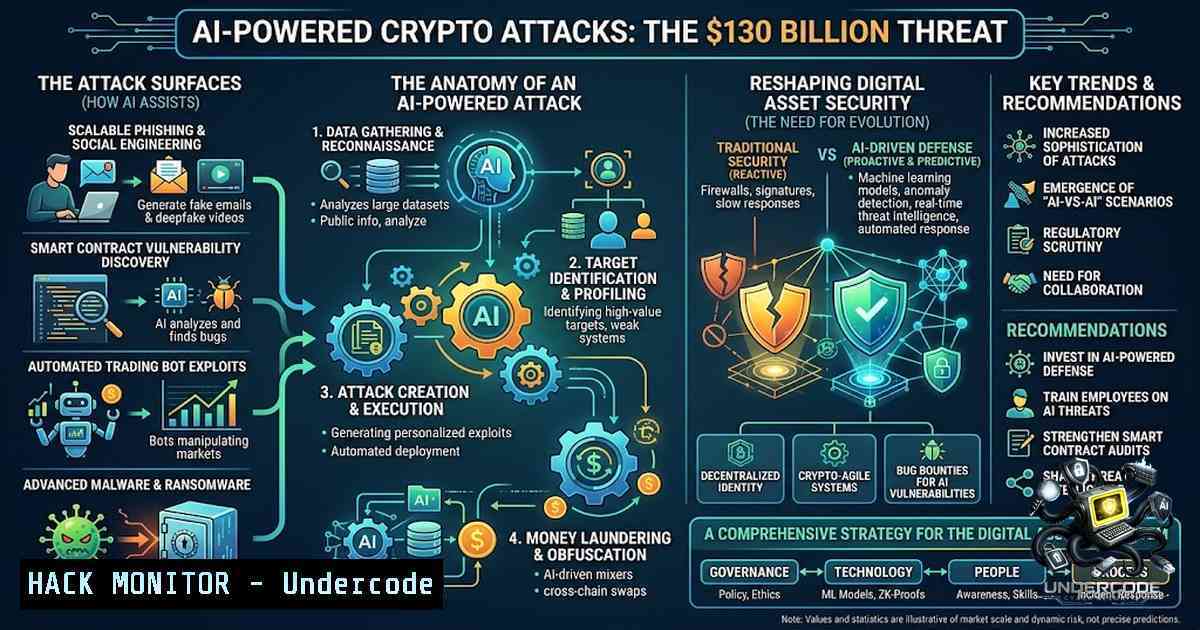
The cryptocurrency industry is facing an unprecedented security crisis as artificial intelligence transforms the threat landscape at machine speed. In the first half of 2026 alone, crypto projects lost more than $1 billion to hacks, with verified exploit incidents already surpassing the total recorded in all of 2025. Non-custodial Bitcoin swap service Boltz recently suspended operations indefinitely after a months-long escalation of AI-assisted probing attacks outpaced its security team’s ability to respond. As digital assets and CBDCs continue to grow, understanding AI-powered attack vectors, smart contract vulnerabilities, and defense strategies has become mission-critical for security professionals.
Learning Objectives
- Understand the mechanics of AI-assisted cryptocurrency attacks, including automated vulnerability scanning, social engineering, and deepfake-based impersonation
- Identify and mitigate common smart contract vulnerabilities such as reentrancy, integer overflow, and cross-chain bridge exploits
- Implement multi-layered security defenses including hardware-based authentication, transaction authority controls, and real-time monitoring
- Apply practical Linux and Windows security commands for crypto infrastructure hardening
- Develop incident response procedures for AI-driven cyber threats targeting digital assets
You Should Know
1. Understanding AI-Assisted Attack Vectors in Cryptocurrency
The threat landscape has fundamentally shifted. Attackers are now using artificial intelligence to scan open-source code, test vulnerabilities, and rapidly modify unsuccessful exploit attempts. According to blockchain forensics firm TRM Labs, North Korea-linked groups have used AI to select targets and design exploits. The Boltz incident exemplifies this new reality: attackers iterated faster than the security team could find and patch vulnerabilities, forcing a complete service shutdown.
Key AI Attack Vectors:
- Automated Vulnerability Scanning: AI tools can scan public code repositories and identify exploitable flaws at machine speed
- AI-Enabled Social Engineering: Threat actors like UNC1069 use deceptive outreach and impersonation tactics to build trust with victims
- Deepfake Impersonation: AI-generated voice clones and fake identities are driving the next wave of blockchain security concerns
- Credential Compromise: Many hacks originate from Web2 operational security issues rather than blockchain compromises
Linux Command for Monitoring Suspicious Network Activity:
 Monitor real-time network connections for unusual outbound traffic
sudo tcpdump -i any -1 'port 8333 or port 18333 or port 30303' -c 1000

Check for established connections to suspicious IPs
ss -tunap | grep ESTAB | awk '{print $5}' | sort | uniq -c | sort -1r

Monitor system logs for unauthorized access attempts
sudo journalctl -f -u sshd -u fail2ban
Windows PowerShell Command for Security Monitoring:
 Monitor active network connections
Get-1etTCPConnection | Where-Object {$_.State -eq "Established"} | Select-Object LocalAddress, LocalPort, RemoteAddress, RemotePort, OwningProcess

Check for recently modified files in critical directories
Get-ChildItem -Path C:\ -Recurse -ErrorAction SilentlyContinue | Where-Object {$_.LastWriteTime -gt (Get-Date).AddHours(-24)}

Audit Windows event logs for failed login attempts
Get-WinEvent -FilterHashtable @{LogName='Security'; ID=4625} -MaxEvents 50
2. Smart Contract Vulnerabilities: The Developer’s Blind Spot
Smart contract vulnerabilities remain a primary attack vector, with unverified DeFi contracts linked to at least $36.7 million in losses over six months. The largest incident involved Truebit, which lost $26.2 million due to an integer overflow vulnerability in a contract unverified since 2021.
Critical Smart Contract Vulnerabilities in 2026:
- CVE-2026-1111 – Cross-Function Reentrancy: A contract lacks a global reentrancy guard, allowing attackers to re-enter through different functions during a `withdraw` call
- CVE-2026-23003 – Cross-Chain Bridge Message Forging: Bridges that validate proofs without checking the source chain ID enable message forging attacks
- Integer Overflow/Underflow: Unsafe downcasting allows attackers to settle large debt positions for negligible costs
- Closed-Source Obfuscation: Hidden code can obscure critical vulnerabilities rather than enhance security—a phenomenon known as “insecurity through obscurity”
Smart Contract Security Checklist:
// Use OpenZeppelin's ReentrancyGuard
import "@openzeppelin/contracts/security/ReentrancyGuard.sol";

contract SecureContract is ReentrancyGuard {
// Apply nonReentrant modifier to all state-changing functions
function withdraw(uint256 amount) public nonReentrant {
// Checks-Effects-Interactions pattern
require(balances[msg.sender] >= amount, "Insufficient balance");
balances[msg.sender] -= amount; // Update state BEFORE external call
(bool success, ) = msg.sender.call{value: amount}("");
require(success, "Transfer failed");
}
}
Tool for Smart Contract Analysis:
 Install Mythril for smart contract security analysis
pip3 install mythril

Analyze a contract for vulnerabilities
myth analyze contract.sol

Use Slither for comprehensive static analysis
pip3 install slither-analyzer
slither contract.sol --print human-summary

Verify contract bytecode against source
 Use Etherscan's verification API or local tools
3. CBDC Security: The Sovereign-Scale Challenge
Central Bank Digital Currencies introduce novel operational and cybersecurity vulnerabilities at sovereign scale. The IMF has warned that CBDCs face cyber security risks, unforeseen legal issues, and financial integrity risks. China has already uncovered money laundering using its digital yuan pilot, with fraudsters adapting traditional scams to CBDC wallets.
CBDC-Specific Threats:
- Biometric Coercion: Fraudsters may resort to kidnapping users to force facial or fingerprint scans
- Insufficient Security Audits: South Korea’s CBDC pilot lacked independent security verification
- Sovereign-Scale Concentration: Operational and cyber risks are qualitatively distinct due to centralized control
4. Multi-Layered Defense Architecture for Crypto Infrastructure
As Solana Foundation CISO Michael Coates emphasizes, organizations need multiple layers of security controls so that “when someone gets fooled, the other things take over to protect you”.
Essential Security Layers:
- Hardware-Based Authentication: Use hardware security keys like YubiKey instead of SMS-based 2FA to prevent SIM-swap attacks
-
Transaction Authority Controls: Implement transfer limits, destination restrictions, approval thresholds, and emergency suspension mechanisms
-
Cold Storage Strategy: Keep significant funds in cold storage; verify every transaction request through official channels
-
Continuous Security Audits: Regular smart contract audits and penetration testing are no longer optional
Linux Hardening Commands for Crypto Infrastructure:
 Configure UFW firewall for crypto services
sudo ufw default deny incoming
sudo ufw default allow outgoing
sudo ufw allow 22/tcp  SSH with key-based auth only
sudo ufw allow 8333/tcp  Bitcoin
sudo ufw allow 30303/tcp  Ethereum
sudo ufw enable

Set up Fail2ban for brute force protection
sudo apt-get install fail2ban
sudo systemctl enable fail2ban
sudo systemctl start fail2ban

Monitor file integrity with AIDE
sudo aideinit
sudo aide --check
Windows Security Configuration:
 Enable Windows Defender Advanced Threat Protection
Set-MpPreference -EnableControlledFolderAccess Enabled

Configure Windows Firewall for crypto applications
New-1etFirewallRule -DisplayName "Allow Bitcoin" -Direction Inbound -Protocol TCP -LocalPort 8333 -Action Allow

Enable BitLocker for full disk encryption
Enable-BitLocker -MountPoint "C:" -EncryptionMethod XtsAes256

Configure PowerShell logging for security auditing
Set-ItemProperty -Path "HKLM:\SOFTWARE\Policies\Microsoft\Windows\PowerShell\ScriptBlockLogging" -1ame "EnableScriptBlockLogging" -Value 1
5. Real-Time Monitoring and Incident Response
With attackers operating at machine speed, real-time monitoring and rapid incident response are essential. TRM Labs recorded 207 hacks in the first half of 2026—more than double the 83 logged a year earlier.
Monitoring Tools and Commands:
 Monitor blockchain transactions for suspicious activity (using Python)
python3 -c "
from web3 import Web3
w3 = Web3(Web3.HTTPProvider('https://mainnet.infura.io/v3/YOUR_KEY'))
latest_block = w3.eth.block_number
print(f'Monitoring block: {latest_block}')
 Add custom alerting logic for large transfers
"

Set up Prometheus and Grafana for infrastructure monitoring
docker run -d --1ame prometheus -p 9090:9090 prom/prometheus
docker run -d --1ame grafana -p 3000:3000 grafana/grafana

Monitor system resource usage
htop
iostat -x 5
Incident Response Checklist:
- Immediate Isolation: Disconnect affected systems from the network
- Preserve Evidence: Capture memory dumps and forensic images
- Analyze Attack Vectors: Identify whether the breach was smart contract, Web2, or social engineering
- Communicate Transparently: Notify users and stakeholders without delay
- Implement Fixes: Patch vulnerabilities and deploy additional security controls
- Post-Incident Review: Update security protocols based on lessons learned
-
The AI Defense Dilemma: Fighting Fire with Fire
As Ledger CTO Charles Guillemet noted, AI lets attackers “scan code and uncover vulnerabilities at machine speed,” forcing defenders to adopt similar tooling just to keep up. The defense stack wasn’t built for adversaries that automate at agent speed.
AI-Powered Defense Strategies:
- Automated Vulnerability Scanning: Deploy AI tools to continuously scan smart contracts and infrastructure
- Anomaly Detection: Machine learning models can identify unusual transaction patterns in real-time
- Phishing Detection: AI can help identify and block AI-generated phishing attempts
Python Script for Transaction Monitoring:
import requests
import time

def monitor_large_transactions(threshold=1000000):
"""Monitor for large cryptocurrency transactions"""
url = "https://api.blockchair.com/bitcoin/transactions"
while True:
try:
response = requests.get(url, params={"limit": 10})
data = response.json()
for tx in data.get('data', []):
if tx.get('output_total') > threshold:
print(f"ALERT: Large transaction detected: {tx['hash']}")
 Add alerting logic (email, Slack, etc.)
time.sleep(60)
except Exception as e:
print(f"Error: {e}")
time.sleep(300)

if <strong>name</strong> == "<strong>main</strong>":
monitor_large_transactions()
What Undercode Say
Dr. Divya Tanwar’s analysis of rising cyber threats in cryptocurrency highlights several critical takeaways:
- AI-Powered Attacks Are Not Theoretical: The Boltz shutdown and $1 billion+ in H1 2026 losses demonstrate that AI-assisted attacks are actively reshaping the threat landscape
- Smart Contracts Remain Vulnerable: Even unverified contracts dating back to 2021 can be exploited, with Chainalysis reporting $36.7 million in losses from such incidents
- CBDCs Introduce New Risks: As central banks digitize currencies, fraudsters adapt traditional scams to new platforms, and sovereign-scale concentration creates novel cybersecurity challenges
- Multi-Layered Defense Is Essential: No single security measure suffices—organizations must implement hardware authentication, transaction controls, continuous monitoring, and user education
- The Speed Asymmetry Is Critical: Attackers using AI can iterate faster than human security teams can respond, requiring automated defenses
The article by Dr. Tanwar underscores that as digital assets and CBDCs continue to grow, security must remain the top priority. The shift from individual exploits to systemic AI-driven threats represents a fundamental paradigm change that demands immediate attention from security professionals, developers, and regulators alike.
Prediction
- +1 AI-powered attacks will become the dominant threat vector in cryptocurrency by 2027, with automated vulnerability discovery and exploitation surpassing traditional manual hacking methods
- +1 The development of AI-driven defense systems will accelerate, creating a new cybersecurity sub-industry focused on machine-speed threat detection and response
- -1 Smaller crypto projects and startups will face existential pressure as the cost of enterprise-grade security becomes prohibitive in the age of LLMs
- -1 CBDC implementations without rigorous independent security audits will become prime targets for state-sponsored and criminal actors, potentially undermining public trust in digital currencies
- +1 Regulatory frameworks will evolve to mandate minimum security standards for crypto platforms, including mandatory smart contract verification and regular third-party audits
- -1 The convergence of AI-enabled social engineering and deepfake technology will make traditional security awareness training insufficient, requiring fundamental redesign of authentication systems
- +1 Post-quantum cryptography adoption will accelerate as the industry prepares for “Q-day,” with major blockchain platforms already developing quantum-readiness strategies
▶️ Related Video (86% Match):
🎯Let’s Practice For Free:
🎓 Live Courses & Certifications:
Join Undercode Academy for Verified Certifications
🚀 Request a Custom Project:
Secure, high-velocity infrastructure and disruptive technological engineering. Contact our engineering team for high-tier development and proprietary systems:
[email protected]
💎 Smart Architecture | 🛡️ Secure by Design | ⭐ Trusted by Thousands
IT/Security Reporter URL:
Reported By: Dr Divya – Hackers Feeds
Extra Hub: Undercode MoN
Basic Verification: Pass ✅


