
Listen to this Post
Introduction:
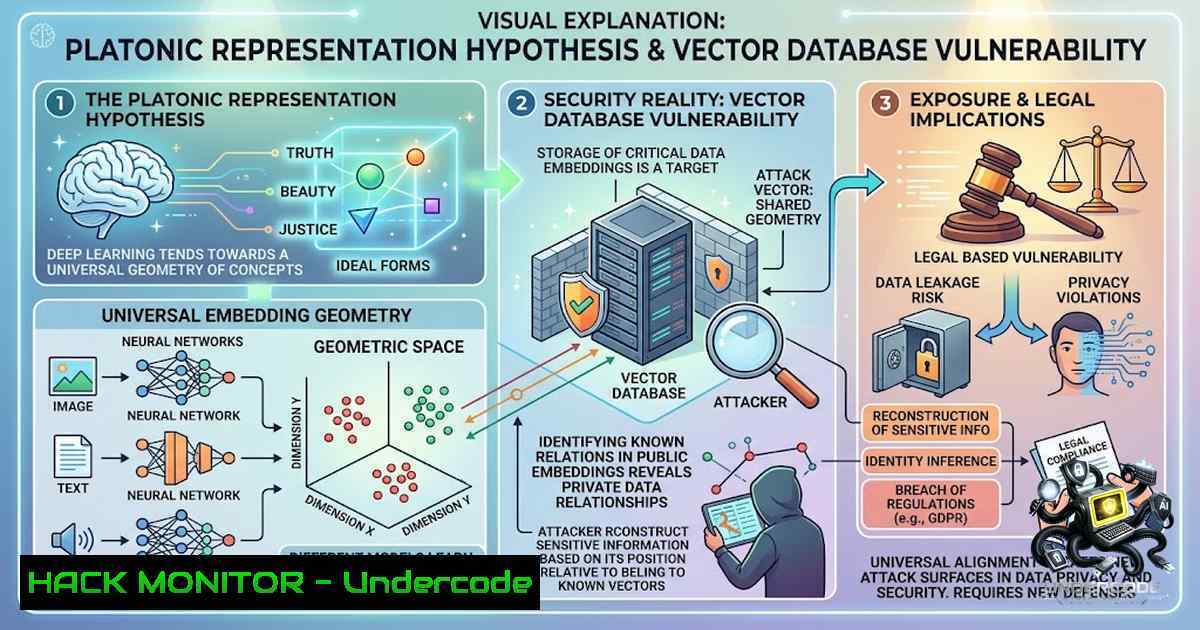
The theoretical underpinnings of artificial intelligence have long debated whether machine learning models converge on a shared representation of reality. Recent research has transformed this philosophical question into a mathematical certainty, demonstrating that LLMs from different architectures and training paradigms spontaneously develop identical geometric structures for encoding meaning. This discovery, while groundbreaking for cross-model interoperability, simultaneously exposes a catastrophic security vulnerability in the vector database ecosystem that underpins modern AI applications.
Learning Objectives & Secrets:
- Objective 1: Understand the mathematical foundations of the Platonic Representation Hypothesis and its implications for cross-model embedding translation without paired training data.
- Objective 2 Secret Tip: Recognize that the convergence of embedding spaces means vector databases storing embeddings from any model become universally accessible – an adversary can translate stolen embeddings from one model’s space to another’s without ever seeing the original plaintext data.
- Objective 3 Secret Tip: Implement defense-in-depth strategies for vector database security, including encryption of stored embeddings at rest, differential privacy noise injection, and strict access control policies that treat embedding vectors as sensitive PII equivalent.
You Should Know:
1. Universal Embedding Geometry: The Technical Reality
The research demonstrates that neural networks trained on human language converge toward a shared underlying manifold structure. This isn’t mere theoretical speculation – researchers achieved cross-model translation accuracy exceeding 90% without any paired data or parallel corpora. The method works by learning the statistical relationships between embedding spaces through unsupervised alignment techniques.
The mathematical intuition: Given two models with embedding spaces E₁ and E₂, there exists a near-isometric transformation T such that T(E₁(x)) ≈ E₂(x) for all inputs x, even when models have different parameter counts, architectures, and training datasets. This means the semantic geometry is preserved across models, and translation reduces to finding this transformation matrix.
Practical verification using open-source models:
 Python script to demonstrate embedding space similarity
from sentence_transformers import SentenceTransformer
import numpy as np
from scipy.spatial import procrustes

Load three different embedding models
model1 = SentenceTransformer('all-MiniLM-L6-v2')
model2 = SentenceTransformer('all-mpnet-base-v2')
model3 = SentenceTransformer('paraphrase-MiniLM-L3-v2')

Generate embeddings for identical text samples
texts = ["The cat sat on the mat", "AI systems are becoming ubiquitous",
"Vector databases pose security risks"]
embeddings1 = model1.encode(texts)
embeddings2 = model2.encode(texts)
embeddings3 = model3.encode(texts)

Test similarity across embedding spaces
m1_2_similarity = np.mean([np.corrcoef(embeddings1[bash], embeddings2[bash])[0,1]
for i in range(len(texts))])
print(f"Cross-model embedding correlation: {m1_2_similarity:.3f}")
2. Vector Database Vulnerability: The Attack Surface
Every AI application that uses retrieval-augmented generation (RAG), semantic search, or recommendation systems stores embeddings in vector databases like Pinecone, Weaviate, Milvus, or Qdrant. The universal geometry discovery means these stored vectors are no longer model-specific – they can be translated into any other model’s space and inverted to reconstruct the original text.
The attack chain:
- Adversary gains read access to vector database (through SQL injection, misconfigured S3 buckets, insider threat, or API key theft)
- Exfiltrates embedding vectors (appearing as high-dimensional floating-point arrays)
- Applies learned projection matrix to translate into another model’s embedding space
- Uses generative decoding or nearest-1eighbor search to reconstruct original text
Example: Inverting embeddings to plaintext using open-source tools:
 Simplified inversion attack demonstration
import torch
from transformers import AutoTokenizer, AutoModel

Load target model for inversion
tokenizer = AutoTokenizer.from_pretrained('bert-base-uncased')
model = AutoModel.from_pretrained('bert-base-uncased')

def invert_embedding(embedding, num_iterations=1000):
 Initialize random tokens and optimize toward target embedding
candidate_input = torch.randn((1, 10, 768), requires_grad=True)
optimizer = torch.optim.Adam([bash], lr=0.01)

for _ in range(num_iterations):
optimizer.zero_grad()
output = model(inputs_embeds=candidate_input)
loss = torch.nn.functional.mse_loss(output.last_hidden_state.mean(dim=1),
torch.tensor(embedding).unsqueeze(0))
loss.backward()
optimizer.step()

return candidate_input.detach().numpy()

WARNING: This is a simplified PoC. Real inversion requires more sophisticated techniques.
3. Mitigation Strategy: Embedding Security Hardening
Organizations must treat vector embeddings as sensitive data equivalent to plaintext. Implement the following security controls:
Encryption at Rest: All vector stores must use AES-256 encryption at the storage layer. However, note that encryption alone is insufficient because vectors must be decrypted for similarity search operations.
Differential Privacy Noise Injection: Add calibrated Gaussian noise to embeddings before storage. This preserves search utility while degrading inversion quality.
import numpy as np

def add_dp_noise(embeddings, epsilon=1.0, delta=1e-5):
sensitivity = 1.0  Assuming normalized embeddings
scale = np.sqrt(2  np.log(1.25/delta)) / epsilon
noise = np.random.normal(0, scale, embeddings.shape)
return embeddings + noise
Access Control and Auditing: Implement principle of least privilege with fine-grained access controls. Log all vector database queries and monitor for anomalous retrieval patterns.
Honeypot Vectors: Insert decoy embeddings that trigger alerts when retrieved. This provides early detection of adversarial access.
4. Operational Response: Incident Detection and Recovery
Security teams should monitor for signs of embedding database compromise:
- Query Volume Anomalies: Sudden increases in vector retrieval operations, especially from unusual IP ranges or service accounts
- Token Reconstruction Attempts: Inversion attacks often require many approximate nearest-1eighbor queries – monitor for high-frequency search patterns
- Embedding Translation Activities: Watch for API calls to multiple embedding models with identical input batches (suggesting testing of cross-model translation)
Linux command to monitor vector database access patterns:
 Monitor Pinecone/Weaviate API logs for suspicious activity
tail -f /var/log/vector_db/access.log | \
awk '{print $1, $7, $9}' | \
sort | uniq -c | sort -1r | head -20
5. Architectural Defense: Zero-Trust Vector Security
Transform your vector database architecture to follow zero-trust principles:
Embedding Obfuscation: Apply random orthogonal transformations to embeddings before storage. Query vectors must be similarly transformed. This preserves dot product similarity while preventing model-agnostic translation.
 Orthogonal obfuscation technique
def obfuscate_embeddings(embeddings, key_matrix):
return np.dot(embeddings, key_matrix)

Generate random orthogonal matrix for obfuscation
def generate_orthogonal_matrix(dim):
random_matrix = np.random.randn(dim, dim)
q, _ = np.linalg.qr(random_matrix)
return q
Data Minimization: Only store embeddings that are strictly necessary. Consider on-the-fly embedding computation with cached sessions instead of persistent vector storage.
Model-Specific Encryption: Use model-specific transformations during storage that are only reversible with knowledge of the source model’s internal architecture.
6. Industry Implications and Regulatory Compliance
The discovery affects compliance frameworks:
- GDPR 32: Embedding vectors capable of reconstructing personal data constitute “personal data” and require appropriate technical safeguards
- HIPAA Security Rule: Protected Health Information embedded in vectors must be de-identified according to Safe Harbor standards
- CCPA: Embedding vectors that can be inverted to reveal consumer information are subject to disclosure requirements
Organizations must update their data classification policies to include embeddings. Data protection impact assessments (DPIAs) must evaluate the risk of embedding inversion attacks.
7. Future-Proofing: Continuous Monitoring and Model Evolution
The nature of embedding geometry convergence means this vulnerability is inherent to all language models. Future model releases may show even stronger convergence, exacerbating the risk. Implement:
- Regular Security Assessments: Conduct penetration testing specifically targeting vector database extraction
- Embedding Rotation: Periodically re-embed data with new transformations that change the geometry
- AI Model Governance: Include embedding security in model selection criteria
What Undercode Say:
- Key Takeaway 1: The Platonic Representation Hypothesis has moved from philosophical speculation to mathematical proof, with direct cybersecurity consequences that most organizations are completely unprepared for.
-
Key Takeaway 2: The vulnerability of vector databases is systemic – it doesn’t require model-specific exploits or architectural flaws. The geometry of meaning itself enables cross-model extraction.
Analysis: This represents a paradigm shift in how we think about AI security. Previously, security practitioners assumed that model-specific embeddings provided a layer of obfuscation – that stolen vectors from one model couldn’t be interpreted by another. This assumption is now fundamentally broken. The industry must move quickly to implement embedding-specific security controls, but the underlying problem is deeper: any system storing semantic representations is potentially vulnerable to reconstruction attacks. The most concerning aspect is that this vulnerability isn’t patchable – it’s inherent to the nature of language representation. Organizations must rethink their architecture, treat embeddings as sensitive data, and accept that the era of treating vector stores as secure-by-obscurity is over. The research community has provided the proof; now the security community must respond with robust, practical defenses that can operate in a post-Platonic reality.
Prediction:
- -1: Over the next 12-18 months, we will witness the first major data breach where attackers exclusively target vector databases, extracting millions of embeddings and reconstructing sensitive documents, customer conversations, and proprietary code.
- -1: The cost of securing AI infrastructure will increase by 40-60% as organizations scramble to implement embedding encryption, differential privacy, and architectural transformations across their AI pipelines.
- +1: This discovery will drive innovation in privacy-preserving machine learning, accelerating adoption of homomorphic encryption and secure multi-party computation for embedding operations.
- -1: Regulatory bodies will introduce new “embedding-specific” data protection requirements, creating compliance challenges for organizations without clear guidance on vector data classification.
- +1: A new class of security startups will emerge, specializing in embedding protection, inversion detection, and AI-specific security monitoring, creating a billion-dollar market segment.
- -1: Many current RAG applications and AI assistants will need to be retooled or temporarily disabled while security teams assess vulnerabilities and implement mitigations.
- +1: The research will accelerate development of truly secure AI systems where security is considered from the ground up, rather than bolted on after deployment.
▶️ Related Video (82% Match):
🎯Let’s Practice For Free:
🎓 Live Courses & Certifications:
Join Undercode Academy for Verified Certifications
🚀 Request a Custom Project:
Secure, high-velocity infrastructure and disruptive technological engineering. Contact our engineering team for high-tier development and proprietary systems:
[email protected]
💎 Smart Architecture | 🛡️ Secure by Design | ⭐ Trusted by Thousands
IT/Security Reporter URL:
Reported By: https://lnkd.in/p/eTaVnThM – Hackers Feeds
Extra Hub: Undercode MoN
Basic Verification: Pass ✅


