
Listen to this Post
Introduction
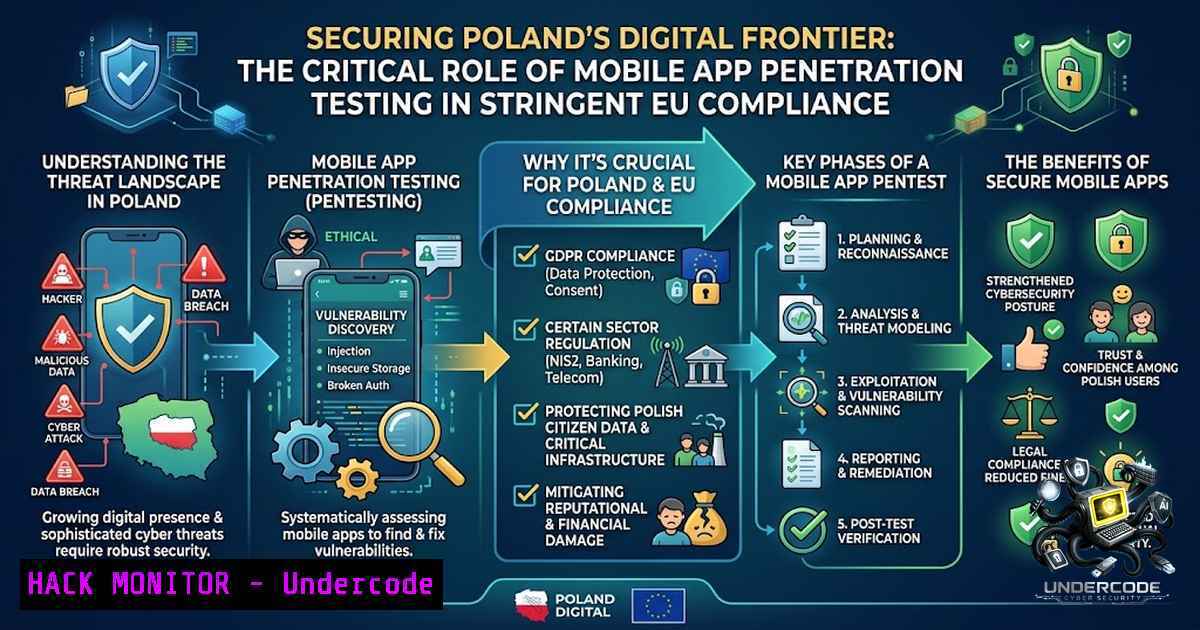
As mobile applications increasingly serve as the primary digital interface for banking, healthcare, e-commerce, and logistics across Poland, they have become prime targets for cyber adversaries. Unlike traditional web applications, mobile platforms introduce unique and often overlooked attack vectors—including insecure data storage, insecure communication, insufficient cryptography, and client-side code tampering. For Polish enterprises, securing these mobile ecosystems is not merely a technical imperative; it is a regulatory necessity driven by the European Union’s stringent frameworks, including the General Data Protection Regulation (GDPR), the Network and Information Security Directive (NIS2), and the Digital Operational Resilience Act (DORA), which took effect in January 2025. A comprehensive mobile application penetration test is the foundational control that validates security postures against these evolving threats and regulatory mandates.
Learning Objectives & Secrets
- Objective 1: Master OWASP MASVS & Mobile Top 10 Risk Identification – Gain proficiency in applying the OWASP Mobile Application Security Verification Standard (MASVS) to systematically identify and remediate the OWASP Mobile Top 10 risks. The MASVS serves as the industry baseline for mobile security controls across storage, cryptography, authentication, and authorization. Secret Tip: Leverage the MASVS not as a checklist but as a threat-modeling framework to prioritize vulnerabilities based on business impact and data sensitivity.
-
Objective 2: Uncover Reverse Engineering & Code Tampering Vulnerabilities – Learn to simulate real-world adversary techniques, including application decompilation, dynamic code injection, and runtime manipulation using tools like Frida and Objection. Secret Tip: Focus on testing custom certificate pinning implementations rather than relying on stock Objection hooks; craft targeted Frida scripts to bypass bespoke validation logic.
-
Objective 3: Secure the API-Backend Integration Layer – Discover how to test the critical data pipelines between mobile frontends and backend servers, identifying flaws such as broken authentication, OAuth misconfigurations, insecure direct object references (IDOR), and JWT manipulation. Secret Tip: Combine Burp Suite with `jwt_tool` to test for the “none” algorithm vulnerability and key confusion attacks, which are frequently overlooked in mobile API assessments.
You Should Know
- Reconnaissance & Static Analysis: Decompiling the Mobile Attack Surface
The first step in any mobile penetration test is to understand the application’s architecture and identify hardcoded secrets, insecure permissions, and exposed components without executing the code.
- Android (APK) Reconnaissance:
Decompile the APK to extract resources and smali code
apktool d target_app.apk -o decompiled_output

Convert DEX to Java source code for readability
d2j-dex2jar target_app.apk -o classes.jar

Search for hardcoded API keys, passwords, or tokens
grep -r -i "api_key|password|secret" decompiled_output/
What this does: `apktool` reverses the APK packaging, exposing the manifest and resources. `dex2jar` converts Android bytecode to Java, enabling source-code analysis. A 2025 CISA/FBI joint classification identified hardcoded credentials as a “dangerous” bad practice (CWE-798), with 71% of iOS apps leaking at least one hardcoded secret.
-
iOS (IPA) Reconnaissance:
Extract the IPA contents (rename .ipa to .zip and unzip)
unzip target_app.ipa -d ios_extracted

Use class-dump to extract Objective-C headers
class-dump -H Payload/AppName.app/AppName -o headers/

Search for sensitive strings in the binary
strings Payload/AppName.app/AppName | grep -i "key|secret|token"
Pro Tip: For encrypted iOS binaries, use tools like `Bagbak` or `frida-ios-dump` to decrypt the application before static analysis.
- Dynamic Analysis & Runtime Manipulation with Frida and Objection
Dynamic analysis reveals how an application behaves during execution, exposing vulnerabilities that are invisible in static code, such as insecure data storage, runtime logic flaws, and the effectiveness of anti-tampering controls.
- Setup and Basic Commands:
Install Frida and Objection
pip3 install frida-tools objection --break-system-packages

On a rooted Android device, start the Frida server
adb push frida-server /data/local/tmp/
adb shell chmod +x /data/local/tmp/frida-server
adb shell /data/local/tmp/frida-server &

Attach Objection to a running Android app
objection --gadget "com.target.app" explore
What this does: Frida allows runtime code injection, enabling testers to hook functions, modify return values, and bypass security controls. Objection provides a user-friendly CLI to automate common tasks like bypassing root/jailbreak detection and SSL pinning.
-
Bypassing Security Controls:
Within the Objection explore environment
Disable Android root detection
android root disable

Disable iOS jailbreak detection
ios jailbreak disable

Bypass certificate pinning (Android)
android sslpinning disable
Pro Tip: If Objection’s stock hooks fail against a custom pinning implementation, write a targeted Frida script:
// frida_script.js - Hook a custom certificate validation method
Java.perform(function () {
var CustomTrustManager = Java.use("com.target.app.CustomTrustManager");
CustomTrustManager.checkServerTrusted.implementation = function (chain, authType) {
console.log("Bypassing custom certificate validation!");
return;
};
});
Execute with:
frida -U -f com.target.app -l frida_script.js --1o-pause.
- API & Backend Integration Security: Intercepting and Manipulating Traffic
Mobile applications are essentially frontends for backend APIs. Securing the communication channel and the API endpoints themselves is critical to preventing data breaches and account takeovers.
- Setting Up a Proxy for Traffic Interception:
Configure Burp Suite or mitmproxy as a proxy on your testing machine and set the mobile device’s Wi-Fi settings to route traffic through it. For applications with SSL pinning, use the Frida/Objection bypass techniques described above. -
Testing for Authentication & Authorization Flaws:
Use jwt_tool to test for common JWT vulnerabilities
jwt_tool <JWT_TOKEN> -X a -d "admin=true"  Attempt algorithm confusion
jwt_tool <JWT_TOKEN> -T  Test for "none" algorithm

Use Burp Suite's Repeater to modify API requests
Intercept a request, send to Repeater, change user_id or role parameters
and observe if the server enforces proper authorization
What this does: `jwt_tool` automates the testing of JSON Web Tokens for flaws like the “none” algorithm, key confusion, and claim manipulation. Burp Suite’s Repeater and Intruder tools allow testers to systematically probe for IDOR and privilege escalation vulnerabilities.
- Data Storage & Cryptography Audits: Securing Data at Rest
Mobile devices are frequently lost or stolen, making the encryption of locally stored data a non-1egotiable security control. Auditing how an application handles sensitive information on the device is paramount.
- Inspecting Local Storage on Android:
Access the app's private data directory (requires root)
adb shell
run-as com.target.app
ls -la /data/data/com.target.app/

Check SharedPreferences for plaintext credentials
cat /data/data/com.target.app/shared_prefs/app_preferences.xml

Check SQLite databases for sensitive data
sqlite3 /data/data/com.target.app/databases/app_database.db "SELECT  FROM user_table;"
-
Inspecting Local Storage on iOS:
Use Objection to explore the iOS filesystem
objection --gadget "Target App" explore
Within Objection, browse the app's sandbox
env
ls
Dump the contents of NSUserDefaults
ios nsuserdefaults get
What this does: These commands reveal whether the application stores sensitive data—such as passwords, session tokens, or PII—in plaintext. The OWASP Mobile Top 10 lists “Insecure Data Storage” as a high-risk vulnerability. A robust audit verifies that cryptographic implementations are correct and that keys are stored securely in the keystore/keychain.
- DORA, NIS2, and GDPR Compliance: The Regulatory Imperative
For Polish enterprises, mobile app security is not optional. DORA mandates that financial entities implement robust security and resilience measures across the entire mobile app ecosystem, from development to runtime. Key requirements include assessing and mitigating risks against malware, session hijacking, and unauthorized access, as well as conducting regular vulnerability assessments and threat-led penetration testing (TLPT) for critical systems. NIS2 imposes stronger expectations around cyber risk management, supplier control, and vulnerability handling.
- Compliance Validation Checklist:
- Incident Reporting: Ensure your mobile app has mechanisms to detect, classify, and report ICT-related incidents as required by DORA.
- Supply Chain Security: Implement Software Bill of Materials (SBOMs) and conduct vendor vetting as emphasized by NIS2.
- Data Minimization: Verify that your mobile app only collects and processes data necessary for its legitimate purpose, as required by GDPR.
6. Developer-Centric Reporting & Remediation
The ultimate goal of a penetration test is to enable secure development. Reports should provide clear, actionable findings with proof-of-concept steps and prioritized remediation guidance.
- Sample Remediation Steps:
- Insecure Data Storage: Migrate all sensitive data to Android’s Keystore or iOS’s Keychain. Encrypt data at rest using AES-256-GCM.
- Broken Authentication: Implement multi-factor authentication (MFA) and enforce strong session management with short-lived JWTs.
- Insecure Communication: Enforce TLS 1.3 and implement robust certificate pinning.
- Code Tampering: Implement runtime application self-protection (RASP) and integrity checks to detect and respond to binary modifications.
What Undercode Say
- Key Takeaway 1: Mobile application penetration testing is a specialized discipline requiring a blend of static analysis, dynamic runtime manipulation, and API security testing. Generic web application testing tools and methodologies are insufficient to uncover the unique vulnerabilities present in Android and iOS ecosystems.
-
Key Takeaway 2: The convergence of stringent EU regulations—GDPR, NIS2, and DORA—has elevated mobile app security from a best practice to a legal and financial necessity for Polish enterprises. Proactive, continuous security validation is essential to avoid regulatory penalties and protect customer trust.
Analysis: The Polish market, with its rapid digitalization in banking and critical infrastructure, is a high-value target for cybercriminals. The unique attack surface of mobile apps—including client-side storage, reverse engineering, and dynamic runtime vulnerabilities—demands a dedicated testing approach. CybiValue’s methodology, which combines automated vulnerability discovery with deep manual ethical hacking, aligns perfectly with the comprehensive requirements of the OWASP MASVS and the stringent expectations of EU regulators. By integrating security into the development lifecycle and conducting regular, thorough penetration tests, Polish businesses can deploy resilient mobile applications without compromising innovation or user experience. The future of mobile security lies in continuous validation, real-time threat detection, and a security-first culture that permeates every stage of the software development lifecycle.
Prediction
- -1: Financial institutions and critical infrastructure operators in Poland that fail to comply with DORA’s mobile security requirements by 2026 will face significant regulatory fines and operational disruptions, potentially impacting their ability to operate within the EU market.
- -1: The sophistication of mobile malware and reverse-engineering tools will continue to evolve, making it increasingly difficult for organizations relying solely on automated scanners to protect their applications without deep manual testing.
- +1: The adoption of comprehensive mobile penetration testing services, like those offered by CybiValue, will become a standard business practice for Polish enterprises, driving a new wave of security innovation and creating a more resilient digital economy.
- +1: The integration of AI-driven threat detection with traditional penetration testing will enable faster identification and remediation of zero-day vulnerabilities in mobile applications, reducing the average time to patch from weeks to days.
- -1: The growing complexity of the mobile supply chain, including third-party libraries and SDKs, will introduce new, hard-to-detect vulnerabilities that require advanced testing techniques like Software Composition Analysis (SCA) and runtime monitoring.
- +1: Polish cybersecurity firms will emerge as leaders in mobile security testing, leveraging their expertise to serve not only the domestic market but also the broader European and global financial sectors.
- +1: The regulatory push from DORA and NIS2 will accelerate the adoption of DevSecOps practices in Poland, embedding security into the CI/CD pipeline and fostering a culture of shared responsibility for mobile application security.
- -1: The increasing use of AI-powered coding assistants may inadvertently introduce new classes of vulnerabilities in mobile applications, as developers may not fully understand the security implications of AI-generated code.
- +1: The demand for skilled mobile security professionals in Poland will surge, creating new job opportunities and driving investment in cybersecurity education and training programs.
- +1: The proactive security measures mandated by EU regulations will ultimately enhance consumer confidence in digital services, driving further growth in Poland’s digital economy.
▶️ Related Video (74% Match):
🎯Let’s Practice For Free:
🎓 Live Courses & Certifications:
Join Undercode Academy for Verified Certifications
🚀 Request a Custom Project:
Secure, high-velocity infrastructure and disruptive technological engineering. Contact our engineering team for high-tier development and proprietary systems:
[email protected]
💎 Smart Architecture | 🛡️ Secure by Design | ⭐ Trusted by Thousands
IT/Security Reporter URL:
Reported By: https://lnkd.in/p/ehkj_nkg – Hackers Feeds
Extra Hub: Undercode MoN
Basic Verification: Pass ✅


