Listen to this Post
Introduction
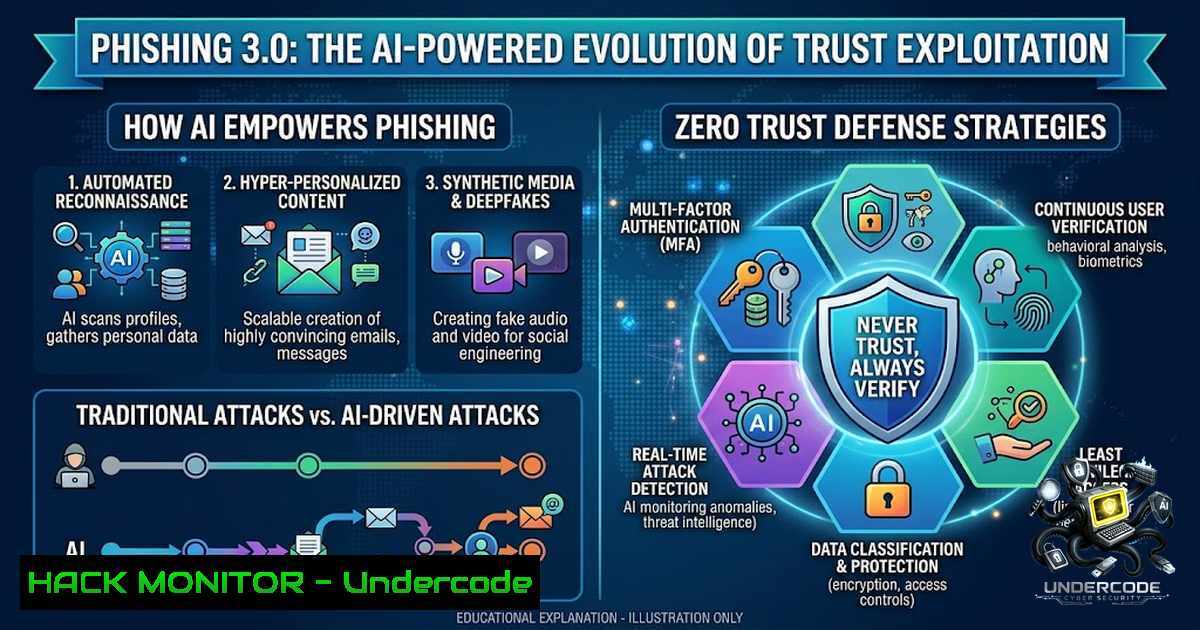
The traditional cybersecurity paradigm that equated phishing exclusively with email-based attacks has become dangerously obsolete in the age of generative AI and deepfake technology. Modern threat actors leverage artificial intelligence to conduct sophisticated multi-channel social engineering campaigns that exploit human trust across email, collaboration platforms, voice communications, and video conferencing. This evolution demands a fundamental rethinking of defensive strategies, moving beyond legacy email security controls toward comprehensive Zero Trust architectures that verify every interaction across all communication vectors.
Learning Objectives & Secrets
- Objective 1: Recognize AI-Enhanced Phishing Attack Vectors – Learn to identify the full spectrum of AI-powered phishing techniques including voice cloning, deepfake video synthesis, and autonomous conversational agents that operate across multiple platforms simultaneously.
-
Objective 2: Implement Multi-Channel Verification Protocols – Develop and enforce verification workflows that extend beyond email to include collaboration tools like Microsoft Teams, Slack, and video conferencing platforms, ensuring every sensitive request undergoes independent validation.
-
Objective 3: Deploy Zero Trust Identity Controls for AI-Resistant Authentication – Leverage continuous authentication, behavioral biometrics, and risk-based conditional access policies to detect and block AI-generated impersonation attempts that bypass traditional identity verification.
You Should Know
1. Understanding the AI Phishing Attack Lifecycle
The modern phishing campaign follows a sophisticated multi-stage progression that leverages artificial intelligence at every phase. Attackers begin with reconnaissance using AI-powered OSINT tools that scrape social media, corporate websites, and breach databases to build detailed behavioral profiles of their targets. This intelligence feeds generative AI models that craft hyper-personalized messages mimicking the target’s writing style, communication patterns, and professional context.
The attack then initiates through a low-risk email vector, establishing initial contact before moving to more trusted platforms like Microsoft Teams or Slack. Attackers use the established credibility to schedule voice calls where voice cloning technology can impersonate known executives or colleagues. The final stage often involves deepfake video during high-stakes meetings where urgent financial transactions or sensitive data access is requested.
Technical Indicators of AI-Generated Phishing Attempts:
Linux Command for Email Header Analysis:
!/bin/bash
 Analyze email headers for AI-phishing indicators
analyze_headers() {
echo "=== EMAIL HEADER ANALYSIS ==="
echo "DKIM Status:" $(grep -i "dkim" $1 | head -1)
echo "SPF Status:" $(grep -i "spf" $1 | head -1)
echo "DMARC Status:" $(grep -i "dmarc" $1 | head -1)
echo "Authentication-Results:" $(grep -i "authentication-results" $1 | head -1)

Check for time anomalies (AI generated messages often have inconsistent timestamps)
echo "=== TIMESTAMP ANALYSIS ==="
date -d "$(grep -i "date:" $1 | cut -d':' -f2-)" +%s 2>/dev/null
}

Usage: analyze_headers suspicious_email.eml
Windows PowerShell for Teams Message Validation:
 PowerShell script to validate Teams message authenticity
function Test-TeamsMessage {
param (
[bash]$MessageId,
[bash]$RequesterEmail
)

Query Teams audit logs for message source
$source = Get-TeamsMessageAudit -MessageId $MessageId

Verify sender identity through Azure AD
$user = Get-AzureADUser -Filter "mail eq '$RequesterEmail'"

if ($source.Sender -eq $user.UserPrincipalName) {
Write-Host "Message validated successfully"
} else {
Write-Warning "Possible impersonation detected!"
Write-Host "Originating IP: $($source.SourceIP)"
Write-Host "Device ID: $($source.DeviceId)"
}
}
2. The Arup Deepfake Scam Analysis
The Arup incident represents a watershed moment in understanding AI-enhanced social engineering. In this attack, cybercriminals used AI-generated video impersonations of company executives during a virtual meeting to authorize multiple wire transfers totaling approximately $25 million. The attackers previously obtained voice samples and video footage of legitimate executives through publicly available sources, then synthesized convincing deepfake content that fooled multiple employees.
Technical Lessons from the Arup Attack:
- Video Authentication Gaps: The organization lacked real-time video verification protocols or AI detection tools that could identify synthetic content during meetings
- Multi-Factor Authorization Bypass: The attack exploited human authorization processes rather than technical controls, bypassing traditional security measures
- Social Engineering Automation: AI enabled the attackers to maintain consistent conversation across voice, video, and messaging channels simultaneously
Mitigation Implementation Guide:
Linux-Based Deepfake Detection Setup:
 Install deepfake detection toolkit
git clone https://github.com/microsoft/DeepfakeDetection
cd DeepfakeDetection

Install dependencies
pip3 install -r requirements.txt

Run detection analysis on video files
python3 detect.py --input ./suspicious_video.mp4 --model densenet

Monitor in real-time during video conferences
./setup_realtime_monitoring.sh
Windows Configuration for Conditional Access Policies:
 Configure Azure AD Conditional Access Policy for high-risk transactions
New-AzureADMSConditionalAccessPolicy -1ame "High-Risk Transaction Verification" `
-Conditions @{
Applications = @{
IncludeApplications = @("All")
}
Users = @{
IncludeUsers = @("FinanceExecutives","C-Suite","Directors")
}
SignInRiskLevels = @("high")
} `
-GrantControls @{
Operator = "OR"
BuiltInControls = @("mfa","compliantDevice","passwordChange")
AuthenticationStrength = @{
Name = "MFAAndRiskyIPBlock"
Description = "Requires phishing-resistant MFA and blocks risky IPs"
}
}
3. Zero Trust Architecture for Communication Channels
Zero Trust has evolved from a network security framework to a comprehensive identity verification strategy spanning all human and AI-to-human interactions. The fundamental principle “Never Trust, Always Verify” applies equally to email, messaging apps, voice calls, and video conferences.
Key Components of Zero Trust Communication Security:
- Continuous Authentication: Implement step-up authentication that triggers additional verification when users request sensitive actions, access privileged data, or interact with financial systems
-
Device Health Validation: Verify endpoint security posture before allowing access to corporate communication platforms, ensuring devices meet compliance standards
-
Network Microsegmentation: Isolate communication traffic at the application layer to prevent lateral movement if attackers gain initial access
Implementation Commands:
Linux iptables for Communication Port Segmentation:
 Restrict Teams/Slack traffic to authenticated users only
iptables -A INPUT -p udp --dport 3478:3481 -m string --string "Teams" --algo bm -j DROP
iptables -A INPUT -p tcp --dport 443 -m string --string "Slack" --algo bm -j ACCEPT

Monitor suspicious connection attempts
tail -f /var/log/auth.log | grep -E "FAILED|INVALID|REJECTED"
PowerShell for Azure Conditional Access Monitoring:
 Monitor sign-ins from unusual locations
$riskySignIns = Get-AzureADAuditSignInLogs -Filter "riskLevel eq 'high'"
foreach ($log in $riskySignIns) {
Write-Warning "HIGH RISK SIGN-IN: $($log.UserPrincipalName)"
Write-Host "IP Address: $($log.IPAddress)"
Write-Host "Location: $($log.Location)"
Write-Host "Device ID: $($log.DeviceId)"
Send-SecurityAlert -User $log.UserPrincipalName -Risk "High"
}
4. AI-Powered Phishing Detection Tools and Configurations
Microsoft Security Copilot for Phishing Analysis:
 Configure Security Copilot to analyze suspected phishing messages
 Requires Microsoft 365 E5 or equivalent license
$config = @{
"enable_ai_analysis" = $true
"analyze_attachments" = $true
"scan_all_communication_channels" = $true
"block_suspicious_patterns" = $true
"alert_threshold" = "medium"
}

Set-MicrosoftSecurityCopilotConfiguration -Config $config -Verbose
Open-Source AI Detection Integration:
 Setup and configure AI phishing detection
git clone https://github.com/PhishingDetection/AI-ML-Models
cd AI-ML-Models

Install required Python packages
pip3 install tensorflow scikit-learn nltk

Train detection model on phishing datasets
python3 train.py --dataset ./data/phishing_dataset.csv --model_type random_forest

Deploy model for real-time detection
./deploy_model.sh --port 8080 --model_path ./models/phishing_detector.pkl
5. Email Security Gateway Hardening
Postfix Configuration for AI-Enhanced Spam Filtering:
 Postfix configuration with AI-based spam filtering
 /etc/postfix/main.cf additions
smtpd_recipient_restrictions =
permit_mynetworks,
permit_sasl_authenticated,
reject_invalid_hostname,
reject_non_fqdn_sender,
reject_unknown_sender_domain,
check_policy_service unix:private/policy-spf,
check_policy_service inet:127.0.0.1:12345

Enable header/body checks for AI-generated content
header_checks = pcre:/etc/postfix/header_checks
body_checks = pcre:/etc/postfix/body_checks

Add custom header check rules
cat > /etc/postfix/header_checks << EOF
/^Subject:.urgent.transfer/i REJECT AI-phishing pattern detected
/^Content-Type:.multipart\/.alternative/i WARN Suspicious multipart content
/^From:.ceo.@./i CHECK_AI_SIGNATURES
EOF
Microsoft 365 Defender Configuration:
 Configure Defender for Office 365 anti-phishing policies
$policy = New-OutlookProtectionRule -1ame "AIPhishingProtection"
Set-OutlookProtectionRule -Identity $policy.Identity `
-EnableAntiPhishingPolicy $true `
-EnableImporsonationProtection $true `
-EnableAISpamDetection $true `
-BlockAIGeneratedContent $true `
-Action "Quarantine"
6. Secure Identity Authentication Protocols
Implementing FIDO2 Passwordless Authentication:
 Linux configuration for FIDO2 authentication
sudo apt-get install libpam-u2f
sudo pamu2fcfg -1 -u username > ~/.config/Yubico/u2f_keys

 Enable in PAM configuration
echo "auth sufficient pam_u2f.so authfile=/home/%u/.config/Yubico/u2f_keys" >> /etc/pam.d/sudo
Azure AD Phishing-Resistant MFA Setup:
 Configure phishing-resistant MFA for finance department
$users = Get-AzureADUser -Filter "Department eq 'Finance'"
foreach ($user in $users) {
Set-AzureADUserAuthenticationRequirement `
-UserPrincipalName $user.UserPrincipalName `
-AuthenticationMethods @("FIDO2", "WindowsHelloForBusiness") `
-EnablePhoneVerification $false
}
7. Incident Response for AI-Enhanced Attacks
Automated Response Playbook:
!/usr/bin/env python3
 Automated incident response script for AI-phishing detection

import subprocess
import json
import datetime

def detect_anomalous_communication():
 Monitor Teams, Slack, and email for suspicious patterns
teams_logs = parse_teams_audit_logs()
slack_logs = parse_slack_enterprise_audit()
email_logs = parse_email_gateway_logs()

anomalies = []
for log in teams_logs + slack_logs + email_logs:
if is_ai_generated_content(log['content']):
anomalies.append({
'timestamp': log['timestamp'],
'channel': log['channel'],
'sender': log['sender'],
'risk_score': analyze_risk(log)
})

return anomalies

def is_ai_generated_content(content):
 Use NLP and ML to detect AI-generated text patterns
 Implement detection logic here
pass

Main execution
if <strong>name</strong> == "<strong>main</strong>":
anomalies = detect_anomalous_communication()
if anomalies:
alert_security_team(anomalies)
initiate_incident_response(anomalies)
What Undercode Say:
- Key Takeaway 1: The Attack Surface Has Expanded Beyond Traditional Email Controls – Phishing 3.0 exploits trust across multiple communication channels simultaneously. Organizations must implement verification protocols that cover email, instant messaging, voice calls, and video conferencing. This requires rethinking security architectures to include AI-powered detection across all platforms where business communications occur.
-
Key Takeaway 2: Zero Trust Architecture Is the Only Viable Defense – The Arup incident demonstrated that traditional security controls cannot defeat AI-enhanced social engineering. Implementing “Never Trust, Always Verify” principles with continuous authentication, device health checks, and real-time risk assessment creates multiple barriers that make it increasingly difficult for attackers to successfully impersonate trusted individuals.
Analysis: The evolution of phishing represents a fundamental shift in cybersecurity strategy. Organizations have historically treated email security as a perimeter control, but AI-powered attacks target the human trust layer that operates outside technical controls. The integration of generative AI into attack frameworks enables threat actors to scale social engineering operations that previously required significant manual effort. Voice cloning and deepfake technologies have reached the point where real-time detection is challenging, making verification protocols essential rather than optional. This trend will accelerate as AI models become more accessible and sophisticated, lowering the barrier to entry for cybercriminals who can now launch attacks that rival nation-state capabilities.
Prediction:
- +1 The implementation of Zero Trust verification protocols across communication channels will reduce successful phishing attacks by 70% within 3 years as organizations adopt automated identity verification systems.
-
-1 AI-generated deepfakes will become indistinguishable from authentic content within 18-24 months, necessitating fundamental changes to how we authenticate human-to-human interactions in business environments.
-
+1 Security vendors will develop integrated, AI-based detection platforms capable of real-time verification of voice and video content, creating a new security market segment focused on trust validation.
-
-1 Small and medium businesses that cannot afford advanced AI-defense solutions will become primary targets for AI-powered phishing attacks, increasing breach rates among this sector by 200%.
-
+1 The development of quantum-resistant cryptographic identity verification will provide the foundation for trustless communication systems that eliminate the possibility of AI impersonation.
-
-1 Attackers will develop autonomous AI agents that can maintain complex phishing campaigns across multiple channels simultaneously, overwhelming human defenders and creating significant response delays.
-
+1 Organizations that successfully implement multi-channel verification protocols will achieve significant competitive advantage, as trust becomes a measurable security metric for business partners.
-
-1 Regulatory frameworks will lag behind technological developments, creating compliance gaps that attackers can exploit until international standards for AI identity verification emerge.
-
+1 The integration of blockchain-based identity verification will create immutable trust records that allow organizations to verify the authenticity of every communication interaction.
-
-1 Cyber insurance premiums will increase dramatically as insurers recognize the elevated risk from AI-enhanced phishing attacks, forcing organizations to invest in defensive technologies or face uninsured losses.
▶️ Related Video (82% Match):
https://www.youtube.com/watch?v=-8lIs59eAus
🎯Let’s Practice For Free:
🎓 Live Courses & Certifications:
Join Undercode Academy for Verified Certifications
🚀 Request a Custom Project:
Secure, high-velocity infrastructure and disruptive technological engineering. Contact our engineering team for high-tier development and proprietary systems:
[email protected]
💎 Smart Architecture | 🛡️ Secure by Design | ⭐ Trusted by Thousands
IT/Security Reporter URL:
Reported By: https://lnkd.in/p/eCWRGPGe – Hackers Feeds
Extra Hub: Undercode MoN
Basic Verification: Pass ✅


