Listen to this Post
Introduction
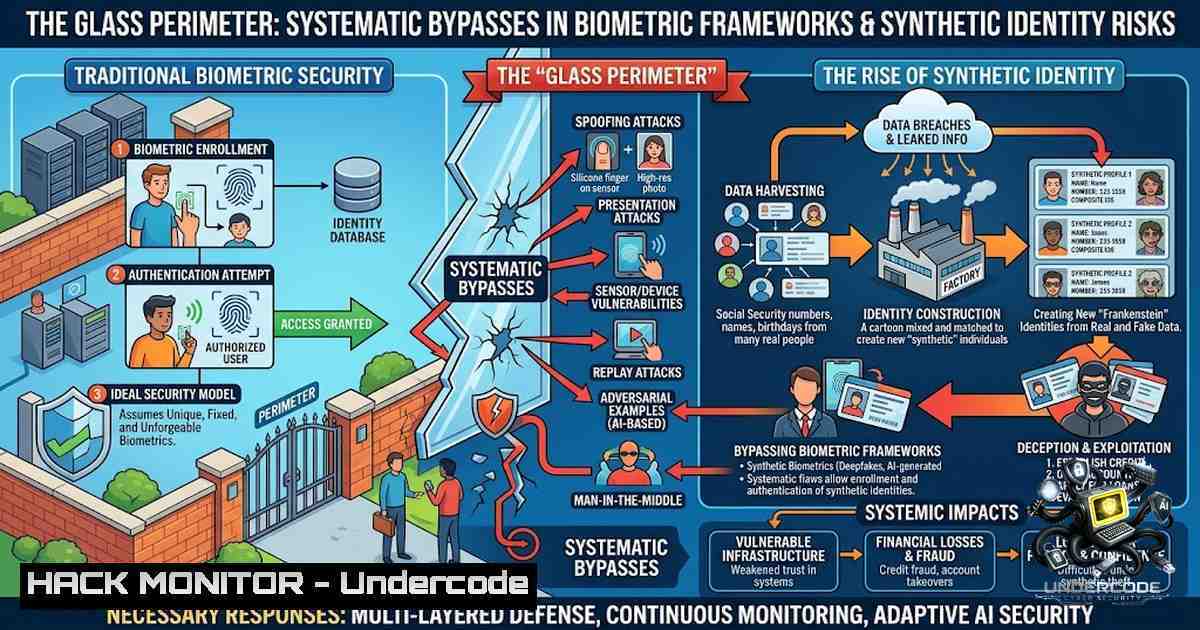
At DEF CON 34, researchers Javier Bernardo and Dan Borgogno presented “The Glass Perimeter: Systematic Bypasses in Biometric Frameworks and the Rise of Synthetic Identity,” revealing a 100% bypass rate across all tested biometric liveness frameworks. The core vulnerability stems from a fundamental architectural assumption: that the device producing the biometric assertion is trustworthy, the camera feed is authentic, and the SDK verdict is definitive. After six months of R&D against seven authorized banking and fintech applications, eight biometric liveness frameworks, and four SDK families, the researchers demonstrated that this assumption is catastrophically false. Synthetic identity fraud is projected to exceed twenty billion dollars annually by 2026.
Learning Objectives & Secrets
- Objective 1: Understand the Biometric Trust Boundary Fallacy – Learn why biometric SDKs that run entirely on the user’s device create a structural blind spot. These SDKs can only audit within their own process; once the attack moves one boundary beyond, the fortress becomes a glass wall.
-
Objective 2 Secret Tip: Map the Camera Pipeline Before You Inject – The researchers mapped six injection techniques across the entire Android camera stack, from swapping compressed images at the application level to writing raw video frames directly into the system camera service. Each technique targets a different pipeline depth, and success depends on injecting at the layer where the specific SDK consumes camera data—if you inject at the wrong layer, the SDK sees the real feed and your bypass fails.
-
Objective 3 Secret Tip: Stop Fighting Anti-Tamper—Move Outside Its Scope – When facing an integrated anti-tamper engine that killed instrumentation every nine seconds, the breakthrough came not from defeating the protection but from stepping outside its reach. Android’s process isolation meant the SDK’s forensic checks could audit everything inside its own process and find it clean, while injected frames arrived through the normal camera path from a system service the SDK could not inspect.
You Should Know
- Android Camera Pipeline Injection: A Technical Deep Dive
The researchers mapped the complete Android camera frame pipeline to identify the optimal injection points. The camera stack in Android follows this path:
Camera Hardware → Kernel Driver → Camera HAL (Hardware Abstraction Layer) → Camera Service (system_server) → Camera API (Camera2/CameraX) → Application → Biometric SDK
Each layer presents a different injection opportunity:
| Injection Layer | Technique | SDK Visibility |
|–|–|-|
| Application-level | Swap compressed images via hooking `onPreviewFrame` | Detected by most SDKs |
| Camera API | Hook `CameraManager` and `CameraDevice` methods | Detected by anti-tamper engines |
| Camera Service | Inject frames into `system_server` camera service | Invisible to SDK forensics |
The critical insight: biometric SDKs consume camera data at different points in this pipeline. Some read from the application-level preview callback; others read directly from the system camera service. By injecting at the system service level, the researchers sustained a 90-second synthetic video injection—over 2,600 frames—with zero crashes and zero detections.
Step-by-step guide for understanding the injection technique:
- Identify the target SDK’s camera consumption point – Use Frida to hook `CameraManager.openCamera()` and trace the flow of `ImageReader` or `Surface` objects through the application.
-
Map the system camera service – On a rooted Android device, examine `/system/bin/cameraserver` and the associated binder interfaces. The system camera service runs as a separate process (
system_server) and provides camera frames to applications via shared memory. -
Inject at the service level – Rather than hooking within the application process (where anti-tamper engines operate), interact with the camera service directly. This can be achieved through:
– Custom HAL modules that replace the camera output
– Binder transaction interception to the camera service
– Shared memory manipulation where camera frames are written
- Synthesize the biometric input – Generate a deepfake video from as few as two public photos using facial reconstruction models, voice cloning (Wav2Lip for audio sync), and liveness-compliant movement patterns.
-
Synthetic Identity Pipeline: From OSINT to Verified Account
The researchers demonstrated an alarmingly short pipeline from public photos to a KYC-passing liveness video:
 OSINT Phase: Collect target photos
 Two public photos are sufficient for synthetic identity generation

Deepfake Generation Pipeline
 1. Facial reconstruction from 2D images
 2. 3D facial model generation
 3. Liveness-compliant video synthesis (blinking, head movement, lighting variation)
 4. Voice cloning with Wav2Lip for audio sync

Result: Face match score of 0.94, liveness score of 0.96
The economics are brutal: Fraud-as-a-Service subscriptions for biometric bypass tooling run between ten and thirty thousand dollars per month, and a single automated tool can produce over one hundred verified accounts per day. Many SDKs had AI deepfake detection available as a toggle—and in the deployments tested, it was turned off.
Step-by-step guide for synthetic identity defense:
- Enable deepfake detection – Verify that all AI-based deepfake detection features in your biometric SDK are enabled, not merely available as optional toggles.
-
Implement multi-factor biometric verification – Do not rely on facial recognition alone. Combine with:
– Behavioral biometrics (typing patterns, swipe gestures, device handling)
– Device fingerprinting and integrity checks (Play Integrity API on Android, App Attest on iOS)
– Cross-device verification where possible
- Audit the camera pipeline – Implement server-side validation of camera metadata and frame timing. Injected video streams often exhibit consistent frame timing that differs from live camera input.
-
Monitor for synthetic identity patterns – Track accounts created with:
– Social media profiles with limited history
– Photos that fail reverse image search (or pass with only 2–3 sources)
– Liveness videos with perfect compliance (humans blink imperfectly)
- Android Anti-Tamper Evasion: The Process Boundary Blind Spot
The researchers’ most significant technical finding concerns the structural limitation of anti-tamper engines. These SDKs cost millions of dollars, are deployed by the world’s largest companies, and share a common blind spot: they can only see within their own process.
The vulnerability in detail:
When a biometric SDK runs inside an application process, its anti-tamper engine can:
– Detect hooking frameworks (Frida, Xposed, LSPosed) within the same process
– Verify code integrity of its own libraries
– Check for debugging and instrumentation
However, it cannot inspect:
- The system camera service process (
system_server) - The camera HAL layer
- Kernel-level camera drivers
- Shared memory segments used for camera frame transport
Step-by-step guide for understanding the evasion:
- Understand Android process isolation – Each Android application runs in its own process with its own memory space. The system camera service runs in a separate process (
system_server). -
Identify the trust boundary – The SDK assumes that anything within its process is the entire universe of possible attack vectors. This is the “glass perimeter” — it looks solid but shatters when pressure is applied from outside.
-
Exploit the cross-process communication – Camera frames are transmitted from the camera service to applications via shared memory or binder transactions. By manipulating the camera service directly (through root access or a custom HAL), an attacker can inject synthetic frames without touching the SDK’s process.
-
Validate the evasion – The researchers demonstrated this by surviving 90 seconds of continuous synthetic video injection with zero crashes and zero detections. The SDK’s forensic checks found everything clean inside its own process while the injected frames arrived through the normal camera path.
4. The CISO Threshold Dilemma: UX vs. Security
The researchers identified what they called the “CISO Threshold Dilemma” — the tension between user experience and security that vendors navigate when setting liveness detection thresholds.
The problem: To avoid blocking legitimate users with poor lighting, suboptimal camera angles, or low-quality front-facing cameras, vendors often lower detection thresholds. This creates a window for presentation attacks (printed photos, silicon masks, screen replay) that would otherwise be detected.
Step-by-step guide for threshold management:
- Implement adaptive thresholds – Adjust liveness detection sensitivity based on:
– Transaction value and risk profile
– Device quality and camera capabilities
– User history and behavioral patterns
- Test with adversarial inputs – Regularly test your biometric system against:
– High-fidelity printed photos (designed to avoid moiré patterns that SDKs detect)
– Silicon masks that replicate light scattering through human skin
– Eye-and-mouth cutout hybrids where a real person blinks behind a printed photo
- Log and analyze failures – Track liveness detection failures by device type, lighting condition, and user segment. Unusual patterns may indicate systematic bypass attempts.
-
Linux and Android Commands for Biometric Security Testing
For security researchers and penetration testers evaluating biometric implementations:
Android Debug Bridge (ADB) Commands:
 List camera services and their current state
adb shell dumpsys media.camera

Identify the target app's process ID
adb shell ps | grep <target_app_package>

Trace binder transactions to the camera service
adb shell strace -p <camera_service_pid> -e trace=ioctl

Monitor camera frame delivery
adb logcat | grep -i camera

Check for root/superuser access (required for system-level injection)
adb shell su -c "id"
Frida Scripting for Camera API Hooking:
// Hook CameraManager.openCamera to identify when the SDK accesses the camera
Java.perform(function() {
var CameraManager = Java.use("android.hardware.camera2.CameraManager");
CameraManager.openCamera.overload('java.lang.String', 'android.hardware.camera2.CameraDevice$StateCallback', 'android.os.Handler').implementation = function(cameraId, callback, handler) {
console.log("[] Camera opened: " + cameraId);
return this.openCamera(cameraId, callback, handler);
};
});
Executing Frida against the target:
 Attach Frida to a running app
frida -U -f <target_app_package> -l camera_hook.js

For system-level injection (requires root)
frida -U -1 system_server -l camera_service_inject.js
Virtual Camera Setup for Testing (Android):
- Install a virtual camera application on a rooted Android device (e.g., Virtual Camera: Live Assist)
- Configure the virtual camera to stream pre-recorded or synthetic video
- Launch the target application and observe whether liveness detection triggers
-
Cloud and API Security Considerations for Biometric Systems
While the DEF CON research focused on mobile device injection, the implications extend to API and cloud architectures:
API Security Hardening:
- Implement server-side liveness verification – Do not trust client-side liveness verdicts. Re-verify critical biometric assertions server-side where possible.
-
Use cryptographic attestation – On Android, implement Play Integrity API to verify the device environment. On iOS, use App Attest to ensure the application hasn’t been tampered with.
3. Monitor for injection patterns – Look for:
- Unusual frame timing (perfectly consistent intervals suggest pre-recorded video)
- Missing or inconsistent camera metadata (EXIF data, focus distance, exposure)
- Repeated liveness challenge responses (deepfakes may struggle with novel challenges)
- Rate-limit and risk-score – Apply progressive authentication requirements based on:
– Transaction velocity
– Geographic inconsistency
– Device reputation
Sample server-side validation pseudocode:
def validate_biometric_assertion(client_assertion, device_attestation, user_history):
 Verify device integrity
if not verify_play_integrity(device_attestation):
return REJECT

Check for injection patterns
if detect_unusual_frame_timing(client_assertion.metadata):
return REJECT

Apply risk-based authentication
risk_score = calculate_risk_score(user_history, transaction_value)
if risk_score > THRESHOLD:
require_secondary_verification()

return ACCEPT
What Undercode Say
Key Takeaway 1: The tools change, but the hacker’s mindset does not. Cliff Stoll’s 1986 pursuit of a $0.75 accounting discrepancy that led to catching a KGB-linked hacker and the 2026 biometric research share the same cognitive DNA: noticing an anomaly everyone else dismisses, questioning embedded trust assumptions, and following the thread with relentless curiosity. The researchers’ breakthrough came not from defeating anti-tamper protection but from stepping outside its scope—the same structural thinking Stoll used when he kept systems open to monitor an intruder rather than closing the hole.
Key Takeaway 2: The glass perimeter is a structural vulnerability, not a bug. Biometric SDKs are million-dollar solutions deployed by the world’s largest companies, yet they share a fundamental blind spot: they can only see within their own process. This is not a coding error—it’s an architectural assumption that the device is trustworthy. When that assumption fails, the entire identity verification framework collapses. The researchers’ 100% bypass rate across all tested frameworks demonstrates that this is a systemic issue, not an isolated weakness.
The analysis reveals a troubling trajectory: synthetic identity fraud is projected to exceed $20 billion annually by 2026, and the cost of creating a verified mule account has collapsed to five minutes of OSINT work and a deepfake pipeline. The problem is not facial recognition as an isolated technology, but the degree of trust that banks and fintechs place in controls that run entirely on the user’s device. When biometrics become the only barrier, a technology designed to simplify access becomes a single point of failure. As the researchers concluded: “A password can be stolen, but a face, it turns out, can be too.”
Prediction
- +1 The DEF CON 34 research will accelerate the development of server-side liveness verification and cross-device attestation. Banks and fintechs that adopt multi-factor biometric approaches combining facial recognition with behavioral biometrics and device integrity checks will be better positioned to withstand synthetic identity attacks. The research community will develop open-source tools for testing biometric SDKs, democratizing security evaluation.
-
-1 Fraud-as-a-Service platforms will rapidly incorporate the injection techniques demonstrated at DEF CON. With bypass tooling already available for $10,000–$30,000 per month and automated account creation exceeding 100 verified accounts per day, the window for remediation is closing fast. Financial institutions that fail to audit their biometric implementations against these attacks will face accelerating losses as synthetic identity fraud scales.
-
-1 The structural nature of the vulnerability—the process boundary blind spot—means that patching individual SDKs will not solve the problem. Attackers will simply move one boundary further, exploiting the camera service, HAL, or kernel level. The arms race will escalate until the industry fundamentally rethinks the trust model for device-based biometric verification.
-
+1 The juxtaposition of the 1986 Cliff Stoll investigation and the 2026 biometric research at DEF CON 34 will inspire a new generation of security researchers to focus on first-principles thinking rather than tool-dependent approaches. The realization that the hacker’s mindset—curiosity, persistence, and the willingness to question trust boundaries—transcends technology generations will drive more fundamental security research.
-
-1 As biometric verification becomes the primary identity proofing mechanism for financial services worldwide, the systemic vulnerability identified in this research will create a massive attack surface. Synthetic identity fraud is projected to exceed $20 billion annually by 2026, and the trend line suggests this is just the beginning. The industry faces a “Glass Perimeter” problem that cannot be solved with incremental fixes—it requires a fundamental re-architecture of how identity verification is performed in untrusted environments.
▶️ Related Video (80% Match):
https://www.youtube.com/watch?v=1uCl7T8–i8
🎯Let’s Practice For Free:
🎓 Live Courses & Certifications:
Join Undercode Academy for Verified Certifications
🚀 Request a Custom Project:
Secure, high-velocity infrastructure and disruptive technological engineering. Contact our engineering team for high-tier development and proprietary systems:
[email protected]
💎 Smart Architecture | 🛡️ Secure by Design | ⭐ Trusted by Thousands
IT/Security Reporter URL:
Reported By: https://lnkd.in/p/eJNmAe8F – Hackers Feeds
Extra Hub: Undercode MoN
Basic Verification: Pass ✅


