Listen to this Post
Introduction:
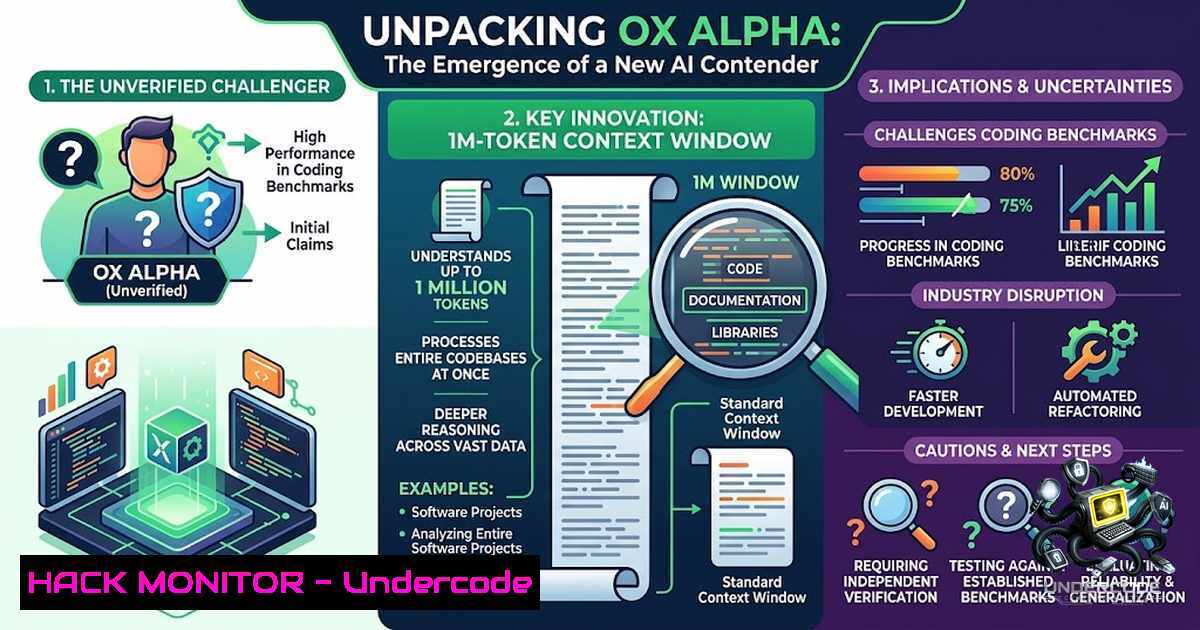
The artificial intelligence landscape has been unexpectedly disrupted by the sudden appearance of “Ox Alpha,” an unverified AI model boasting an impressive 1 million-token context window. Currently offered for free by multiple providers with generous rate limits, this mysterious model has generated significant buzz within the cybersecurity and developer communities due to its reported exceptional performance on complex coding tasks. While official benchmarks remain absent and the originating organization remains undisclosed, early community testing suggests Ox Alpha may represent a significant leap forward in AI-assisted code generation and analysis capabilities.
Learning Objectives & Secrets:
- Objective 1: Understand Ox Alpha’s technical specifications, including its 1M-token context handling and potential architectural similarities to unreleased GLM models for strategic cybersecurity tool evaluation.
- Objective 2 Secret Tip: Leverage Ox Alpha’s extended context window for comprehensive codebase vulnerability scanning by feeding entire project repositories, enabling detection of security flaws across interconnected files simultaneously.
- Objective 3 Secret Tip: Implement proactive security monitoring when utilizing unverified AI services by sandboxing API interactions and analyzing response patterns for potential data leakage or anomalous behavior.
You Should Know:
- Setting Up Ox Alpha Access and API Integration
Ox Alpha is currently accessible through multiple providers, though the official source remains unconfirmed. To begin testing this model for cybersecurity and development purposes, follow this comprehensive setup guide:
Step 1: Identify Available Endpoints
Several providers have offered free Ox Alpha access. Check community forums and developer boards for current endpoint URLs, but exercise caution as some may be phishing attempts. Verify provider legitimacy through DNS validation:
Linux Command:
dig ox-alpha-provider.com +short
nslookup ox-alpha-provider.com
whois ox-alpha-provider.com | grep -i "registrant"
Windows PowerShell Command:
Resolve-DnsName ox-alpha-provider.com
whois ox-alpha-provider.com | Select-String "Registrant"
Step 2: API Key Retrieval and Management
Most providers require API keys. Generate them from provider dashboards and secure them properly:
Linux (Store in .bashrc):
export OX_ALPHA_API_KEY="your-api-key-here"
echo "export OX_ALPHA_API_KEY='your-key'" >> ~/.bashrc
source ~/.bashrc
Windows (Set Environment Variable):
Step 3: Test Basic API Connectivity
Validate your setup with a simple cURL or PowerShell request:
Linux cURL:
curl -X POST https://api.ox-alpha-provider.com/v1/chat/completions \
-H "Authorization: Bearer $OX_ALPHA_API_KEY" \
-H "Content-Type: application/json" \
-d '{
"model": "ox-alpha",
"messages": [{"role": "user", "content": "Hello, are you operational?"}],
"max_tokens": 50
}' | jq '.'
Windows PowerShell:
$body = @{
model = "ox-alpha"
messages = @(@{role="user"; content="Hello, are you operational?"})
max_tokens = 50
} | ConvertTo-Json

$headers = @{
Authorization = "Bearer $env:OX_ALPHA_API_KEY"
Content-Type = "application/json"
}

Invoke-RestMethod -Uri "https://api.ox-alpha-provider.com/v1/chat/completions" -Method Post -Headers $headers -Body $body
- Leveraging the 1M-Token Context Window for Code Analysis
The 1M-token context window is Ox Alpha’s standout feature, enabling analysis of complete codebases. This capability is particularly valuable for cybersecurity professionals performing comprehensive vulnerability assessments.
Step 1: Prepare Your Codebase for Analysis
Consolidate your project files into a single text stream:
Linux (Concatenate with File Markers):
find /path/to/codebase -1ame ".py" -o -1ame ".js" -o -1ame ".java" | while read file; do
echo "=== FILE: $file ===" >> codebase.txt
cat "$file" >> codebase.txt
echo -e "\n" >> codebase.txt
done

Check token count (approximate)
wc -w codebase.txt  Rough token estimation
Windows PowerShell:
Get-ChildItem -Path "C:\codebase" -Include .py,.js,.java -Recurse | ForEach-Object {
"=== FILE: $($<em>.FullName) ===" | Out-File -Append codebase.txt
Get-Content $</em>.FullName | Out-File -Append codebase.txt
"`n" | Out-File -Append codebase.txt
}
Step 2: Craft Effective Security-Focused Prompts
To maximize Ox Alpha’s potential for vulnerability detection, structure your prompt with explicit instructions:
You are a senior cybersecurity analyst. Review the following codebase and identify:
1. SQL injection vulnerabilities
2. Cross-site scripting (XSS) vulnerabilities
3. Insecure direct object references (IDOR)
4. Hardcoded credentials
5. Authentication and authorization flaws
6. Cryptographic weaknesses
7. Input validation failures

For each finding, provide:
- File location
- Line number
- Vulnerability description
- Risk severity (Critical/High/Medium/Low)
- Remediation suggestion

[INSERT CODEBASE TEXT HERE]
Step 3: Analyze Response and Validate Findings
Process Ox Alpha’s output and cross-reference with known security tools:
Linux (Extract and Sort Findings):
cat response.txt | grep -E "FILE:|CRITICAL|HIGH|MEDIUM" > findings.txt
grep -c "CRITICAL" findings.txt  Count critical vulnerabilities
grep -c "HIGH" findings.txt  Count high-severity issues
3. Model Verification and Performance Benchmarking
Given Ox Alpha’s mysterious origins, independent verification is essential. Setup a controlled testing environment:
Linux (Create Isolated Environment):
 Create Python virtual environment
python3 -m venv ox-alpha-test
source ox-alpha-test/bin/activate
pip install requests pandas matplotlib
Windows:
python -m venv ox-alpha-test
.\ox-alpha-test\Scripts\Activate.ps1
pip install requests pandas matplotlib
Test Script (test_ox_alpha.py):
import requests
import json
import time
import pandas as pd

Test Ox Alpha's coding capability
coding_tasks = [
{"task": "Implement a binary search tree with insertion and traversal", "complexity": "medium"},
{"task": "Create an end-to-end encrypted messaging protocol", "complexity": "high"},
{"task": "Optimize a recursive fibonacci function with memoization", "complexity": "low"}
]

results = []
for task in coding_tasks:
start = time.time()
response = requests.post(
"https://api.ox-alpha-provider.com/v1/chat/completions",
headers={"Authorization": f"Bearer {os.getenv('OX_ALPHA_API_KEY')}"},
json={
"model": "ox-alpha",
"messages": [{"role": "user", "content": f"Write code for: {task['task']}"}],
"max_tokens": 500
}
)
duration = time.time() - start
results.append({
"task": task["task"],
"complexity": task["complexity"],
"response_time": duration,
"status": response.status_code,
"length": len(response.json()["choices"][bash]["message"]["content"])
})

df = pd.DataFrame(results)
print(df)
4. API Security and Data Exposure Considerations
Using an unverified AI model raises significant data security concerns. Implement these mitigation strategies:
Step 1: Sanitize Input Data
Before sending code or sensitive data, anonymize and remove proprietary information:
Linux (sed Script for Anonymization):
cat codebase.txt | sed -e 's/private_key.=./private_key = "REDACTED"/g' \
-e 's/password.=./password = "REDACTED"/g' \
-e 's/api_key.=./api_key = "REDACTED"/g' > sanitized.txt
Step 2: Implement Response Content Filtering
Check Ox Alpha outputs for potential data exfiltration:
Python Filter Script:
import re

def filter_response(text):
patterns = [
r'(?:private|secret|key)\s=\s"[\w-]+"',
r'password\s=\s"[\w-]+"',
r'AWS_SECRET_ACCESS_KEY\s=\s"[\w/+=]+"',
r'ssh-rsa\s+AAAA[0-9A-Za-z+/]+'
]
for pattern in patterns:
if re.search(pattern, text, re.IGNORECASE):
return False, f"Sensitive pattern detected: {pattern}"
return True, "OK"

Usage within API callback
safe, message = filter_response(api_response)
if not safe:
log_security_event(message)
5. Mystery Investigation and OSINT Techniques
Uncover Ox Alpha’s origins through systematic investigation:
Step 1: DNS and Domain Analysis
 Check domain registration details
whois ox-alpha-provider.com
dig -t ANY ox-alpha-provider.com
 Reverse IP lookup
curl -s https://api.hackertarget.com/reverseiplookup/?q=IP_ADDRESS
Step 2: API Fingerprinting
 Analyze response headers and behaviors
curl -I https://api.ox-alpha-provider.com/v1/models
curl -X POST https://api.ox-alpha-provider.com/v1/models \
-H "Authorization: Bearer $OX_ALPHA_API_KEY" | jq '.'

Check for GLM-specific patterns
curl -X POST https://api.ox-alpha-provider.com/v1/chat/completions \
-H "Authorization: Bearer $OX_ALPHA_API_KEY" \
-H "Content-Type: application/json" \
-d '{"model":"ox-alpha","messages":[{"role":"user","content":"What is your architecture?"}],"max_tokens":100}' \
| grep -i "glm|zhipu|transformer"
6. Integration with Development Workflows
GitHub Actions Automation:
name: Ox Alpha Code Review
on: [bash]
jobs:
security-review:
runs-on: ubuntu-latest
steps:
- uses: actions/checkout@v3
- name: Run Ox Alpha Security Scan
env:
OX_API_KEY: ${{ secrets.OX_ALPHA_API_KEY }}
run: |
find . -1ame ".py" -exec cat {} \; > codebase.txt
curl -X POST https://api.ox-alpha-provider.com/v1/chat/completions \
-H "Authorization: Bearer $OX_API_KEY" \
-H "Content-Type: application/json" \
-d "{\"model\":\"ox-alpha\",\"messages\":[{\"role\":\"user\",\"content\":\"Review this code for vulnerabilities: $(cat codebase.txt | base64 -w 0)\"}],\"max_tokens\":2000}" \

<blockquote>
  review_output.json
  grep -q "CRITICAL" review_output.json && exit 1 || exit 0
What Undercode Say:
- Key Takeaway 1: Ox Alpha’s sudden emergence without attribution represents a paradigm shift in AI deployment transparency—cybersecurity teams must treat any unverified AI service as a potential supply chain risk, implementing rigorous data sanitization and isolation protocols before adoption.
- Key Takeaway 2: The 1M-token context window capability creates unprecedented opportunities for automated code auditing and vulnerability discovery, but also introduces new attack surfaces where malicious actors could inject obfuscated code patterns designed to exploit AI response mechanisms.
Analysis: The Ox Alpha phenomenon highlights the growing tension between AI innovation and security verification. While the technical capabilities appear remarkable, the lack of transparency raises concerns about model provenance, training data contamination, and potential backdoors. Security professionals must balance performance benefits against data exposure risks. This scenario underscores the critical need for AI governance frameworks in enterprise environments, where unverified tools could inadvertently leak intellectual property or provide attackers with insights into system vulnerabilities. The community’s enthusiasm, while justified by early performance metrics, must be tempered with skepticism until official benchmarks validate these claims. As AI models increasingly participate in security-critical workflows, the industry must establish verification standards and certification processes to prevent the proliferation of unaccountable black-box systems.
Prediction:
+1: Ox Alpha’s competition will accelerate development of open-source alternatives with comparable context windows, democratizing advanced AI security tools for smaller organizations and independent researchers.
+1: The demand for AI-powered code review will drive integration with existing DevSecOps pipelines, reducing manual auditing efforts and enabling more frequent, comprehensive vulnerability assessments.
-1: Unverified AI models could become targets for adversarial attacks, where attackers craft specific prompts to generate insecure code or training data poisoning to compromise model outputs.
-1: The mystery surrounding Ox Alpha may indicate state-sponsored development or corporate espionage activities, potentially leading to international cybersecurity tensions and regulatory interventions.
+N: Benchmarked performance improvements will push established AI labs (OpenAI, Anthropic, Google) to prioritize larger context windows and more efficient token processing in their next-generation models.
-P: The free access model may establish new business paradigms for AI deployment, reducing entry barriers but potentially leading to market consolidation once providers discontinue free tiers.
▶️ Related Video (82% Match):
🎯Let’s Practice For Free:
🎓 Live Courses & Certifications:
Join Undercode Academy for Verified Certifications
🚀 Request a Custom Project:
Secure, high-velocity infrastructure and disruptive technological engineering. Contact our engineering team for high-tier development and proprietary systems:
[email protected]
💎 Smart Architecture | 🛡️ Secure by Design | ⭐ Trusted by Thousands
IT/Security Reporter URL:
Reported By: https://lnkd.in/p/eNeMuiss – Hackers Feeds
Extra Hub: Undercode MoN
Basic Verification: Pass ✅


