Listen to this Post
Introduction:
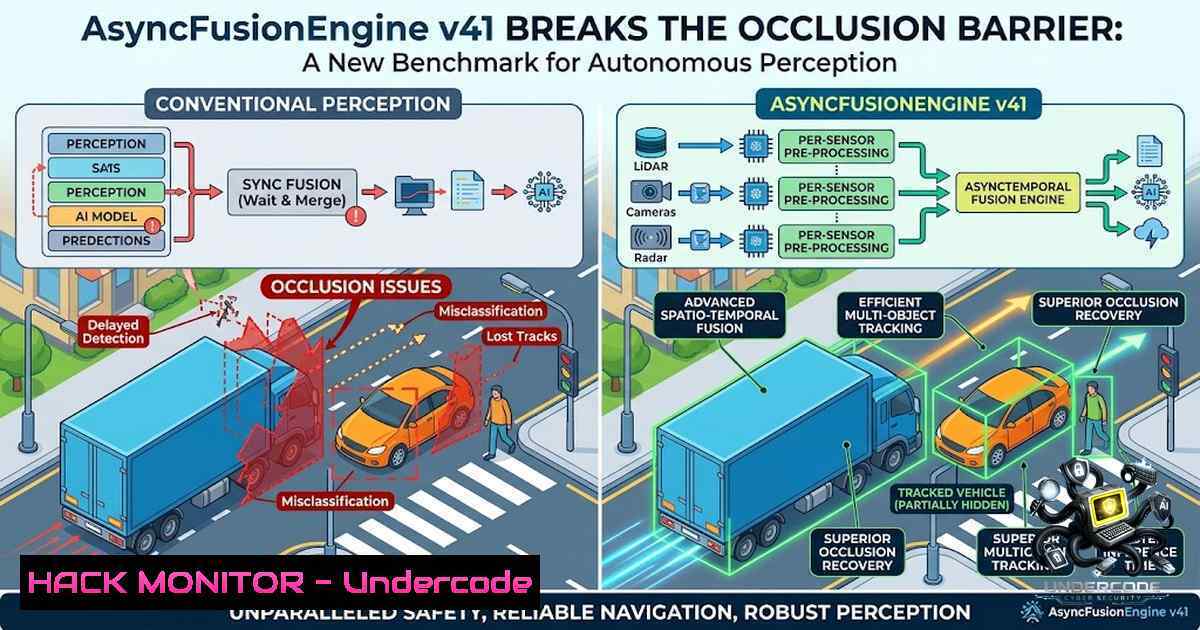
Multi-sensor fusion is the cornerstone of autonomous systems, combining data from cameras, LiDAR, and radar to create a coherent environmental model. However, a critical challenge known as the Out-of-Order Measurement (OOSM) problem arises when sensor data arrives at the fusion center with varying latencies—a 5 Hz radar might have a 150 ms processing delay, arriving after several 30 Hz camera frames have already been processed. This temporal mismatch can severely degrade state estimation if not handled correctly. The recently announced AsyncFusionEngine v4.1 demonstrates a significant leap in addressing this, achieving up to 89% RMSE improvement in occlusion-heavy scenarios, setting a new performance benchmark for sensor fusion algorithms.
Learning Objectives & Secrets:
- Objective 1: Understanding the Out-of-Order Measurement (OOSM) Problem. Learn how data from asynchronous sensors can arrive out of sequence, violating the Markov assumption of Kalman filters and corrupting state estimation if applied naively.
- Objective 2: Mastering “Rewind & Replay” for OOSM. Discover the “rewind and replay” technique—a model-agnostic strategy that maintains a history of filter states and replays measurements in correct chronological order to guarantee consistency.
- Objective 3: Benchmarking and Statistical Certainty. Learn how to validate sensor fusion performance using Root Mean Square Error (RMSE) and 95% Confidence Intervals to ensure reproducible and guaranteed behaviors, not just statistical flukes.
You Should Know:
1. The OOSM “Rewind & Replay” Architecture
The core innovation of the AsyncFusionEngine lies in its sophisticated handling of OOSM. Instead of discarding late-arriving data or applying it incorrectly, the engine uses a “rewind and replay” strategy. This involves maintaining two persistent data structures: a `_history` buffer storing periodic checkpoints of the filter’s state (state vector `x` and covariance P), and an `_applied` buffer holding all previously fused measurements, sorted by timestamp.
Step-by-Step Guide:
- Checkpoint Creation: Every time a measurement is fused in the correct sequence, a new checkpoint (
t, x.copy(), P.copy()) is appended to the `_history` buffer. - Late Arrival: A delayed measurement arrives with a timestamp (
t_delayed) that is earlier than the filter’s current time. - Rewind: The engine identifies the closest checkpoint in `_history` that precedes `t_delayed` and restores the filter to that past state.
- Replay: It then retrieves all measurements from the `_applied` buffer that occurred after `t_delayed` and replays them, along with the new delayed measurement, in correct time order.
- Result: This process yields the exact same result as if all measurements had arrived in sequence, maintaining filter consistency and optimality.
2. Validating Performance: From SIL to HIL
The AsyncFusionEngine v4.1 results were validated in a high-fidelity Simulation-in-the-Loop (SIL) environment. However, the architecture is designed for Hardware-in-the-Loop (HIL) validation. This progression is critical for real-world deployment.
Step-by-Step Guide:
- Model-in-the-Loop (MIL): Validate the fusion algorithm’s mathematical model against ideal data.
- Software-in-the-Loop (SIL): Deploy the actual production code (e.g., C++ or Python) in a simulated environment with realistic, noisy sensor data. This is where the 160 synthetic scenarios (80 Automotive + 80 Drone) were run.
- Hardware-in-the-Loop (HIL): Connect the actual embedded hardware (ECUs, processors) to a simulator that provides synthetic sensor signals, testing real-time performance and timing constraints.
- Metric Tracking: Monitor key performance indicators like RMSE (Overall and for Occluded Objects) and 95% Confidence Intervals to assess accuracy and reliability.
3. Sensor Fusion Security: The Spoofing Threat
While advanced fusion algorithms enhance performance, they also introduce new attack surfaces. Sensor fusion systems, particularly those using Kalman filters, are vulnerable to sensor spoofing attacks. Attackers can inject false signals into GPS, LiDAR, or camera streams to manipulate the fusion output. A sophisticated attack, known as “Cross-Modal Phantom,” can even fabricate cross-sensor consistency, making multiple sensors agree on a false object.
Linux Command for Network Analysis (Detecting Spoofing):
To monitor for unusual sensor data patterns on a network, you can use `tcpdump` to capture and analyze traffic from sensors.
sudo tcpdump -i eth0 -w sensor_traffic.pcap
 Analyze the capture for anomalies in data rates or packet timing
tshark -r sensor_traffic.pcap -Y "udp.port == 52001" -T fields -e frame.time -e data
- Implementing a Basic Kalman Filter for OOSM in Python
For developers looking to understand the fundamentals, the open-source Stone-Soup library provides an excellent example of handling OOSM with a Kalman filter.
Step-by-Step Guide:
1. Install Stone-Soup:
pip install stonesoup
2. Set up the Simulation: Define the ground truth, transition model (e.g., Constant Velocity), and sensor models.
3. Create the Tracker: Instantiate a Kalman filter-based tracker.
4. Handle Delayed Measurements: Use the library’s OOSM capabilities to reorder or adjust for delayed detections.
5. Compare Results: Run a tracker that ignores delays and one that handles them to visualize the performance improvement.
5. Cloud Hardening for Sensor Fusion Pipelines
As autonomous systems become more connected, sensor data is often processed in the cloud. Hardening this infrastructure is vital.
Windows Command for Firewall Configuration:
To secure a cloud instance, configure the Windows Firewall to restrict access to the fusion service port.
New-1etFirewallRule -DisplayName "Allow Fusion Service" -Direction Inbound -Protocol TCP -LocalPort 8080 -Action Allow -RemoteAddress 192.168.1.0/24
Replace `192.168.1.0/24` with your trusted network range.
What Undercode Say:
- Key Takeaway 1: The “rewind and replay” OOSM strategy is a powerful, model-agnostic technique that guarantees filter consistency, making it superior to simpler methods like discarding late data.
- Key Takeaway 2: Achieving high accuracy in occluded scenarios is the true test of a sensor fusion system’s intelligence. The AsyncFusionEngine’s leap from ~56% to ~89% in this area signifies a major step towards reliable autonomy in complex environments.
The results from AsyncFusionEngine v4.1 are not just incremental; they represent a fundamental improvement in how autonomous systems perceive and react to their environment, particularly in the most challenging and safety-critical situations. The ability to handle sensor asynchrony with statistical certainty and exceptional performance in occlusion is a game-changer for the industry.
Prediction:
- +1 The demonstrated accuracy improvements will accelerate the deployment of Level 4 and Level 5 autonomous vehicles by instilling greater confidence in perception systems during safety validation.
- +1 The robust OOSM handling will become a standard feature in next-generation sensor fusion frameworks, influencing both academic research and commercial software stacks.
- -1 The increased reliance on complex sensor fusion algorithms will simultaneously expand the attack surface, making the development of robust countermeasures against sensor spoofing an even more critical priority.
▶️ Related Video (84% Match):
🎯Let’s Practice For Free:
🎓 Live Courses & Certifications:
Join Undercode Academy for Verified Certifications
🚀 Request a Custom Project:
Secure, high-velocity infrastructure and disruptive technological engineering. Contact our engineering team for high-tier development and proprietary systems:
[email protected]
💎 Smart Architecture | 🛡️ Secure by Design | ⭐ Trusted by Thousands
IT/Security Reporter URL:
Reported By: https://lnkd.in/p/eX4srw_B – Hackers Feeds
Extra Hub: Undercode MoN
Basic Verification: Pass ✅


