Listen to this Post
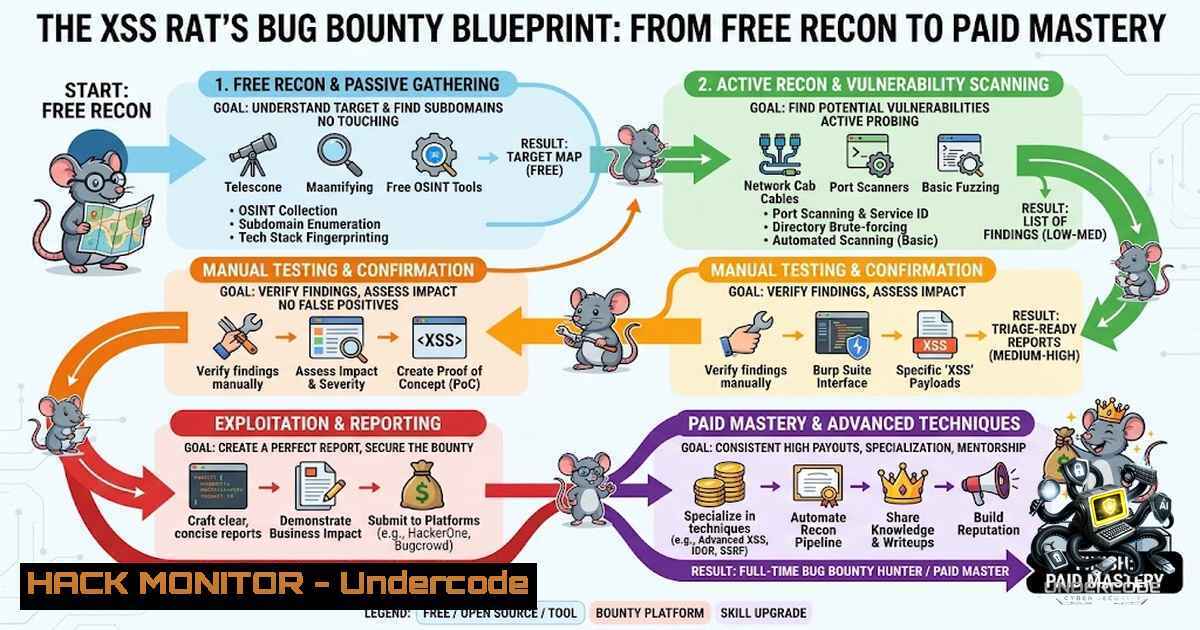
Introduction:
Bug bounty hunting has evolved from a niche hobby into a legitimate career path for ethical hackers worldwide. However, the journey from beginner to proficient hunter is often cluttered with misinformation, overpriced courses, and tools that promise results but deliver noise. Wesley Thijs—known as The XSS Rat, an OWASP speaker and OSCP-certified ethical hacker with over 200,000 students globally—advocates for a pragmatic, budget-conscious approach. His philosophy centers on starting with free, high-impact reconnaissance tools before investing in structured education, and never paying for promises of guaranteed bugs or jobs. This roadmap respects both your time and your wallet while building real, actionable skills.
Learning Objectives & Secrets:
- Objective 1: Master Free Reconnaissance – Learn to automate subdomain enumeration and attack surface mapping using subScraper, a single-file orchestrator that runs traditional recon tools, probes hosts, and executes vulnerability scanning workflows with a live web UI.
-
Objective 2 Secret Tip: Hunt with Intelligence, Not Brute Force – Instead of blindly scanning targets, use BountySkiller to study disclosed HackerOne hacktivity and writeups from recent months. Understanding what’s actually paying helps you prioritize your efforts and craft reports that get rewarded.
-
Objective 3 Secret Tip: Fingerprint Before You Fire – As Thijs emphasizes, “Don’t scan—fingerprint. Tools are noisy. Identify what you’re hitting first (frameworks, headers, versions) before blasting it”. This context-aware approach reduces false positives and increases the quality of your findings.
You Should Know:
1. SubScraper – Your All-in-One Reconnaissance Pipeline
SubScraper is a subdomain enumeration tool that uses multiple techniques to discover an organization’s attack surface. It supports DNS resolution, HTTP(S) requests, CNAME lookups for takeover detection, and modular integration with various data sources. The tool is especially valuable during penetration testing and bug bounty hunting to uncover assets that might otherwise remain hidden.
Step‑by‑Step Guide:
Installation (Linux/macOS):
git clone https://github.com/m8sec/subscraper
cd subscraper
pip install -r requirements.txt
Installation (Windows – using PowerShell with Python installed):
git clone https://github.com/m8sec/subscraper
cd subscraper
pip install -r requirements.txt
Basic Usage – Enumerate subdomains for a target:
python subscraper.py -d example.com
Advanced Usage – Enumerate with DNS resolution and HTTP probing:
python subscraper.py -d example.com -r -http
CNAME Lookup for Subdomain Takeover:
python subscraper.py -d example.com -c
Save Results to File:
python subscraper.py -d example.com -o output.txt
What This Does: The tool performs comprehensive subdomain enumeration using techniques like certificate transparency logs, DNS brute-forcing, and search engine scraping. The `-r` flag resolves discovered subdomains to IP addresses, `-http` checks for live web servers, and `-c` performs CNAME lookups to identify potential takeover vectors.
- BountySkiller – Study What Pays Before You Hunt
BountySkiller is a Flask-based hacktivity and writeup collector that pulls disclosed HackerOne reports from recent months and stores them in JSON format under data/. This tool transforms raw vulnerability data into actionable intelligence, allowing you to identify trending vulnerability types, common payout patterns, and effective exploitation techniques.
Step‑by‑Step Guide:
Installation:
git clone https://github.com/The-XSS-Rat/BountySkiller
cd BountySkiller
pip install -r requirements.txt
Running the Collector:
python app.py
 Access the web interface at http://localhost:5000
Collect Writeups from the Last 3 Months:
python bounty_skiller.py --months 3
Filter by Program or Vulnerability Type:
python bounty_skiller.py --program hackerone --type xss
Export to JSON for Analysis:
python bounty_skiller.py --months 6 --output reports.json
What This Does: The application queries HackerOne’s disclosed hacktivity feed, aggregates writeups, and structures them for easy consumption. By analyzing what vulnerabilities are being reported and rewarded, you can prioritize your testing methodology toward high-impact, high-probability bug classes.
3. The Art of Fingerprinting Before Scanning
Thijs’s “fingerprint, don’t scan” principle is a cornerstone of effective bug bounty hunting. Blindly running vulnerability scanners generates noise, consumes resources, and often misses context-specific vulnerabilities that manual testing would uncover.
Step‑by‑Step Fingerprinting Guide:
Identify Web Server and Technologies:
curl -I https://example.com
Check for Framework Signatures:
whatweb https://example.com
Examine HTTP Headers for Security Configurations:
curl -I https://example.com | grep -i "x-frame-options|content-security-policy|strict-transport-security"
Detect CMS or Framework Version:
wappalyzer-cli https://example.com
What This Does: Fingerprinting reveals the technology stack, server software, frameworks, and security headers in place. This intelligence guides your subsequent testing—for example, knowing a target runs WordPress 5.8 directs you toward known plugin vulnerabilities, while identifying a CSP header informs your XSS payload development strategy.
- XSS Beyond alert(1) – Bypassing CSP and WAF
Cross-Site Scripting remains one of the most common and rewarding bug classes in bounty programs. However, modern defenses like Content Security Policy (CSP) and Web Application Firewalls (WAF) have made simple payloads obsolete. Thijs’s XSS Guide focuses on the part after alert(1)—understanding context, bypassing filters, and chaining vulnerabilities.
Step‑by‑Step CSP Bypass Techniques:
Identify CSP Policy:
curl -I https://example.com | grep -i "content-security-policy"
Test for Unsafe-inline or Unsafe-eval:
If the policy allows unsafe-inline, classic `` may work.
If `unsafe-eval` is allowed, look for eval()-based injection points.
Exploit JSONP Endpoints for CSP Bypass:
<script src="https://example.com/jsonp?callback=alert(1)"></script>
Leverage CDN or Allowed Domains:
If `script-src` allows `https://cdn.example.com`, host your payload there.
What This Does: CSP bypasses require deep understanding of the policy’s directives and fallbacks. By systematically testing each directive—script-src, object-src, base-uri, and form-action—you can identify misconfigurations that allow script execution despite the policy.
- Building a Python Recon Pipeline for Broad Scope Targets
Broad-scope bug bounty programs—those covering entire organizations or .example.com—demand automation. Thijs’s Python recon pipeline integrates subdomain discovery, port scanning, web technology detection, and vulnerability scanning into a cohesive workflow.
Step‑by‑Step Pipeline Construction:
Install Core Dependencies:
pip install requests beautifulsoup4 dnspython shodan
Subdomain Discovery Script:
import dns.resolver
def enumerate_subdomains(domain):
subdomains = ['www', 'mail', 'ftp', 'dev', 'api', 'test']
found = []
for sub in subdomains:
try:
dns.resolver.resolve(f"{sub}.{domain}", 'A')
found.append(f"{sub}.{domain}")
except:
pass
return found
Port Scanning with Python:
import socket
def scan_port(ip, port):
sock = socket.socket(socket.AF_INET, socket.SOCK_STREAM)
sock.settimeout(1)
result = sock.connect_ex((ip, port))
sock.close()
return result == 0
Web Technology Detection:
import requests
def detect_tech(url):
headers = requests.get(url).headers
return {
'server': headers.get('Server'),
'x-powered-by': headers.get('X-Powered-By'),
'framework': headers.get('X-Generator')
}
What This Does: This pipeline automates the repetitive aspects of reconnaissance while keeping you in control of each stage. By chaining these functions, you can systematically discover assets, identify live services, and profile technologies before launching targeted exploits.
6. API Security Testing – The Next Frontier
Modern applications expose extensive APIs, and these endpoints are often neglected during traditional web app testing. API vulnerabilities—broken object-level authorization (BOLA), excessive data exposure, and mass assignment—are among the highest-paying bug classes.
Step‑by‑Step API Reconnaissance:
Discover API Endpoints:
gobuster dir -u https://api.example.com -w /usr/share/wordlists/api.txt
Test for BOLA (IDOR):
curl -X GET "https://api.example.com/v1/users/1" -H "Authorization: Bearer $TOKEN"
 Change the ID to another user's ID
curl -X GET "https://api.example.com/v1/users/2" -H "Authorization: Bearer $TOKEN"
Check for Excessive Data Exposure:
curl -X GET "https://api.example.com/v1/users/me" -H "Authorization: Bearer $TOKEN"
 Look for sensitive fields in the response (emails, phone numbers, internal IDs)
Mass Assignment Testing:
curl -X PATCH "https://api.example.com/v1/users/1" \
-H "Authorization: Bearer $TOKEN" \
-H "Content-Type: application/json" \
-d '{"role":"admin"}'
What This Does: API testing requires understanding RESTful conventions, authentication mechanisms (JWT, OAuth), and data models. By methodically testing each endpoint for authorization flaws and data leakage, you can uncover critical vulnerabilities that traditional scanners miss.
What Undercode Say:
- Key Takeaway 1: Start free, climb smart. The most expensive mistake isn’t buying the wrong course—it’s buying any course before you’ve done the free groundwork. subScraper and BountySkiller provide a solid foundation at zero cost.
-
Key Takeaway 2: Education should be accessible, not exploitative. Thijs’s bundle pricing—€84 worth of courses for €22—demonstrates that quality cybersecurity education doesn’t require a second mortgage. The honest math reflects a commitment to community over profit.
The bug bounty landscape is crowded with “gurus” selling dreams of easy money. Thijs’s approach stands out precisely because it’s grounded in reality: no promises of guaranteed bugs or jobs, just a clear, structured path that respects your time and intelligence. His emphasis on starting with free tools, studying real-world writeups, and only investing in structured education when you’re ready creates a sustainable learning curve. The technical skills—recon automation, fingerprinting, CSP bypass, API testing—are universal and transferable across programs. What sets successful hunters apart isn’t expensive tooling but systematic methodology and contextual awareness.
Prediction:
- +1 The democratization of bug bounty education through affordable bundles and free open-source tools will continue to lower barriers to entry, diversifying the talent pool and increasing the overall quality of vulnerability research.
-
+1 As organizations expand their attack surfaces through cloud adoption and API proliferation, hunters who master reconnaissance automation and API-specific testing will command premium bounties.
-
-1 The increasing sophistication of WAFs and CSP policies will render basic XSS payloads obsolete, forcing hunters to invest significantly more time in understanding context-aware exploitation.
-
-1 Platform consolidation (HackerOne, Bugcrowd) and stricter disclosure policies may reduce the availability of public writeups, making tools like BountySkiller less effective over time.
-
+1 Community-driven resources like Thijs’s GitHub repositories and free guides will continue to provide high-quality, up-to-date methodologies that compete with—and often surpass—paid alternatives.
-
+1 The shift toward “coached not lectured” education models—where students learn through guided practice rather than passive consumption—will become the industry standard for cybersecurity training.
-
-1 The influx of new hunters following accessible roadmaps may increase competition for low-hanging fruit, driving bounty values down for common vulnerabilities while rewarding deep, chained exploits.
-
+1 Ethical hackers who combine recon automation with manual validation and contextual fingerprinting will consistently outperform those relying solely on automated scanners.
▶️ Related Video (84% Match):
https://www.youtube.com/watch?v=1EuDHpIgxEA
🎯Let’s Practice For Free:
🎓 Live Courses & Certifications:
Join Undercode Academy for Verified Certifications
🚀 Request a Custom Project:
Secure, high-velocity infrastructure and disruptive technological engineering. Contact our engineering team for high-tier development and proprietary systems:
[email protected]
💎 Smart Architecture | 🛡️ Secure by Design | ⭐ Trusted by Thousands
IT/Security Reporter URL:
Reported By: https://lnkd.in/p/ecH4zF3x – Hackers Feeds
Extra Hub: Undercode MoN
Basic Verification: Pass ✅


