
Listen to this Post
Introduction:
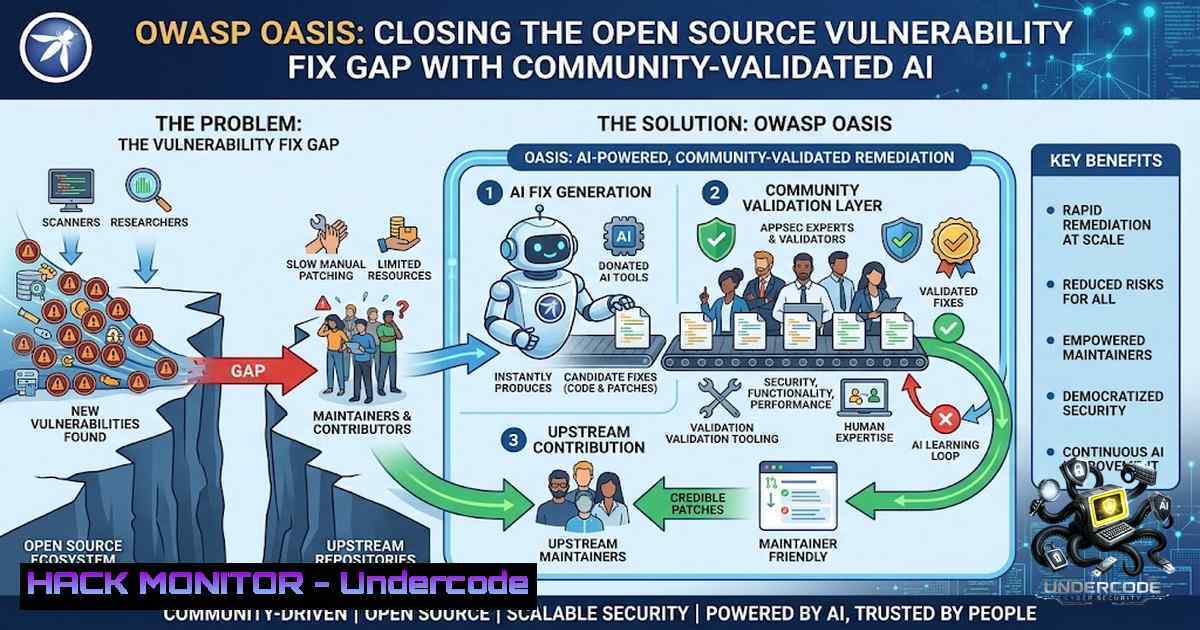
Open source has become the universal foundation of modern software, appearing in 98% of commercial codebases according to Black Duck’s 2026 Open Source Security and Risk Analysis (OSSRA) report. While the security community has grown remarkably adept at discovering vulnerabilities—with mean vulnerabilities per codebase jumping 107% to an average of 581—the ability to fix them at scale has not kept pace. The median time to fix a vulnerability remains 243 days, and third-party open source flaws have a remediation half-life of 358 days. OWASP OASIS (Open Automated Security Initiative for Software) emerges as a community-driven response to this crisis, using AI to generate candidate fixes and experienced AppSec professionals to validate them before they reach upstream maintainers.
Learning Objectives & Secrets:
- Objective 1: Understand the Open Source Vulnerability Remediation Gap – Recognize that discovery capabilities have outpaced remediation capacity. AI-powered tools are finding vulnerabilities faster than ever, but the fix pipeline remains bottlenecked by manual triage and maintainer overload.
-
Objective 2 Secret Tip: Leverage AI for Generation, Not Validation – The secret to OASIS’s effectiveness is keeping AI in its lane: generating candidate fixes at scale, while human experts perform the critical validation step. AI-generated code has a security pass rate of only ~55%, meaning roughly 45% introduces OWASP Top 10 vulnerabilities when no security guidance is provided. Human validation is non-1egotiable.
-
Objective 3 Secret Tip: Think Upstream, Not Just Downstream – Fixing a vulnerable component inside your own company protects one organization. Validating and advancing fixes upstream can protect thousands. OASIS turns security expertise into a force multiplier.
You Should Know:
- The 2026 OSSRA Report: The State of Open Source Risk
Black Duck’s 2026 OSSRA report, based on 947 commercial codebases across 17 industries, reveals an alarming acceleration in open source risk. The average number of vulnerabilities per codebase has more than doubled—a 107% increase—reaching 581 vulnerabilities per application. Open source component counts rose 30% year-over-year, and the number of files per codebase grew by 74%. Two-thirds of audited codebases now contain license conflicts, the highest rate in the report’s history, representing a 12% single-year jump.
AI-assisted development has introduced new risks not previously captured at scale. AI-generated code can reproduce code governed by restrictive licenses like GPL and AGPL without retaining original license information—a phenomenon called “license laundering”. Meanwhile, governance has not kept up: while 76% of organizations check AI-generated code for security risks, only 54% evaluate it for IP and licensing concerns, and just 24% conduct comprehensive assessments. Jason Schmitt, CEO of Black Duck, captured the moment: “The pace at which software is created now exceeds the pace at which most organizations can secure it”.
2. OWASP OASIS: The Community-Validated Fix Pipeline
OASIS is an official OWASP community project with a three-step mechanism:
- Generate: AI automation tools produce candidate patches for known vulnerabilities in open source repositories.
- Validate: AppSec experts review the vulnerability and the proposed fix, separating credible signal from AI-generated noise.
- Advance: Maintainers receive vetted security signal while keeping full control over what fits and what merges.
Founding members include AppSecAI, Intigriti, and DryRun Security, ensuring vendor-1eutral, community-led governance. The project was developed in partnership with Dave Wichers, co-founder of the OWASP Top 10, giving it deep community credibility.
Why this model matters: AI is good at generating candidate fixes at scale without the triage overhead that has historically made open source vulnerability remediation unsustainable. But AI-generated code needs the same review, testing, and validation as human-written changes. OASIS keeps humans in the loop at the validation step—exactly where human judgment matters most.
3. The Remediation Crisis: Why OASIS Matters Now
The velocity of vulnerability discovery has dramatically outpaced the capacity to fix. Anthropic’s Claude discovered over 500 high-severity zero-days across production open source codebases. Autonomous systems are scanning millions of lines of code at costs that make continuous testing economically viable. Meanwhile, the Sonatype 2026 State of the Software Supply Chain Report found over 1.2 million malicious packages in the open source ecosystem, with 454,648 new ones discovered in 2025 alone.
The fix side tells a different story. According to the 2026 Veracode State of Software Security Report, 82% of organizations carry security debt. The median time to fix a vulnerability remains 243 days. SCA tools, researchers, bug bounty programs, and scanners have given organizations visibility into the problem for years. What they haven’t given is a scalable way to fix it. OASIS changes the denominator on the fix equation.
4. Getting Involved: How AppSec Professionals Can Contribute
OASIS turns security expertise into focused validation work that can be done in minutes, without owning the whole remediation workflow. The work unit is small, focused, and useful: decide whether a candidate fix is real, credible, and worth advancing.
For AppSec professionals, product security engineers, vulnerability managers, and anyone who cares about open source security, the path to contribution is straightforward:
- Visit owasp-oasis.org and register
- Join as a Validator—review AI-generated fixes for known vulnerabilities
- Validate credible fixes and advance them upstream to maintainers
- Watch your expertise protect organizations you will never meet
OASIS belongs to the AppSec community. It treats fix automation as an enabler, not the authority. Credibility comes from transparent human validation and respect for open source maintainers.
5. Security Automation Commands and Tools
For organizations looking to complement OASIS-style validation with internal automation, here are practical commands and configurations:
Linux – Dependency Scanning with OWASP Dependency-Check:
 Install OWASP Dependency-Check
wget https://github.com/jeremylong/DependencyCheck/releases/download/v9.0.0/dependency-check-9.0.0-release.zip
unzip dependency-check-9.0.0-release.zip
cd dependency-check/bin

Scan a project for known vulnerabilities
./dependency-check.sh --scan /path/to/your/project --format HTML --out /path/to/report

Scan with suppression file for false positives
./dependency-check.sh --scan /path/to/your/project --suppression /path/to/suppression.xml
Windows – SCA with Black Duck or Similar Tools:
 Using Black Duck Detect (PowerShell)
Invoke-WebRequest -Uri "https://detect.blackduck.com/detect8.sh" -OutFile "detect.sh"
 Run detect with project name and version
bash detect.sh --blackduck.url=https://your-blackduck-instance --blackduck.api.token=YOUR_TOKEN --detect.project.name=YourProject
Generating and Validating SBOMs:
 Generate SPDX SBOM using Syft (Linux/macOS)
syft dir:/path/to/your/project -o spdx-json > sbom.spdx.json

Generate CycloneDX SBOM using CycloneDX CLI
cyclonedx-bom -p /path/to/your/project -o bom.xml -f cyclonedx

Validate SBOM against schema
validate-sbom --file bom.xml --schema https://cyclonedx.org/schema/bom-1.5.schema.json
API Security – Dependency Validation in CI/CD:
 GitHub Actions example for dependency scanning
- name: OWASP Dependency Check
uses: dependency-check/Dependency-Check_Action@main
with:
project: 'My Project'
path: '.'
format: 'HTML'
out: 'reports'
What Undercode Say:
- Key Takeaway 1: Discovery is no longer the bottleneck—fixing is. The security industry has spent decades perfecting vulnerability discovery. SCA tools, AI scanners, and bug bounties have made us excellent at finding problems. But finding vulnerabilities without fixing them is like diagnosing a disease without prescribing treatment. OASIS represents a fundamental shift in focus from finding to fixing.
-
Key Takeaway 2: Community validation is the trust layer AI needs. AI-generated code is impressive but unreliable—roughly 45% introduces OWASP Top 10 vulnerabilities. OASIS doesn’t replace human judgment; it amplifies it. By distributing validation work across the global AppSec community, the project creates a trust layer that maintainers can actually rely on. This isn’t about replacing maintainers—it’s about giving them signal instead of noise.
Prediction:
-
+1 OASIS will become the model for how the security industry handles vulnerability remediation at scale. The AI-generation + human-validation pattern will be adopted by other OWASP projects and commercial vendors, creating a new category of “community-validated security automation.”
-
+1 The project will accelerate upstream fixes by orders of magnitude. With hundreds of AppSec professionals contributing validation work, the backlog of unpatched open source vulnerabilities will begin to shrink for the first time in years.
-
-1 Regulatory pressure from the EU Cyber Resilience Act (CRA) will force organizations to track AI models and open source components with unprecedented rigor. Organizations that fail to modernize their supply chain governance will face compliance penalties and competitive disadvantages.
-
-1 The malicious package problem will continue to grow—over 1.2 million malicious packages already exist, with nearly half a million discovered in 2025 alone. OASIS addresses known vulnerabilities but does not solve the supply chain integrity problem. Additional solutions will be needed.
-
+1 OASIS will create a new career path for AppSec professionals: vulnerability validator. Just as bug bounties created a new class of security researchers, OASIS will create a new class of practitioners who specialize in reviewing and validating AI-generated fixes—turning security expertise into measurable, upstream impact.
▶️ Related Video (84% Match):
https://www.youtube.com/watch?v=96A_YPaXhAU
🎯Let’s Practice For Free:
🎓 Live Courses & Certifications:
Join Undercode Academy for Verified Certifications
🚀 Request a Custom Project:
Secure, high-velocity infrastructure and disruptive technological engineering. Contact our engineering team for high-tier development and proprietary systems:
[email protected]
💎 Smart Architecture | 🛡️ Secure by Design | ⭐ Trusted by Thousands
IT/Security Reporter URL:
Reported By: https://lnkd.in/p/eyZ8VGZi – Hackers Feeds
Extra Hub: Undercode MoN
Basic Verification: Pass ✅


