
Listen to this Post
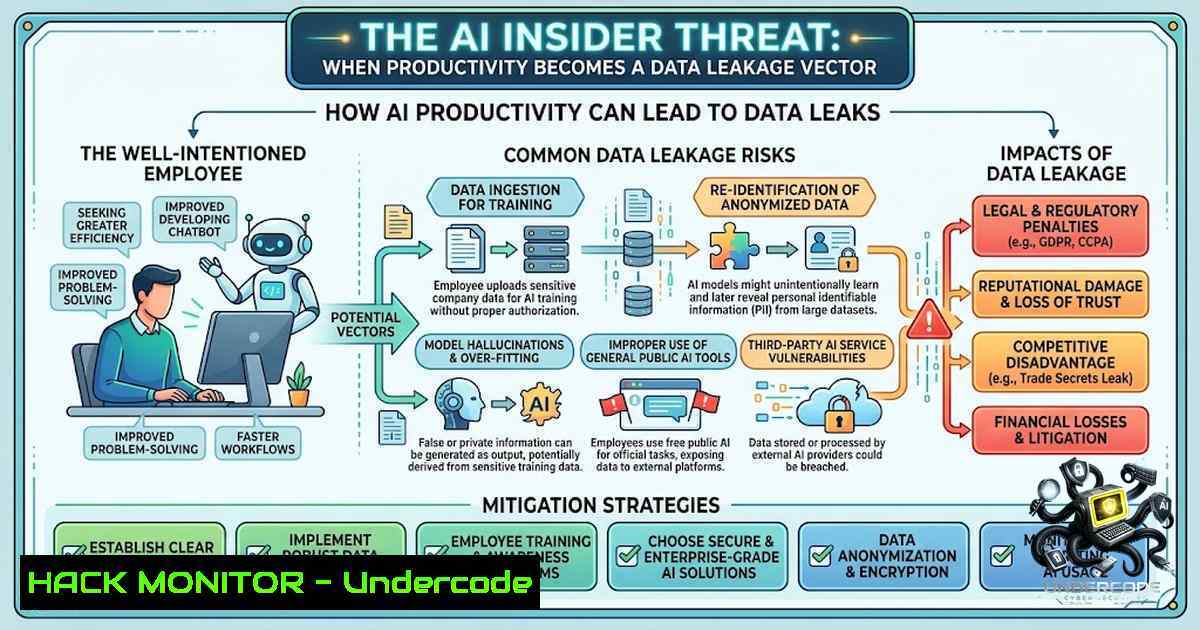
Introduction:
The widespread adoption of generative AI tools has created an unprecedented security paradox: employees are actively injecting proprietary business logic, internal processes, and sensitive data into third-party AI platforms to accelerate their workflows. While these tools demonstrably enhance individual productivity—often producing results superior to unaided human efforts—they simultaneously introduce catastrophic data leakage vectors, intellectual property exposure, and create a workforce increasingly dependent on external cognitive augmentation. This article examines the intersection of AI-assisted productivity, insider threat vectors, and the impending transformation of IT roles, providing actionable security controls for organizations navigating this treacherous landscape.
Learning Objectives & Secrets:
- Objective 1: Insider Risk Identification — Recognize the behavioral indicators of unauthorized AI usage, including unusual data export patterns, frequent interactions with external AI platforms, and discrepancies between employee output capabilities and historical performance metrics. Security teams must implement User and Entity Behavior Analytics (UEBA) to establish baseline patterns and detect anomalies in data movement toward unapproved external services.
-
Objective 2: Hallucination Exploitation Prevention — Understand that LLM hallucinations are not merely academic concerns but active vectors for security misconfigurations. Secret tip: Always validate AI-generated code against static analysis tools before deployment. Implement automated testing pipelines that flag AI-suggested configurations that deviate from organizational security standards.
-
Objective 3: Workforce Automation Mapping — Secret tip: Conduct a comprehensive audit identifying which employee functions are effectively “copy-paste” operations and map these to potential robotic process automation (RPA) candidates. Organizations should proactively identify roles susceptible to automation before external forces force these changes, allowing for strategic workforce transition planning.
You Should Know:
1. Operational Security Assessment for AI Usage
Organizations must immediately implement network-layer controls to monitor and regulate AI platform interactions. This includes DNS filtering, SSL inspection, and data loss prevention (DLP) rules targeting known AI endpoints. The following Linux command sequence establishes baseline monitoring:
 Monitor outbound connections to known AI platforms
sudo tcpdump -i eth0 -1 'host api.openai.com or host anthropic.com or host cohere.ai'
For Windows environments, implement PowerShell-based monitoring:
 PowerShell script to monitor AI service connections
Get-1etTCPConnection -RemotePort 443 | Where-Object {$_.RemoteAddress -match "openai|anthropic|cohere"}
Step-by-step guide:
- Deploy SSL inspection certificates to all corporate devices
- Configure firewall rules to block unauthorized AI platforms by default
- Create an approved AI platform list with clear usage policies
- Implement data classification tags that automatically block sensitive data transmission
- Deploy endpoint detection and response (EDR) rules specifically targeting AI tool usage patterns
2. Insider Threat Detection & Response
The most significant security vulnerability identified in the original discourse is the unauthorized ingestion of proprietary business logic into private AI accounts. This creates an irreversible data leakage scenario where trade secrets become training data for public models. Implement the following detection mechanisms:
Linux-based monitoring:
 Monitor clipboard activity for large text transfers (potential AI injection)
inotifywait -m /proc/$(pgrep -1 firefox)/fd -e close_write | grep -i 'clipboard'
Windows registry monitoring:
 Monitor clipboard history size as an indicator of bulk data copying
Get-ItemProperty -Path "HKCU:\Software\Microsoft\Clipboard" -1ame "ClipboardHistorySize"
Step-by-step response protocol:
- Establish a formal AI usage policy with explicit prohibited use cases
- Deploy DLP systems that scan outbound traffic for API keys, PII, and source code patterns
- Implement real-time alerting for detections exceeding threshold volumes
- Create an automated quarantine procedure for compromised workstations
- Maintain an incident response playbook specifically for AI data leakage scenarios
3. Secure AI Implementation Architecture
For organizations that recognize AI’s productivity benefits, a secure implementation architecture is essential. This includes on-premises deployment of open-source models or private cloud instances with strict access controls:
Deploying local LLM with security controls:
 Using Ollama with security isolation
docker run -d -v ollama:/root/.ollama -p 11434:11434 --1ame ollama ollama/ollama
docker exec -it ollama ollama pull llama2
 Implement rate limiting and input sanitization
API security configuration:
 Configure reverse proxy with authentication for AI API access
 Nginx configuration example
location /ai-api/ {
proxy_pass http://localhost:11434/;
auth_request /auth;
 Implement request logging for audit trails
}
Step-by-step secure deployment:
- Conduct a risk assessment to determine acceptable AI use cases
- Select models that support on-premises deployment (e.g., Llama 2, Mistral, Falcon)
- Deploy models in isolated environments with network segmentation
4. Implement strict authentication and authorization mechanisms
- Establish comprehensive logging and audit trails for all AI interactions
6. Regularly update models and apply security patches
7. Conduct penetration testing on the AI infrastructure
4. Workforce Transformation & Automation Strategy
The original post identifies a critical reality: 8 out of 10 employees in small businesses may be reduced to “keyboard/mouse extensions.” This represents both a security risk and an operational efficiency challenge. Organizations should proactively identify automation opportunities:
Automation candidate identification script:
 Linux: Identify repetitive command patterns in shell history
sort ~/.bash_history | uniq -c | sort -1r | head -20
Windows: Analyze PowerShell usage patterns
 Identify most common PowerShell commands for potential automation
Get-History | Group-Object CommandLine | Sort-Object Count -Descending | Select-Object -First 20
Step-by-step workforce automation approach:
- Conduct a comprehensive workflow analysis for each role
- Identify tasks that are purely data transformation without creative input
- Map these tasks to RPA candidates or AI automation opportunities
- Develop a transition plan that includes reskilling for higher-value functions
5. Implement a controlled pilot program for automation
- Establish clear metrics for automation success and employee value-add
- Create new roles focused on AI orchestration and validation rather than raw execution
5. Cloud Security Hardening for AI Adoption
Organizations that choose to leverage cloud-based AI solutions must implement robust cloud security controls to prevent data leakage and account compromise:
AWS AI service security configuration:
 AWS CLI security group for AI service access
aws ec2 authorize-security-group-ingress --group-id sg-12345678 --protocol tcp --port 443 --cidr 10.0.0.0/8
 Implement VPC endpoints for AI services
aws ec2 create-vpc-endpoint --vpc-id vpc-12345678 --service-1ame com.amazonaws.us-east-1.bedrock
Azure AI security hardening:
 Azure CLI - restrict AI service access
az network nsg rule create --1sg-1ame AINetworkSecurityGroup --1ame DenyAIPublic --priority 100 --direction Inbound --access Deny --protocol Tcp --destination-port-range 443 --source-address-prefixes Internet
Step-by-step cloud hardening:
- Implement principle of least privilege for all AI service access
- Enable comprehensive logging and monitoring for all AI interactions
- Configure data encryption in transit and at rest
4. Implement token-based authentication with short-lived credentials
5. Deploy content filtering and prompt injection protection
6. Regular security assessments and vulnerability scanning
- Establish data retention policies compliant with organizational requirements
What Undercode Say:
- Key Takeaway 1: The unauthorized use of AI tools represents one of the most significant current insider threats, with employees unwittingly exposing proprietary information to external platforms. Organizations must urgently implement technical controls to identify, monitor, and regulate AI usage while providing approved alternatives.
-
Key Takeaway 2: The workforce transformation is imminent—organizations that fail to proactively identify automation opportunities risk being disrupted by competitors that leverage AI more effectively. The transition from “copy-paste” roles to AI orchestration roles is inevitable, requiring strategic workforce planning.
Analysis: The original post underscores a critical tension: AI tools demonstrably improve productivity, yet their casual adoption creates substantial security risks. The “hacking daily work tasks” metaphor is particularly apt—employees are effectively performing unauthorized security bypasses to gain productivity advantages. This creates an adversarial relationship between security teams and employees who view AI restrictions as productivity barriers.
The prediction that 80% of small business employees may become redundant reflects a harsh reality: roles based purely on information transformation and low-level cognitive work are highly susceptible to AI replacement. However, this also creates opportunities for those who develop AI orchestration and validation skills. The security implications extend beyond data leakage to include the erosion of institutional knowledge as employees become dependent on AI for problem-solving.
The mention of physical world robots parallel is particularly prescient—as AI and robotics advance, even physical labor roles face similar replacement dynamics. Organizations must address both the immediate security risks and the long-term workforce transformation challenges.
Prediction:
- -1: Immediate Risk Acceleration — Organizations lacking robust AI usage monitoring will experience significant data breaches within 6-12 months, with proprietary algorithms, source code, and customer data becoming training material for public models. The velocity of data leakage through unauthorized AI usage will outpace traditional DLP capabilities.
-
-1: Skill Erosion Crisis — A generation of workers will develop dependency on AI for basic problem-solving, resulting in systemic skill degradation. Organizations will face critical failures when AI tools are unavailable or hallucinate incorrect solutions, leading to catastrophic system failures in mission-critical applications.
-
+1: New Security Roles Emergence — The AI security landscape will generate demand for specialized roles including AI security architects, prompt injection specialists, and AI compliance officers. These positions will command premium compensation and represent the next evolution of cybersecurity careers.
-
-1: Economic Displacement — The workforce transformation predicted will result in significant unemployment for roles categorized as “copy-paste” functions, with small businesses particularly affected. The lack of a clear solution for workforce transition will create economic instability and social unrest.
-
+1: Security-Enhanced AI Adoption — Organizations that successfully implement secure AI architectures will gain significant competitive advantages, combining productivity benefits with robust data protection. These organizations will establish AI governance frameworks that balance innovation with security, positioning themselves as market leaders in the AI-enabled economy.
The information provided in this article is for educational and informational purposes only. Organizations should consult with qualified security professionals before implementing any of the mentioned security controls or configurations.
▶️ Related Video (86% Match):
🎯Let’s Practice For Free:
🎓 Live Courses & Certifications:
Join Undercode Academy for Verified Certifications
🚀 Request a Custom Project:
Secure, high-velocity infrastructure and disruptive technological engineering. Contact our engineering team for high-tier development and proprietary systems:
[email protected]
💎 Smart Architecture | 🛡️ Secure by Design | ⭐ Trusted by Thousands
IT/Security Reporter URL:
Reported By: https://lnkd.in/p/e5TGbCpw – Hackers Feeds
Extra Hub: Undercode MoN
Basic Verification: Pass ✅


