
Listen to this Post
Introduction:
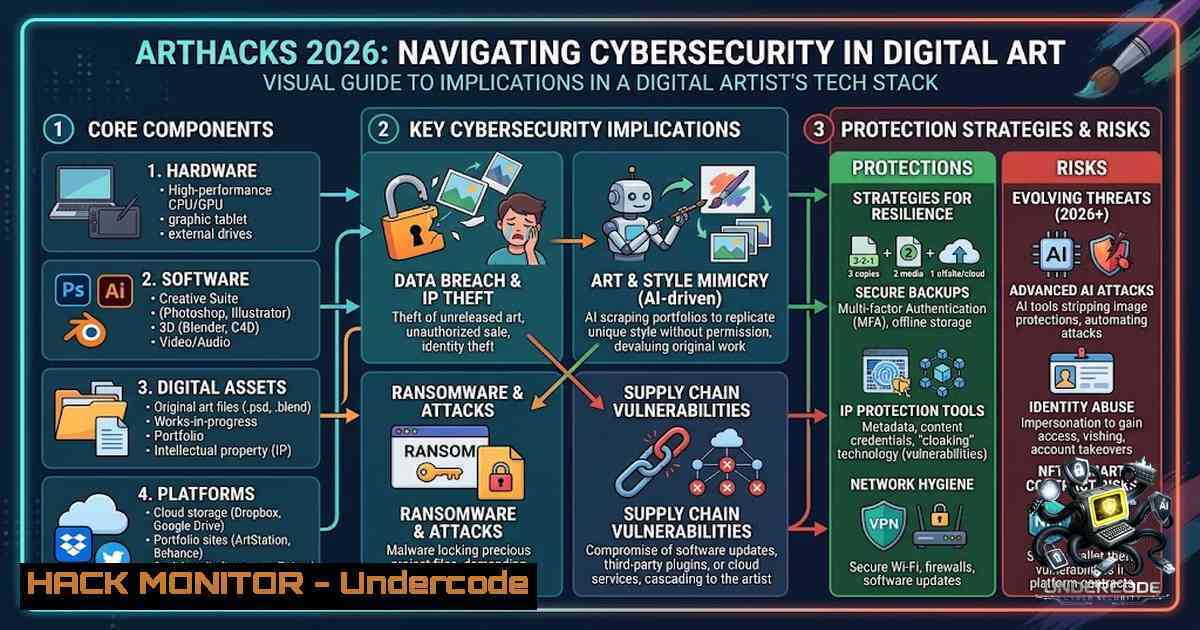
In 2026, Marjan Moghaddam celebrated the 10-year anniversary of her Arthacks project—a Net Art initiative that began as a radical form of digital curation and has since evolved into a ubiquitous technique now widely replicated with AI. While the artistic process is innovative, the underlying technology stack—spanning 3D modeling, motion capture, video editing, and GPU-accelerated rendering—presents a complex attack surface that cybersecurity professionals must understand. From file format vulnerabilities in 3D asset libraries to GPU memory attacks and AI motion data privacy risks, the tools of digital artists are increasingly becoming vectors for exploitation.
Learning Objectives & Secrets:
- Objective 1: Identify and mitigate file format-based vulnerabilities in 3D content creation pipelines, including LWO and .blend file exploits.
-
Objective 2 (Secret Tip): Secure GPU-accelerated rendering environments against Rowhammer-style attacks targeting VRAM—most artists overlook GPU memory security, yet attacks like GeForge and GDDRHammer can fully compromise systems through bit-flipping in protected memory regions.
-
Objective 3 (Secret Tip): Implement AI motion capture data anonymization—skeleton-based motion data, while appearing non-identifiable, can be exploited to derive personally identifiable information (PII) through inference attacks.
You Should Know:
1. File Format Exploits in 3D Asset Pipelines
Marjan Moghaddam’s workflow relies heavily on Lightwave 3D, Blender, and various asset import/export processes. The Open Asset Import Library (Assimp)—widely used across 3D applications for importing asset files—contains CVE-2025-15538, a use-after-free vulnerability affecting LWO (LightWave Object) file processing. This vulnerability resides in the `FindUVChannels` function within LWOMaterial.cpp, where improper memory handling leads to a use-after-free condition when processing malformed LWO files. Similarly, Blender versions 3.0.0 through 5.1.2 are affected by CVE-2026-60103, an out-of-bounds read vulnerability exploitable through crafted .blend files with malicious SDNA block values.
Step-by-Step Mitigation:
- Update Assimp to version 6.0.3 or later—patches addressing CVE-2025-15538 are now available.
- For Blender, upgrade to version 5.1.3 or newer to address CVE-2026-60103.
- Validate all incoming 3D assets using file integrity checks before importing into production environments.
- Implement sandboxing for 3D asset processing—run import operations in isolated containers to contain potential exploits.
- Monitor logs for crashes or unexpected behavior during LWO or .blend file imports, as these may indicate attempted exploitation.
-
GPU Memory Attacks: The Hidden Threat in Rendering Workstations
Moghaddam renders with dual GPUs using Octane Render. Recent research has uncovered GeForge and GDDRHammer—Rowhammer-style attacks targeting NVIDIA GPU memory that force bit flips in protected VRAM regions. These attacks can grant attackers read/write access to system memory, potentially exfiltrating sensitive data or corrupting AI models mid-rendering.
Step-by-Step GPU Hardening:
- Enable ECC (Error-Correcting Code) memory on supported NVIDIA GPUs (e.g., RTX A-series, Quadro) to detect and correct bit flips.
- Monitor GPU memory temperature—Rowhammer attacks often correlate with thermal stress; keep GPUs below 85°C.
- Use NVIDIA’s `nvidia-smi` to monitor VRAM utilization and detect anomalies:
nvidia-smi --query-gpu=index,name,temperature.gpu,utilization.gpu,memory.used --format=csv
- Disable unnecessary GPU compute features in production environments where possible.
- For Linux systems, configure kernel parameters to mitigate Rowhammer:
echo 1 > /proc/sys/vm/panic_on_oom
3. Video Editing Software Vulnerabilities
Moghaddam uses Adobe Premiere Pro (with plans to migrate to DaVinci Resolve). Premiere Pro versions 25.3, 24.6.5, and earlier are affected by CVE-2025-54242—a use-after-free vulnerability enabling arbitrary code execution in the context of the current user. DaVinci Resolve on macOS is vulnerable to CVE-2025-4081 (TCC bypass via dylib substitution) and CVE-2025-1413 (incorrect file permissions—rwxrwxrwx).
Step-by-Step Remediation:
- Update Adobe Premiere Pro to version 25.4 or 24.6.6+ (see Adobe Security Bulletin APSB25-87).
- For DaVinci Resolve, upgrade to version 19.1.3 or later.
3. On macOS, verify DaVinci Resolve installation permissions:
ls -la /Applications/DaVinci\ Resolve/
 Correct permissions should be 755, not 777
sudo chmod -R 755 /Applications/DaVinci\ Resolve/
4. Disable library validation bypass for DaVinci Resolve by removing the `com.apple.security.cs.disable-library-validation` entitlement where possible.
4. Camera Tracking and Motion Data Security
Moghaddam uses Syntheyes for camera tracking. SynthEyes instances can be vulnerable to hostile remote browser scripts that, if successful, can cause arbitrary binary code execution and file overwrites. Additionally, AI motion capture data—while seemingly non-identifiable—can be exploited to derive PII through inference attacks, with motion sensors often classified as zero-permission sensors accessible without explicit user consent.
Step-by-Step Hardening:
- Enable SynthEyes pin code protection to defend against remote browser scripts.
- Run SynthEyes in a restricted user account with minimal file system permissions.
- For AI motion capture data, implement anonymization techniques such as deep motion retargeting to obfuscate identifiable skeletal patterns.
- Encrypt motion capture datasets both at rest and in transit using AES-256.
- Conduct regular audits of motion data access logs to detect unauthorized inference attempts.
5. AI-Generated Art and Model Poisoning Risks
The Arthacks form is now “ubiquitous and created on scale by everyone with AI”. AI art generation pipelines are susceptible to data poisoning attacks—for instance, the 3D Gaussian Splatting algorithm can be exploited through Poison-Splat, where perturbed input images dramatically increase GPU memory consumption (by up to 70GB), potentially causing server downtime.
Step-by-Step AI Security:
- Validate all training data inputs using checksums and provenance tracking.
- Implement differential privacy in AI model training to limit the impact of poisoned samples.
3. Monitor GPU memory usage during AI inference:
watch -1 1 nvidia-smi
4. Use model versioning—retain clean baseline models for rollback in case of poisoning detection.
5. Deploy anomaly detection systems that flag unusual GPU memory spikes indicative of poisoning attacks.
6. Network Rendering and Cloud Security
Octane Render supports network rendering across Windows and Linux systems. Improperly configured network rendering setups can expose rendering nodes to unauthorized access, potentially allowing attackers to inject malicious render jobs or exfiltrate sensitive 3D assets.
Step-by-Step Network Rendering Security:
- Isolate rendering nodes on a dedicated VLAN with strict firewall rules.
- Use TLS encryption for all rendering network traffic.
- Implement authentication for render job submission—avoid open, unauthenticated render queues.
4. Regularly scan rendering nodes for vulnerabilities:
nmap -sV --script vuln <render-1ode-IP>
5. Apply principle of least privilege—render nodes should only have access to necessary storage volumes.
7. Supply Chain Risks in 3D Content Creation
Moghaddam’s toolchain includes Lightwave 3D (now owned and upgraded by 3D animators), Blender, Octane Render, Premiere Pro, Syntheyes, and AE. Each third-party dependency introduces supply chain risk—compromised plugins, outdated libraries, or maliciously crafted asset files can serve as entry points for attackers.
Step-by-Step Supply Chain Hardening:
- Maintain a software bill of materials (SBOM) for all creative tools and libraries.
- Verify digital signatures of all downloaded software and plugins.
- Use dependency scanning tools like OWASP Dependency-Check to identify known vulnerabilities in third-party libraries.
- Establish a patch management policy—apply security updates within 48 hours of release for critical CVEs.
- Conduct regular security assessments of the entire content creation pipeline, from asset ingestion to final render output.
What Undercode Say:
- Key Takeaway 1: Digital art pipelines are not just creative workflows—they are complex, interconnected systems with multiple attack vectors. File format vulnerabilities (CVE-2025-15538, CVE-2026-60103), GPU memory attacks, and AI model poisoning represent real, exploitable risks that can compromise entire production environments.
-
Key Takeaway 2: The democratization of AI in art creation introduces new security challenges—model poisoning, data inference attacks, and supply chain vulnerabilities are no longer theoretical. Artists and studios must adopt DevSecOps principles, including SBOMs, regular patching, and network isolation, to protect their creative assets and intellectual property.
Analysis: The Arthacks project’s evolution from a manual, human-driven process to a form now “ubiquitously created by everyone with AI” mirrors a broader trend in creative industries. This shift introduces significant cybersecurity risks that are often overlooked in artistic communities. The tools Moghaddam uses—Lightwave 3D, Blender, Octane, Premiere Pro, Syntheyes—each have documented vulnerabilities that, if exploited, could lead to data loss, intellectual property theft, or system compromise. The convergence of AI, GPU computing, and 3D rendering creates a rich attack surface that requires proactive security measures. As AI-generated art becomes more prevalent, understanding and mitigating these risks will be essential for protecting both individual artists and the broader creative economy.
Prediction:
- +1 The growing awareness of cybersecurity risks in creative pipelines will drive demand for specialized “creative tech security” consultants and tools, creating new market opportunities for cybersecurity professionals with domain expertise in 3D rendering and AI art.
-
-1 Without widespread adoption of security best practices, the creative industry will see an increase in ransomware attacks targeting rendering farms and AI model theft, potentially costing studios millions in lost work and reputational damage.
-
-1 The proliferation of AI-generated art will accelerate the development of adversarial attacks against generative models, leading to a “cat and mouse” dynamic where security researchers and threat actors continuously evolve their techniques, potentially undermining trust in AI-created content.
-
+1 File format vulnerabilities like CVE-2025-15538 and CVE-2026-60103 will prompt software vendors to implement more robust input validation and fuzzing in their development cycles, ultimately improving the security posture of the entire 3D ecosystem.
-
-1 The use of zero-permission motion sensors in AI motion capture systems will lead to privacy scandals as attackers increasingly exploit skeleton-based data to re-identify individuals, potentially triggering regulatory action similar to GDPR but focused on biometric motion data.
-
+1 GPU manufacturers will respond to GeForge and GDDRHammer attacks by implementing hardware-level mitigations, such as improved ECC and VRAM access controls, which will benefit not just creative professionals but also the broader AI and high-performance computing communities.
▶️ Related Video (86% Match):
https://www.youtube.com/watch?v=2jU-mLMV8Vw
🎯Let’s Practice For Free:
🎓 Live Courses & Certifications:
Join Undercode Academy for Verified Certifications
🚀 Request a Custom Project:
Secure, high-velocity infrastructure and disruptive technological engineering. Contact our engineering team for high-tier development and proprietary systems:
[email protected]
💎 Smart Architecture | 🛡️ Secure by Design | ⭐ Trusted by Thousands
IT/Security Reporter URL:
Reported By: https://lnkd.in/p/ee-gGSCr – Hackers Feeds
Extra Hub: Undercode MoN
Basic Verification: Pass ✅


