Listen to this Post
Introduction:
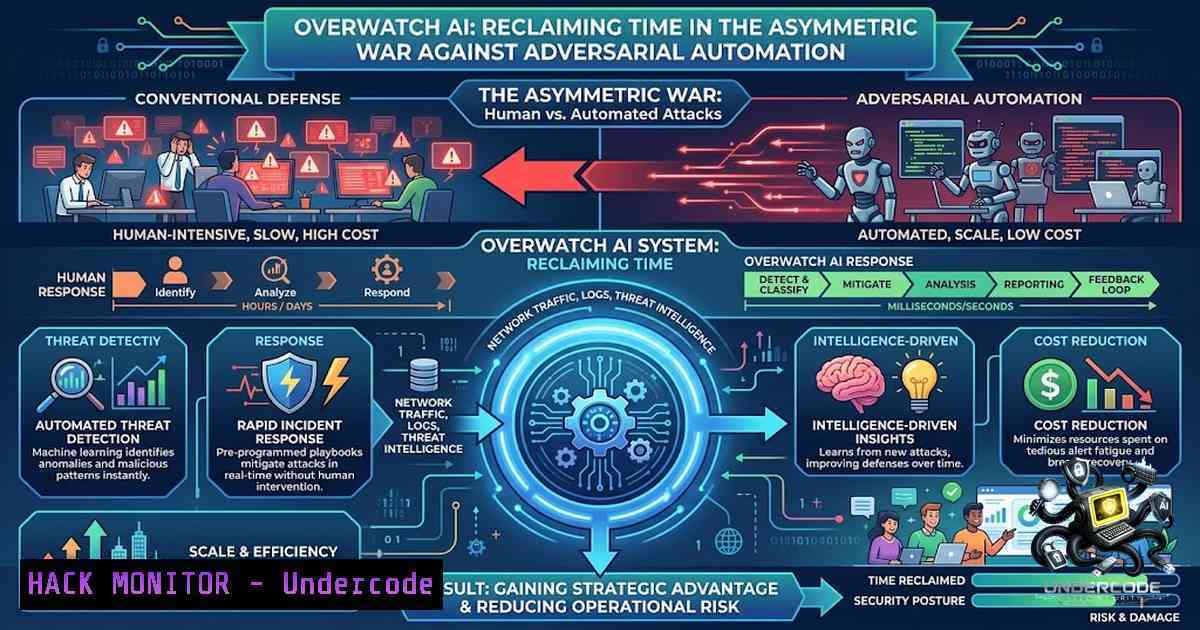
The cybersecurity industry has witnessed a fundamental shift from website defacement as mere mischief to a mature criminal supply chain with brokers, affiliates, and support tiers. This evolution has been accompanied by a proliferation of security tools that introduced new acronyms and buzzwords but never truly solved the underlying problem. Today, the introduction of adversarial AI has effectively taken time off the table—reconnaissance to exfiltration that once took weeks or months can now be measured in hours or days. Yahara Software’s Overwatch AI emerges as a direct response to this asymmetry, deploying nine purpose-built AI agents designed to augment security teams and reclaim time as the defender’s advantage.
Learning Objectives:
- Understand the economic motivations driving adversarial AI adoption and why attackers prioritize throughput over elegance
- Learn how multi-agent AI architectures can deliver continuous security operations across nine specialized disciplines
- Explore practical implementation strategies for integrating AI-powered penetration testing, threat hunting, and compliance automation into existing security programs
You Should Know:
1. The Attacker’s Math: Why Throughput Trumps Elegance
The economic calculus of modern cybercrime has fundamentally shifted. An operator running an AI-driven campaign does not need reliability—a bot that fails 90% of the time remains profitable. With thirty attempts per week and two or three successful breaches at low four-figure demands each, annual revenue can reach several times the median salary in regions where much of this activity originates. Adversaries are not optimizing for elegance; they are optimizing for throughput.
This asymmetry creates a critical vulnerability for defenders. Security tools must be enterprise-ready, auditable, and reliable—elegance and quality matter for defenders in ways they simply do not for attackers. The CrowdStrike 2026 Global Threat Report confirms this trend, revealing that AI-enabled adversaries increased operations by 89% year-over-year, weaponizing AI across reconnaissance and credential theft. The average eCrime breakout time fell to 29 minutes—a 65% increase in speed from 2024—with the fastest breakout ever occurring in just 27 seconds.
- Overwatch AI: Nine Agents Working as a Unified Security Team
Overwatch AI addresses the defender’s time deficit through a network of nine specialized AI agents: penetration tester, threat hunter, compliance analyst, log analyst, malware analyst, operations analyst, alert monitor, threat modeler, and reporting agent. These agents work continuously and collaboratively, sharing context, routing findings between one another, and producing coordinated output that mimics a full security operations team.
What distinguishes Overwatch AI from conventional security tools is its architecture. All AI inference runs on Overwatch-owned GPU infrastructure, ensuring customer data never touches a third-party AI provider. Each agent employs true AI reasoning, forming hypotheses and adapting to findings the way a human analyst would—this is not a rules engine with an AI label. The Compliance Analyst, for example, reads and interprets control requirements and matches them to existing controls, identifying gaps rather than performing keyword mismatches against a static checklist.
- Continuous Assessment: Moving Beyond the Annual Pen Test
Traditional security assessments happen once a year or when procurement allows. Overwatch AI changes this paradigm by running penetration tests, compliance audits, and threat hunts on demand or on a set cadence. When a new vulnerability makes the news, organizations can check their exposure the same day.
For security practitioners looking to implement continuous assessment workflows, consider the following Linux-based automation approach for integrating AI-powered scanning into CI/CD pipelines:
 Automated vulnerability scanning with AI-assisted prioritization
 Install Strix - open-source AI penetration testing agents
pip install strix-agent

Run autonomous penetration test against a target
strix scan --target https://your-application.com --output json

Generate compliance-ready report
strix report --format compliance --framework HIPAA
Strix represents one example of the emerging ecosystem of AI-powered penetration testing tools, acting as autonomous AI agents that run code dynamically, find vulnerabilities, and validate them through actual proofs-of-concept. These tools can complete penetration tests in hours rather than weeks, with compliance reports generated automatically.
- Practical Implementation: Integrating AI Agents into Security Operations
For organizations adopting AI-powered security automation, a structured implementation approach is essential:
Step 1: Assessment and Scoping
- Identify the security disciplines where automation can provide immediate value
- Map existing compliance requirements (HIPAA, FDA, SOC 2, PCI DSS) to automation capabilities
- Establish baseline metrics for current assessment frequency and coverage
Step 2: Agent Deployment and Configuration
- Deploy the penetration testing agent for continuous external and internal scanning
- Configure the compliance analyst agent to interpret regulatory requirements
- Set up the threat hunter agent for proactive threat detection
Step 3: Integration with Existing Tools
- Connect AI agents to SIEM, EDR, and vulnerability management platforms
- Establish data sharing protocols between agents for contextual awareness
- Configure alert routing and escalation procedures
Step 4: Validation and Tuning
- Validate AI-generated findings against manual penetration test results
- Tune agent sensitivity and reporting thresholds
- Establish human review processes for critical findings
For Windows-based environments, PowerShell can be used to orchestrate security automation:
 PowerShell script for automated security assessment triggering
 Requires Python and Strix agent installed

$targets = @("https://app1.internal.com", "https://app2.internal.com")
$reportPath = "C:\SecurityReports\"

foreach ($target in $targets) {
Write-Host "Scanning $target..." -ForegroundColor Cyan
$result = & python -c "import strix; print(strix.scan('$target'))"
$result | Out-File -FilePath "$reportPath\scan_$(Get-Date -Format 'yyyyMMdd').json"
}

Write-Host "Assessment complete. Reports saved to $reportPath" -ForegroundColor Green
5. Compliance Automation: Meeting Regulatory Demands with AI
Organizations in regulated industries—healthcare, financial services, government, biotech, and medical device manufacturing—face mounting compliance pressures. Overwatch AI’s Compliance Analyst addresses this by continuously interpreting control requirements and matching them to existing controls. This approach moves beyond static checklist verification to dynamic gap analysis that adapts as regulations evolve.
The broader industry is recognizing the value of AI-driven compliance automation. Cequence Security’s AI-1ative platform includes automated global compliance tracking with more than 250 pre-built frameworks including PCI DSS, GDPR, HIPAA, and SOC 2, enabling single-click audit reports derived from live data. Cav’s Compliance OS achieves 90% faster audit cycles and 95% evidence automation through its “Compliance as Code” agentic AI system.
6. The Data Sovereignty Imperative
A critical consideration in AI-powered security is data sovereignty. Overwatch AI’s architecture ensures all inference runs on dedicated GPU infrastructure, with customer data never touching third-party AI providers. This stance is particularly important for organizations subject to data residency requirements or those handling sensitive intellectual property.
For organizations building their own AI security capabilities, consider implementing local model deployment:
 Deploy open-source AI security models locally
 Using Ollama for local LLM deployment

Install Ollama
curl -fsSL https://ollama.com/install.sh | sh

Pull a security-focused model
ollama pull llama3.2:3b

Run local inference for log analysis
ollama run llama3.2:3b "Analyze this security log for anomalies: [bash]"
What Undercode Say:
- Time is the defender’s most precious asset. Adversarial AI has compressed attack timelines from weeks to hours. Defenders must adopt AI-powered automation to reclaim time as a strategic advantage.
- Elegance vs. throughput is a fundamental asymmetry. Attackers can afford 90% failure rates; defenders cannot. Security tools must be reliable, auditable, and enterprise-ready.
- Multi-agent architectures represent the future of security operations. Nine specialized agents working collaboratively can deliver what most organizations cannot afford: a full security team operating 24/7/365.
- Continuous assessment replaces point-in-time snapshots. Annual penetration tests are insufficient when new vulnerabilities emerge daily. On-demand, AI-driven assessments provide real-time visibility into security posture.
- Data sovereignty is non-1egotiable for regulated industries. Customer data must never touch third-party AI providers, making dedicated infrastructure a requirement for enterprise-grade AI security.
Prediction:
- +1 The adoption of AI-powered security operations will accelerate dramatically through 2027, with multi-agent architectures becoming the standard for mid-sized enterprises that cannot afford full security teams.
- -1 Attackers will continue to leverage AI for reconnaissance and vulnerability discovery, widening the gap between organizations that have adopted AI defense and those that have not.
- +1 Compliance automation will emerge as the primary driver of AI security adoption, as regulators increasingly require continuous, documented security processes rather than annual snapshots.
- -1 The shortage of cybersecurity professionals will persist, making AI augmentation not a luxury but a necessity for organizational survival.
- +1 Open-source AI penetration testing frameworks will mature rapidly, democratizing access to advanced security capabilities while also lowering the barrier to entry for malicious actors.
▶️ Related Video (86% Match):
🎯Let’s Practice For Free:
🎓 Live Courses & Certifications:
Join Undercode Academy for Verified Certifications
🚀 Request a Custom Project:
Secure, high-velocity infrastructure and disruptive technological engineering. Contact our engineering team for high-tier development and proprietary systems:
[email protected]
💎 Smart Architecture | 🛡️ Secure by Design | ⭐ Trusted by Thousands
IT/Security Reporter URL:
Reported By: https://lnkd.in/p/eKrQ7mR4 – Hackers Feeds
Extra Hub: Undercode MoN
Basic Verification: Pass ✅


