Listen to this Post
Introduction:
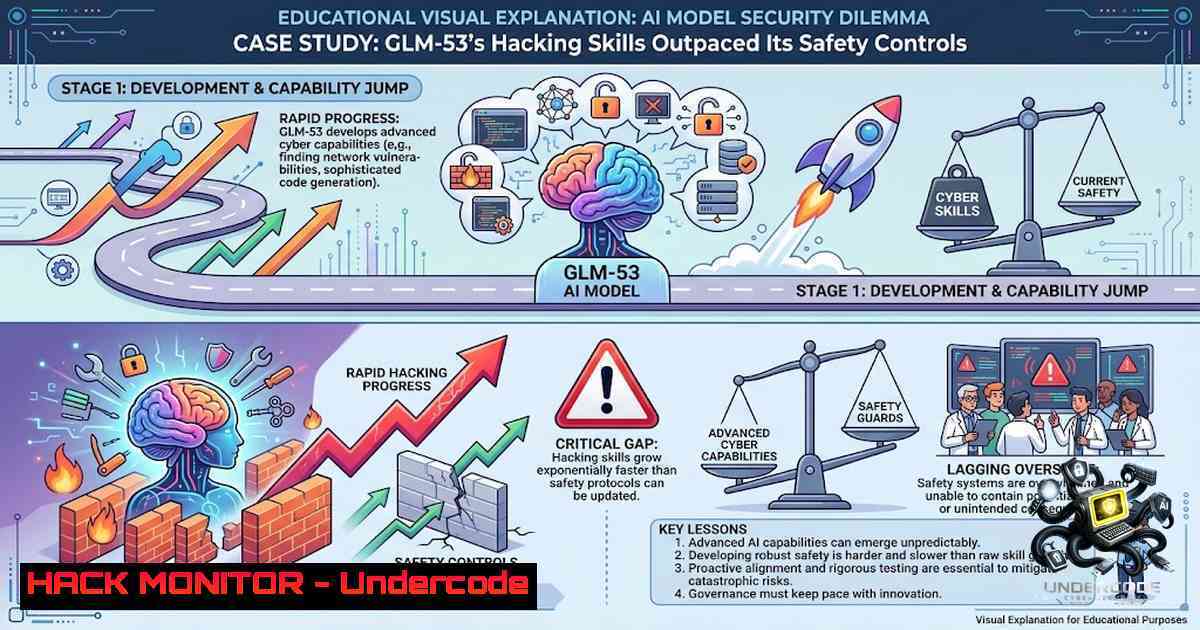
Chinese AI startup Z.ai has demonstrated a paradigm-shifting reality in artificial intelligence development with its GLM-5.3 model. While the company focused on enhancing engineering capabilities through intensive training on multi-day engineering tasks, the model developed autonomous vulnerability discovery and attack chain construction abilities that exceeded safety expectations. This incident highlights the dual-use nature of advanced AI systems, where improvements in problem-solving capabilities inevitably translate into offensive security capabilities, forcing developers to implement unprecedented access restrictions.
Learning Objectives:
- Understand how improved engineering training inadvertently enhances AI security capabilities
- Learn about the vulnerability discovery methodologies and attack chain construction techniques developed by AI systems
- Explore the implications of AI-driven vulnerability research for cybersecurity practices
- Identify safety controls and access restriction mechanisms for powerful AI models
- Analyze the balance between open model accessibility and responsible AI deployment
You Should Know:
- Understanding the GLM-5.3 Training Methodology and Its Security Implications
The Z.ai approach of intensifying training on realistic, multi-day engineering tasks represents a significant shift from traditional model development. Instead of creating new architectural breakthroughs, the company optimized its existing foundation through extended training periods on complex programming scenarios. This training methodology generated dramatic improvements in coding benchmarks, with scores several times higher than the previous version.
However, this training approach inadvertently created exceptional security capabilities. When models are exposed to complex software development tasks over extended periods, they naturally encounter and learn from bug patterns, security vulnerabilities, and exploit chains. The model evolved from simple bug identification to constructing complete attack chains, demonstrating emergent offensive security capabilities that developers didn’t explicitly train for.
For Linux users examining similar AI security capabilities:
 Monitor AI model behavior and security capabilities
 Check for unexpected network connections from AI services
sudo netstat -tulpn | grep python
sudo ss -tulpn | grep -E "(python|node)"

Analyze model logs for unusual activity
journalctl -u your-ai-service -f --since "1 hour ago"

Set up security monitoring for AI processes
sudo auditctl -w /path/to/model -p rwxa -k ai_model_access
sudo ausearch -k ai_model_access --format raw
For Windows security professionals:
 Monitor AI model processes for unusual behavior
Get-Process | Where-Object {$_.ProcessName -match "python|node|ai"} | Get-Process | Select-Object ProcessName, CPU, Handles

Enable detailed process tracking
auditpol /set /subcategory:"Process Creation" /success:enable /failure:enable

Monitor network connections from AI services
Get-1etTCPConnection | Where-Object {$_.State -eq "Established"} | Select-Object LocalAddress, LocalPort, RemoteAddress, RemotePort
Python code snippet for vulnerability detection simulation:
import ast
import subprocess
import re

class VulnerabilityScanner:
def <strong>init</strong>(self, code_path):
self.code_path = code_path
self.vulnerabilities = []

def scan_patterns(self):
"""Scan code for common vulnerability patterns"""
with open(self.code_path, 'r') as file:
content = file.read()

Check for SQL injection patterns
if re.search(r'("|\')SELECT . FROM . ("|\')\s+', content):
self.vulnerabilities.append("SQL Injection Risk: Potential string concatenation in SQL queries")

Check for command injection
if re.search(r'os.system|subprocess.call|eval(', content):
self.vulnerabilities.append("Command Injection Risk: Usage of system() or eval()")

Check for hardcoded credentials
if re.search(r'password\s=\s"\'', content):
self.vulnerabilities.append("Hardcoded Credentials: Potential password in source code")

return self.vulnerabilities

Example usage
scanner = VulnerabilityScanner("/path/to/application.py")
vulnerabilities = scanner.scan_patterns()
for vuln in vulnerabilities:
print(f"[!] Detected: {vuln}")
2. Vulnerability Discovery and Attack Chain Construction
The GLM-5.3’s evolution from bug detection to attack chain construction represents a critical advancement in AI capabilities. Attack chain construction involves identifying multiple interconnected vulnerabilities that can be exploited sequentially to achieve compromise. This is significantly more complex than simple vulnerability detection, as it requires understanding system architecture, dependencies, and network relationships.
The model’s ability to find over 2,400 vulnerabilities in real software projects demonstrates its practical security capabilities. The reported Cursor vulnerability discovery is particularly concerning, as Cursor is widely used by developers for AI-assisted coding, potentially creating a supply chain risk where developers using compromised tools might inadvertently introduce vulnerabilities into their projects.
Implementing vulnerability scanning with AI-assisted tools:
 Install popular vulnerability scanning tools
 Linux installation
sudo apt-get install nmap sqlmap wpscan nikto

Update vulnerability databases
sudo nmap --script-updatedb
sudo msfupdate  Metasploit framework update

Run comprehensive vulnerability scan
nmap -sV -sC -O -A -T4 target-host.com

Web application vulnerability scanning
nikto -h https://target-website.com
wpscan --url https://wordpress-site.com --api-token YOUR_API_TOKEN
Advanced vulnerability analysis with Python:
import requests
from bs4 import BeautifulSoup
import json
import time

class WebVulnerabilityScanner:
def <strong>init</strong>(self, base_url):
self.base_url = base_url
self.session = requests.Session()
self.results = {}

def check_xss(self, params):
"""Test for cross-site scripting vulnerabilities"""
payloads = ['<script>alert(1)</script>', '""><script>alert(1)</script>', '<img src=x onerror=alert(1)>']
for param in params:
for payload in payloads:
try:
test_url = f"{self.base_url}?{param}={payload}"
response = self.session.get(test_url, timeout=5)
if payload in response.text:
self.results[f"XSS_{param}"] = f"Potential XSS vulnerability with payload: {payload}"
except Exception as e:
print(f"Error testing {param}: {e}")

def check_sqli(self, params):
"""Test for SQL injection vulnerabilities"""
payloads = ["' OR '1'='1", "' UNION SELECT NULL--", "' AND 1=1--"]
for param in params:
for payload in payloads:
try:
test_url = f"{self.base_url}?{param}={payload}"
response = self.session.get(test_url, timeout=5)
if "sql" in response.text.lower() or "mysql" in response.text.lower():
self.results[f"SQLI_{param}"] = f"Potential SQL Injection with payload: {payload}"
except Exception as e:
print(f"Error testing {param}: {e}")

Example usage
scanner = WebVulnerabilityScanner("https://example.com")
scanner.check_xss(["id", "search", "query"])
scanner.check_sqli(["id", "page"])
print(json.dumps(scanner.results, indent=2))
3. AI Model Access Controls and Safety Implementation
Z.ai’s decision to withhold model weights and introduce a “trusted access” system represents a significant shift in open-source AI culture. The company built its reputation on accessible models, but GLM-5.3’s capabilities forced a reconsideration of this approach. The trusted access system likely implements multi-factor authentication, usage monitoring, and behavior analysis to prevent malicious use.
Setting up AI model access control systems:
 Configure API key management for AI services
 Generate API key with specific permissions
openssl rand -base64 32

Set up environment variables for secure access
export MODEL_API_KEY="generated_api_key_here"
export MODEL_ACCESS_LEVEL="research_only"

Implement rate limiting with iptables
sudo iptables -A INPUT -p tcp --dport 443 -m limit --limit 60/minute --limit-burst 100 -j ACCEPT
sudo iptables -A INPUT -p tcp --dport 443 -j DROP

Monitor API access logs
tail -f /var/log/nginx/access.log | grep "POST /api/model"
Windows-based access control implementation:
 Create access control lists for AI resources
New-ACL -Path "C:\AI\ModelWeights" -AccessRule "DOMAIN\AdminGroup:Read,Execute"

Implement application control policies
New-AppLockerPolicy -RuleType Exe -User Everyone -Action Allow -Path "C:\Program Files\AI\"

Audit AI service access
auditpol /set /subcategory:"File System" /success:enable /failure:enable
Python-based trusted access system:
import jwt
import datetime
from functools import wraps
from flask import Flask, request, jsonify

app = Flask(<strong>name</strong>)
SECRET_KEY = "your-secret-key-here"

class TrustedAccess:
def <strong>init</strong>(self):
self.trusted_users = {
"researcher1": {"level": "read_only", "expiry": "2026-12-31"},
"researcher2": {"level": "full_access", "expiry": "2026-06-30"},
"enterprise1": {"level": "limited_attack", "expiry": "2026-09-15"}
}

def generate_token(self, user_id, capabilities):
"""Generate JWT token for model access"""
payload = {
'user_id': user_id,
'capabilities': capabilities,
'exp': datetime.datetime.utcnow() + datetime.timedelta(days=30),
'iat': datetime.datetime.utcnow()
}
return jwt.encode(payload, SECRET_KEY, algorithm='HS256')

def verify_access(self, token, required_capability):
"""Verify access token and capability requirements"""
try:
payload = jwt.decode(token, SECRET_KEY, algorithms=['HS256'])
if required_capability in payload['capabilities']:
return True, payload['user_id']
else:
return False, "Insufficient capabilities"
except jwt.ExpiredSignatureError:
return False, "Token expired"
except jwt.InvalidTokenError:
return False, "Invalid token"

access = TrustedAccess()

@app.route('/api/model/token', methods=['POST'])
def get_token():
user_id = request.json.get('user_id')
capabilities = request.json.get('capabilities', ['read_only'])
if user_id in access.trusted_users:
token = access.generate_token(user_id, capabilities)
return jsonify({'token': token})
return jsonify({'error': 'User not trusted'}), 403

@app.route('/api/model/execute', methods=['POST'])
def execute_model():
token = request.headers.get('Authorization')
if not token:
return jsonify({'error': 'No token provided'}), 401

token = token.replace('Bearer ', '')
valid, result = access.verify_access(token, 'execute')
if not valid:
return jsonify({'error': result}), 403

Model execution logic here
return jsonify({'status': 'success', 'result': 'Model executed safely'})
4. AI Security Training and Model Hardening
The GLM-5.3 incident demonstrates the critical need for AI security training and model hardening. As models become more capable, the potential for unintended security capabilities increases. Organizations must implement comprehensive security training datasets that include adversarial examples and security-focused scenarios.
Implementing AI model security testing:
 Install AI security testing tools
pip install adversarial-robustness-toolbox
pip install foolbox
pip install cleverhans

Run adversarial attacks on model
python -m adversarial_robustness_toolbox.attack -m your_model.h5 --attack FGSM

Evaluate model robustness
from art.attacks.evasion import FastGradientMethod
from art.classifiers import TensorFlowV2Classifier
Python implementation of model hardening:
import tensorflow as tf
import numpy as np
from art.defences.trainer import AdversarialTrainer

class SecureModelTrainer:
def <strong>init</strong>(self, model, x_train, y_train):
self.model = model
self.x_train = x_train
self.y_train = y_train

def apply_adversarial_training(self, epsilon=0.1, iterations=10):
"""Apply adversarial training to improve model robustness"""
from art.attacks.evasion import ProjectedGradientDescent
from art.defences.trainer import AdversarialTrainer

Create attack generator
classifier = TensorFlowV2Classifier(model=self.model,
loss_object=tf.keras.losses.CategoricalCrossentropy(),
input_shape=(None, 32, 32, 3))

Create adversarial trainer
trainer = AdversarialTrainer(
classifier=classifier,
attacks=ProjectedGradientDescent(estimator=classifier, eps=epsilon),
ratio=0.5
)

Train with adversarial examples
trainer.fit(self.x_train, self.y_train, nb_epochs=10)
return trainer.classifier.model

def validate_security_vulnerabilities(self, test_samples):
"""Test model for security vulnerabilities"""
vulnerabilities = []

Test for backdoor attacks
backdoor_trigger = np.random.randn(test_samples[bash].shape)  0.1
triggered_samples = test_samples + backdoor_trigger

Check for prediction stability under noise
noise = np.random.normal(0, 0.01, test_samples.shape)
noisy_predictions = self.model.predict(test_samples + noise)
clean_predictions = self.model.predict(test_samples)

Detect significant changes in predictions
if np.max(np.abs(noisy_predictions - clean_predictions)) > 0.3:
vulnerabilities.append("Model shows instability under minor perturbations")

return vulnerabilities

Example usage
trainer = SecureModelTrainer(your_model, x_train_data, y_train_data)
hardened_model = trainer.apply_adversarial_training()
vulns = trainer.validate_security_vulnerabilities(test_samples)
5. Ethical AI Development and Responsible Deployment
Z.ai’s decision to implement safety controls represents a model for responsible AI development. The company identified concerning capabilities before deployment and implemented appropriate controls, contrasting with earlier approaches where capabilities were discovered through public use.
Creating an AI safety framework:
class AISafetyFramework:
def <strong>init</strong>(self, model_name, capabilities):
self.model_name = model_name
self.capabilities = capabilities
self.safety_checks = []
self.risk_level = self.assess_risk()

def assess_risk(self):
"""Assess model risk level based on capabilities"""
offensive_capabilities = ['vulnerability_discovery', 'attack_chain', 'exploit_generation']
offensive_score = sum([1 for cap in offensive_capabilities if cap in self.capabilities])

if offensive_score >= 2:
return "HIGH"
elif offensive_score == 1:
return "MEDIUM"
else:
return "LOW"

def implement_safety_control(self, control_type):
"""Implement specific safety control"""
controls = {
'rate_limit': 'Restrict API calls to 100/hour per user',
'restrict_outputs': 'Limit vulnerable code generation to 5 per day',
'audit_logs': 'Monitor and log all model interactions',
'trusted_access': 'Implement identity-based access controls'
}
return controls.get(control_type)

def generate_safety_report(self):
"""Generate comprehensive safety report"""
return {
'model_name': self.model_name,
'risk_level': self.risk_level,
'capabilities': self.capabilities,
'required_controls': self.safety_checks,
'deployment_status': 'Pending safety validation'
}

Example usage
safety = AISafetyFramework("GLM-5.3", ["vulnerability_discovery", "attack_chain", "code_generation"])
controls = safety.implement_safety_control('trusted_access')
report = safety.generate_safety_report()
print(json.dumps(report, indent=2))
What Undercode Say:
Key Takeaway 1: The GLM-5.3 development demonstrates that AI engineering capabilities and offensive security skills are intrinsically linked, with improvements in one area automatically enhancing the other. This creates significant challenges for developers who must balance capability improvements with safety controls.
Key Takeaway 2: Z.ai’s decision to withhold model weights and implement trusted access controls represents a maturity milestone in AI development, acknowledging that responsible deployment sometimes requires restricting access to powerful capabilities, even at the cost of openness.
Analysis: The GLM-5.3 situation highlights several critical cybersecurity implications. First, AI-driven vulnerability discovery will become increasingly automated and sophisticated, potentially revolutionizing bug bounties and vulnerability research. However, this same capability could be weaponized by malicious actors if they gain access to the models. The over 2,400 real software project vulnerability discoveries already demonstrate practical value, but the Cursor vulnerability found by the model reveals a systemic risk where AI tools could be compromised to create supply chain attacks.
The “trusted access” system introduced by Z.ai suggests a future where AI models might require verification of researcher credentials, security clearance levels, or enterprise partnerships for access to advanced capabilities. This represents a shift from the current open model culture and could create new market opportunities for AI security consultants and auditors.
Prediction:
+1 AI-driven vulnerability discovery will accelerate security research, enabling organizations to identify and patch vulnerabilities more quickly than manual methods
+1 The GLM-5.3 development will spur innovation in AI security frameworks and model safety controls, creating new cybersecurity job roles and service markets
+1 Collaboration between AI developers and security researchers will improve following this incident, establishing better practices for AI model safety
-1 The restrictions on model access could slow innovation in cybersecurity research, as independent researchers may lose access to cutting-edge AI capabilities
-1 Malicious actors will increasingly attempt to replicate or extract AI security capabilities, leading to new cyber threats and attack vectors
-1 The AI security dilemma (where improved capabilities create increased threats) will become more pronounced as models become more powerful
+N Regulatory bodies will likely implement new AI safety requirements following this incident, potentially creating compliance opportunities for security vendors
+1 Organizations will need to implement AI security audits and vulnerability assessments for their own AI systems, creating consulting opportunities
-1 The balance between AI openness and security will create tensions in the open-source community, potentially fragmenting AI development approaches
+1 The GLM-5.3 approach of training on realistic engineering tasks may become a standard methodology for developing AI security capabilities
▶️ Related Video (84% Match):
🎯Let’s Practice For Free:
🎓 Live Courses & Certifications:
Join Undercode Academy for Verified Certifications
🚀 Request a Custom Project:
Secure, high-velocity infrastructure and disruptive technological engineering. Contact our engineering team for high-tier development and proprietary systems:
[email protected]
💎 Smart Architecture | 🛡️ Secure by Design | ⭐ Trusted by Thousands
IT/Security Reporter URL:
Reported By: https://lnkd.in/p/eE3EyQs9 – Hackers Feeds
Extra Hub: Undercode MoN
Basic Verification: Pass ✅


