
Listen to this Post
Introduction:
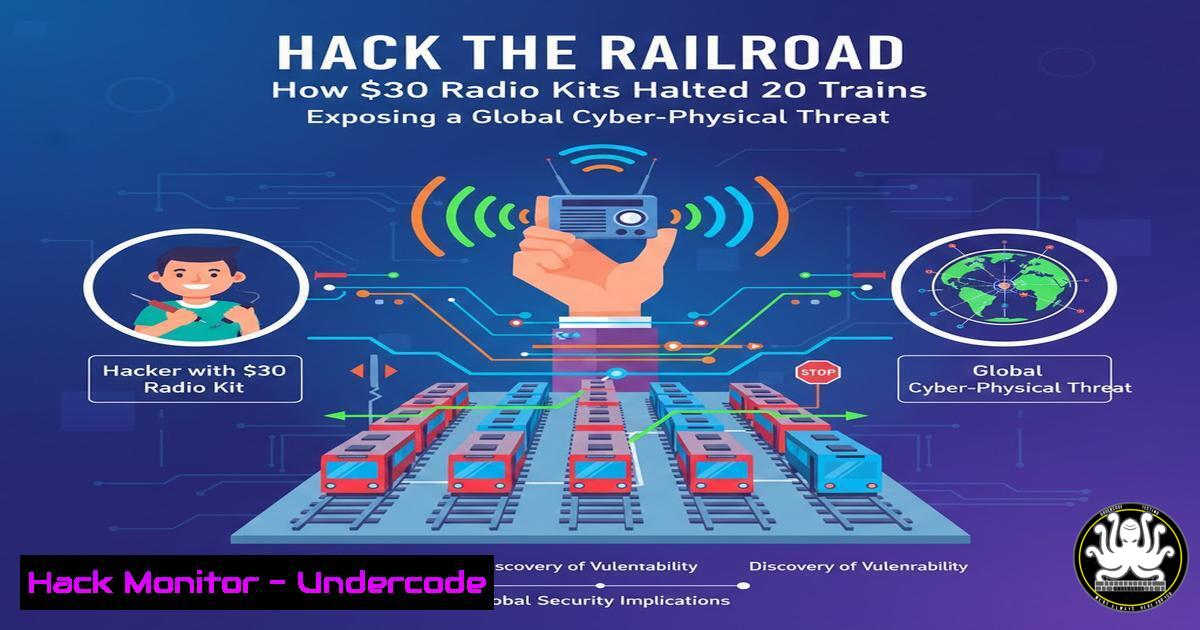
The convergence of legacy industrial control systems and modern cybersecurity threats has created a new frontier for critical infrastructure attacks. Recent incidents in Poland’s rail sector demonstrate how unencrypted radio signals and proprietary software vulnerabilities can be exploited to cause widespread disruption, posing significant risks to national security and public safety. This article deconstructs the technical methodologies behind these attacks and provides actionable mitigation strategies for rail and other industrial operators.
Learning Objectives:
- Understand the technical mechanisms behind radio-frequency-based train halting attacks and software sabotage in rolling stock.
- Learn practical command-line and software-defined radio techniques for testing and securing industrial control systems.
- Implement comprehensive defense strategies for legacy operational technology environments migrating to secure cellular communications.
You Should Know:
1. Exploiting Unencrypted VHF Radio Emergency Stops
The August 2023 incident in Poland exploited a fundamental design flaw in legacy rail systems: safety commands transmitted without authentication or encryption. The “radio-stop” function operates on three sequential audio tones broadcast over 150.100 MHz VHF frequencies, a standard documented for interoperability but lacking security considerations.
Step-by-step guide explaining what this does and how to use it:
Reconnaissance Phase:
- Identify target rail systems using legacy radio communications through public documentation or physical observation
- Acquire software-defined radio (SDR) hardware such as HackRF One (~$300) or cheaper RTL-SDR dongles (~$30)
- Install necessary software packages:
Kali Linux installation
sudo apt update
sudo apt install gqrx gnuradio gr-osmosdr multimon-ng
Signal Analysis & Replication:
- Use GQRX to scan and monitor rail frequencies near target infrastructure:
gqrx -r 150.100M
- Record and analyze the three-tone “radio-stop” sequence using Audacity or similar tools
- Recreate the exact tone sequence using GNU Radio Companion or pre-record the audio
Execution Phase:
- Transmit the captured or recreated emergency stop signal using your SDR:
Using hackrf_transfer for transmission
hackrf_transfer -t radio_stop.raw -f 150100000 -s 2000000 -x 47
- The -x 47 parameter sets transmission gain (adjust based on proximity needs)
Mitigation Implementation:
- Immediately deploy spectrum monitoring to detect unauthorized transmissions
- Begin migration to GSM-R systems with implemented A5/1 or A5/3 encryption
- Implement signal authentication protocols even for legacy systems
2. Software Sabotage in Rolling Stock Systems
The December 2023 Newag incident revealed critical vulnerabilities in proprietary train control software, including deliberate lockout mechanisms that could render trains inoperable. The Dragon Sector analysis uncovered backdoors and anti-maintenance code designed to create vendor lock-in through system sabotage.
Step-by-step guide explaining what this does and how to use it:
Forensic Analysis Methodology:
- Extract firmware from train control systems using JTAG or debug interfaces:
Using openocd for ARM-based systems
openocd -f interface.cfg -f target.cfg -c "dump_image firmware.bin 0x08000000 0x100000"
- Analyze extracted binaries using Ghidra or IDA Pro for malicious logic
- Conduct dynamic analysis using QEMU for embedded systems:
qemu-system-arm -M versatilepb -kernel firmware.bin -nographic -monitor stdio
Vulnerability Identification:
- Search for hardcoded credentials and maintenance counters:
Strings analysis for suspicious patterns
strings firmware.bin | grep -i "counter|maintenance|lock"
- Reverse engineer proprietary protocols using Wireshark with custom dissectors
- Identify time-based logic bombs and geographic fencing mechanisms
Remediation Development:
- Develop integrity verification scripts for operational software:
import hashlib
import os</li>
</ul>

def verify_firmware_integrity(firmware_path, expected_hash):
with open(firmware_path, 'rb') as f:
bytes = f.read()
readable_hash = hashlib.sha256(bytes).hexdigest()
return readable_hash == expected_hash
– Implement secure boot mechanisms using TPM or hardware security modules
– Create automated checks for unauthorized code modifications3. Physical Infrastructure Sabotage Detection
The November 2025 coordinated attacks demonstrated the intersection of cyber and physical threats, where track damage and freight train sabotage required both physical access and timing coordination to maximize disruption.
Step-by-step guide explaining what this does and how to use it:
Surveillance System Hardening:
- Implement computer vision algorithms for track obstruction detection:
import cv2
import numpy as np</li>
</ul>

def detect_track_obstruction(frame, background):
diff = cv2.absdiff(background, frame)
gray = cv2.cvtColor(diff, cv2.COLOR_BGR2GRAY)
blur = cv2.GaussianBlur(gray, (5,5), 0)
_, thresh = cv2.threshold(blur, 20, 255, cv2.THRESH_BINARY)
dilated = cv2.dilate(thresh, None, iterations=3)
contours, _ = cv2.findContours(dilated, cv2.RETR_TREE, cv2.CHAIN_APPROX_SIMPLE)

for contour in contours:
if cv2.contourArea(contour) > 500:  Adjust based on camera perspective
return True
return False
Vibration Anomaly Detection:
- Deploy IoT sensors with machine learning for unusual track vibrations:
Sensor data collection and analysis pipeline
python3 -m pip install tensorflow scikit-learn
- Train models to distinguish between normal operations and sabotage attempts
- Implement real-time alerting systems integrated with security operations
4. GSM-R Migration Security Implementation
Poland’s planned migration to GSM-R by 2025 represents a critical security upgrade, but introduces new attack surfaces that must be properly secured.
Step-by-step guide explaining what this does and how to use it:
GSM-R Security Configuration:
- Implement strong authentication mechanisms:
Example RADIUS configuration for GSM-R authentication client railway-gsmr { ipaddr = 10.10.1.0/24 secret = complex_psk_rotation_system require_message_authenticator = yes } - Configure encryption using A5/3 algorithms rather than vulnerable A5/1 or A5/2
- Deploy signaling firewalls between public networks and rail operational networks
Network Segmentation:
- Create strict separation between operational GSM-R and corporate networks:
iptables rules for network segmentation
iptables -A FORWARD -s 10.10.1.0/24 -d 192.168.1.0/24 -j DROP
iptables -A FORWARD -d 10.10.1.0/24 -s 192.168.1.0/24 -j DROP
- Implement deep packet inspection for GSM-R specific protocols
- Conduct regular penetration testing of the new infrastructure
5. Incident Response for Rail Cyber-Physical Events
Developing specialized incident response capabilities for rail-specific cyber incidents requires understanding both digital forensics and operational safety procedures.
Step-by-step guide explaining what this does and how to use it:
Rail-Specific IR Playbook Development:
- Create isolation procedures that maintain safety while containing threats:
Network isolation while maintaining operational safety
Isolate compromised segments but keep safety systems operational
iptables -A ISOLATION -s [bash] -j DROP
iptables -A ISOLATION -d [bash] -j DROP
But exempt safety-critical communication
iptables -A ISOLATION -s [bash] -d [bash] -j ACCEPT
- Develop communication protocols for coordinating between cybersecurity teams and train operations
- Implement forensic data collection from specialized rail control systems
Tabletop Exercise Development:
- Create realistic scenarios based on actual attacks:
Sample scenario generator for rail cyber exercises
import random</li>
</ul>

scenarios = [
"radio_stop_attack",
"software_sabotage",
"track_sensor_manipulation",
"gsm_r_eavesdropping"
]

def generate_scenario():
base_scenario = random.choice(scenarios)
intensity = random.randint(1, 5)
return f"{base_scenario}<em>level</em>{intensity}"
What Undercode Say:
- Legacy safety systems become critical vulnerabilities when exposed to adversarial contexts, requiring immediate security retrofits even for “air-gapped” systems.
- The convergence of physical and cyber sabotage demands integrated defense strategies that span digital security, physical protection, and operational safety procedures.
- Vendor proprietary systems with hidden lockout mechanisms represent both supply chain risks and potential safety hazards that require independent verification.
The Polish rail incidents demonstrate a troubling evolution in critical infrastructure attacks, where adversaries combine multiple techniques across physical and digital domains. The radio frequency attacks show how legacy systems designed for interoperability become liabilities when security isn’t considered. Meanwhile, the software sabotage case reveals how commercial interests can inadvertently create systemic vulnerabilities. What makes these incidents particularly concerning is their accessibility – the technical barriers to execution are surprisingly low, while the potential impact remains extremely high. This combination suggests we’ll see similar attack patterns replicated against other transportation and industrial systems globally.
Prediction:
The migration to GSM-R and other modern communication systems will reduce simple radio-based attacks but introduce more sophisticated cellular network vulnerabilities. We anticipate increased targeting of railway software supply chains, with attackers exploiting the trust relationships between manufacturers, maintenance providers, and operators. Additionally, AI-enhanced attack tools will likely automate the reverse engineering of rail control protocols, making sophisticated attacks accessible to less technically capable threat actors. The industry must accelerate security-by-design principles and implement robust monitoring for these evolving threats, as the consequences of successful attacks extend far beyond service disruption to potentially catastrophic safety implications.
🎯Let’s Practice For Free:
IT/Security Reporter URL:
Reported By: Armando Seay – Hackers Feeds
Extra Hub: Undercode MoN
Basic Verification: Pass ✅🔐JOIN OUR CYBER WORLD [ CVE News • HackMonitor • UndercodeNews ]
📢 Follow UndercodeTesting & Stay Tuned:
- Deploy IoT sensors with machine learning for unusual track vibrations:
- Implement computer vision algorithms for track obstruction detection:


