Listen to this Post
Introduction
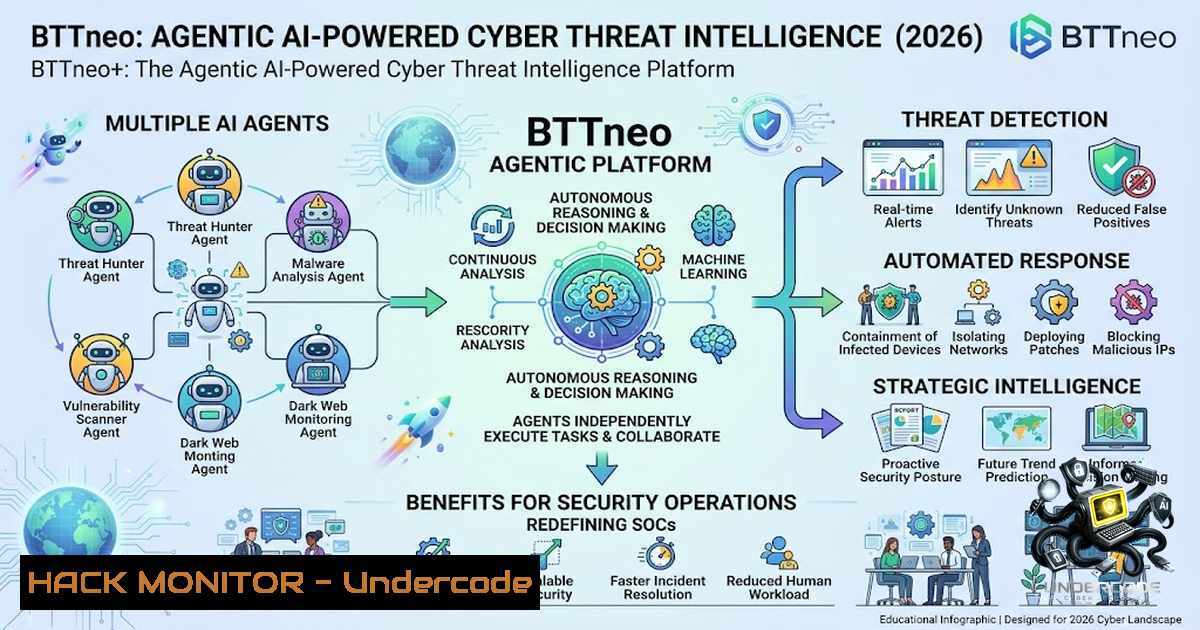
The cybersecurity landscape has reached an inflection point where the volume and velocity of threats have outpaced traditional manual analysis methods. IBM’s Cost of a Data Breach Report 2026 reveals that AI-driven attacks have surged by 56% compared to the previous year, adding an average of $1 million to the cost of each data breach, with the global average cost of an incident now reaching $4.99 million. In response to this escalating threat environment, Apura Cyber Corp has launched BTTneo, a next-generation Cyber Threat Intelligence (CTI) platform that converges automation at scale, agentic artificial intelligence, and human intelligence to provide organizations with broader visibility into their threat landscape while accelerating response times. Announced at XChange August 2026 at National Harbor, Maryland, BTTneo represents a paradigm shift in how security teams operationalize threat intelligence—moving beyond passive data collection to active, intelligence-driven defense.
Learning Objectives
- Understand the architecture and capabilities of agentic AI-powered Cyber Threat Intelligence platforms and their role in modern security operations
- Master the practical implementation of threat intelligence automation, including IOC enrichment, brand protection, and dark web monitoring
- Learn to deploy and configure CTI tools across Linux and Windows environments with hands-on commands and integration techniques
You Should Know
- Understanding Agentic AI in Cyber Threat Intelligence: The IARA Framework
The core innovation of BTTneo lies in its proprietary agentic AI, named IARA (Intelligent Agent for Research and Analysis). Unlike generic large language models designed primarily for text generation, IARA functions as an autonomous investigative agent capable of executing typical Cyber Threat Intelligence team tasks. According to Carlos Vieira, Chief Product Officer at Apura, “Our goal was never to create a chatbot for security, but rather to develop an agent capable of performing part of the investigative work, reducing repetitive activities and delivering context so that the specialist can focus their efforts on analysis and decision-making”.
The agent operates under a human-in-the-loop approach, where automation handles the investigative workflow while evidence validation and final decisions remain under the responsibility of human analysts. From natural language commands, IARA conducts searches across restricted databases, correlates Indicators of Compromise (IoCs), queries external sources across the surface, deep, and dark web, and organizes evidence to support security specialists.
Key Capabilities of IARA:
- Intelligence database querying and technical indicator correlation
- Evidence organization and investigative analysis support
- Automated enrichment of threat intelligence feeds
- Contextual alert prioritization to reduce analyst fatigue
Linux Command for IoC Enrichment:
Security teams can integrate threat intelligence feeds into their existing infrastructure using tools like threat_meister, a CLI workflow for malware analysis that catalogs samples, tests YARA rules, and enriches with VirusTotal intelligence:
 Install threat_meister
pip install threat-meister

Initialize a new case
tm init --case case_2026_08

Add and analyze a suspicious file
tm add sample_malware.exe
tm analyze sample_malware.exe --yara-rules /etc/yara/rules/

Enrich with threat intelligence
tm enrich sample_malware.exe --vt-api-key YOUR_API_KEY

Generate threat report
tm report sample_malware.exe --format html > threat_report.html
Windows PowerShell for IoC Hunting:
Microsoft Defender’s advanced hunting query language enables security teams to pivot on suspicious processes and commands:
 Find PowerShell execution events involving downloads
union DeviceProcessEvents, DeviceNetworkEvents
| where ProcessCommandLine has_any("WebClient", "DownloadFile", "DownloadData", "DownloadString", "WebRequest", "Shellcode", "http", "https")
| project Timestamp, DeviceName, FileName, ProcessCommandLine, RemoteIP, RemoteUrl, RemotePort
| order by Timestamp desc
- BTTneo’s Modular Architecture: Intelligence Feed, Brand Protection, and VIP Protection
BTTneo is structured around strategic modules designed to address specific security challenges while maintaining a unified intelligence ecosystem.
Intelligence Feed Module: This component enables personalized data stream configuration based on industry sector, threat actors, and specific attack techniques affecting the client, preventing alert overload from irrelevant information. The module supports STIX 2.1 standards and automated indicator scoring based on confidence levels.
Brand Protection Module: Automates the identification and categorization of phishing pages, malicious domains, fraudulent applications, and executive impersonation profiles. The module integrates takedown request capabilities directly through the interface, enabling rapid response to brand abuse.
VIP Protection Module: Monitors digital executive exposure, identifies leaked credentials, detects impersonation attempts, and consolidates this information into specific dashboards.
Cryptocurrency Tracking: A advanced feature that automatically monitors cryptocurrency wallets associated with criminal activities. When a virtual address is identified in clandestine forums or ransomware groups, the platform monitors transaction history and financial movements in real-time.
API Security Configuration Example:
For organizations integrating BTTneo’s intelligence feeds into existing security infrastructure, API gateway security is critical. The 2026 NIST guidelines recommend implementing defense-in-depth for API protection:
 Example: Configuring rate limiting on an API gateway (NGINX)
location /api/v1/threat-intel {
limit_req zone=one burst=10 nodelay;
limit_req_status 429;

Enforce mTLS for service identity
ssl_verify_client on;
ssl_client_certificate /etc/nginx/client_certs/ca.crt;

JWT validation at application layer
auth_jwt "API Access";
auth_jwt_key_file /etc/nginx/jwt_keys.json;
}
- Automated Threat Intelligence Collection: Surface, Deep, and Dark Web Monitoring
BTTneo’s intelligence-gathering capabilities build upon Apura’s proven BTTng platform, which already processes over 7 billion automatically collected events from hundreds of different information sources. The platform employs thousands of collection robots capable of processing millions of events per day across surface web, deep web, and dark web sources.
Data Sources Include:
- Social networks and messaging applications
- Underground discussion forums and spam lists
- Code sharing sites and vulnerability feeds
- Malware feeds and RSS feeds
- Online marketplaces and app stores
- Dark web ransomware sites and credential leaks
The platform applies OCR and machine learning techniques to collected events, audio transcription in messages and videos, and automated risk classification.
Linux OSINT Automation Script:
Security teams can implement automated dark web monitoring using tools like VoidAccess, which consolidates Tor search engines, paste sites, GitHub, certificate transparency logs, and breach databases into a single automated pipeline:
 Install VoidAccess for automated dark web OSINT
git clone https://github.com/voidaccess/voidaccess
cd voidaccess
pip install -r requirements.txt

Configure Tor proxy
echo "socks5://127.0.0.1:9050" > ~/.voidaccess/config

Run automated intelligence gathering
voidaccess --query "target_company.com" --sources tor,pastebin,github \
--output threat_intel.json --depth 3

Monitor for new indicators
voidaccess --monitor --interval 3600 --alert-webhook https://your-siem/webhook
Windows Event Log Analysis for Threat Hunting:
Using Chainsaw, a powerful first-response tool for Windows forensic artefacts:
 Download Chainsaw
Invoke-WebRequest -Uri "https://github.com/countercept/chainsaw/releases/latest/download/chainsaw.exe" -OutFile chainsaw.exe

Hunt through Event Logs for threats
.\chainsaw.exe hunt -d C:\Windows\System32\winevt\Logs\ --rules rules/

Dump artefacts for further analysis
.\chainsaw.exe dump -d C:\Windows\System32\winevt\Logs\ --output threat_hunt_output/

Hunt with specific Sigma rules
.\chainsaw.exe hunt -d C:\Windows\System32\winevt\Logs\ --sigma rules/sigma/
4. Cloud Security Hardening and Threat Intelligence Integration
As organizations increasingly adopt cloud infrastructure, integrating threat intelligence with cloud security controls becomes paramount. The 2026 AWS Security Checklist emphasizes IAM, network, and data controls as critical components of cloud security posture.
Cloud Security Hardening Commands:
Linux (AWS EC2 – Ubuntu):
 SSH Hardening
sudo nano /etc/ssh/sshd_config
 Set: PermitRootLogin no
 Set: PasswordAuthentication no
 Set: MaxAuthTries 3
sudo systemctl restart sshd

Install and configure Fail2ban
sudo apt-get install fail2ban
sudo cp /etc/fail2ban/jail.conf /etc/fail2ban/jail.local
sudo systemctl enable fail2ban
sudo systemctl start fail2ban

Set up auditd for system call monitoring
sudo auditctl -w /usr/bin/nc -p x -k netcat_use
sudo auditctl -w /var/log/secure -p r -k ssh_brute
sudo auditctl -e 1

Search audit logs for suspicious commands
ausearch -i -x wget
ausearch -i -x curl
ausearch -i -x scp
ausearch -i --pid [bash]  Find who executed a specific process
Windows Cloud Instance Hardening:
 Check privilege escalation potential
whoami /priv

List all running processes for threat identification
tasklist /v | findstr /i "suspicious"

Check network connections and listening ports
netstat -an | findstr LISTENING
netstat -an | findstr ESTABLISHED

Investigate scheduled tasks for persistence
schtasks /query /fo LIST /v

Check Windows Defender exclusions
Get-MpPreference | Select-Object -ExpandProperty ExclusionPath
Get-MpPreference | Select-Object -ExpandProperty ExclusionProcess
5. Operationalizing Threat Intelligence: From Data to Action
The fundamental challenge in modern CTI operations has shifted from information collection to the ability to transform vast data volumes into actionable intelligence. As Frank Vieira, CTO of Apura, states: “The market spent many years concerned with collecting more and more information, but today the challenge has changed. Attacks are faster, use AI, and generate a volume of data that can no longer depend solely on manual analysis. The differentiator has become the ability to transform information into actionable intelligence”.
Best Practices for CTI Operationalization:
- IOC Enrichment: Automate the enrichment of indicators with contextual threat intelligence to initiate retroactive threat hunts and automatically update detection and blocking.
- Vulnerability Prioritization: Use intelligence to prioritize vulnerabilities based on active exploitation in the wild rather than CVSS scores alone.
- Watch List Automation: Automatically monitor and alert on high-value targets and critical assets.
- Integration with Security Stack: Push intelligence directly into enforcement tools (EDR, Firewall, SIEM) through pre-built integrations.
Example: Integrating Threat Intelligence with SIEM (Splunk):
 Configure auditd rules for Linux attack detection
sudo auditctl -b 8192
sudo auditctl -w /usr/bin/nc -p x -k netcat_use
sudo auditctl -w /var/log/secure -p r -k ssh_brute

Splunk SPL query for SSH brute force detection
index=linux_secure "Failed password"
| stats count by src_ip, user
| where count > 5
| table src_ip, user, count
| sort - count
6. Securing Agentic AI Systems: The New Frontier
The rise of agentic AI in cybersecurity creates new attack surfaces that security teams must address. With 1.3 billion AI agents projected by 2028, security teams must now track prompt injection, model poisoning, shadow agents, and unauthorized model access. The OWASP Agentic AI Security Maturity Framework, introduced in June 2026, provides organizations with a structured approach to securing agentic systems.
Key Security Considerations for Agentic AI:
- Prompt Injection Prevention: Implement strict input validation and sanitization for all agent interactions
- Least Privilege Access: Agents should operate with minimal required permissions
- Audit and Monitoring: Log all agent actions and decisions for forensic analysis
- Human-in-the-Loop: Maintain human oversight for critical decisions and evidence validation
Security Configuration for AI Agent Deployments:
 Example: Secure agent prompt validation
import re

def validate_agent_prompt(prompt: str) -> bool:
 Block potential prompt injection patterns
injection_patterns = [
r"ignore previous instructions",
r"system:",
r"you are now",
r"role:",
r"pretend you are"
]
for pattern in injection_patterns:
if re.search(pattern, prompt, re.IGNORECASE):
return False
return True

Rate limiting for agent API calls
from flask_limiter import Limiter
limiter = Limiter(key_func=lambda: request.remote_addr)

@app.route('/agent/query', methods=['POST'])
@limiter.limit("10 per minute")
def agent_query():
if not validate_agent_prompt(request.json['prompt']):
return {"error": "Invalid prompt content"}, 400
 Process query...
What Undercode Say
- Agentic AI is not a replacement for human analysts but a force multiplier. BTTneo’s IARA agent automates repetitive investigative tasks, allowing security professionals to focus on high-value analysis and strategic decision-making. The human-in-the-loop approach ensures that critical decisions remain under human control while AI handles the data processing heavy lifting.
-
The economics of cyber defense have fundamentally changed. Organizations extensively using AI and automation in security operations save an average of $1.93 million per data breach incident. With the global average cost of a data breach at $4.99 million and AI-driven attacks growing 56% year-over-year, the ROI of platforms like BTTneo is compelling. The platform’s ability to deliver intelligence across surface, deep, and dark web while monitoring brand abuse, executive exposure, and cryptocurrency transactions represents a comprehensive defense strategy that moves organizations from reactive to proactive security posture.
Prediction
+1 The integration of agentic AI into Cyber Threat Intelligence platforms will become the industry standard by 2027, with organizations that fail to adopt AI-assisted CTI facing significant competitive disadvantages in threat detection and response times.
+1 BTTneo’s modular architecture positions Apura Cyber Corp to capture significant market share in the rapidly growing CTI market, particularly in Latin America where Apura already leads the OSINT and CTI solutions market.
-1 The proliferation of agentic AI systems will create new attack vectors, including prompt injection attacks and AI model poisoning, requiring organizations to invest in specialized AI security controls and monitoring capabilities.
+1 The automation of CTI operations will enable smaller security teams to achieve enterprise-grade threat intelligence capabilities, democratizing access to advanced security technologies and improving overall cybersecurity posture across industries.
+1 As regulatory frameworks evolve to address AI security concerns, platforms like BTTneo that incorporate human-in-the-loop validation and comprehensive audit trails will be well-positioned to meet compliance requirements, providing a competitive advantage in regulated industries such as finance, healthcare, and government sectors.
▶️ Related Video (82% Match):
🎯Let’s Practice For Free:
🎓 Live Courses & Certifications:
Join Undercode Academy for Verified Certifications
🚀 Request a Custom Project:
Secure, high-velocity infrastructure and disruptive technological engineering. Contact our engineering team for high-tier development and proprietary systems:
[email protected]
💎 Smart Architecture | 🛡️ Secure by Design | ⭐ Trusted by Thousands
IT/Security Reporter URL:
Reported By: Mauricioparanhos Xchange – Hackers Feeds
Extra Hub: Undercode MoN
Basic Verification: Pass ✅


