
Listen to this Post
Introduction:
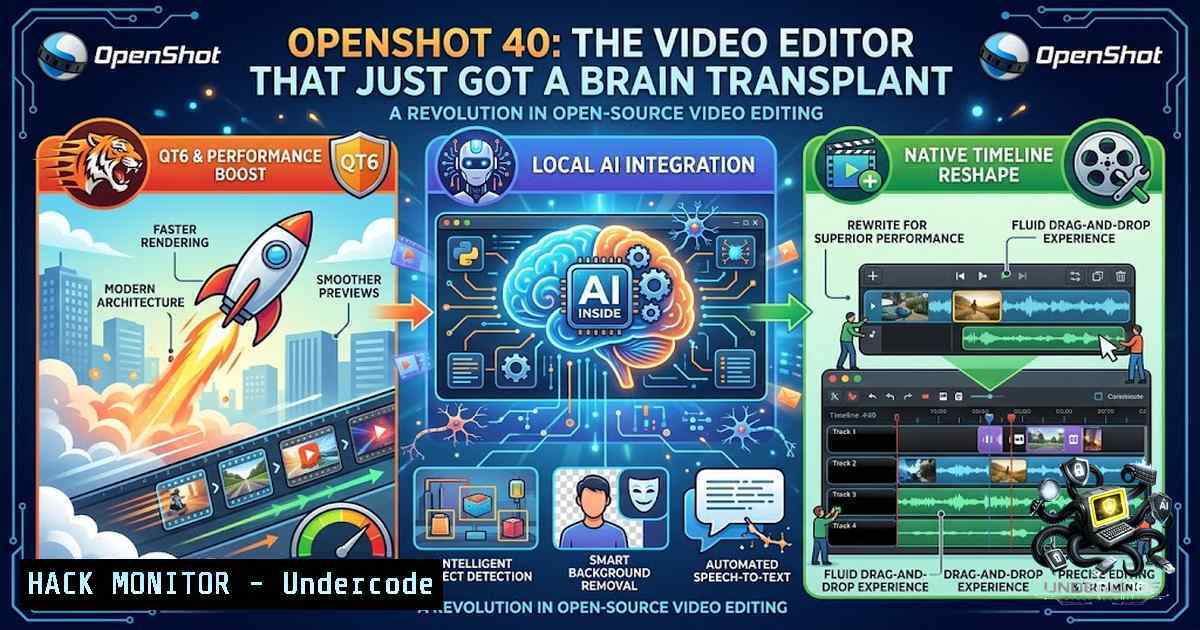
OpenShot 4.0 represents a fundamental architectural shift for the open-source nonlinear video editor, moving from Qt5 to Qt6 and replacing its problematic web-based timeline with a fully native Qt implementation. This release introduces local AI-powered object masking that runs entirely offline via ONNX models, a dedicated color grading workspace with professional scopes, and a native recording view for screen, webcam, and audio capture. For cybersecurity and IT professionals, the local AI approach eliminates cloud data exposure risks, while the Qt6 migration resolves years of Wayland instability and delivers measurable performance gains.
Learning Objectives & Secrets:
- Objective 1: Master the Qt6 Migration for Performance Optimization – Learn how to leverage OpenShot 4.0’s Qt6 foundation for improved Wayland support, fractional scaling, and up to 61.8% faster blur processing. Secret tip: Adjust the `QT_SCALE_FACTOR` environment variable on Linux to fine-tune UI scaling for high-DPI displays.
-
Objective 2: Deploy Local AI Object Masking Without Cloud Exposure – Understand how to use EfficientSAM and YOLO models via ONNX Runtime for subject isolation and tracking, with all processing remaining on your local machine. Secret tip: Pre-download the model files manually to avoid on-demand downloads during editing – locate them in `~/.openshot_qt/models/` on Linux or `%APPDATA%\OpenShot\Models` on Windows.
-
Objective 3: Optimize Multi-Platform Export Workflows – Configure export presets for TikTok, Instagram, YouTube, Snapchat, and Twitter using OpenShot 4.0’s new social media export filters. Secret tip: Create batch export scripts using OpenShot’s command-line interface (
openshot-qt-cli) to render multiple format versions of the same project in a single operation.
You Should Know:
1. Qt6 Migration: Performance Benchmarks and Configuration
OpenShot 4.0 completes the full transition from Qt5 to Qt6/PySide6, removing the WebKit/WebEngine backend entirely. This migration delivers measurable performance improvements: blur processing is 61.8% faster, sharpen is 12.8% faster, and general timeline rendering improved 3.4–5.1%. The OMG Ubuntu reviewer noted this as “the first version of OpenShot that hasn’t crashed during testing”.
Step-by-Step Guide for Qt6 Performance Tuning:
Linux (Wayland/X11):
 Check your current display server
echo $XDG_SESSION_TYPE

Enable Wayland-specific optimizations
export QT_QPA_PLATFORM=wayland
export QT_WAYLAND_DISABLE_WINDOWDECORATION=1

For fractional scaling (e.g., 125% or 150%)
export QT_SCALE_FACTOR=1.25
export QT_AUTO_SCREEN_SCALE_FACTOR=0

Launch OpenShot with these settings
openshot-qt
Windows:
 Set high-DPI awareness via registry or shortcut
 Right-click openshot-qt.exe → Properties → Compatibility → Change high DPI settings
 Check "Override high DPI scaling behavior" and select "Application"
Performance Monitoring:
 Monitor OpenShot's CPU and memory usage during editing
htop  Linux
 or
tasklist /FI "IMAGENAME eq openshot-qt.exe"  Windows
2. Local AI Object Masking: Privacy-First Implementation
OpenShot 4.0’s Object Mask effect uses EfficientSAM and YOLO models converted to ONNX, running locally via ONNX Runtime with no cloud uploads, accounts, or subscriptions required. This is a significant privacy advantage for IT professionals handling sensitive video content.
Step-by-Step Guide for AI Masking:
1. Install Dependencies (Linux):
 Ensure OpenCV and ONNX Runtime are available
sudo apt install python3-opencv python3-onnxruntime  Debian/Ubuntu
 or
sudo dnf install opencv onnxruntime  Fedora
2. Download Models Manually (Optional):
 Model directory locations
mkdir -p ~/.openshot_qt/models/
 Download EfficientSAM and YOLO models from OpenShot's repository
 or let OpenShot download them on first use
3. Apply Object Mask Effect:
- Right-click a clip in the timeline
- Select Effects → Object Mask
- In the preview window, click positive points on the subject you want to isolate
- Click negative points to refine the mask boundary
- OpenShot propagates the mask automatically across the clip
4. Use Object Detection:
- Select Effects → Object Detection
- Choose a YOLO model from the picker (YOLOv5 is pre-configured)
- OpenShot identifies and tracks objects automatically
3. Color Grading Workspace: Professional Tools Without Subscription
The new Color View provides color wheels, curves, LUT support, and live video scopes including Luma Waveform, Histogram, RGB Parade, and Vectorscope. All parameters are fully keyframeable.
Step-by-Step Guide for Color Grading:
1. Access Color View:
- Click the Color tab in the main window, or
- Right-click a clip → Look → Adjust Colors
2. Apply Quick Presets:
- Select from one-click presets: Reset Color, Auto Contrast, Lift Shadows, Warm Up, Boost Color
3. Manual Color Correction:
- Adjust Exposure, Contrast, Temperature, Tint, Highlights, Shadows, Saturation, and Vibrance
- Use separate color wheels for Global, Shadows, Midtones, and Highlights
4. Load LUTs:
- OpenShot reads `.cube` LUT files
- Use the intensity control to blend LUTs instead of applying full strength
5. Monitor with Scopes:
- Vectorscope includes a skin-tone reference line for accurate skin color correction
4. Recording View: Native Multi-Source Capture
OpenShot 4.0 introduces a Recording View that captures screen, webcam, microphone, and system audio directly into a project. Each source saves as its own clip on the timeline, enabling independent editing.
Platform-Specific Recording Configuration:
Linux (Wayland): Uses PipeWire for desktop capture
 Verify PipeWire is running
systemctl --user status pipewire pipewire-pulse

If not installed
sudo apt install pipewire pipewire-pulse  Debian/Ubuntu
macOS: Uses AVFoundation for native capture
Windows: Supports region selection for targeted screen capture
5. Export Framework for Social Media Platforms
OpenShot 4.0 adds new export filters for TikTok, Snapchat, Instagram, YouTube, and Twitter.
Recommended Export Settings:
| Platform | Resolution | Aspect Ratio | Codec | Bitrate |
|-||–|-||
| TikTok | 1080×1920 | 9:16 (Vertical) | H.264 | 6–8 Mbps |
| Instagram Reels | 1080×1920 | 9:16 (Vertical) | H.264 | 6–8 Mbps |
| YouTube | 1920×1080 | 16:9 | H.264 | 10–15 Mbps |
| Snapchat | 1080×1920 | 9:16 | H.264 | 5–6 Mbps |
| Twitter/X | 1280×720 | 16:9 | H.264 | 4–5 Mbps |
Batch Export Using Presets:
 Command-line export example (Linux)
openshot-qt-cli --project myproject.osp --export-preset "YouTube HD" --output youtube.mp4
openshot-qt-cli --project myproject.osp --export-preset "TikTok Vertical" --output tiktok.mp4
What Undercode Say:
- Key Takeaway 1: OpenShot 4.0’s migration from Qt5 to Qt6 is not just a version bump – it’s a complete architectural rewrite that eliminates the web-based timeline backend, resolving years of Wayland instability and delivering quantifiable performance gains of 3.4–61.8% across key operations. For Linux users, this finally makes OpenShot a reliable production tool.
-
Key Takeaway 2: The local AI object masking implementation sets a new standard for privacy in open-source video editing. By running EfficientSAM and YOLO models entirely offline via ONNX Runtime, OpenShot proves that sophisticated AI features don’t require cloud dependencies, subscriptions, or data transmission. This is particularly significant for IT professionals, developers, and organizations working with sensitive or proprietary video content.
The release marks a turning point for OpenShot as a serious competitor to both proprietary and open-source video editors. The combination of a modern Qt6 foundation, local AI capabilities, professional color grading tools, and native recording functionality addresses the core pain points that previously limited its adoption in professional workflows. For cybersecurity-minded users, the local-first AI approach eliminates the data privacy concerns associated with cloud-based editing tools. The addition of Android platform support also signals a broader strategic direction beyond desktop environments.
Prediction:
- +1 OpenShot 4.0 will accelerate adoption among Linux users and privacy-conscious creators, potentially displacing older open-source alternatives like Kdenlive and Shotcut in the coming 12–18 months.
-
+1 The local AI object masking architecture will inspire other open-source multimedia tools to adopt similar ONNX-based workflows, reducing dependence on cloud APIs for AI features.
-
-1 The Qt6 migration, while beneficial, may introduce compatibility issues with older Linux distributions and hardware configurations, potentially fragmenting the user base during the transition period.
-
+1 OpenShot’s new Android platform support positions it as a potential cross-platform editing solution, though mobile performance will likely lag behind desktop capabilities initially.
-
+1 The Recording View’s ability to capture screen, webcam, and audio simultaneously – eliminating OBS as a dependency for many screencast workflows – will make OpenShot the go-to tool for developers creating tutorial content and software demonstrations.
-
-1 The reliance on ComfyUI for advanced audio processing (denoise, voice enhancement, repair) requires a separate ComfyUI installation, which may confuse less technical users and create a fragmented user experience.
▶️ Related Video (62% Match):
https://www.youtube.com/watch?v=1k-ISfd-YBE
🎯Let’s Practice For Free:
🎓 Live Courses & Certifications:
Join Undercode Academy for Verified Certifications
🚀 Request a Custom Project:
Secure, high-velocity infrastructure and disruptive technological engineering. Contact our engineering team for high-tier development and proprietary systems:
[email protected]
💎 Smart Architecture | 🛡️ Secure by Design | ⭐ Trusted by Thousands
IT/Security Reporter URL:
Reported By: https://lnkd.in/p/eFux-jbF – Hackers Feeds
Extra Hub: Undercode MoN
Basic Verification: Pass ✅


