
Listen to this Post
Introduction
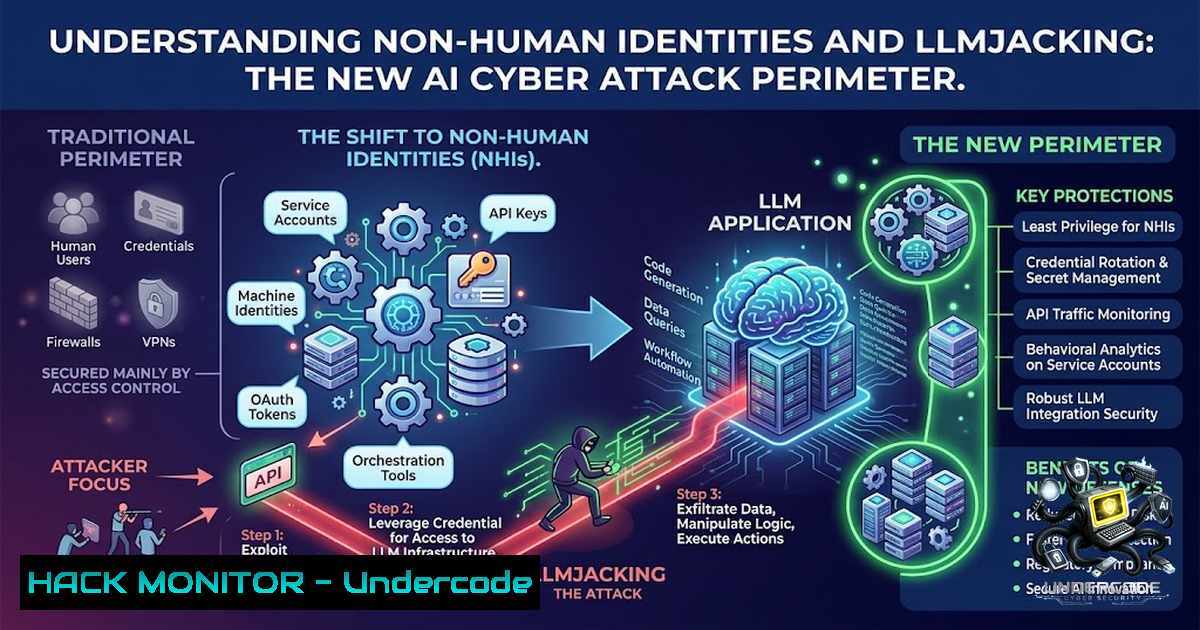
The cybersecurity landscape is undergoing a fundamental shift as attackers pivot from targeting human identities to exploiting non-human identities (NHIs)—the API keys, OAuth tokens, service accounts, and machine credentials that power modern AI-driven infrastructure. Recent threat intelligence from Flashpoint and the Cloud Security Alliance (CSA) reveals a dramatic surge in infostealer malware specifically designed to harvest AI agent credentials, enabling threat actors to hijack cloud compute resources, bypass multi-factor authentication, and move laterally through enterprise networks undetected. With non-human identities now outnumbering human users by an average of 45 to 1—and reaching ratios of 144 to 1 in cloud-1ative environments—organizations can no longer afford to treat machine credentials as an afterthought.
Learning Objectives & Secrets
- Objective 1: Understand the LLMjacking Attack Chain – Learn how attackers systematically discover, validate, and exploit stolen AI API credentials through automated scanning, credential validation, and underground marketplaces. Operation Bizarre Bazaar documented 35,000 attack sessions across 30+ LLM providers in just 36 days.
-
Objective 2 Secret Tip: Implement Ephemeral Credentials – Replace long-lived static API keys with short-lived, scoped tokens that expire automatically. CSA research emphasizes that ephemeral credentials with least-privilege access are the single most effective defense against NHI compromise.
-
Objective 3 Secret Tip: Monitor Behavioral Anomalies, Not Just Invoices – Most organizations discover LLMjacking only when the cloud bill arrives—often after tens of thousands of dollars in unauthorized inference costs. Implement real-time monitoring of API call volumes, geographic patterns, and inference spend to detect attacks while they’re still in progress, not after the damage is done.
You Should Know
- The LLMjacking Kill Chain: From Leak to Exploitation
LLMjacking—the theft and unauthorized use of AI API credentials—has evolved from opportunistic key scraping into industrial-scale criminal infrastructure. Sysdig documented a 376% increase in credential theft targeting AI services between Q4 2025 and Q1 2026. The attack chain follows a predictable pattern:
Step 1: Discovery – Attackers use automated scanners to search public code repositories, Pastebin, CI/CD pipelines, and exposed environment variables for AI provider credentials. Entro Labs research found that reconnaissance attempts occur within an average of 17 minutes after a token is leaked.
Step 2: Validation – Stolen credentials are tested against AI provider APIs (OpenAI, Anthropic, AWS Bedrock, Azure OpenAI, Google Vertex AI) to confirm they are active and have sufficient quota.
Step 3: Monetization – Validated credentials are either:
- Resold on underground marketplaces at 40–60% below legitimate pricing
- Used directly to route inference costs onto the victim’s account—up to $46,000 per day for Claude-class models
- Integrated into offensive frameworks like VAPT, which uses hijacked LLM capacity as a reasoning engine for automated exploitation
Step 4: Lateral Movement – Compromised AI agent tokens with elevated privileges enable attackers to pivot through networks, access cloud storage, and exfiltrate additional secrets including AWS credentials and Snowflake tokens.
Detection Commands:
 AWS: List all IAM users and their access keys to identify stale credentials
aws iam list-users --query 'Users[].UserName' --output text | xargs -I {} aws iam list-access-keys --user-1ame {}

AWS: List service-specific credentials for Bedrock (AI service)
aws iam list-service-specific-credentials --service-1ame bedrock.amazonaws.com

Azure: List all service principals and their credential expiry dates
az ad sp list --all --query "[].[bash]" -o tsv | xargs -I {} az ad sp credential list --id {} --query "[].endDate"

Kubernetes: List all service accounts and check token age
kubectl get serviceaccounts --all-1amespaces
kubectl describe serviceaccount <name> -1 <namespace>
- The OAuth Token Blind Spot: When Machine Identity Becomes the Attack Surface
Traditional IAM systems were designed for human identities with sessions that expire, passwords that can be reset, and MFA that adds a second layer of verification. AI agents, however, authenticate programmatically using pre-issued credentials and operate autonomously at machine speed—creating a fundamental architectural mismatch.
The August 2025 Salesloft Drift breach demonstrated the scale of this vulnerability. Attackers tracked as UNC6395 stole OAuth tokens from a single chatbot integration and used them to access over 700 Salesforce environments, including Cloudflare, Google, Palo Alto Networks, and Zscaler. No passwords were cracked, no MFA prompts were answered—the tokens were the identity.
Why Human-Centric IAM Fails for AI Agents:
| Human Identity | Non-Human Identity (AI Agent) |
|||
| Sessions expire in hours | Tokens can be valid indefinitely |
| Login from new country triggers step-up auth | No geographic or behavioral checks |
| Behavioral analytics track human patterns | Agent behavior is code-driven and bursty |
| Access reviews occur regularly | Credentials rarely reviewed or rotated |
Mitigation Steps:
Step 1: Inventory All NHIs – Create a continuously updated register of every service account, API key, OAuth token, and machine certificate across your environment.
Step 2: Enforce Short-Lived Credentials – Replace static credentials with ephemeral tokens that expire automatically. Use workload identity federation (AWS IAM Roles Anywhere, Azure Managed Identities, GCP Workload Identity) to eliminate long-lived secrets.
Step 3: Implement OAuth Token Revocation – When a compromise is suspected, revoke all active tokens immediately:
 PowerShell: Revoke all refresh tokens for an Azure AD user
Revoke-AzureADUserAllRefreshToken -ObjectId "user-object-id"

Microsoft Graph API: Revoke all sign-in sessions
Invoke-RestMethod -Method Post -Uri "https://graph.microsoft.com/v1.0/me/revokeSignInSessions" -Headers $headers
Step 4: Monitor OAuth Consent Flows – Implement alerting for new OAuth consent grants to applications, especially those requesting high-privilege scopes. Datadog Security Labs identified “CoPhish” attacks where adversaries build malicious Copilot agents with fake consent flows to harvest OAuth tokens at scale.
- Infostealer Malware: The Primary Vector for NHI Compromise
Infostealer families—Lumma, RedLine, and StealC—now account for 86% of observed stealer-log volume and are specifically targeting AI coding agent credentials and developer platform tokens. These malware variants harvest browser-stored credentials, environment variables, and configuration files, extracting API keys, OAuth tokens, and session cookies.
The Economics of Stolen AI Keys:
- A stolen LLM API key sells for as little as $30 on underground markets
- That $30 key can generate tens of thousands of dollars in unauthorized inference costs
- Attackers sent nearly 200,000 API requests in two minutes in one documented campaign
Defensive Measures:
Step 1: Scan for Exposed Secrets – Implement automated secret scanning across all code repositories:
 GitHub API: List secret scanning alerts for a repository
curl -H "Authorization: token GITHUB_TOKEN" \
https://api.github.com/repos/OWNER/REPO/secret-scanning/alerts

TruffleHog: Scan a repository for exposed secrets
trufflehog git https://github.com/owner/repo.git --json

GitLeaks: Detect secrets in git history
gitleaks detect --source . --verbose
Step 2: Enable Push Protection – Configure GitHub secret scanning push protection to block commits containing known secret patterns.
Step 3: Rotate Compromised Credentials Immediately – When a secret is exposed, rotate it before attackers can exploit it. GitGuardian found that 64% of valid secrets exposed in 2022 were still live and unrevoked in 2026.
- Zero Trust for Non-Human Identities: A Governance Framework
Extending Zero Trust principles to NHIs requires fundamental changes to identity governance. The CSA’s Non-Human Identity Governance framework prescribes four core principles:
Principle 1: Least Privilege – Every NHI should have only the permissions it needs to perform its specific function, and nothing more. AI agents should not inherit human permissions—they need their own task-scoped credentials.
Principle 2: Continuous Monitoring – Instrument all NHI activity as first-class security telemetry. Monitor for:
– Anomalous inference volume and spend
– First-time API calls from new geographic locations
– Unusual API error rates that may indicate testing of stolen credentials
Step 1: Enable CloudTrail Insights for Anomaly Detection:
 AWS: Enable CloudTrail Insights to detect unusual API activity
aws cloudtrail put-insight-selectors --trail-1ame my-trail \
--insight-selectors '[{"InsightType": "ApiCallRateInsight"}]'
Principle 3: Automated Lifecycle Management – NHIs should be created, modified, and decommissioned through automated workflows tied to deployment lifecycles. When a workload is terminated, its credentials should be automatically revoked.
Step 2: Implement Kubernetes Bound Service Account Tokens:
 Kubernetes: Create a service account with bound token (automatic rotation)
kubectl create serviceaccount my-agent -1 production

The kubelet automatically rotates bound tokens every hour by default
 Verify token rotation is enabled
kubectl get pod my-pod -1 production -o yaml | grep -A 5 "serviceAccountToken"
Principle 4: Cryptographic Workload Attestation – Use standards like SPIFFE (Secure Production Identity Framework for Everyone) to issue cryptographic identities to workloads:
 SPIRE: Register a workload with a SPIFFE ID
spire-server entry create \
-parentID spiffe://example.org/ns/production/sa/spire-agent \
-spiffeID spiffe://example.org/ns/production/sa/my-workload \
-selector k8s:pod-label:app:my-app
5. AI Agent Identity: The Next-Generation Threat Surface
Agentic AI systems introduce qualitatively new identity challenges. AI agents are not passive credential holders—they are autonomous actors that acquire permissions dynamically at runtime, spawn sub-agents, invoke external APIs, and chain actions across systems. The OWASP AI Security Top 10 ranks Identity & Privilege Abuse as 3 (ASI03) because it determines the blast radius for every other agent risk.
Key Risks:
- Credential Aggregation – Each AI agent operates with the combined authority of every token and key assigned to it. Compromise one agent, inherit all its permissions.
-
Confused Deputy – Agents with legitimate permissions can be manipulated into misusing them. Traditional IAM cannot distinguish legitimate requests from manipulated ones.
-
Identity Debt – Okta Threat Intelligence predicted that rapid AI agent adoption would generate “identity debt” as developers experiment with these technologies without proper governance.
Step-by-Step Implementation:
Step 1: Scope Every LLM API Key to Least Privilege – Kill unused and long-lived keys immediately.
Step 2: Implement Per-Agent Credentials – Never share credentials across multiple agents. Each agent should have its own unique, task-scoped identity with a full audit trail.
Step 3: Alert on Anomalous Inference Spend – Set up budget alerts and usage thresholds:
 AWS: Create a budget alert for Bedrock usage
aws budgets create-budget --account-id 123456789012 \
--budget file://bedrock-budget.json \
--1otifications-with-subscribers file://notifications.json
What Undercode Say
- Key Takeaway 1 – The perimeter has shifted. With AI agents communicating via APIs with routers, firewalls, and cloud services, Non-Human Identities are the new exposed boundary. A single compromised high-privilege token can deliver the entire network to attackers, bypassing MFA through implicit machine-to-machine trust.
-
Key Takeaway 2 – Traditional identity governance is structurally inadequate for the AI era. Organizations must extend Zero Trust to NHIs with ephemeral credentials, least privilege, continuous monitoring, and cryptographic workload attestation. The 45:1 (or 144:1 in cloud environments) ratio of machine to human identities makes this an existential security requirement, not a nice-to-have.
-
Analysis – The convergence of AI adoption, infostealer proliferation, and NHI governance gaps creates a perfect storm. Attackers have demonstrated they can move from credential theft to network compromise in minutes, not days. The industry must shift from reactive detection (waiting for the bill) to proactive defense (real-time behavioral monitoring, automated rotation, and zero-standing privilege). Organizations that treat NHI governance as a secondary concern will find themselves structurally unprepared for the breach vectors already materializing in enterprise environments. The Salesloft Drift breach wasn’t an anomaly—it was a preview of the next decade of cyber attacks.
Prediction
-
+1 – Organizations that implement comprehensive NHI governance frameworks—including ephemeral credentials, automated rotation, and continuous behavioral monitoring—will achieve a measurable reduction in breach risk and cloud cost overruns, establishing a competitive advantage in the AI-driven economy.
-
+1 – Standards like SPIFFE/SPIRE and OWASP’s NHI Top 10 will drive the development of purpose-built NHI security tools, creating a new category of identity security solutions that treat machine identities with the same rigor as human identities.
-
-1 – Organizations that fail to address NHI governance will experience increasingly sophisticated LLMjacking attacks, with threat actors using stolen AI compute to power autonomous offensive frameworks that outpace human defenders.
-
-1 – The 376% increase in credential theft targeting AI services suggests this trend will accelerate, with infostealer malware becoming more specialized and the underground market for stolen AI credentials expanding into a fully commercialized supply chain.
-
-1 – Regulatory and compliance frameworks will catch up slowly, leaving a governance gap that attackers will continue to exploit. Organizations will face not only financial losses from unauthorized AI usage but also reputational damage and regulatory penalties when compromised AI agents are used to generate illicit content or exfiltrate sensitive data.
▶️ Related Video (86% Match):
https://www.youtube.com/watch?v=03xzTjJ420A
🎯Let’s Practice For Free:
🎓 Live Courses & Certifications:
Join Undercode Academy for Verified Certifications
🚀 Request a Custom Project:
Secure, high-velocity infrastructure and disruptive technological engineering. Contact our engineering team for high-tier development and proprietary systems:
[email protected]
💎 Smart Architecture | 🛡️ Secure by Design | ⭐ Trusted by Thousands
IT/Security Reporter URL:
Reported By: https://lnkd.in/p/eRdiCQTv – Hackers Feeds
Extra Hub: Undercode MoN
Basic Verification: Pass ✅


