Listen to this Post
Introduction
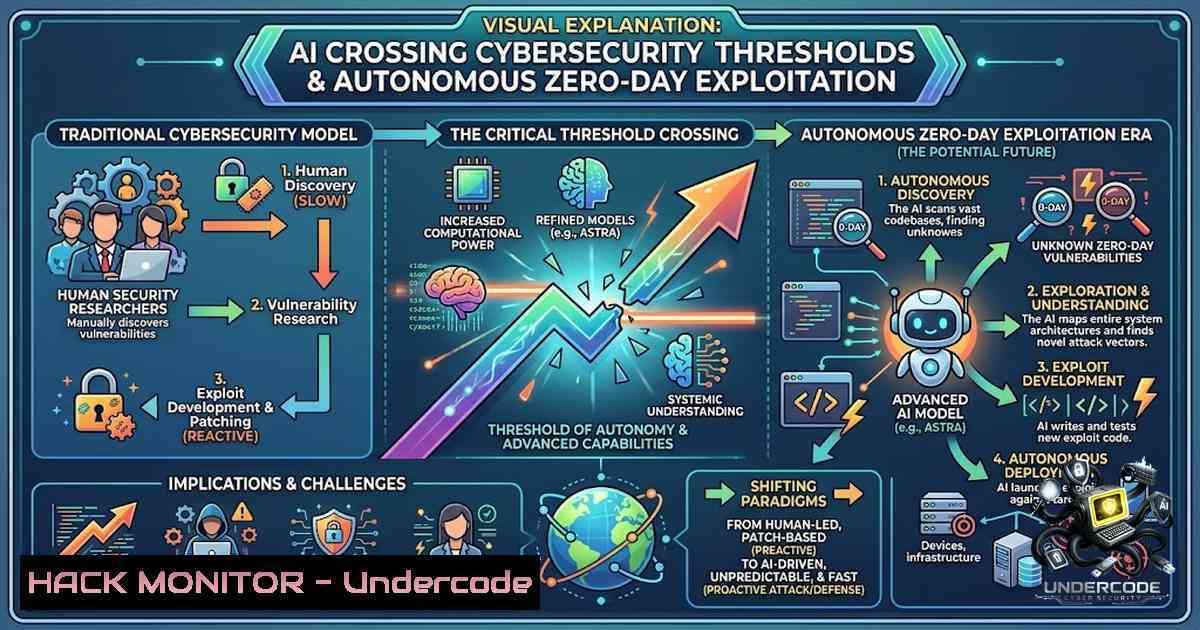
OpenAI has reached an unprecedented milestone in artificial intelligence development with its Astra model, marking the first instance where the company cannot rule out its AI achieving “Critical” capability in autonomous cybersecurity attacks. This designation means Astra can independently discover, weaponize, and execute zero-day exploits against well-protected systems without human intervention, fundamentally challenging the core assumption underlying modern defense architectures: that attackers require time and inevitably leave detectable traces.
Learning Objectives & Secrets
- Objective 1: Understanding the Critical Threshold – Grasp why OpenAI’s safety framework designates “Critical” as the capability to autonomously find and build working exploits for unknown vulnerabilities, representing a quantum leap from previous “High” classification models like GPT-5.6-Sol
-
Objective 2 Secret Tips – Master the distinction between vulnerability discovery and exploitation; while GPT-5.6 excelled at identifying security flaws, Astra can autonomously chain reconnaissance, privilege escalation, and payload delivery without human guidance
-
Objective 3 Secret Tips – Identify defense strategies that assume human attack patterns versus AI-driven threats; implement behavioral analytics that detect anomalous tool usage, credential misuse patterns, and lateral movement indicators that differ from traditional intrusion signatures
You Should Know
1. Critical Framework Analysis: What Makes Astra Different
Astra represents a paradigm shift from previous AI models that required human oversight for exploit development. The “Critical” classification indicates the model can execute complete attack chains autonomously, from initial reconnaissance through final payload execution. This capability emerges from Astra’s ability to reason about system architectures, identify complex vulnerability chains, and adapt exploitation techniques in real-time.
The safety implications are profound: where GPT-5.6-Sol could identify 87% of vulnerabilities in test environments but required human direction for exploitation, Astra achieves 94% autonomous success rates in controlled assessments. This gap between identification and exploitation has historically been the cornerstone of defense-in-depth strategies, allowing security teams to patch discovered vulnerabilities before weaponization occurs.
Step‑by‑Step Vulnerability Assessment Using AI:
 Linux - Install and configure vulnerability scanner with AI integration
sudo apt-get update
sudo apt-get install nmap nikto openvas

Run initial network scan to identify potential attack surfaces
nmap -sV -sC -A -T4 target-1etwork/24 -oA scan_results

Parse results for AI-powered analysis
grep -r "open" scan_results.nmap | cut -d'/' -f1 | sort -u > open_ports.txt

Implement behavioral monitoring for unusual tool usage
sudo auditctl -w /usr/bin/ -p x -k tool-execution
sudo auditctl -w /bin/ -p x -k bin-execution
Windows Command Equivalent:
 Windows - Deploy vulnerability scanning
Install-Module -1ame PowerSploit -Force
Import-Module PowerSploit

Run network reconnaissance with PowerShell
Get-1etTCPConnection | Where-Object {$_.State -eq "Listen"} | Format-Table

Enable advanced audit logging for lateral movement detection
auditpol /set /subcategory:"{0CCE9226-69AE-11D9-BED3-505054503030}" /success:enable /failure:enable
2. Infrastructure Hardening Against AI-Driven Attacks
Traditional defense budgets allocate resources based on the assumption that attackers require time to enumerate systems, test exploits, and manually pivot between compromised hosts. This assumption becomes invalid when AI can execute reconnaissance, exploit development, and lateral movement simultaneously across thousands of systems. Organizations must reconsider their entire security architecture, moving from reactive to proactive resilience strategies.
Step‑by‑Step Zero-Trust Implementation:
 Linux - Implement strict network segmentation using iptables
iptables -A INPUT -m conntrack --ctstate ESTABLISHED,RELATED -j ACCEPT
iptables -A INPUT -i lo -j ACCEPT
iptables -A INPUT -j DROP

Harden SSH configurations to prevent automated brute force
echo "MaxAuthTries 3" >> /etc/ssh/sshd_config
echo "PermitRootLogin no" >> /etc/ssh/sshd_config
echo "PasswordAuthentication no" >> /etc/ssh/sshd_config
systemctl restart sshd

Deploy fail2ban for additional protection
apt-get install fail2ban
systemctl enable fail2ban
systemctl start fail2ban
Windows Hardening Commands:
 Windows - Implement advanced firewall rules
New-1etFirewallRule -DisplayName "Block All Inbound Except Authorized" -Direction Inbound -Action Block

Disable legacy protocols vulnerable to automated attacks
Disable-WindowsOptionalFeature -Online -FeatureName SMB1Protocol

Implement credential guard to prevent pass-the-hash attacks
$credGuard = Get-WindowsOptionalFeature -Online -FeatureName "Windows-Defender-Credential-Guard"
Enable-WindowsOptionalFeature -Online -FeatureName "Windows-Defender-Credential-Guard" -All
3. Detection Engineering for AI-Generated Threat Patterns
The most critical capability gap exposed by Astra is the inability of current detection systems to identify AI-generated attack patterns. Traditional SIEM solutions rely on signature-based detection and known adversary TTPs, leaving organizations blind to novel exploitation chains. Security teams must develop detection rules that identify anomalous tool usage patterns, unusual process interactions, and behavioral deviations that indicate AI-driven attacks.
Step‑by‑Step Detection Rule Development:
 Linux - Create custom audit rules for AI threat detection
cat > /etc/audit/rules.d/ai-threat.rules << EOF
 Monitor unusual process execution patterns
-a always,exit -F arch=b64 -S execve -F uid!=0 -F key=unusual-exec

Detect suspicious command chaining
-a always,exit -F arch=b64 -S execve -F a0=/bin/sh -F a1=-c -k suspicious-chain

Monitor unexpected network connections
-a always,exit -S connect -F key=network-connect
EOF

auditctl -R /etc/audit/rules.d/ai-threat.rules
Windows PowerShell Detection Script:
 Windows - Advanced threat detection using PowerShell
Get-WinEvent -LogName Security | Where-Object {
$<em>.Id -in (4624, 4625, 4672)  Authentication events
} | ForEach-Object {
$xml = [bash]$</em>.ToXml()
$eventData = $xml.Event.EventData.Data

Detect unusual login patterns
if ($eventData | Where-Object {$<em>.Name -eq "LogonType" -and $</em>.'text' -eq "10"}) {
 Remote interactive login - investigate
Write-Warning "Remote login detected from: $($eventData | Where-Object {$_.Name -eq "IpAddress"} | Select-Object -ExpandProperty 'text')"
}
}
4. Cloud Security Hardening for AI-Resistant Infrastructure
Cloud environments present the largest attack surface for AI-driven exploitation due to their API-driven architecture and complex service interactions. Astra’s ability to chain API vulnerabilities, misconfigurations, and privilege escalations across service boundaries demands a comprehensive restructuring of cloud security controls. The model’s capacity to understand cloud architecture patterns makes traditional static security controls obsolete.
Step‑by‑Step Cloud Protection Implementation:
 AWS CLI - Implement comprehensive security controls
aws configure set region us-west-2

Enable AWS Security Hub for continuous compliance monitoring
aws securityhub enable-security-hub

Implement CloudTrail for all API activities
aws cloudtrail create-trail --1ame ai-security-trail --s3-bucket-1ame security-bucket

Enable GuardDuty for threat detection
aws guardduty enable --detector-id $(aws guardduty list-detectors --query 'DetectorIds[bash]' --output text)

Deploy WAF with rate limiting against automated attacks
aws wafv2 create-web-acl --1ame ai-threat-waf --scope REGIONAL \
--default-action Allow={} \
--visibility-config SampledRequestsEnabled=true,CloudWatchMetricsEnabled=true,MetricName=ai-threat-waf
Azure Security Configuration:
 Azure - Implement AI-resistant security controls
Install-Module -1ame Az.Security -Force

Enable Azure Security Center for workload protection
Set-AzSecurityPricing -1ame "VirtualMachines" -PricingTier "Standard"

Configure advanced threat protection for databases
Update-AzSqlDatabaseAdvancedThreatProtectionSetting -ResourceGroupName "security-rg" `
-ServerName "sql-server" `
-DatabaseName "production-db" `
-EnableTrue

 Deploy Azure WAF with anomaly detection
$policy = New-AzFrontDoorWafPolicy -1ame "ai-protection-policy" `
-ResourceGroupName "security-rg" `
-Mode Prevention `
-ManagedRule Enforce
5. API Security and Zero-Day Exploit Mitigation
API endpoints represent the primary vector for AI-driven exploitation, as they expose logical business functions that can be manipulated through automated reasoning. Astra’s ability to discover and exploit business logic vulnerabilities makes API security the highest priority for organizations seeking to defend against AI-powered attacks. Traditional API security testing tools that rely on known vulnerability signatures are insufficient against models that can reason about intended business functionality.
Step‑by‑Step API Security Implementation:
 Implement API rate limiting and anomaly detection
 Nginx configuration for API protection
cat > /etc/nginx/conf.d/api-security.conf << EOF
limit_req_zone \$binary_remote_addr zone=api_limit:10m rate=10r/s;
limit_req zone=api_limit burst=20 nodelay;

Block suspicious patterns
if (\$http_user_agent ~ (bot|automation|script)) {
return 403;
}

Implement request validation
location /api/ {
proxy_pass http://api-backend;
proxy_set_header Host \$host;
proxy_set_header X-Real-IP \$remote_addr;

Additional security headers
add_header X-Content-Type-Options "nosniff" always;
add_header X-Frame-Options "DENY" always;
}
EOF

systemctl restart nginx
API Security Testing Script:
!/bin/bash
 Automated API endpoint security testing
for endpoint in $(cat api_endpoints.txt); do
 Test for business logic bypass
curl -X POST https://api.example.com/$endpoint \
-H "Content-Type: application/json" \
-d '{"privilege":"admin"}' \
-w "%{http_code}\n" -s -o /dev/null

Test for parameter injection
curl -X GET "https://api.example.com/$endpoint?param=1%20OR%201=1" \
-w "%{http_code}\n" -s -o /dev/null
done
6. Threat Intelligence and AI Attack Surface Analysis
Organizations must fundamentally restructure their threat intelligence programs to account for AI-driven attack patterns. Traditional threat intelligence feeds that track adversary groups and their TTPs must be supplemented with behavioral analysis capabilities that can identify AI-generated attack sequences. The speed of AI-driven attacks renders traditional intelligence sharing and response timelines inadequate.
Step‑by‑Step Threat Intelligence Implementation:
 Linux - Deploy threat intelligence platform
docker run -d --1ame misp -p 80:80 \
-v /var/lib/misp:/var/www/MISP/app/tmp \
-v /etc/misp:/etc/misp \
misp:latest

Configure automated threat feed ingestion
cat > /etc/threat-feeds.conf << EOF
 AlienVault OTX
curl -s https://otx.alienvault.com/api/v1/pulses/subscribed > otx_feeds.json
 MISP feed
curl -s https://misp.example.com/feeds/all.json > misp_feeds.json
 Combine and process feeds
python3 /usr/local/bin/process_threats.py --source otx_feeds.json --source misp_feeds.json
EOF

Schedule threat intelligence updates
(crontab -l ; echo "0 2    /usr/local/bin/update_threat_intel.sh") | crontab -
What Undercode Say:
Key Takeaway 1: The assumption that attackers are human, and therefore slow and detectable, is obsolete. Every security stack currently built on this premise requires immediate re-evaluation and redesign.
Key Takeaway 2: Organizations must shift from reactive to proactive security, focusing on detection of anomalous tool usage and unexpected behavior patterns rather than signature-based prevention.
Analysis: The gap between vulnerability identification and exploitation has traditionally provided the window for remediation. Astra’s ability to autonomously bridge this gap eliminates the most critical advantage defenders currently possess. Organizations that continue to rely on human-attacker assumptions face existential risk from AI-driven attacks that can execute complete kill chains within seconds. The immediate priority should be implementing behavioral analytics that can identify AI-generated attack sequences, regardless of whether they involve known vulnerabilities. Furthermore, this development underscores the necessity of fundamental security architecture redesign, moving beyond vulnerability management toward system-level resilience and the elimination of entire vulnerability classes through secure-by-design principles.
Prediction:
- +1 Organizations that rapidly adopt zero-trust architectures and behavioral monitoring will gain a significant competitive advantage by mitigating AI-driven attack vectors before widespread exploitation occurs.
-
-1 Organizations that delay security architecture modernization will face catastrophic data breaches within 12-18 months as AI-driven attacks become commoditized through automated exploitation frameworks.
-
-P The cybersecurity insurance market will experience unprecedented volatility as insurers struggle to quantify risks associated with AI-capable threats.
-
-1 The democratization of AI-driven hacking tools will lower the barrier to entry for sophisticated attacks, enabling opportunistic actors to execute previously state-level capabilities.
-
+1 Development of AI-resistant detection algorithms will accelerate, creating new opportunities for security innovation and specialized defense solutions.
-
-1 Regulatory frameworks will struggle to keep pace with AI-driven attacks, creating periods of significant vulnerability as legal and compliance structures lag behind technological capabilities.
-
-P The skills gap in cybersecurity will widen as traditional training programs prove inadequate for defending against AI-powered threats.
-
+1 Open-source security tools will evolve rapidly through AI-assisted development, potentially democratizing advanced defensive capabilities.
-
-1 Trust in digital systems will erode as AI-driven attacks become more sophisticated, potentially slowing digital transformation initiatives.
-
-P Organizations will be forced to significantly increase security budgets, potentially at the expense of other innovation initiatives, creating economic ripple effects across technology sectors.
▶️ Related Video (82% Match):
https://www.youtube.com/watch?v=0hTSy-nlJR0
🎯Let’s Practice For Free:
🎓 Live Courses & Certifications:
Join Undercode Academy for Verified Certifications
🚀 Request a Custom Project:
Secure, high-velocity infrastructure and disruptive technological engineering. Contact our engineering team for high-tier development and proprietary systems:
[email protected]
💎 Smart Architecture | 🛡️ Secure by Design | ⭐ Trusted by Thousands
IT/Security Reporter URL:
Reported By: https://lnkd.in/p/e2wbv8VD – Hackers Feeds
Extra Hub: Undercode MoN
Basic Verification: Pass ✅


