Listen to this Post
Introduction:
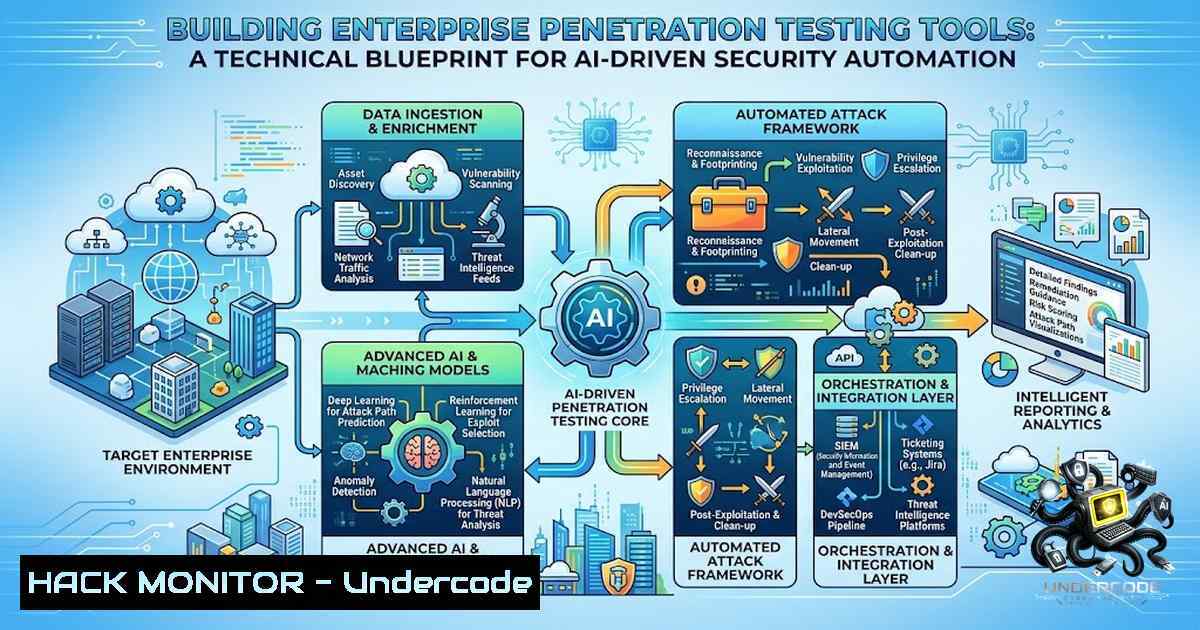
The evolution of penetration testing from manual, labor-intensive processes to autonomous, AI-driven platforms represents a paradigm shift in application security. By integrating machine learning agents that operate in read-only, safe modes, organizations can now continuously discover and validate vulnerabilities without the operational overhead of traditional testing cycles. This technical blueprint explores the architectural decisions, development workflows, and security controls necessary to build an enterprise-grade automated penetration testing tool, similar to the platform discussed by SpiderSwift, which leverages an AI agent named Ralph to perform non-destructive vulnerability detection across modern web applications and APIs.
Learning Objectives & Secrets:
- Objective 1: Understand the core architecture of an autonomous security scanner, including safe-mode execution and endpoint discovery.
- Objective 2 (Secret Tip): Implement dynamic parameter analysis for SQL injection and XSS by using fuzzing dictionaries that adapt based on server response headers and status codes, rather than static payload lists.
- Objective 3 (Secret Tip): Enhance JWT analysis by automatically rotating cryptographic keys and testing for algorithm confusion attacks (e.g., RS256 to HS256) to uncover critical authentication bypasses.
You Should Know:
1. Autonomous Vulnerability Discovery and Safe-Mode Scanning
The cornerstone of the platform is the Ralph AI Agent, which operates under strict safe-mode policies. This means all payloads are executed in a sandboxed environment where database write operations, file system modifications, and system commands are intercepted and blocked. The agent begins by crawling the target application to build a comprehensive site map, identifying all endpoints, parameters, and JavaScript files. For each discovered endpoint, it performs a series of read-only tests. For example, when testing for Path Traversal, the agent attempts to read sensitive files like `/etc/passwd` on Linux or `C:\Windows\win.ini` on Windows using encoded payloads such as ..%252f..%252fetc%252fpasswd. To verify vulnerabilities without causing harm, the agent checks for the presence of known strings (e.g., “root:x:”) in the response body. If detected, the vulnerability is logged, but the test stops there, ensuring no data is exfiltrated or altered. This approach allows for continuous scanning without the risk of production downtime or data corruption.
Step‑by‑step guide for implementing safe-mode scanning in a custom Python script:
1. Setup: Initialize a Python virtual environment and install `requests` and beautifulsoup4.
2. Crawling: Use a recursive function to visit all links within the target domain, respecting `robots.txt` rules.
3. Parameter Fuzzing: For each form and URL parameter, inject a set of benign test strings (e.g., `test’ OR ‘1’=’1` for SQL injection) and analyze the HTTP response for error messages or timing differences.
4. Response Analysis: Implement a rule-based engine that flags potential vulnerabilities based on regex patterns (e.g., `SQL syntax` error messages).
5. Reporting: Store findings in a JSON file with detailed request/response pairs for manual verification.
2. Comprehensive Testing Modules and API Security
The platform includes critical testing modules that cover OWASP Top 10 vulnerabilities. SQL Injection testing goes beyond simple boolean-based blind injection; it employs time-based and out-of-band techniques for databases where error messages are suppressed. XSS Testing includes payloads that attempt to bypass Content Security Policy (CSP) by using event handlers and `javascript:` URIs. IDOR/BOLA testing is particularly challenging; the agent systematically modifies user identifiers (e.g., `user_id=123` to user_id=124) and checks if the response contains data belonging to another user. For API Security, the platform integrates JWT Analysis, which decodes the token and checks for vulnerabilities like missing expiration, weak signing keys (secret), and improper claim validation. To harden your APIs, you can use the following command to brute-force a weak JWT secret on Linux using hashcat:
hashcat -a 0 -m 16500 jwt_token.txt /usr/share/wordlists/rockyou.txt
This tests if the token’s `HS256` signature can be forged, a critical step in API security assessments. Furthermore, Rate Limiting tests are performed by sending high-frequency requests to identify DoS vulnerabilities. On Linux, you can simulate this with `ab -1 1000 -c 100 https://target.com/api/endpoint`.
3. Development Workflow and Automation Pipeline
A robust CI/CD integration is essential for embedding security into the development lifecycle. The platform’s workflow begins with project creation where the user defines the target URL and authentication tokens. The AI agent then scans the application in stages: first, discovering endpoints passively by analyzing client-side JavaScript; second, actively testing each endpoint with non-destructive payloads; and third, generating a detailed report. To integrate this into a pipeline, you can use a shell script that triggers the scanner upon every new deployment:
!/bin/bash
 Linux command to trigger a scan after a new commit
curl -X POST https://api.spiderswift.com/v1/scan \
-H "Authorization: Bearer $API_KEY" \
-d '{"target":"https://staging.myapp.com", "safe_mode":true}'
This ensures that vulnerabilities are caught early. On Windows, you can use PowerShell:
Invoke-RestMethod -Method Post -Uri "https://api.spiderswift.com/v1/scan" -Headers @{Authorization="Bearer $env:API_KEY"} -Body '{"target":"https://staging.myapp.com", "safe_mode":true}'
The system then reviews the findings, and the developer is notified via Slack or email.
4. Reporting and Analytics with Visualization (Recharts)
The platform uses Recharts to generate interactive dashboards that present vulnerability severity distributions. Critical findings are highlighted in red, while informational items are in gray. The trend analysis chart visualizes the number of vulnerabilities discovered over time, helping security teams understand whether their remediation efforts are effective. To export a professional report, the platform compiles all findings into a PDF, including executive summaries and technical details. For organizations seeking to implement similar reporting, you can leverage open-source tools like `pandoc` to convert Markdown vulnerability reports to PDF:
pandoc report.md -o report.pdf --template=template.tex
On Windows, you can use `wkhtmltopdf` to convert HTML reports to PDF:
wkhtmltopdf report.html report.pdf
5. Cloud Security and Infrastructure Hardening
Given the platform’s reliance on serverless and cloud-1ative components (NextJS, Supabase, Vercel), cloud security is paramount. The platform enforces security controls such as encrypted environment variables, secrets rotation, and strict IAM policies. For instance, when using Supabase (PostgreSQL), the platform implements row-level security (RLS) to ensure that each user can only access their own scan results. A typical RLS policy in SQL looks like:
CREATE POLICY user_scan_policy ON scans FOR SELECT USING (auth.uid() = user_id);
Additionally, the platform uses Vercel’s edge functions for rate limiting, preventing abuse of the scanning API. To harden your serverless infrastructure, ensure that all third-party dependencies are scanned for known vulnerabilities using tools like npm audit:
npm audit --audit-level=moderate
What Undercode Say:
- Key Takeaway 1: The integration of an AI agent with safe-mode scanning bridges the gap between continuous security testing and operational stability, allowing for daily scans without fear of production outages.
- Key Takeaway 2: Effective vulnerability assessment is not just about running tools but about implementing a feedback loop where findings are automatically triaged and linked to developer workflows, enabling faster remediation.
The platform exemplifies how modern security engineering can be woven into the fabric of development. By focusing on non-destructive testing, organizations can shift their security posture from reactive to proactive. The use of clear visualizations and automated reporting democratizes security data, making it accessible to both technical and non-technical stakeholders. However, the reliance on automation should not eliminate the need for human expertise; complex business logic flaws and privilege escalation vulnerabilities still require manual oversight.
Prediction:
- +1: The trend towards autonomous security agents will empower small teams to achieve enterprise-grade security coverage, significantly democratizing access to advanced penetration testing capabilities.
- +1: As AI models improve, we can expect a 90% reduction in false positives, making automated remediation pipelines more reliable and actionable.
- -1: The rise of AI-driven testing will lead to an arms race, where attackers develop AI to bypass detection, necessitating continuous model retraining and adaptive defense mechanisms.
- -1: Organizations may become over-reliant on automated tools, potentially overlooking complex, multi-step vulnerabilities that require human reasoning and contextual understanding.
▶️ Related Video (84% Match):
🎯Let’s Practice For Free:
🎓 Live Courses & Certifications:
Join Undercode Academy for Verified Certifications
🚀 Request a Custom Project:
Secure, high-velocity infrastructure and disruptive technological engineering. Contact our engineering team for high-tier development and proprietary systems:
[email protected]
💎 Smart Architecture | 🛡️ Secure by Design | ⭐ Trusted by Thousands
IT/Security Reporter URL:
Reported By: https://lnkd.in/p/ekaZ3xqu – Hackers Feeds
Extra Hub: Undercode MoN
Basic Verification: Pass ✅


