
Listen to this Post
Introduction:
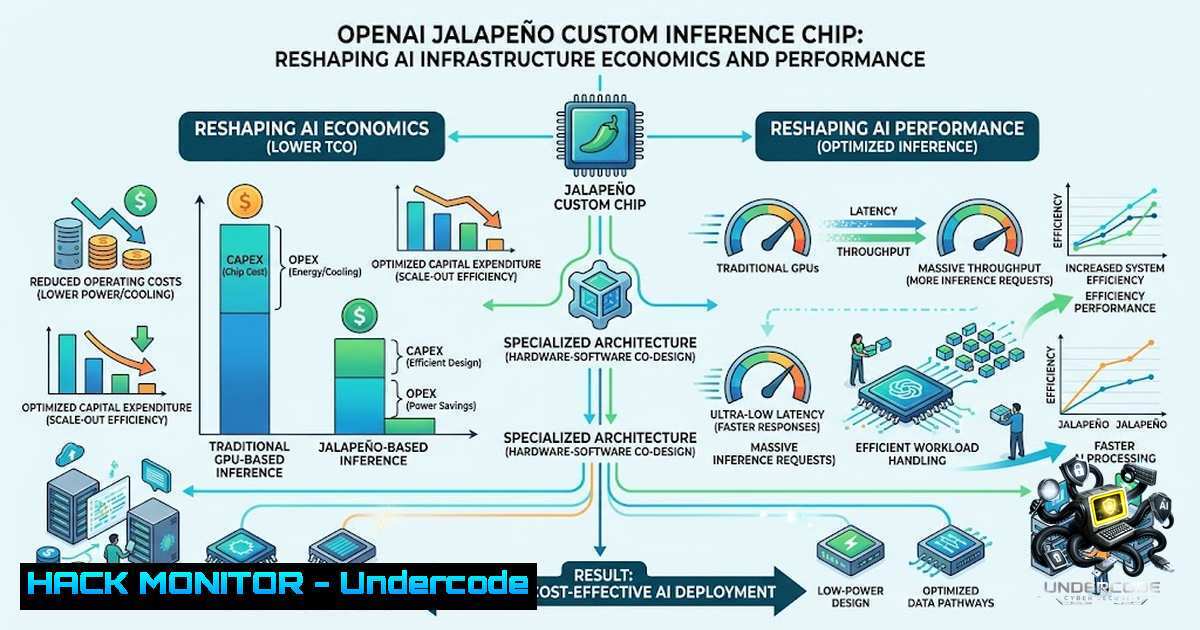
OpenAI has published the first measured performance results for Jalapeño, its custom inference chip developed with Broadcom. On the public InferenceX benchmark using GPT-OSS 120B, Jalapeño delivered approximately 1.9 times higher peak throughput per kilowatt and significantly lower token latency than commercial systems including NVIDIA GB200 and GB300. This marks a strategic shift in the AI industry—leading model providers are now designing the infrastructure beneath their products rather than relying entirely on commercial chips.
Learning Objectives & Secrets:
- Objective 1: Understand Jalapeño’s architectural advantages—a purpose-built ASIC with 216 GB of HBM4 memory, 15.4 TB/s bandwidth, and 700W TDP (sustained at ≤550W), delivering 3.4 MXFP8 PFLOPS and 13.4 MXFP4 PFLOPS
- Objective 2 Secret Tip: Leverage the NUMA-style spatial architecture—Jalapeño uses single-token prediction while baselines use multi-token prediction, yet still achieves 1.5–1.9× more work per watt and 1.7–3.6× lower end-to-end latency
- Objective 3 Secret Tip: Deploy at scale—128-chip racks deliver 1.7 ExaFLOPs of 4-bit processing, scaling to 2,048 ASICs in 16-rack pods offering 27 EFLOPS and 32 PB/s aggregate memory bandwidth
1. Understanding InferenceX Benchmarking and Performance Metrics
InferenceX, developed by semiconductor research firm SemiAnalysis, is a public benchmark measuring full AI request processing from prefill to decode. OpenAI tested Jalapeño across three models: GPT-OSS 120B (OpenAI’s own), DeepSeek R1 670B, and Kimi K2.5 1T. Results normalized to package TDP showed Jalapeño at 700W versus GB200 at 1.2kW and GB300 at 1.4kW.
Step-by-Step Guide to Reproduce Performance Testing:
 Linux - Monitor GPU/accelerator power consumption during inference
nvidia-smi --query-gpu=power.draw,utilization.gpu,memory.used --format=csv

For custom ASIC monitoring (conceptual - vendor-specific tools)
 Measure tokens per second per kilowatt
echo "Throughput per kW = (tokens/sec) / (power_consumption_watts / 1000)"

Simulate inference latency testing
time curl -X POST https://api.openai.com/v1/completions \
-H "Authorization: Bearer $API_KEY" \
-H "Content-Type: application/json" \
-d '{"model":"gpt-oss-120b","prompt":"Test latency","max_tokens":100}'
Windows PowerShell Equivalent:
 Monitor GPU power (NVIDIA SMI on Windows)
& "C:\Program Files\NVIDIA Corporation\NVSMI\nvidia-smi.exe" --query-gpu=power.draw,utilization.gpu --format=csv

Measure API latency
Measure-Command { Invoke-RestMethod -Uri "https://api.openai.com/v1/completions" -Method Post -Headers @{Authorization="Bearer $env:API_KEY"} -Body '{"model":"gpt-oss-120b","prompt":"Test","max_tokens":50}' }
2. Full-Stack Co-Design: The Jalapeño Architecture
OpenAI designed Jalapeño as an integrated system spanning chips, memory, network, serving software, and models. The architecture minimizes data movement and communication latency—KV caches and model states are explicitly stored locally, with resources allocated per inference phase. The chip moved from initial RTL to tapeout in approximately nine months.
Step-by-Step Guide to Optimize Inference Throughput:
 Linux - Optimize NUMA memory allocation for inference workloads
numactl --cpunodebind=0 --membind=0 ./inference_server --model gpt-oss-120b

Set HugePages for memory-intensive LLM inference
echo 2048 > /proc/sys/vm/nr_hugepages
mount -t hugetlbfs none /mnt/huge

Monitor memory bandwidth (likwid on Linux)
likwid-perfctr -C 0-7 -g MEM_DP ./inference_benchmark
Windows Configuration for High-Performance Inference:
 Set large pages for Windows Server
Set-ItemProperty -Path "HKLM:\SYSTEM\CurrentControlSet\Control\Session Manager\Memory Management" -1ame "LargePageMinimum" -Value 1

Monitor performance counters
Get-Counter "\Memory\Available MBytes" -Continuous
Get-Counter "\Processor(_Total)\% Processor Time" -Continuous
3. Power Efficiency and Cost Economics
Jalapeño’s sustained power consumption stays at or below 550W during active workloads, less than half of GB300’s 1.4kW rating. This translates to 1.5–1.9× more AI work per watt, directly impacting inference costs. For business leaders, the relevant metric is whether custom infrastructure improves economics, speed, and reliability enough to expand production workflows.
Step-by-Step Guide to Calculate Inference Cost Efficiency:
 Linux - Calculate cost per 1M tokens
echo "Cost per 1M tokens = (instance_cost_per_hour  power_consumption_kW  hours_per_month) / (tokens_per_second  3600  1e6)"

Monitor real-time power consumption (if using IPMI)
ipmitool dcmi power reading

Estimate token throughput from API logs
grep "tokens" /var/log/inference.log | awk '{sum+=$NF} END {print "Total tokens: " sum}'
Windows Power Monitoring:
 Get power consumption via WMI
Get-WmiObject -Class Win32_PerfFormattedData_Counters_PowerMeter | Select-Object Power, Frequency

Calculate monthly inference cost estimate
$tokensPerSec = 1400  Kimi K2.5 performance
$powerKW = 0.7
$hoursPerMonth = 720
$costPerKWh = 0.12
$costPerMonth = $powerKW  $hoursPerMonth  $costPerKWh
Write-Host "Monthly power cost: $$costPerMonth"
4. Scaling Infrastructure: From Racks to Pods
Jalapeño scales to 128 accelerators per rack interconnected via Ethernet at 600 GB/s, and 2,048 ASICs in 16-rack pods at 200 GB/s per processor. This distributed architecture supports agentic workloads requiring continuous multi-step reasoning where latency accumulates across steps.
Step-by-Step Guide to Configure Distributed Inference:
 Linux - Configure Ethernet fabric for multi-rack scaling
 Set up RoCE (RDMA over Converged Ethernet)
echo "options mlx5_core roce_en=1" >> /etc/modprobe.d/mlx5.conf
modprobe mlx5_core

Verify interconnect bandwidth
ib_write_bw -d mlx5_0 -x 3 --report_gbits

Scale inference across multiple nodes using Kubernetes
kubectl create deployment jalapeno-inference --image=openai/inference:latest --replicas=128
kubectl expose deployment jalapeno-inference --port=8080 --target-port=8080
Windows Container Orchestration:
 Docker Desktop with Kubernetes on Windows
kubectl config use-context docker-desktop
kubectl apply -f jalapeno-inference-deployment.yaml

Check pod distribution
kubectl get pods -o wide
5. Security and API Hardening for Inference Workloads
As inference becomes more distributed, API security and access control become critical. Jalapeño’s deployment will affect API pricing, latency, and capacity.
Step-by-Step Guide to Secure AI Inference APIs:
 Linux - Implement rate limiting with nginx
limit_req_zone $binary_remote_addr zone=inference:10m rate=10r/s;
limit_req zone=inference burst=20 nodelay;

Enforce TLS 1.3 only
ssl_protocols TLSv1.3;
ssl_ciphers TLS_AES_256_GCM_SHA384:TLS_CHACHA20_POLY1305_SHA256;

Monitor API abuse with fail2ban
fail2ban-client set openai-api banip $MALICIOUS_IP
Windows API Security Configuration:
 Configure IIS rate limiting
Install-WindowsFeature -1ame Web-Server -IncludeAllSubFeature
Add-WebConfigurationProperty -Filter "system.webServer/security/requestFiltering" -1ame "requestLimits" -Value @{maxUrl="4096"; maxQueryString="2048"}

Enable Windows Defender Firewall for inference ports
New-1etFirewallRule -DisplayName "Inference API" -Direction Inbound -Protocol TCP -LocalPort 8080 -Action Allow -Profile Domain,Private
6. Mitigating Supply Chain and Vendor Lock-in Risks
OpenAI maintains a portfolio including AWS, AMD, Broadcom, Cerebras, CoreWeave, Microsoft, NVIDIA, Oracle, SB Energy, and SoftBank. Jalapeño provides a credible first-party path alongside partner accelerators, expanding the ability to match workloads to optimal cost-performance systems.
Step-by-Step Guide to Multi-Provider Load Balancing:
 Linux - HAProxy configuration for multi-provider routing
backend inference_backend
balance roundrobin
server openai-jalapeno jalapeno-cluster:8080 check weight 100
server nvidia-gb300 nvidia-cluster:8080 check weight 70
server amd-mi355x amd-cluster:8080 check weight 50

Monitor provider latency and cost
curl -w "Time: %{time_total}s\n" -o /dev/null -s https://api.provider1.com/v1/inference
Windows Multi-Provider Monitoring:
 PowerShell script to compare inference costs across providers
$providers = @("openai", "azure", "aws")
foreach ($p in $providers) {
$latency = Measure-Command { Invoke-WebRequest -Uri "https://api.$p.com/health" }
Write-Host "$p latency: $($latency.TotalMilliseconds)ms"
}
7. Deployment Roadmap and Future Generations
OpenAI plans to begin deploying Jalapeño in its computing infrastructure by the end of 2026, with a second-generation processor already at an advanced stage and third-generation work underway. The company will continue deploying NVIDIA and partner hardware for both training and inference.
Step-by-Step Guide to Plan Infrastructure Migration:
 Linux - Capacity planning for Jalapeño deployment
 Estimate current inference load
grep "inference_request" /var/log/api.log | wc -l

Calculate required Jalapeño chips
REQUIRED_CHIPS=$(echo "scale=0; $DAILY_REQUESTS / ($TOKENS_PER_CHIP  3600  24)" | bc)
echo "Estimated chips needed: $REQUIRED_CHIPS"

Simulate phased rollout in Kubernetes
kubectl set image deployment/inference jalapeno=openai/jalapeno:v1 --record
kubectl rollout status deployment/inference
What Undercode Say:
- Key Takeaway 1: Vendor-reported benchmarks are not proof that customer prices will fall or every workload will run faster—watch for independent benchmark results, deployment at scale, and measurable effects on API pricing, latency, or capacity.
-
Key Takeaway 2: The strategic change is clear: leading model providers are designing more infrastructure beneath their products instead of relying entirely on commercial chips. This vertical integration trend—following Google, Meta, and Amazon—signals a fundamental shift in AI infrastructure economics.
Analysis: The Jalapeño announcement represents a pivotal moment in AI infrastructure, but several critical questions remain unanswered. First, independent benchmark verification is essential—vendor-reported results often reflect ideal conditions not reproducible in production. Second, deployment at scale will reveal real-world challenges including thermal management of 700W chips in dense racks and software optimization across heterogeneous hardware. Third, the economic impact on API pricing depends on whether efficiency gains translate to lower customer costs or higher margins. Fourth, the multi-generation roadmap suggests OpenAI is committed to custom silicon long-term, potentially reducing dependence on NVIDIA and reshaping the accelerator market. Finally, the full-stack co-design approach—integrating chips, models, and software—may become the new competitive battleground, favoring vertically integrated AI providers over pure-play hardware vendors.
Prediction:
- +1 Jalapeño will accelerate the commoditization of AI inference, enabling new use cases in real-time agents, autonomous systems, and edge deployment as costs decrease
- +1 OpenAI’s custom silicon strategy will pressure NVIDIA to accelerate innovation and pricing, benefiting the entire AI ecosystem through increased competition
- -1 Short-term API pricing may not decrease if OpenAI prioritizes margin expansion over passing savings to customers
- -1 Early adopters face migration risks as software optimization for Jalapeño may lag behind mature NVIDIA CUDA ecosystems
- +1 The nine-month development cycle demonstrates AI-accelerated chip design—models assisted in design, verification, and optimization, potentially revolutionizing semiconductor development timelines
▶️ Related Video (86% Match):
🎯Let’s Practice For Free:
🎓 Live Courses & Certifications:
Join Undercode Academy for Verified Certifications
🚀 Request a Custom Project:
Secure, high-velocity infrastructure and disruptive technological engineering. Contact our engineering team for high-tier development and proprietary systems:
[email protected]
💎 Smart Architecture | 🛡️ Secure by Design | ⭐ Trusted by Thousands
IT/Security Reporter URL:
Reported By: https://lnkd.in/p/eY96pcnt – Hackers Feeds
Extra Hub: Undercode MoN
Basic Verification: Pass ✅


