
Listen to this Post
Introduction:
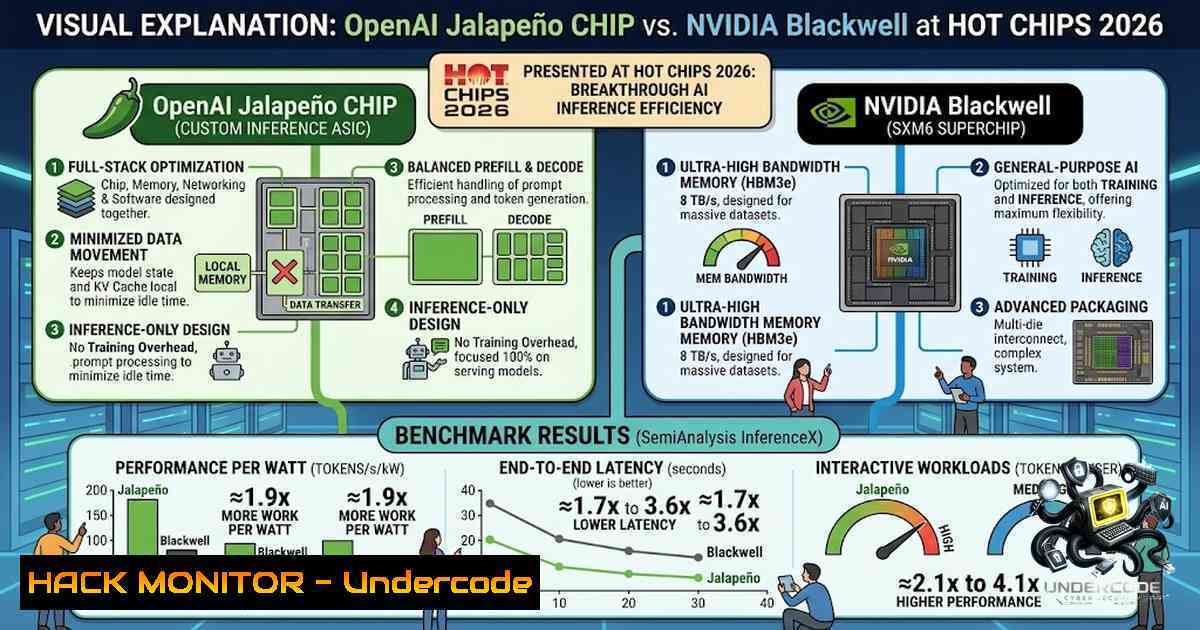
The landscape of AI hardware is witnessing a pivotal shift as OpenAI unveils its custom inference chip, codenamed “Jalapeño,” at the Hot Chips 2026 conference. This new silicon, co-developed with Broadcom, directly challenges Nvidia’s dominant position in the AI accelerator market by delivering superior performance-per-watt and drastically lower latency for large language model inference. This strategic move highlights a growing trend where AI model developers are vertically integrating hardware to gain a competitive edge, focusing on architectural innovations like localized KV caching and reduced data movement to solve bottlenecks that general-purpose accelerators cannot address.
Learning Objectives & Secrets:
- Objective 1: Understand the performance metrics where the Jalapeño chip outperforms Nvidia Blackwell and Rubin, including throughput per kilowatt and interactive workload performance.
- Objective 2 (Secret Tip): Master the art of optimizing AI inference by minimizing data movement, a core design philosophy of the Jalapeño chip that reduces prefill and communication phase delays.
- Objective 3 (Secret Tip): Learn how vertical integration (models, chips, memory) allows for specific cost efficiencies, enabling API price reductions while maintaining a competitive hardware advantage.
You Should Know:
- Diving Deep into the Jalapeño Architecture and Performance Metrics
The Jalapeño chip’s success is rooted in its architecture, which specifically targets the inefficiencies of current AI accelerators. By focusing on reducing data movement, it effectively minimizes the time spent moving data between compute cores and memory, a primary bottleneck in transformer-based models. The chip’s design keeps the KV (Key-Value) cache local to the processing units, drastically improving inference speed. To understand the significance of these performance claims, one must look at benchmark results: Jalapeño delivers 1.5 to 1.9 times more AI work per watt at peak throughput and offers 1.7 to 3.6 times lower latency compared to Nvidia Blackwell. This is critical for real-time applications, such as interactive AI agents and complex reasoning tasks that require immediate responses.
Step‑by‑step guide to analyzing AI chip performance:
- Identify Key Metrics: Focus on “tokens per second per watt” and “time-to-first-token” (TTFT) as primary indicators of inference efficiency.
- Analyze the Workload: Understand the difference between prefill (processing the initial prompt) and decode (generating subsequent tokens) phases. Jalapeño excels by optimizing prefill and communication.
- Use Benchmarking Tools: For on-premise systems, you can use tools like `llama.cpp` with built-in benchmarking flags to measure inference speed.
 Linux/Ubuntu command to run a benchmark using llama.cpp
./llama-bench -m /path/to/model.gguf -t 4 -r 5
This command runs the Llama benchmark with 4 threads and 5 repetitions, outputting tokens per second for various batch sizes. Compare this to cloud-based metrics to understand relative performance.
2. The Cost-Efficiency Equation and Vertical Integration
OpenAI’s strategy is not just about raw performance; it’s about economic efficiency. The chip enables a significant reduction in operational costs, which OpenAI has passed on to consumers by reducing GPT-5.6 Sol API prices by 20% to 33%. This is a direct result of a full-stack strategy where the models, the chips they run on, and the memory subsystems are co-designed to work seamlessly. This approach allows OpenAI to identify and solve bottlenecks that standard accelerators would miss, resulting in hardware that is specifically tailored to their unique model architectures.
Step‑by‑step guide to implementing cost-saving AI inference:
- Evaluate Instance Types: Compare the cost per million tokens on various cloud providers (AWS, Azure, GCP) against the new OpenAI pricing.
- Consider Quantization: For on-premise deployments, using quantization (e.g., INT8, FP8) can reduce memory bandwidth requirements, mimicking the efficiency gains seen in custom hardware.
- Monitor Throughput: Use monitoring tools to ensure you are utilizing your compute resources to peak efficiency to maximize output per kilowatt-hour.
 PowerShell command to check GPU utilization on Windows
nvidia-smi --query-gpu=utilization.gpu,memory.used,power.draw --format=csv
This command provides real-time data on GPU utilization and power draw, helping to correlate power efficiency with workload performance, a key metric for the Jalapeño chip’s success.
3. Strategic Implications for the AI Industry
OpenAI’s move into custom silicon is a significant threat to Nvidia’s market position. By creating its own chip, OpenAI is no longer solely reliant on Nvidia’s release cycles. While the chip is expected in small volumes at the end of 2026 and mass production in 2027, this timeline is a strategic chess move. By the time Jalapeño is widely available, Nvidia will have likely released its own next-generation chips. However, the control over the entire stack gives OpenAI the ability to iterate and adapt its hardware as its models evolve. This fosters a competitive landscape where specialization and co-optimization become key differentiators.
Step‑by‑step guide to using alternative AI frameworks:
- Explore Alternative Hardware: Research and test AI workloads on other hardware, such as AMD’s MI300X or Google’s TPUs, to reduce vendor lock-in.
- Framework Agnosticism: Use open-source frameworks like PyTorch or JAX, which support multiple backends, to ensure your models are portable and can be easily moved between different hardware platforms.
- Simulate Performance: For architecture evaluation, use tools like `ArchSim` or custom simulators to model the expected performance of a custom chip based on your specific model’s memory and compute requirements.
4. Hands-on Tool Configurations for AI Model Deployment
To truly appreciate the significance of the Jalapeño chip, it is essential to understand the configuration of current AI deployment tools that manage performance. Optimizing model serving involves adjusting batch sizes, sequence lengths, and memory management to maximize throughput. The Jalapeño chip automates many of these optimizations at the hardware level, but understanding them is crucial for efficient deployment on standard hardware.
Step‑by‑step guide for optimizing a model with TensorRT-LLM on Linux:
1. Install TensorRT-LLM:
pip install tensorrt-llm
2. Convert a Model: Use a script to convert a Hugging Face model to a TensorRT-LLM checkpoint.
3. Build an Engine: Build a TensorRT engine with specific parameters to balance performance and memory.
trtllm-build --checkpoint_dir /path/to/checkpoint --output_dir /path/to/engine --gemm_plugin float16 --max_batch_size 16 --max_input_len 1024 --max_output_len 512
4. Run Inference: Use the generated engine to serve the model, noting the tokens per second and latency.
- API Security and Cloud Hardening in the Era of Custom Silicon
As AI inference becomes more efficient and widespread, API security and cloud hardening become increasingly critical. More efficient chips mean that malicious actors can also afford to run more sophisticated attacks, such as prompt injection or model extraction at scale. Securing the API endpoints and the underlying infrastructure is paramount.
Step‑by‑step guide for hardening an AI API:
- Implement Rate Limiting: Use a reverse proxy like Nginx or cloud-1ative solutions (AWS WAF) to limit API calls per user.
- Use API Keys and Tokens: Ensure all requests require a valid, short-lived JWT token for authentication.
- Validate Inputs: Implement strict input validation and sanitization to prevent prompt injection and other forms of data poisoning.
- Monitor Anomalies: Set up monitoring and logging (e.g., using AWS CloudWatch or Splunk) to detect unusual patterns or excessive API calls that could indicate an attack.
 Example of an Nginx configuration for rate limiting
http {
limit_req_zone $binary_remote_addr zone=mylimit:10m rate=5r/m;
server {
location /api {
limit_req zone=mylimit burst=10 nodelay;
proxy_pass http://ai_service;
}
}
}
This Nginx configuration limits API requests to 5 per minute with a burst of 10, protecting the backend service from being overwhelmed by potential attackers.
What Undercode Say:
- Key Takeaway 1: OpenAI’s custom chip represents a paradigm shift towards vertical integration, where AI leaders design their own hardware to break free from the constraints of general-purpose accelerators.
- Key Takeaway 2: The co-design of models and hardware is the new frontier for achieving cost efficiency, enabling price cuts that can disrupt the competitive landscape of AI APIs.
- Key Takeaway 3: The success of the Jalapeño chip hinges on a deep understanding of data movement and communication bottlenecks, a lesson for all developers striving to optimize AI workloads.
Prediction:
- +1 This move will accelerate innovation in the AI hardware space, pushing incumbents like Nvidia to innovate more aggressively.
- +1 OpenAI’s vertical integration will create a new standard for AI efficiency, potentially making AI models more accessible and affordable for a wider range of developers.
- -1 The timeline for mass production gives competitors like Nvidia a significant window to counter with their own advanced chips, possibly mitigating Jalapeño’s impact.
- -1 The industry may see increased fragmentation, with proprietary hardware ecosystems making it harder for open-source models to compete on cost and performance parity.
▶️ Related Video (80% Match):
🎯Let’s Practice For Free:
🎓 Live Courses & Certifications:
Join Undercode Academy for Verified Certifications
🚀 Request a Custom Project:
Secure, high-velocity infrastructure and disruptive technological engineering. Contact our engineering team for high-tier development and proprietary systems:
[email protected]
💎 Smart Architecture | 🛡️ Secure by Design | ⭐ Trusted by Thousands
IT/Security Reporter URL:
Reported By: https://lnkd.in/p/eSeg_P_A – Hackers Feeds
Extra Hub: Undercode MoN
Basic Verification: Pass ✅


