
Listen to this Post
Introduction:
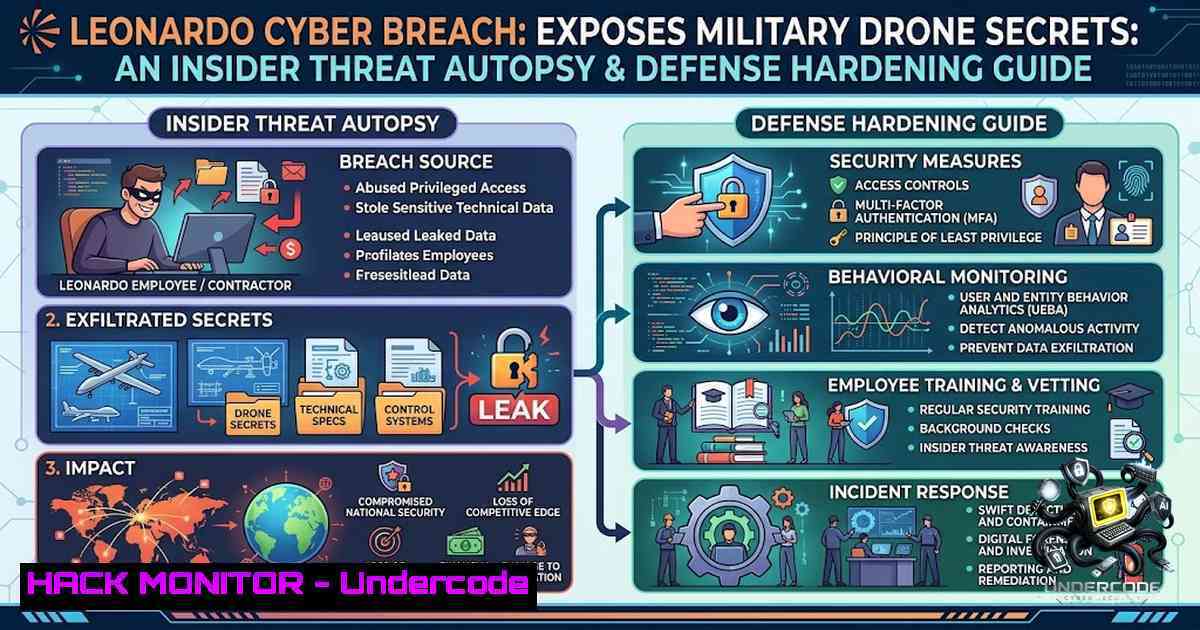
The intersection of defense industrial bases and cyber espionage has reached a critical inflection point. In a stark reminder that the greatest threats often reside within trusted perimeters, an internal hacker within Italian defense giant Leonardo was found to have systematically targeted and exfiltrated sensitive data pertaining to Europe’s largest unmanned fighter jet program and aircraft used by military and police forces. This incident underscores a pivotal shift in modern cyber warfare: the insider threat, armed with legitimate credentials, can bypass even the most sophisticated perimeter defenses to compromise national security assets.
Learning Objectives & Secrets:
- Objective 1: Insider Threat Detection & Behavioral Analytics – Master the art of identifying anomalous user behavior by establishing baselines and utilizing User and Entity Behavior Analytics (UEBA) to detect deviations that signal malicious intent, such as unusual access patterns to classified repositories.
- Objective 2 Secret Tips: Privileged Access Management (PAM) Hardening – Implement a robust PAM framework that includes just-in-time (JIT) access, credential rotation, and session recording. The secret lies in rigorously enforcing the principle of least privilege and continuously monitoring privileged sessions for anomalous commands or data transfers.
- Objective 3 Secret Tips: Zero-Trust Architecture for Critical Infrastructure – Move beyond perimeter-based security. Implement micro-segmentation and continuous verification of every access request, regardless of origin. The secret is to treat every user and device as untrusted until proven otherwise, enforcing strict identity verification and device health checks at every access point.
You Should Know:
- Insider Threat Mitigation: A Step‑by‑Step Guide to Monitoring and Response
Insider threats are notoriously difficult to detect as they operate with legitimate credentials. The Leonardo breach, where a trusted employee allegedly targeted sensitive military project data, exemplifies this challenge. To build a defense-in-depth strategy, security teams must implement a multi-layered detection and response framework.
Step 1: Establish a User Activity Baseline. Deploy a SIEM (Security Information and Event Management) solution like Splunk or Elastic Stack to collect logs from all critical systems, including Active Directory, file servers, and databases. Use machine learning algorithms to establish a behavioral baseline for each user based on their job function, typical working hours, and data access patterns.
Step 2: Implement UEBA for Anomaly Detection. Integrate a UEBA tool (e.g., Exabeam, Securonix) to analyze user behavior in real-time. Configure alerts for high-risk activities, such as:
– Accessing files outside of normal working hours.
– Downloading large volumes of data, especially from classified or project-specific repositories.
– Attempting to access systems or data outside of their role-based access control (RBAC) permissions.
– Executing commands that indicate data exfiltration (e.g., using `tar` or `zip` on sensitive directories, or scp/rsync to external IPs).
Step 3: Deploy Data Loss Prevention (DLP). Implement a DLP solution (e.g., Symantec, Forcepoint) to monitor and control data in motion, at rest, and in use. Configure policies to block or alert on the transfer of sensitive data to unauthorized external storage devices, cloud services, or personal email accounts.
Step 4: Establish an Insider Threat Response Plan. Create a dedicated incident response playbook for insider threats. This should include:
– Identification: Clear criteria for escalating alerts to a threat response team.
– Containment: Steps to immediately revoke access, isolate the user’s workstation, and disable accounts if malicious activity is confirmed.
– Eradication: Forensic analysis to determine the scope of the breach and identify all compromised systems.
– Recovery: Restoring systems from clean backups and implementing additional controls to prevent recurrence.
– Legal & HR Coordination: Procedures for involving legal counsel and human resources for investigation and potential disciplinary action.
Step 5: Conduct Regular Insider Threat Drills. Simulate insider threat scenarios to test the effectiveness of your detection and response capabilities. Use red team exercises that mimic the tactics, techniques, and procedures (TTPs) of malicious insiders to identify gaps in your security posture.
2. Securing Critical Infrastructure: A Zero-Trust Implementation Guide
The Leonardo breach highlights the vulnerability of critical defense infrastructure. A Zero Trust Architecture (ZTA) is essential for protecting such high-value targets. This model assumes breach and verifies every request as if it originates from an open network.
Step 1: Define the Protect Surface. Identify your most critical data, applications, assets, and services (DAAS). This is your “protect surface,” not just the perimeter. For Leonardo, this would include repositories for the unmanned fighter jet program and aircraft data.
Step 2: Map Transaction Flows. Understand how users, devices, and applications interact with your protect surface. Create a data flow diagram that maps all connections, from the user’s initial authentication to the final data access or transaction. This helps identify dependencies and potential attack paths.
Step 3: Build a Zero Trust Network. Implement micro-segmentation to isolate your protect surface from the rest of the network. Use next-generation firewalls (NGFWs) or software-defined networking (SDN) to create granular policies that allow only specific, authorized transactions. For example, a developer might only be able to access a specific development server, and only through a specific application gateway.
Step 4: Create a Zero Trust Policy. Define a policy that grants access based on a combination of factors:
– User Identity: Multi-factor authentication (MFA) and identity verification.
– Device Health: Endpoint compliance checks (e.g., antivirus, patching status, device posture).
– Location & Behavior: Geolocation, time of access, and behavioral anomalies.
Use a policy engine that dynamically evaluates these factors for every access request.
Step 5: Implement Continuous Monitoring and Logging. Deploy a comprehensive monitoring system that logs all activity within the Zero Trust environment. Use a SIEM to correlate logs from various sources and detect anomalies. Implement automated response actions, such as terminating a session or prompting for additional authentication when suspicious behavior is detected.
Command Example (Linux – Log Monitoring for Anomalies):
 Monitor failed login attempts in real-time
sudo tail -f /var/log/auth.log | grep "Failed password"

Check for unusual sudo command usage
sudo grep "sudo:" /var/log/auth.log | awk '{print $1, $2, $3, $9, $10, $11, $12}'

Monitor for large data transfers via scp/rsync (using auditd)
sudo auditctl -w /home/ -p rwxa -k data_transfer
sudo ausearch -k data_transfer -ts recent
Command Example (Windows – PowerShell for Auditing):
 Get all logon events (Event ID 4624) for the last 24 hours
Get-WinEvent -FilterHashtable @{LogName='Security'; ID=4624; StartTime=(Get-Date).AddDays(-1)} | Format-Table TimeCreated, UserId, Message

Audit file access for a sensitive directory
auditpol /set /subcategory:"File System" /success:enable /failure:enable
 Then use Get-WinEvent to query for Event ID 4663 (File accessed)
Get-WinEvent -FilterHashtable @{LogName='Security'; ID=4663; StartTime=(Get-Date).AddDays(-1)} | Where-Object {$_.Message -like "C:\SensitiveData"}
3. Cloud Security Hardening for Defense Contractors
Defense contractors like Leonardo are increasingly moving to hybrid cloud environments to enhance agility and collaboration. However, this introduces new attack surfaces. Securing cloud deployments requires a shared responsibility model and robust configuration management.
Step 1: Implement Cloud Security Posture Management (CSPM). Use a CSPM tool (e.g., Prisma Cloud, Orca Security) to continuously monitor your cloud environment for misconfigurations, compliance violations, and security risks. This includes checking for publicly exposed storage buckets, overly permissive IAM roles, and unencrypted data.
Step 2: Enforce Principle of Least Privilege in IAM. Implement strict Identity and Access Management (IAM) policies. Use roles and policies to grant only the minimum necessary permissions. Regularly review and revoke unused or excessive permissions. Enable MFA for all user accounts and service accounts.
Step 3: Secure Data at Rest and in Transit. Encrypt all data at rest using cloud provider-managed keys (e.g., AWS KMS, Azure Key Vault) or customer-managed keys. Ensure all data in transit is encrypted using TLS 1.2 or higher. Implement strict network security controls, such as security groups and network ACLs, to limit access to cloud resources.
Step 4: Implement Continuous Threat Monitoring. Deploy a cloud-1ative security solution like AWS GuardDuty, Azure Defender, or a third-party SIEM to monitor for threats. Configure alerts for suspicious activities, such as unusual API calls, unauthorized access attempts, or the creation of new resources.
Step 5: Conduct Regular Security Audits and Penetration Testing. Perform regular security assessments, including vulnerability scanning and penetration testing, of your cloud environment. Use these findings to remediate vulnerabilities and improve your security posture.
4. API Security: Protecting the Digital Backbone
Modern defense systems are increasingly composed of interconnected APIs. The Leonardo breach might have been facilitated by exploiting insecure APIs used to access sensitive project data. Securing these APIs is crucial.
Step 1: Discover and Inventory All APIs. Use an API discovery tool to identify all APIs in your environment, including shadow APIs that may not be documented. Create a comprehensive inventory that includes the API’s purpose, data sensitivity, and security controls.
Step 2: Implement Strong Authentication and Authorization. Use OAuth 2.0 or OpenID Connect for authentication. Implement fine-grained authorization using scopes and claims to control access to specific resources. Never rely on API keys alone; they are not sufficient for securing sensitive data.
Step 3: Validate and Sanitize Input. Implement strict input validation to prevent injection attacks (e.g., SQL injection, command injection). Use a positive validation approach (allowlisting) rather than a negative one (denylisting). Sanitize all input to remove potentially malicious characters.
Step 4: Implement Rate Limiting and Throttling. Protect your APIs from denial-of-service (DoS) attacks and brute-force attempts by implementing rate limiting. Define thresholds for the number of requests per minute/hour from a single IP or user.
Step 5: Log and Monitor All API Activity. Implement comprehensive logging for all API requests and responses. Use a SIEM to monitor for anomalies, such as unusual request patterns, high error rates, or attempts to access unauthorized endpoints. Set up alerts for suspicious activities.
API Security Commands (using `curl` for testing and `jq` for parsing JSON responses):
 Test for basic authentication enforcement
curl -X GET https://api.example.com/sensitive-data

Attempt to access an endpoint without proper authorization
curl -X GET https://api.example.com/sensitive-data -H "Authorization: Bearer INVALID_TOKEN"

Test for rate limiting (send multiple requests in a loop)
for i in {1..100}; do curl -s -o /dev/null -w "%{http_code}\n" https://api.example.com/endpoint; done

Check for insecure direct object references (IDOR) by manipulating IDs
curl -X GET https://api.example.com/user/123
curl -X GET https://api.example.com/user/124
- Advanced Persistent Threat (APT) Defense and Threat Intelligence
The Leonardo incident, with its focus on high-value military assets, bears the hallmarks of an Advanced Persistent Threat (APT) operation. Defending against APTs requires a proactive threat intelligence-driven approach.
Step 1: Establish a Threat Intelligence Program. Subscribe to commercial and open-source threat intelligence feeds (e.g., AlienVault OTX, MISP, IBM X-Force). Collect and analyze intelligence on the TTPs of threat actors targeting the defense industrial base. This includes understanding their infrastructure, malware, and common attack vectors.
Step 2: Implement Threat Hunting. Proactively search for threats that have evaded your existing security controls. Use threat intelligence to develop hypotheses about potential attack scenarios. For example, search for indicators of compromise (IoCs) associated with known APT groups targeting the defense sector.
Step 3: Deploy Endpoint Detection and Response (EDR). Implement an EDR solution (e.g., CrowdStrike, Carbon Black, Microsoft Defender for Endpoint) on all endpoints. EDR provides continuous monitoring, threat detection, and response capabilities at the endpoint level, which is crucial for detecting and containing APT activity.
Step 4: Harden Network Segmentation. Implement network segmentation to limit the lateral movement of attackers. Use firewalls and VLANs to isolate critical systems and data from the rest of the network.
Step 5: Conduct Regular Red Team Exercises. Engage a red team to simulate APT attacks against your organization. These exercises help identify vulnerabilities and weaknesses in your security controls and incident response processes.
- AI and Machine Learning for Defensive Cyber Operations
Leveraging AI and ML is becoming essential for detecting sophisticated threats. Leonardo’s approach to cybersecurity involves integrating AI to enhance threat detection and response capabilities.
Step 1: Implement AI-Powered Threat Detection. Use ML algorithms to analyze network traffic, user behavior, and system logs to identify anomalies that may indicate a cyberattack. This includes detecting unusual patterns that traditional signature-based systems might miss.
Step 2: Automate Incident Response. Develop playbooks that use AI to automate incident response tasks, such as isolating infected endpoints, blocking malicious IP addresses, and gathering forensic data. This accelerates response times and reduces the burden on security teams.
Step 3: Use AI for Vulnerability Management. Employ AI to prioritize vulnerability remediation based on the likelihood of exploitation and the potential impact on critical assets. This helps security teams focus on the most critical risks.
Step 4: Implement AI-Powered Phishing Detection. Use ML models to detect and block phishing emails by analyzing email content, sender reputation, and other attributes. This is crucial for preventing credential theft, a common initial access vector for APT attacks.
Step 5: Leverage AI for Threat Hunting. Use AI to automate the generation of threat hunting hypotheses and to analyze large datasets for signs of malicious activity. This can significantly enhance the efficiency and effectiveness of threat hunting teams.
What Undercode Say:
- Key Takeaway 1: The Leonardo breach is a critical case study in the evolving landscape of cyber espionage, demonstrating that insider threats are a primary vector for compromising national security assets. Organizations must prioritize insider threat detection and behavioral analytics as a core component of their security strategy.
- Key Takeaway 2: A Zero Trust Architecture, coupled with robust Privileged Access Management and continuous monitoring, is not optional but essential for protecting critical infrastructure. The principle of “never trust, always verify” must be applied rigorously to every user, device, and application, regardless of their location or perceived trustworthiness.
Analysis: The Leonardo incident serves as a stark reminder that cyber threats are not limited to external actors. The convergence of physical and digital security, the increasing sophistication of attacks, and the growing reliance on interconnected systems necessitate a fundamental shift in how we approach cybersecurity. The breach underscores the need for a proactive, intelligence-driven defense that combines technology, processes, and people. As defense contractors like Leonardo expand their global footprint, the attack surface grows, making it imperative to adopt a Zero Trust mindset and to continuously invest in advanced threat detection and response capabilities. The integration of AI and ML into defensive operations offers a promising path forward, but it must be coupled with a strong human element: skilled analysts, rigorous training, and a culture of security awareness. The future of cyber defense lies in the ability to anticipate, detect, and respond to threats with speed and precision, leveraging every tool at our disposal.
Prediction:
- -1 The Leonardo breach will likely trigger a wave of regulatory scrutiny and stricter compliance requirements for defense contractors, particularly concerning insider threat programs and data protection measures. This will increase operational costs and compliance burdens.
- -1 We can expect a rise in similar insider threat attacks targeting other defense and aerospace companies globally, as nation-state actors and cybercriminals recognize the effectiveness of this vector. The attack surface will expand as more sensitive data is stored and processed digitally.
- +1 This incident will accelerate the adoption of advanced technologies like Zero Trust Architecture, AI-driven threat detection, and behavioral analytics within the defense sector. This will lead to more resilient and secure systems in the long run.
- +1 The breach will serve as a catalyst for greater international collaboration on cybersecurity, particularly among NATO members and allies, to share threat intelligence and develop common defense standards. This will strengthen collective defense capabilities.
- -1 There will be increased public and political pressure on governments and defense contractors to enhance cybersecurity, potentially leading to over-regulation and a focus on compliance over security. This could stifle innovation and agility.
- +1 The demand for skilled cybersecurity professionals, particularly those with expertise in insider threat detection, Zero Trust, and cloud security, will surge. This will create new opportunities for training and career development in the field.
- -1 The incident may damage Leonardo’s reputation and erode customer trust, potentially impacting its business and market share. The long-term financial and reputational consequences could be significant.
- +1 The lessons learned from the Leonardo breach will be incorporated into best practices and security frameworks, ultimately improving the overall security posture of the defense industrial base and critical infrastructure.
- -1 The breach highlights the vulnerability of critical infrastructure to cyberattacks, which could have cascading effects on national security and public safety. This underscores the need for continuous vigilance and investment in cybersecurity.
- +1 The incident will likely lead to increased investment in research and development of new security technologies, such as quantum-resistant cryptography and advanced AI-based defense systems, driving innovation in the cybersecurity industry.
▶️ Related Video (78% Match):
🎯Let’s Practice For Free:
🎓 Live Courses & Certifications:
Join Undercode Academy for Verified Certifications
🚀 Request a Custom Project:
Secure, high-velocity infrastructure and disruptive technological engineering. Contact our engineering team for high-tier development and proprietary systems:
[email protected]
💎 Smart Architecture | 🛡️ Secure by Design | ⭐ Trusted by Thousands
IT/Security Reporter URL:
Reported By: https://lnkd.in/p/eVQHeKpu – Hackers Feeds
Extra Hub: Undercode MoN
Basic Verification: Pass ✅


