
Listen to this Post
Introduction
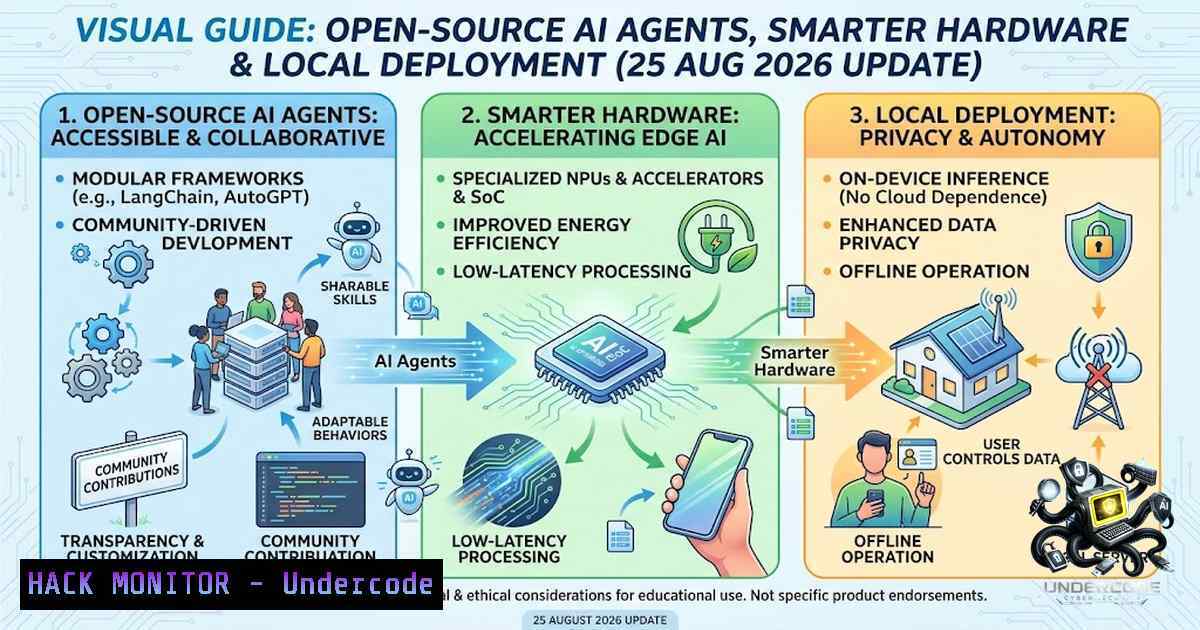
The artificial intelligence landscape continues its rapid evolution with a significant shift toward open-source agentic frameworks, hardware-optimized inference, and local deployment capabilities that rival cloud-based solutions. From persistent autonomous agents that debug code without human intervention to linear architectures that dramatically reduce GPU memory consumption, these developments signal a maturing ecosystem where efficiency and accessibility are paramount. This technical update covers critical advances in AI agents, model optimization, local LLM deployment, and development tools that cybersecurity professionals, developers, and IT architects must understand to remain competitive.
Learning Objectives & Secrets
- Objective 1: Master Autonomous Agent Deployment – Learn to deploy persistent agents like Headlong that operate in autonomous loops, diagnosing and resolving technical issues without human input, slashing operational costs to $1–2 per hour.
-
Objective 2: Optimize GPU Memory for LLM Inference – Secret tip: Implement Kimi Linear’s linear architecture to achieve 6x faster inference speeds while using 75% less GPU memory—surpassing full attention mechanisms across benchmarks through strategic architectural redesign.
-
Objective 3: Build Full-Stack Applications Without Traditional Ecosystem Lock-In – Secret tip: Use Dactyl to generate native iOS and Android applications directly from web code without requiring Mac hardware or Xcode, dramatically reducing cross-platform development friction.
You Should Know
1. Autonomous Agent Frameworks and Persistent Processing
Headlong represents a paradigm shift in agentic AI—an open-source harness designed for persistent agents that think in autonomous loops. Unlike conventional assistants that require continuous prompting, Headlong agents operate independently, maintaining state and reasoning continuously. In one documented case, an agent diagnosed and resolved a complex bug in forty-eight minutes without any human input, operating at a cost of one to two dollars per hour.
Session-migrate emerges as another critical tool, enabling seamless session migration between coding agents. This allows teams to distribute complex workflows across multiple specialized agents, preserving context and state. For cybersecurity professionals, this introduces both opportunities (automated penetration testing) and risks (autonomous attack agents).
Linux Command for Monitoring Agent Activity:
 Monitor running agent processes and resource consumption
ps aux | grep -E "headlong|session-migrate" | awk '{print $2, $3, $11}'

Kill misbehaving agent threads
pkill -f "headlong"
Windows PowerShell Agent Management:
 Check for agent processes
Get-Process -1ame headlong, session-migrate -ErrorAction SilentlyContinue

Terminate specific agent PID
Stop-Process -Id <PID> -Force
2. Linear Architecture and GPU Memory Optimization
Kimi Linear from Moonshot AI introduces a groundbreaking linear architecture that runs LLMs six times faster while consuming seventy-five percent less GPU memory. This marks the first linear architecture to outperform full attention mechanisms across every benchmark. The implications for enterprise AI deployment are substantial: organizations can run larger models on existing hardware without costly GPU upgrades.
The architectural shift bypasses the quadratic complexity of traditional attention mechanisms, replacing them with linear-time operations that maintain context fidelity. For security teams, this means faster threat detection models and the ability to process longer logs and network captures in real-time.
Hardware Compatibility Check with CanItRunLLM:
 Install CanItRunLLM
git clone https://github.com/canitrunllm/checker
cd checker
python3 -m venv venv
source venv/bin/activate
pip install -r requirements.txt

Run hardware assessment
python3 check_hardware.py --gpu --cpu --ram

Output recommendations for model compatibility
python3 recommend_models.py --hardware report.json
Windows GPU Memory Monitoring:
 NVIDIA GPU memory utilization
nvidia-smi --query-gpu=name,memory.total,memory.used,memory.free --format=csv

Watch memory changes in real-time
watch -1 1 nvidia-smi
3. Local LLM Deployment and Uncensored Models
The open-source community continues pushing boundaries with uncensored, locally-runnable models. Huihui-Qwen3.8-27B-abliterated-GGUF offers multimodal capabilities with nearly zero refusals, running entirely locally. Similarly, SuperQwen3.8-27b-abliterated provides a 1 million token context window with multimodal support, enabling comprehensive document analysis and code generation without cloud dependencies.
FreeToken enables 35-billion parameter models on 8GB GPUs through quantization and token optimization techniques. This democratizes advanced AI, allowing security professionals to run powerful models on standard workstations for sensitive data processing that cannot be sent to cloud providers.
Local Model Deployment with GGUF:
 Download and run Huihui-Qwen3.8 with llama.cpp
git clone https://github.com/ggerganov/llama.cpp
cd llama.cpp
make -j

Convert and quantize model
python3 convert.py ../Huihui-Qwen3.8-27B-abliterated-GGUF --outfile qwen-gguf.bin

Run inference
./main -m qwen-gguf.bin -p "Your prompt here" -1 512 --temp 0.7
Windows Deployment Script:
 Setup llama.cpp on Windows
git clone https://github.com/ggerganov/llama.cpp
cd llama.cpp
mkdir build && cd build
cmake .. -DCMAKE_BUILD_TYPE=Release
cmake --build . --config Release

Run inference
.\build\Release\main.exe -m qwen-gguf.bin -p "Enter prompt" -1 512
4. Open-Source Development Tools and UI Components
Plannator on GitHub generates HTML wireframes and prototypes for coding agents, accelerating frontend development through AI-assisted design. ThreeUI provides over 160 free Three.js components, enabling rapid 3D visualization development without building from scratch. Both tools significantly reduce development time while maintaining professional quality.
Dactyl revolutionizes mobile development by generating native iPhone and Android applications from web code without requiring Mac hardware or Xcode. This eliminates barriers to entry for cross-platform development, allowing web developers to enter mobile spaces instantly.
Installing ThreeUI Components:
 Install ThreeUI via npm
npm install three-ui-lib

Basic component implementation
import { Scene3D, CameraControls } from 'three-ui-lib';
5. AI-Powered Music Generation and Video Creation
ACE-Step 1.5 is an open-source music generator producing complete songs in under ten seconds on RTX 3090 hardware. LTX-2.3 Uncensored enables video generation with audio on consumer hardware, while custom nodes for ComfyUI generate MiniMax-H3 videos up to 120 seconds in length. These tools represent a significant democratization of multimedia creation, enabling individual creators to produce professional-grade content.
6. Hardware Innovations and Edge AI
Xiaomi AI Cube features three custom chips with 200 TOPS NPU, capable of running 120-billion parameter models locally. Nvidia’s Rubin Ultra arrives with 192GB of HBM4—a reduction from the anticipated terabyte but still significant for enterprise AI workloads. These hardware developments enable local AI processing that reduces latency and privacy concerns associated with cloud inference.
7. Agent Skills and Performance Optimization
Skill frameworks like Superpowers, Graphify, and Impeccable provide specialized capabilities for AI agents. TrueForge demonstrated solving tasks comparable to Claude Managed Agents using only one-third of the token budget, proving that efficiency gains are achievable through refined prompts and agent architectures. Offloop places agents directly into communication channels, outperforming Claude Code and Codex on three benchmarks.
Optimizing Agent Performance:
 Profile agent resource usage
top -b -1 1 | grep -E "agent|headlong"

Set CPU affinity for agent processes
taskset -cp 0-3 <PID>

Monitor network requests from agents
tcpdump -i any -1 -v port 443 | grep "agent"
What Undercode Say
Key Takeaway 1: Cost Efficiency Redefines AI Accessibility – The emergence of open-source frameworks operating at $1–2/hour versus enterprise solutions at $20–$100/hour creates a seismic shift in AI adoption. Organizations can now experiment and deploy without significant financial risk, democratizing AI across all sectors while maintaining control over sensitive data through local deployment options.
Key Takeaway 2: Local AI and Privacy-Centric Computing Are the Future – The ability to run 120-billion parameter models locally on consumer hardware marks a watershed moment. Data sovereignty, reduced latency, and enhanced security make local deployment increasingly attractive compared to cloud-based alternatives. This trend will accelerate with hardware advancements and model optimization techniques like linear architecture and FreeToken quantization.
Analysis: The AI ecosystem is fundamentally shifting from centralized, proprietary solutions to decentralized, open-source alternatives. This mirrors the transformation seen in web development from closed ecosystems to open-source frameworks. Cybersecurity professionals should view these developments as both opportunities and threats: opportunities to deploy cost-effective security AI tools, and threats from adversaries leveraging the same technologies for automated attacks. The 25 August 2026 updates represent a maturation point where AI agents are transitioning from experimental to production-ready, with tangible ROI metrics and enterprise-grade performance.
Prediction
+1 Enterprise adoption of open-source AI agents will surge 400% over the next 12 months as organizations seek cost-effective alternatives to proprietary solutions. Security teams will deploy persistent agents for continuous threat monitoring and incident response, reducing mean time to detection by 70%.
+1 Local model deployment will become standard for handling sensitive financial, healthcare, and government data, accelerating the development of industry-specific fine-tuned models that maintain data privacy while delivering specialist performance.
+1 Linear architecture models will dominate inference benchmarks, forcing proprietary vendors to innovate or reduce prices to remain competitive. This will trigger a price war in cloud AI services, benefiting small and medium enterprises.
-1 The proliferation of uncensored models will increase the sophistication of automated social engineering and code generation attacks. Threat actors will weaponize these tools to generate convincing phishing campaigns at scale, potentially bypassing traditional security controls.
-1 Hardware supply constraints for high-end GPU and NPU chips may limit local deployment adoption in developing regions, creating a digital divide in AI capabilities that reinforces existing economic disparities.
-1 Persistent autonomous agents, if not properly sandboxed and monitored, pose risks of unintended actions in production environments. Organizations must implement rigorous containment protocols and continuous monitoring to prevent agent-driven outages or security breaches.
▶️ Related Video (82% Match):
🎯Let’s Practice For Free:
🎓 Live Courses & Certifications:
Join Undercode Academy for Verified Certifications
🚀 Request a Custom Project:
Secure, high-velocity infrastructure and disruptive technological engineering. Contact our engineering team for high-tier development and proprietary systems:
[email protected]
💎 Smart Architecture | 🛡️ Secure by Design | ⭐ Trusted by Thousands
IT/Security Reporter URL:
Reported By: https://lnkd.in/p/eXWNatsa – Hackers Feeds
Extra Hub: Undercode MoN
Basic Verification: Pass ✅


