
Listen to this Post
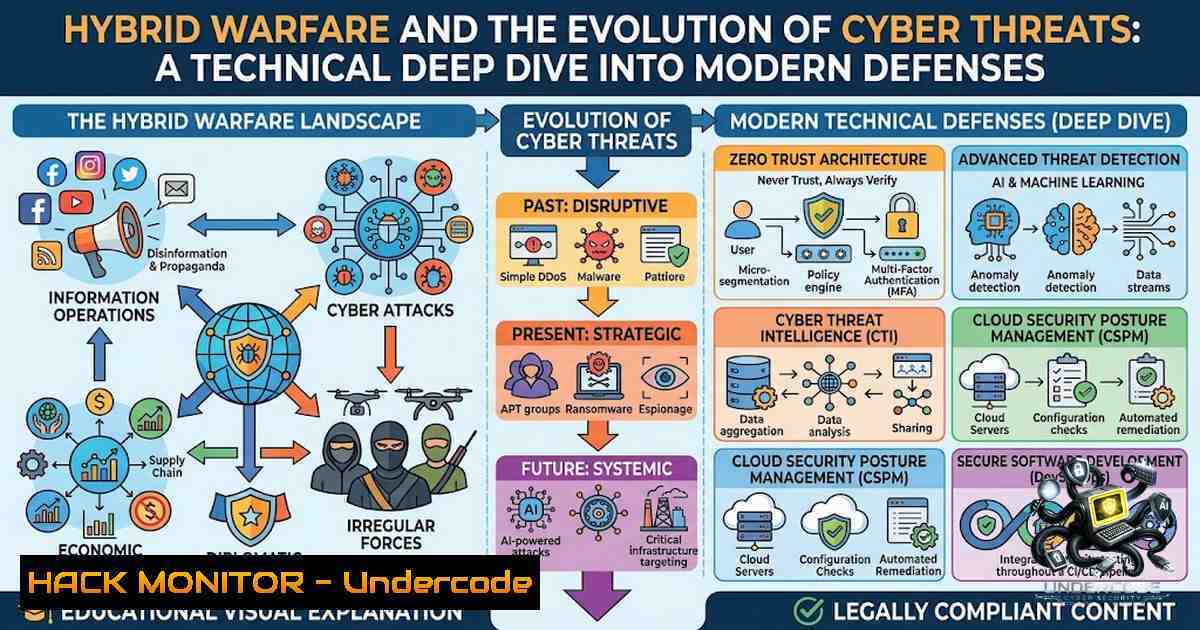
Introduction:
In the current geopolitical landscape, hybrid warfare has emerged as one of the most insidious challenges to global security, combining conventional and unconventional methods to inflict damage on adversaries. Recent reports from law enforcement agencies have highlighted a significant surge in ransomware and DDoS attacks targeting a broad spectrum of public and private infrastructures, particularly in the transportation and financial sectors. As application-layer DDoS attacks evolve to amplify damage and complicate defense, organizations must adopt advanced solutions—including secure-by-design architectures, trustworthy AI, and continuous monitoring—to ensure predictive protection of strategic data and assets.
Learning Objectives & Secrets:
- Objective 1: Master the implementation of use-case-based security frameworks that bridge technical operations with strategic business interests, moving beyond compliance checklists to address real-world risk scenarios.
- Objective 2 (Secret Tip): Prioritize predictive protection and continuous monitoring through Security Operations Centers (SOCs) that leverage big data and virtualization to filter false positives and detect genuine threats.
- Objective 3 (Secret Tip): Integrate Trustworthy AI and secure-by-design principles into product development lifecycles to proactively mitigate vulnerabilities before deployment.
You Should Know:
1. Use-Case-Based Security: Moving Beyond Compliance
The traditional approach of deploying security tools merely to satisfy regulatory checklists is no longer sufficient. Cybersecurity systems must be designed based on the risk scenarios most likely to occur in the field, such as account misuse, internal data leaks, and attacks leveraging legitimate credentials. This use-case approach effectively bridges operational technical needs with strategic business goals. For SOC teams drowning in thousands of daily alerts, relevant use cases are the foundation of cyber resilience—they help distinguish false positives from critical incidents.
Step-by-Step Guide:
- Identify Critical Assets: Map your organization’s crown jewels—data, applications, and infrastructure.
- Threat Modeling: Conduct threat modeling sessions to identify the most likely and impactful attack vectors (e.g., credential theft, insider threats, DDoS).
- Develop Use Cases: For each threat, create a specific security use case that defines the attack scenario, the data sources needed for detection (e.g., logs, network flows), and the alert logic.
- Tune and Test: Implement the use cases in your SIEM or SOC platform. Continuously tune detection rules to minimize false positives and test them with simulated attacks.
- Integrate with Response: Ensure each use case is linked to a clear incident response playbook, defining roles, communication channels, and remediation steps.
Relevant Commands (Linux – Log Analysis):
 Search for failed SSH login attempts (potential brute-force)
grep "Failed password" /var/log/auth.log

Monitor real-time system logs for suspicious activity
tail -f /var/log/syslog | grep -i "error|fail|attack"

Check for established connections on common attack ports
netstat -tunapl | grep -E ':22|:3389|:445'
Relevant Commands (Windows – PowerShell):
 Get failed logon events (Event ID 4625)
Get-WinEvent -LogName Security | Where-Object { $_.Id -eq 4625 } | Select-Object TimeCreated, Message

Check for suspicious scheduled tasks
Get-ScheduledTask | Where-Object { $_.State -1e 'Disabled' }

List all active network connections
netstat -an | findstr /R "ESTABLISHED LISTENING"
2. Defending Against Evolved Application-Layer DDoS Attacks
Application-layer DDoS attacks have evolved to become more sophisticated, targeting specific web application vulnerabilities to exhaust server resources and disrupt services. These attacks are particularly concerning as they aim to temporarily interrupt web services, causing significant inconvenience to citizens, businesses, and institutions, and damaging corporate reputation. Defending against them requires a multi-layered strategy that includes rate limiting, web application firewalls (WAFs), and anomaly detection.
Step-by-Step Guide:
- Deploy a Web Application Firewall (WAF): Configure a WAF (e.g., ModSecurity, AWS WAF, Cloudflare) to filter and monitor HTTP traffic. Implement rules to block common attack patterns like SQL injection and cross-site scripting (XSS), which are often used in application-layer attacks.
- Implement Rate Limiting: Configure rate limiting on your web servers or load balancers to restrict the number of requests from a single IP address within a specific time window. This mitigates brute-force and request-flooding attacks.
- Utilize a Content Delivery Network (CDN): Use a CDN with DDoS protection capabilities (e.g., Cloudflare, Akamai, Fastly) to absorb and mitigate large-scale volumetric attacks before they reach your origin servers.
- Monitor and Analyze Traffic: Continuously monitor traffic patterns for anomalies. Use tools that can detect sudden spikes in requests, unusual user agents, or abnormal geographic distributions.
- Develop an Incident Response Plan: Have a clear incident response plan for DDoS attacks, including communication protocols with your ISP, CDN provider, and internal teams.
Relevant Commands (Linux – Nginx Rate Limiting Configuration):
 In /etc/nginx/nginx.conf, define a rate limiting zone
http {
limit_req_zone $binary_remote_addr zone=mylimit:10m rate=10r/s;
}

In your site configuration, apply the rate limiting
server {
location / {
limit_req zone=mylimit burst=20 nodelay;
proxy_pass http://your_backend;
}
}
Relevant Commands (Linux – iptables for basic DDoS mitigation):
 Limit new connections from a single IP to 60 per minute
iptables -A INPUT -p tcp --dport 80 -m connlimit --connlimit-above 60 -j REJECT

Drop packets from a specific IP (if identified as an attacker)
iptables -A INPUT -s <ATTACKER_IP> -j DROP
- Predictive Protection with the Global Cybersec Center (GCC) Model
The Global Cybersec Center (GCC) model, as exemplified by Leonardo, guarantees predictive protection of data and strategic assets through continuous monitoring. This approach leverages innovative technologies including secure-by-design architectures, trustworthy AI, big data, and virtualization. The GCC acts as a centralized hub for threat intelligence, analysis, and response, enabling organizations to stay ahead of emerging threats.
Step-by-Step Guide:
- Centralize Logging: Aggregate logs from all critical systems (servers, firewalls, applications, endpoints) into a centralized SIEM or data lake.
- Implement Threat Intelligence Feeds: Subscribe to reputable threat intelligence feeds to receive real-time indicators of compromise (IOCs) and emerging threat actor tactics, techniques, and procedures (TTPs).
- Deploy AI-Powered Analytics: Use machine learning and AI algorithms to analyze security data for anomalies and patterns that may indicate a sophisticated attack, reducing reliance on static signatures.
- Establish a 24/7 SOC: Staff a Security Operations Center (SOC) with skilled analysts who can monitor alerts, investigate incidents, and coordinate response efforts around the clock.
- Conduct Proactive Threat Hunting: Proactively search through your networks and data to identify hidden threats that may have evaded existing security controls.
Relevant Commands (Linux – Rsyslog for Centralized Logging):
 In /etc/rsyslog.conf, configure to forward logs to a central server
. @@<CENTRAL_LOG_SERVER_IP>:514

Restart rsyslog service
sudo systemctl restart rsyslog
Relevant Commands (Windows – Event Log Forwarding):
 Configure Windows Event Forwarding (WEF) using wecutil
wecutil qc /q
 Create a subscription to forward events to a collector
wecutil cs <subscription_file.xml>
4. Securing the Expanding IoT Attack Surface
With the proliferation of Internet of Things (IoT) devices, the attack surface has expanded dramatically. These devices are often vulnerable and can be easily compromised to form botnets for DDoS attacks or as entry points into corporate networks. A holistic security approach is needed to protect these devices, including network segmentation, regular firmware updates, and strong authentication mechanisms.
Step-by-Step Guide:
- Inventory and Classify: Create a complete inventory of all IoT devices connected to your network. Classify them based on their function, criticality, and risk profile.
- Network Segmentation: Segment your network to isolate IoT devices from critical systems and sensitive data. Use VLANs and firewalls to restrict communication between segments.
- Enforce Strong Authentication: Change default credentials on all IoT devices. Implement strong, unique passwords and enable multi-factor authentication (MFA) where possible.
- Patch Management: Establish a rigorous patch management process for IoT devices. Regularly check for and apply firmware and software updates from vendors.
- Continuous Monitoring: Monitor IoT network traffic for anomalous behavior, such as unusual communication patterns or data exfiltration attempts.
Relevant Commands (Linux – Nmap for IoT Network Scanning):
 Scan the local network to discover all connected devices
sudo nmap -sn 192.168.1.0/24

Perform a more detailed scan on a specific device to detect open ports and services
sudo nmap -sV -p- <DEVICE_IP>
Relevant Commands (Windows – ARP Cache for device discovery):
 Display the ARP cache to see IP-to-MAC address mappings of devices on the local network
arp -a
5. The Imperative of International Collaboration
Cyber attacks do not recognize borders, making this a global problem that requires collective efforts from various countries and industries. International collaboration facilitates the sharing of threat intelligence, best practices, and coordinated response strategies. Organizations should actively participate in Information Sharing and Analysis Centers (ISACs) and collaborate with government agencies and industry peers to stay informed about global threats.
Step-by-Step Guide:
- Join an ISAC: Identify and join the relevant Information Sharing and Analysis Center (ISAC) for your industry sector (e.g., FS-ISAC for financial services, IT-ISAC for technology).
- Establish Partnerships: Build relationships with peer organizations, government cybersecurity agencies (e.g., CISA, ENISA, BSSN), and law enforcement.
- Share Threat Intelligence: Actively share anonymized threat intelligence, such as IOCs and attack patterns, with trusted partners to enhance collective defense.
- Participate in Exercises: Participate in joint cybersecurity exercises and tabletop simulations to practice coordinated response to cross-border cyber incidents.
- Stay Informed: Regularly review threat intelligence reports and alerts from international sources to understand the global threat landscape.
What Undercode Say:
- Key Takeaway 1: Cybersecurity is not just a technical issue but a matter of building awareness; every individual has a role in protecting data and maintaining digital security.
- Key Takeaway 2: Security systems must be designed based on the most probable risk scenarios, and a use-case approach is fundamental to building cyber resilience.
- Analysis: The current threat landscape, characterized by sophisticated ransomware, evolved DDoS attacks, and expanding IoT vulnerabilities, demands a paradigm shift from reactive to predictive security. Experts like Leonardo Hutabarat emphasize moving beyond compliance-driven checklists to implement context-aware, use-case-based defenses that prioritize real-world risks. The integration of AI and big data into SOC operations is crucial for managing the alert fatigue that plagues security teams, enabling them to focus on genuine threats. Furthermore, as cyber threats are inherently transnational, international cooperation and information sharing are not optional but essential for effective defense. Investing in cybersecurity is ultimately an investment in business continuity and infrastructural stability. The future of cybersecurity lies in secure-by-design principles, where security is baked into products from the outset, and in the cultivation of a security-conscious culture across all levels of an organization.
Prediction:
- +1 Increased adoption of AI-driven predictive analytics will significantly reduce mean time to detect (MTTD) and respond (MTTR) to sophisticated cyber threats.
- +1 The use-case-based security model will become an industry standard, leading to more efficient SOC operations and a lower rate of false positives.
- -1 The proliferation of IoT devices and the complexity of hybrid cloud environments will continue to expand the attack surface, creating new vulnerabilities that threat actors will exploit.
- -1 The sophistication of application-layer DDoS and ransomware attacks will increase, potentially overwhelming traditional defenses and causing more severe disruptions to critical infrastructure.
- +1 International collaboration and information sharing will strengthen global cyber resilience, fostering a more unified and effective front against transnational cybercrime.
▶️ Related Video (78% Match):
🎯Let’s Practice For Free:
🎓 Live Courses & Certifications:
Join Undercode Academy for Verified Certifications
🚀 Request a Custom Project:
Secure, high-velocity infrastructure and disruptive technological engineering. Contact our engineering team for high-tier development and proprietary systems:
[email protected]
💎 Smart Architecture | 🛡️ Secure by Design | ⭐ Trusted by Thousands
IT/Security Reporter URL:
Reported By: https://lnkd.in/p/e3pizRGj – Hackers Feeds
Extra Hub: Undercode MoN
Basic Verification: Pass ✅


