Listen to this Post
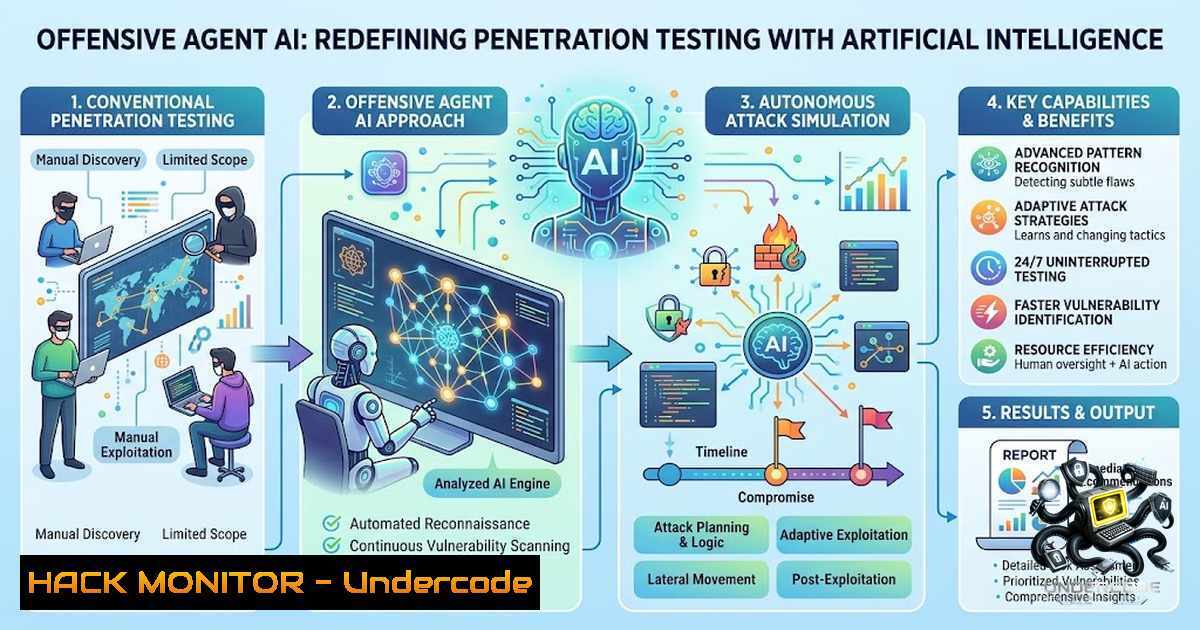
Introduction:
The integration of artificial intelligence into offensive security workflows is no longer experimental—it is a practical necessity. As organizations deploy AI at scale, penetration testers and red teamers must adapt by leveraging machine learning models to automate reconnaissance, vulnerability discovery, and exploitation. The completion of the Offensive Agent AI Certification signifies a crucial milestone in mastering AI-driven security automation, bridging the gap between traditional VAPT (Vulnerability Assessment and Penetration Testing) and next-generation adversarial AI techniques. This article dissects the core concepts, practical implementations, and real-world commands necessary to operationalize AI in penetration testing environments.
Learning Objectives & Secrets:
- Objective 1: Automate Reconnaissance with AI-powered OSINT – Use large language models and natural language processing to parse breach data, extract subdomains, and correlate vulnerabilities faster than manual enumeration.
- Objective 1 Secret Tip: Combine `httpx` with AI-based filtering (e.g., using
chatgpt-cli) to prioritize high-value targets based on technology stack, reducing false positives in scope. - Objective 2: AI-Enhanced Fuzzing and Payload Generation – Implement generative models to craft context-aware payloads for XSS, SQLi, and command injection, dynamically adapting to WAF rules.
- Objective 2 Secret Tip: Use `Burp Suite` with the `Turbo Intruder` extension, feeding AI-generated wordlists to bypass rate-limiting and signature-based detection.
- Objective 3: Autonomous Exploitation and Post-Exploitation – Train reinforcement learning agents to navigate internal networks, escalate privileges, and exfiltrate data without human intervention.
- Objective 3 Secret Tip: Leverage `Metasploit` resource scripts generated by AI to chain exploits automatically, reducing dwell time during red team exercises.
You Should Know:
1. Setting Up Your AI Offensive Security Toolkit
Before launching AI-driven attacks, ensure your environment includes foundational tools and AI model interfaces. Install the following Python packages: openai, transformers, langchain, requests, and paramiko. For Linux (Kali/Parrot), execute:
sudo apt update && sudo apt install python3-pip git nmap masscan
pip3 install openai transformers torch langchain requests beautifulsoup4
For Windows with WSL2, enable virtualization and run:
wsl --install -d Ubuntu
wsl sudo apt update && wsl sudo apt install python3-pip
Next, configure your OpenAI or local model API key:
export OPENAI_API_KEY="your-key-here"
Step‑by‑step:
- Clone the Offensive AI toolkit repository: `git clone https://github.com/offensiveai/agentic-pentest.git`
– Navigate into the directory and install dependencies: `pip install -r requirements.txt` - Run the initial reconnaissance module: `python3 recon_agent.py –domain example.com` – this spawns an LLM agent that queries Shodan, Censys, and VirusTotal to build a target profile.
2. AI-Assisted Vulnerability Scanning and Exploit Development
Traditional scanners miss logic flaws and context-dependent bugs. Use a fine-tuned CodeLlama model to analyze source code repositories and generate exploit primitives. On Linux, start the model server:
python3 -m transformers.models.llama.modeling_llama --model_name codellama/CodeLlama-7b-hf --port 8080
Then, invoke the model via a Python script to review a snippet:
import requests
payload = {"inputs": "Analyze this PHP code for SQL injection: $id = $_GET['id']; $query = 'SELECT  FROM users WHERE id = ' . $id;"}
response = requests.post("http://localhost:8080/generate", json=payload)
print(response.json()["generated_text"])
Step‑by‑step:
- Use `sqlmap` with an AI-generated tamper script: `python3 tamper_generator.py –output tamper_ai.py`
- Run `sqlmap -u “http://target.com/page?id=1” –tamper=tamper_ai.py –batch`
- For Windows, utilize the same Python environment within WSL; ensure your firewall allows outbound connections to the model API.
3. Automating Red Team Simulations with AI Agents
Deploy a multi-agent framework where each agent specializes in a phase of the kill chain (recon, persistence, exfiltration). On Linux, use `docker` to pull an agentic image:
docker pull offensiveai/redteam-agent:latest
docker run -e TARGET_IP="192.168.1.100" -e AGENT_ROLE="persistence" --rm offensiveai/redteam-agent
For cloud environments (AWS/GCP), integrate with the model to scan S3 buckets and IAM misconfigurations. Example using AWS CLI and Python:
aws s3 ls --profile target-profile | python3 ai_analyzer.py --filter-public
Step‑by‑step:
- Install AWS CLI and configure credentials: `aws configure`
- Run the AI discovery module: `python3 cloud_discover.py –provider aws –account-id 123456789012`
- This agent will output potential privilege escalation paths using a decision tree derived from generative AI.
4. API Security and AI-Driven Fuzzing
Modern APIs are prime attack surfaces. Use AI to parse OpenAPI/Swagger specs and generate malformed JSON payloads. On Linux, install `postman-to-openapi` and openapi-generator:
npm install -g postman-to-openapi
openapi-generator generate -i swagger.yaml -g python -o ./api_client
Then, run an AI fuzzer:
python3 ai_fuzz.py --endpoint https://api.target.com/v1/users --spec swagger.yaml
Step‑by‑step:
- Use `Burp Suite` with the `BApp Store` extension “AI Fuzzer” – configure it to use a local GPT-2 model for payload variations.
- In Windows, use `curl` with AI-generated headers to test rate-limiting: `curl -H “X-Forwarded-For: $(python3 gen_ip.py)” https://api.target.com/login`.
5. Hardening AI Models Against Adversarial Attacks
Defensive AI is equally critical. Implement adversarial training by generating poisoned datasets using `CleverHans` and Foolbox. On Linux:
pip install cleverhans foolbox
python3 adversarial_retrain.py --model_path ./my_model.h5 --dataset ./benign_samples --attack fgsm
Step‑by‑step:
- Monitor model drift with
EvidentlyAI: `pip install evidently` - Run `python3 drift_detection.py –reference ./baseline_stats.json –current ./current_predictions.csv`
- Mitigate by applying feature squeezing:
python3 squeeze.py --input ./input_samples --epsilon 0.1.
6. Extracting and Exploiting Secrets from Code Repositories
AI can automate secret scanning using entropy and pattern recognition. Use `truffleHog` with an LLM post-processor:
trufflehog git https://github.com/target/repo.git --json | python3 ai_secret_classifier.py
The classifier will prioritize high-confidence keys and suggest exploitation paths (e.g., AWS keys, GitHub tokens).
Step‑by‑step:
- On Windows, install `truffleHog` via `pip install trufflehog` and run PowerShell: `trufflehog filesystem . –json | python ai_secret_classifier.py`
- Use `replicate` keys to simulate AWS CLI exploitation:
aws sts assume-role --role-arn arn:aws:iam::123456789012:role/Admin --role-session-1ame ai-session.
7. Red Teaming with AI-Generated Social Engineering
While technical skills dominate, AI also enhances phishing simulations. Use `GoPhish` with LLM-generated templates:
import openai
template = openai.Completion.create(model="text-davinci-003", prompt="Write a convincing phishing email about a security alert")
print(template.choices[bash].text)
Step‑by‑step:
- Deploy `GoPhish` on a VPS: `sudo apt install gophish`
- Import generated templates and launch campaigns, tracking click-rates via AI analytics dashboards.
What Undercode Say:
- Key Takeaway 1: AI is not replacing penetration testers but supercharging their capabilities—automating mundane tasks and surfacing complex attack chains that traditional tools miss.
- Key Takeaway 2: The certification is a strong signal to employers, but true mastery requires hands-on integration of AI agents into live environments and continuous adaptation to evolving WAF/EDR bypasses.
- Analysis: The Offensive Agent AI course emphasizes practical application, aligning with industry demands for security professionals who can both code and model adversarial behaviors. However, the ethical implications of autonomous exploitation must be rigorously managed; every AI-driven action should be carefully scoped and logged for accountability.
Prediction:
- +1 AI-augmented penetration testing will become standard within 18 months, reducing overall assessment time by 60% and enabling continuous automated red teaming.
- +1 Offensive AI certifications will see a 300% increase in demand as organizations shift to DevSecOps pipelines that integrate AI scanners.
- -1 The rise of AI-powered offensive tools will trigger a corresponding surge in defensive AI, leading to an arms race where sophisticated attacks may outpace patch cycles for legacy systems.
- -1 Without strict regulatory frameworks, AI agents could be repurposed by malicious actors, amplifying the scale and speed of ransomware campaigns.
▶️ Related Video (90% Match):
🎯Let’s Practice For Free:
🎓 Live Courses & Certifications:
Join Undercode Academy for Verified Certifications
🚀 Request a Custom Project:
Secure, high-velocity infrastructure and disruptive technological engineering. Contact our engineering team for high-tier development and proprietary systems:
[email protected]
💎 Smart Architecture | 🛡️ Secure by Design | ⭐ Trusted by Thousands
IT/Security Reporter URL:
Reported By: https://lnkd.in/p/e6ZtRed5 – Hackers Feeds
Extra Hub: Undercode MoN
Basic Verification: Pass ✅


