Listen to this Post
Introduction:
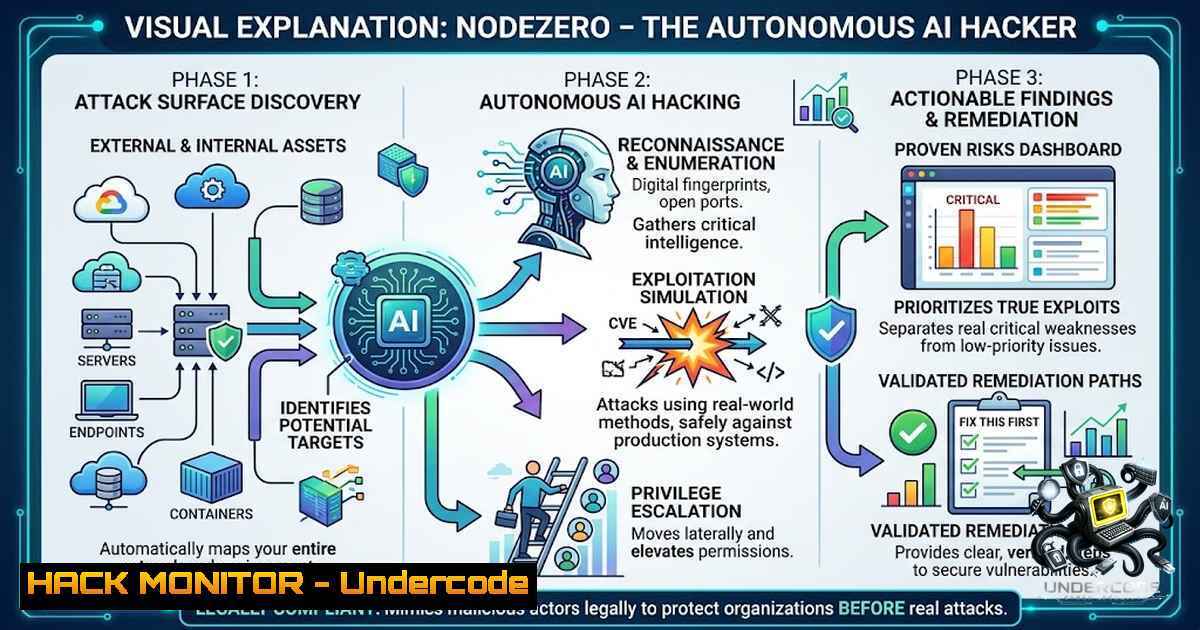
Security teams don’t get breached because attackers are smarter. They get breached because no one tested whether the defenses actually worked before the attack did. Horizon3.ai, the San Francisco-based autonomous security company behind NodeZero®, just closed a $250 million Series E at a valuation exceeding $2 billion—more than tripling its valuation from $650 million in just over 14 months. The round was co-led by NightDragon and NEA, with participation from SAIC, Acrew Capital, Sapphire Ventures, Qualcomm Ventures, and others. NodeZero is an AI-1ative platform that autonomously and safely attacks production environments, uncovers exploitable attack paths, prioritizes remediation, deploys honeypots, and verifies fixes instantly. With over 310,000 production tests executed with zero disruptions and 120% year-over-year ARR growth, Horizon3 is redefining how enterprises validate security posture.
Learning Objectives:
- Understand how autonomous AI penetration testing differs from traditional manual pentesting and breach-and-attack simulation (BAS)
- Learn to deploy and configure NodeZero for production-safe security validation across infrastructure, cloud, Kubernetes, and web applications
- Master attack graph analysis, remediation verification workflows, and integrated honeypot (Tripwire) deployment
- Explore API-driven automation and MCP Server integration for AI-powered security orchestration
- Identify compliance alignment with FedRAMP High, DORA, NIS2, NIST CSF 2.0, HIPAA, and SOC 2
You Should Know:
1. Autonomous Penetration Testing vs. Traditional Security Validation
Traditional penetration testing is a point-in-time exercise—typically annual or semi-annual—that samples only 2–3% of an organization’s infrastructure. Breach and attack simulation (BAS) platforms like AttackIQ, Cymulate, and SafeBreach validate defenses by running pre-scripted attack scenarios drawn from known adversary behavior. NodeZero operates on a fundamentally different architectural principle.
NodeZero builds a knowledge graph of the target environment—mapping hosts, services, credentials, Active Directory configurations, cloud identities, and network paths into a live model of the attack surface. A graph-based reasoning engine then traverses that model autonomously, identifying how individual weaknesses can be chained into working attack paths: a misconfigured service plus a weak credential plus an identity gap equals a route to domain compromise.
Key Distinction: A predefined playbook can only test for scenarios its vendor has already anticipated. NodeZero can chain together weaknesses in the specific configuration of a specific organization’s network—the kind of path a real attacker would discover.
Deployment Commands:
NodeZero can be deployed using a preconfigured Open Virtual Appliance (OVA) for VMware vSphere, VirtualBox, or Hyper-V:
 Download the NodeZero OVA and import into your hypervisor
 VM Requirements: 2 x CPUs (x86_64), 8GB RAM, 40GB disk

For manual Linux installation (Ubuntu):
 Run the NodeZero environment validation script
./nodezero-env-check.sh

Check Docker functionality
docker run hello-world

Verify minimum requirements
 [+] PASSED: Docker version installed meets minimum required version 20.10
2. Attack Path Discovery and the Exploit Chain
NodeZero doesn’t just find vulnerabilities—it proves they are exploitable. The platform’s attack graph is a directed acyclic graph (DAG) where nodes represent hosts, services, weaknesses, credentials, and other entities discovered and exploited during the pentest. Edges define the sequence of steps from one node to the next along the attack path.
How Attack Chaining Works:
A typical NodeZero attack sequence follows this pattern:
- Asset Discovery – Fingerprinting network and infrastructure assets
- Vulnerability Identification – Detecting misconfigurations, weak credentials, and identity gaps
- Exploitation – Safely exploiting vetted vulnerabilities with no operational impact
- Credential Pivoting – Discovering and leveraging credentials for lateral movement
- Path Validation – Proving the full attack chain to critical systems
The platform has demonstrated remarkable speed: NodeZero solved the Game of Active Directory (GOAD) in just 14 minutes—50× faster than an expert human, with perfect execution of the full attack chain from initial foothold to complete domain compromise. CEO Snehal Antani noted that the same attack that took 7 minutes and 19 seconds three years ago now takes just 77 seconds.
Remediation Verification Workflow:
Once NodeZero identifies an exploitable attack path, the countdown begins for the customer to remediate discovered issues and confirm they are no longer exploitable. The platform provides detailed reports outlining attack paths, exploited vulnerabilities, collected evidence, and remediation recommendations. Fixes can be instantly re-tested to verify effectiveness.
3. NodeZero Tripwires: Autonomous Honeypot Deployment
During a pentest, NodeZero strategically places decoys—such as fake files and credentials—based on the exploitable attack paths it discovers. These “Tripwires” are deployed where NodeZero has gained access through exploiting a vulnerability, deploying either a Remote Access Tool (RAT) or by directly writing to the asset.
Tripwire Activation:
 In the NodeZero portal:
 1. Navigate to configuration for Internal, External, Phishing Impact, or Rapid Response pentest
 2. Scroll to Tripwires section
 3. Click toggle to enable tripwire deployment
Tripwire Types:
- Fake credential files
- Decoy configuration files
- Remote Access Tool (RAT) implants
- SMB-based tripwire deployments
If a malicious actor triggers one of these tripwires, security teams receive immediate alerts, enabling rapid response and containment. This provides the cheapest, fastest, and most effective way of detecting AI attackers and proving they are inside the environment.
4. NodeZero MCP Server: AI-Powered Security Orchestration
The NodeZero Model Context Protocol (MCP) Server connects NodeZero’s GraphQL API to AI agents and LLMs, enabling natural language querying of security posture and automated remediation workflows.
MCP Server Capabilities:
- Ingest pentest results into AI agents
- Prioritize vulnerabilities based on exploitability
- Create remediation tickets automatically
- Re-test fixes to confirm they work
Deployment:
 Install Docker (prerequisite)
 Download NodeZero MCP Server container
docker pull horizon3/nodezero-mcp-server:latest

Run MCP Server (local deployment)
docker run -d \
-e HORIZON3_API_KEY="your-api-key" \
-p 8080:8080 \
horizon3/nodezero-mcp-server:latest
Security Considerations:
- Limit to 1 user, 1 API key per NodeZero MCP Server instance
- Do not expose the endpoint to untrusted networks
- Use locally-hosted MCP Server for sensitive environments
5. Kubernetes and Cloud-1ative Security Validation
NodeZero Kubernetes Pentesting runs from inside Kubernetes clusters to test security controls and vulnerabilities at the runtime level. It actively scans for insecure configurations, exploits runtime vulnerabilities, and works with all Kubernetes distributions.
Kubernetes Deployment:
 Deploy NodeZero Kubernetes Operator using Helm
helm repo add horizon3 https://horizon3.ai/charts
helm install nodezero-operator horizon3/nodezero-operator

Or deploy using kubectl
kubectl apply -f https://horizon3.ai/manifests/nodezero-operator.yaml

Verify deployment
kubectl get pods -1 nodezero-system
Capabilities:
- Tests internal, external, cloud, and hybrid environments
- Validates real attack paths across Kubernetes clusters
- No persistent or credentialed agents required
- Continuous testing—not a snapshot
6. NodeZero WebApp: Production-Safe Web Application Pentesting
Announced in July 2026, NodeZero WebApp extends autonomous attack validation to web applications. It chains vulnerabilities from application abuse through credential theft, lateral movement, cloud pivots, and sensitive data exposure.
WebApp Testing Coverage:
- OWASP Top 10 weaknesses
- Broken access control and IDOR
- Injection vulnerabilities
- API security flaws
- Complex access control failures scanners routinely miss
Key Advantage: Legacy web application security tools flood teams with theoretical findings that lack context. NodeZero WebApp delivers under 10% false positives, verified across approximately 380 vulnerabilities in early testing—matching a good manual pentester’s benchmark.
7. Compliance and Regulatory Alignment
NodeZero helps organizations meet multiple regulatory frameworks:
- FedRAMP High – Authorized for federal environments
- DORA – Digital Operational Resilience Act
- NIS2 – EU Network and Information Security Directive
- NIST CSF 2.0 – Cybersecurity Framework
- HIPAA – Healthcare compliance
- SOC 2 – Service Organization Control
- GDPR – General Data Protection Regulation
Compliance frameworks and cyber insurance requirements now demand proof of security—not just posture. Autonomous validation is the only way to deliver that proof continuously.
8. API-Driven Automation and Integration
NodeZero provides a publicly accessible GraphQL API for automation, integration, and advanced workflows:
 Example GraphQL query for pentest results
query GetPentestResults($pentestId: ID!) {
pentest(id: $pentestId) {
id
status
attackPaths {
nodes {
type
description
}
edges {
from
to
}
}
weaknesses {
id
severity
remediation
}
}
}
Integration Points:
- SIEM and SOAR platforms
- IT Service Management (ITSM) ticketing systems
- Cloud platforms and EDR solutions
What Undercode Say:
- Continuous validation is the new baseline. Annual pen tests are obsolete. Attackers probe continuously—defenders must validate continuously. NodeZero’s 310,000 production tests with zero disruptions prove autonomous validation is safe and scalable at enterprise scale.
-
Attack graphs beat scripted playbooks. BAS platforms test what vendors already know. NodeZero discovers what’s actually broken in your environment. The architectural distinction is continuous validation, not point-in-time assessment.
-
Production-safe testing is the hardest trust barrier. Horizon3 spent six years earning the right to autonomously pentest the most critical networks in the world—with no humans in the loop. SAIC’s participation in the Series E confirms federal validation has already happened.
-
The AI-vs-AI era has arrived. OpenAI and Anthropic disclosed that their own AI models breached real production systems. The question is no longer if AI can attack—it’s who controls the AI that attacks your network first. Horizon3’s $2B valuation reflects this reality.
Prediction:
-
+1 The autonomous security validation market will consolidate around AI-1ative platforms that combine attack graph reasoning, production-safe testing, and automated remediation. Horizon3’s first-mover advantage and 310,000-test data moat will be difficult to replicate.
-
+1 Continuous validation will become a regulatory requirement within 3–5 years. Compliance frameworks already demand proof of security—autonomous validation is the only scalable way to provide it.
-
+1 AI agents capable of autonomous remediation (“blue-team agents”) will emerge as the next frontier, extending NodeZero from detection to automated fix deployment.
-
-1 Autonomous attack tools in production environments carry liability sensitivity. A single misconfiguration or edge case could cause operational disruption, despite Horizon3’s perfect track record.
-
-1 Federal expansion adds procurement complexity that no commercial velocity can fully offset. FedRAMP High authorization is necessary but not sufficient for widespread federal adoption.
-
-1 Competitors including Pentera, AttackIQ, Cymulate, and emerging LLM-1ative startups like XBOW will accelerate innovation, potentially commoditizing autonomous penetration testing and compressing margins.
▶️ Related Video (80% Match):
https://www.youtube.com/watch?v=-RN34dKLiFQ
🎯Let’s Practice For Free:
🎓 Live Courses & Certifications:
Join Undercode Academy for Verified Certifications
🚀 Request a Custom Project:
Secure, high-velocity infrastructure and disruptive technological engineering. Contact our engineering team for high-tier development and proprietary systems:
[email protected]
💎 Smart Architecture | 🛡️ Secure by Design | ⭐ Trusted by Thousands
IT/Security Reporter URL:
Reported By: Security Teams – Hackers Feeds
Extra Hub: Undercode MoN
Basic Verification: Pass ✅


