Listen to this Post
Introduction:
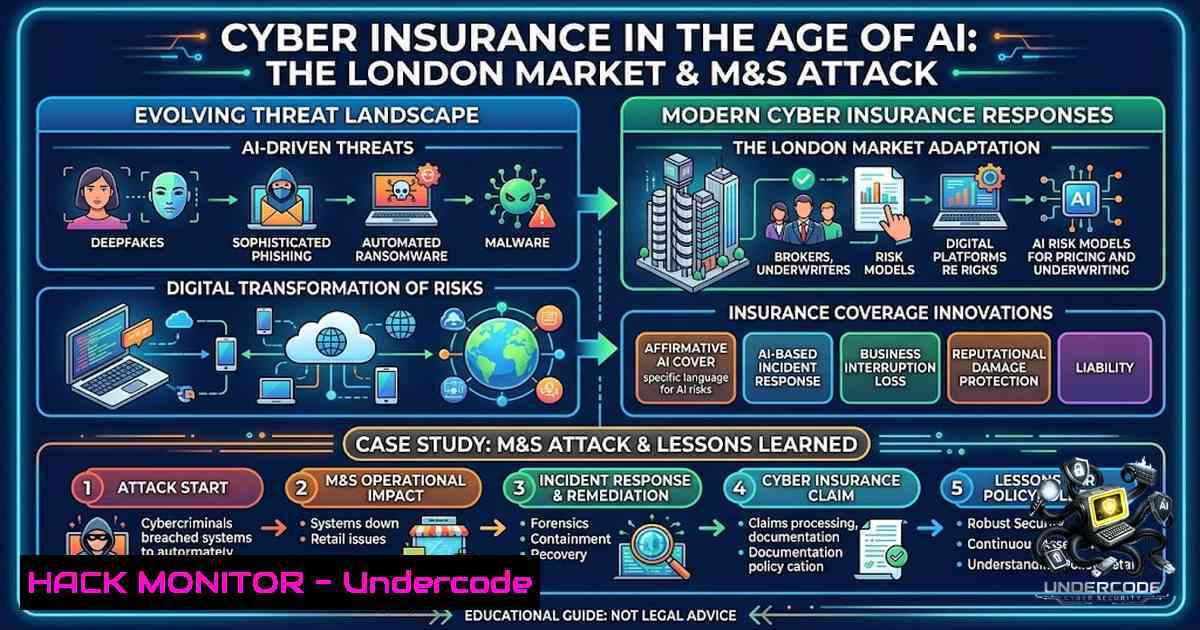
The £300 million ransomware attack on Marks & Spencer over Easter 2025 serves as a stark reminder that no organisation is immune to sophisticated cyber threats. As the London insurance market rapidly integrates artificial intelligence into underwriting and claims management, the intersection of cybersecurity, data analytics, and insurance has never been more critical. This article explores how AI is reshaping risk assessment, the technical lessons from major cyber incidents, and the practical steps professionals can take to navigate this evolving landscape.
Learning Objectives:
- Understand the technical and financial impact of major cyber attacks, using the M&S case study as a benchmark.
- Explore how AI and machine learning are being integrated into underwriting workflows, risk modelling, and claims management.
- Gain practical knowledge of tools, commands, and configurations for cyber risk assessment and cloud security hardening.
- Deconstructing the M&S Cyber Attack: A Technical and Financial Post-Mortem
The Marks & Spencer cyber attack was not a minor breach; it was a sophisticated ransomware operation that caused significant operational disruption and financial loss. The attack led to a £1 billion drop in market capitalisation and an estimated total cost of £300 million, with approximately £100 million recovered through cyber insurance.
What Happened:
The attack exploited vulnerabilities, potentially within third-party software or IT service providers. This highlights a crucial attack vector: the supply chain. For security professionals, this underscores the need for rigorous vendor risk management and continuous monitoring of third-party access.
Technical Deep-Dive & Mitigation Commands (Linux):
To defend against similar supply chain attacks, security teams should implement rigorous file integrity monitoring and vulnerability scanning.
- Audit Third-Party Dependencies (Linux):
Use `rpm -qa` (RHEL/CentOS) or `dpkg -l` (Debian/Ubuntu) to list all installed packages. Pipe this to a vulnerability database like `yum check-update` or `apt-get upgrade –dry-run` to see pending security patches.Check for known vulnerabilities in installed packages (using yum) yum updateinfo list cves Or using Debian's security tracker apt-get upgrade --dry-run | grep -i security
-
File Integrity Monitoring (FIM):
Implement FIM using `aide` (Advanced Intrusion Detection Environment). Initialize the database and run daily checks.Initialize AIDE database aide --init Move the database to the correct location mv /var/lib/aide/aide.db.new.gz /var/lib/aide/aide.db.gz Run a check aide --check
-
Windows Command for Patch Management:
On Windows, use `wmic qfe list` to list installed hotfixes or `Get-HotFix` in PowerShell to audit missing patches.Get-HotFix | Sort-Object InstalledOn -Descending
Step-by-Step Guide:
1. Identify all third-party software and service providers.
- Automate vulnerability scanning using tools like `OpenVAS` or `Nessus` to regularly assess these components.
- Implement a strict patch management policy, prioritising critical and zero-day vulnerabilities.
-
Monitor file integrity on critical system files and application binaries to detect unauthorised changes indicative of ransomware activity.
-
AI in Underwriting: From Translating Needs to Autonomous Agents
The London market is witnessing a seismic shift with AI being built directly into underwriting workflows. The goal is not to replace underwriters but to augment their capabilities, translating complex risk data into actionable insights. This involves using AI for data extraction, submission review, and even loss-run generation.
The Technology Stack:
Modern underwriting AI leverages a combination of:
- Optical Character Recognition (OCR): To digitise and extract data from paper-based submissions.
- Natural Language Processing (NLP): To understand and categorise risk descriptions in broker emails and policy documents.
- Large Language Models (LLMs): To summarise complex datasets and generate risk appetite insights in real-time.
- Predictive Analytics: To model cyber risk using vast datasets on threat intelligence and security controls.
Practical Application & API Security:
Many of these AI tools are delivered as API-enabled solutions. Securing these APIs is paramount.
- API Security Checklist (Linux/Windows):
- Authentication: Ensure OAuth 2.0 or API keys are used and rotated regularly.
- Rate Limiting: Configure rate limiting to prevent abuse and DoS attacks. On an NGINX server (Linux), this can be configured in
/etc/nginx/nginx.conf:limit_req_zone $binary_remote_addr zone=mylimit:10m rate=10r/s; server { location /api/ { limit_req zone=mylimit burst=20 nodelay; proxy_pass http://your_api_backend; } } - Input Validation: Sanitize all inputs to prevent injection attacks. Use libraries like `express-validator` (Node.js) or `WTForms` (Python).
Step-by-Step Guide for AI Integration:
- Data Aggregation: Consolidate data from internal systems (policy admin, claims) and external sources (threat intelligence feeds).
- Model Training: Use machine learning algorithms to train models on historical claims data to predict future risk probabilities.
- Workflow Automation: Implement AI agents to handle routine tasks like data entry and initial risk scoring, freeing up underwriters for complex analysis.
- Continuous Monitoring: Establish feedback loops where underwriters can correct AI outputs, continuously improving the model’s accuracy.
3. Modernising Claims Management with AI and Automation
The claims process is often the first real test of an insurance policy’s value. Companies like DOCOsoft are revolutionising this space with AI-driven claims management systems that streamline the entire lifecycle.
Key Technologies:
- Straight-Through Processing (STP): AI identifies uncontroversial claims and automates their processing, agreement, and payment, significantly reducing turnaround times.
- AI-Driven Data Ingestion: Automates the creation and updating of claims directly from emails and documents, reducing manual data entry.
- Visual Workflow Management: Provides dashboards that highlight processing times, throughput, and bottlenecks in the claims journey.
Cloud Hardening for Insurance Platforms:
As claims management moves to SaaS-based platforms, securing cloud infrastructure is critical.
- Azure CLI Command for Hardening:
Enforce Multi-Factor Authentication (MFA) for all users.
az ad conditional-access policy create --1ame "Require MFA for All Users" --conditions "{\"applications\":{\"includeApplications\":[\"All\"]},\"users\":{\"includeUsers\":[\"All\"]}}" --grant-controls "{\"builtinControls\":[\"Mfa\"]}"
- AWS CLI Command for S3 Bucket Security:
Block public access to S3 buckets containing sensitive claims data.aws s3api put-public-access-block --bucket your-claims-bucket --public-access-block-configuration "BlockPublicAcls=true,IgnorePublicAcls=true,BlockPublicPolicy=true,RestrictPublicBuckets=true"
Step-by-Step Guide for Claims Automation:
- Assess current claims workflow to identify bottlenecks and manual processes.
- Implement an AI-powered data ingestion tool to automatically process incoming claims notifications.
- Configure STP rules to automatically approve low-risk, straightforward claims.
- Deploy a visual management dashboard for claims adjusters to monitor progress and intervene on complex cases.
- Migrate to a secure, cloud-based claims management system to improve scalability and accessibility.
-
The Bermuda Form: A Legal and Technical Framework for Catastrophic Risk
The “Bermuda Form” is a unique insurance policy developed in the 1980s to cover catastrophic liabilities such as serious explosions or mass tort litigation. Understanding its structure is crucial for any professional dealing with high-value, complex risks.
Key Features:
- Occurrence Reported Form: It covers claims based on when the incident is reported, not when it occurred.
- Dispute Resolution: It mandates arbitration in London under the English Arbitration Act, but applies modified New York substantive law.
- Unique Coverage Triggers: The policy includes specific conditions and exclusions that differ from standard commercial policies.
Technical Implication for Data Management:
Managing claims under a Bermuda Form requires meticulous data retention and reporting. Legal and compliance teams must ensure that all relevant data is captured and stored securely to support potential arbitration.
- Linux Command for Secure Data Archiving:
Use `tar` with encryption to archive and secure claim-related documents.Create an encrypted archive tar -czf - /path/to/claim-data | openssl enc -aes-256-cbc -salt -out claim-data-archive.tar.gz.enc Decrypt the archive openssl enc -aes-256-cbc -d -in claim-data-archive.tar.gz.enc | tar -xzf -
-
Windows Command for File Hashing (Integrity Check):
Use PowerShell to generate a SHA-256 hash of critical documents to ensure they haven’t been tampered with.Get-FileHash -Path "C:\Claims\Policy.pdf" -Algorithm SHA256
Step-by-Step Guide:
- Identify all policies that fall under the Bermuda Form structure.
- Establish a secure, auditable data retention policy for all related claims documentation.
- Implement a robust document management system with version control and access logging.
- Train legal and claims teams on the specific notification and arbitration procedures required by the form.
5. The Human Element and Future-Proofing Your Career
Despite the rise of AI, the London insurance market remains a relationship-driven industry. Trust and personal connections are paramount when dealing with complex risks and claims. For professionals, this means combining technical acumen with strong interpersonal skills.
What Undercode Say:
- Cybersecurity is a Board-Level Issue: The M&S attack demonstrates that cyber risk is not just an IT problem but a financial and strategic one that demands executive attention.
- AI is an Augmentation, Not a Replacement: AI tools are designed to support underwriters and claims adjusters, making them more efficient and accurate, not obsolete.
Analysis:
The integration of AI into the London market is creating a new breed of professional who is part technologist, part risk expert. Understanding how to leverage AI for data analysis, while maintaining the human touch for relationship management, will be the defining skill of the future. The industry is moving towards “agentic AI” – systems that can act autonomously to solve problems. This requires professionals to become adept at overseeing and guiding these AI agents, ensuring they align with business strategy and ethical guidelines. The ability to translate complex technical risks into commercial language for brokers and clients will be invaluable.
Prediction:
- +1 The increasing sophistication of AI in underwriting will lead to more accurate pricing of cyber risk, potentially lowering premiums for well-secured organisations and encouraging better security practices.
- -1 The reliance on AI and third-party platforms will create new, concentrated points of failure. A successful attack on a major AI underwriting platform could have systemic consequences across the entire insurance market.
- +1 The demand for professionals with hybrid skills in cybersecurity, data science, and insurance will surge, creating new and lucrative career paths.
- -1 The speed of AI adoption may outpace regulatory frameworks, leading to a period of uncertainty and potential mis-selling or unfair pricing practices.
- +1 Advanced cyber risk modelling tools, like those from CyberCube, will enable insurers to better understand and manage catastrophic cyber events, improving overall market resilience.
▶️ Related Video (68% Match):
🎯Let’s Practice For Free:
🎓 Live Courses & Certifications:
Join Undercode Academy for Verified Certifications
🚀 Request a Custom Project:
Secure, high-velocity infrastructure and disruptive technological engineering. Contact our engineering team for high-tier development and proprietary systems:
[email protected]
💎 Smart Architecture | 🛡️ Secure by Design | ⭐ Trusted by Thousands
IT/Security Reporter URL:
Reported By: Kennedy W – Hackers Feeds
Extra Hub: Undercode MoN
Basic Verification: Pass ✅


