Listen to this Post
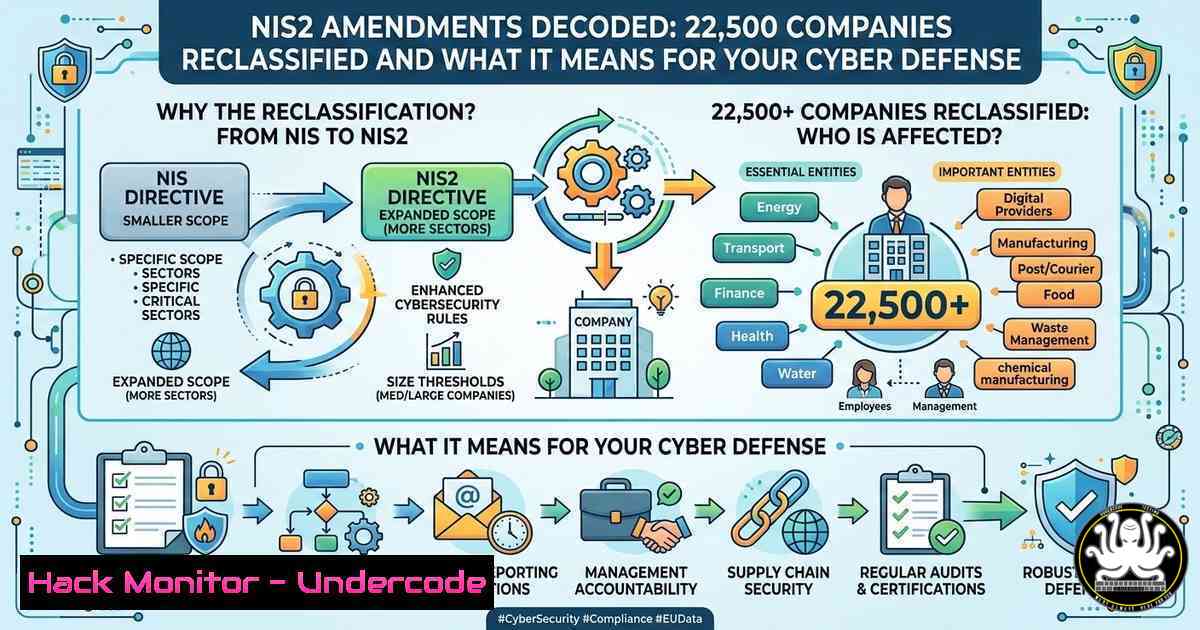
Introduction:
The European Union’s NIS2 Directive is undergoing its first major amendment, shifting from broad-stroke regulation to a targeted, risk-based framework. With the proposed COM(2026) 13, the Commission aims to “simplify” compliance, but the reality involves a significant redrawing of the digital battlefield. Organizations must now navigate a new scope that adds critical infrastructure like submarine data cables while removing low-impact energy producers, fundamentally altering the cybersecurity compliance landscape for 2026 and beyond.
Learning Objectives:
- Understand the revised scope thresholds and how to determine if your organization shifts between “essential” and “important” entity status.
- Analyze the practical implications of EU-wide harmonization rules and the “ceiling” on national gold-plating.
- Learn how to leverage CSA2 cybersecurity certifications as a supervisory shield to reduce audit burdens.
- Identify the new mandatory ransomware reporting requirements and structure internal incident response to capture required data.
You Should Know:
1. Scope Rebalancing: Who’s In and Who’s Out
The amendment COM(2026) 13 introduces a surgical adjustment to the entities covered by NIS2. Electricity producers operating below 1 MW and specific chemical importers are being removed from the scope, reducing the compliance burden on genuinely low-risk local operators. Conversely, the digital frontier is expanding. Providers of Digital Identity Wallets, operators of submarine data infrastructure (the physical backbone of the internet), and owners of strategic dual-use infrastructure are now explicitly included.
Step‑by‑step guide: How to audit your current NIS2 classification
To determine if your entity status changes under the new proposal, conduct this internal audit:
1. Review Sector Classification: Verify your NACE code against the updated Annex I and II lists (focus on the new digital infrastructure and dual-use categories).
2. Calculate Employee Headcount: Use the average number of employees during the last financial year, including temporary staff.
3. Analyze Financial Thresholds: Calculate the annual turnover and balance sheet total. The new “small mid-cap” category shifts the boundary from €50M to €150M revenue and from 250 to 750 employees.
4. Cross-Reference Criticality: Even if below thresholds, check if you are the sole provider of a service in a member state (a designation that overrides standard thresholds).
5. Document the Rationale: Create a memo detailing why you qualify as “essential” (proactive audits, higher fines) or “important” (reactive supervision) based on the new figures.
2. The Reclassification Impact: Essential vs. Important
The amendment creates a new “small mid-cap” layer, effectively moving an estimated 22,500 companies from “essential” to “important” status. This is not merely a bureaucratic relabeling; it has direct operational consequences. Essential entities are subject to ex-ante supervision, meaning they must undergo regular, proactive audits and can face fines of up to €10M or 2% of global turnover. Important entities face ex-post supervision, where authorities only intervene after an incident or suspicion of non-compliance.
Step‑by‑step guide: Adjusting your compliance program for status shift
If your organization is reclassified, update your Governance, Risk, and Compliance (GRC) workflows:
1. Update the Register of Processing Activities (RoPA): Formally document your new status.
2. Revise Audit Cadence: If moving from Essential to Important, shift internal audit resources from proactive, scheduled audits to a “ready for reactive inspection” posture. If moving up, schedule your first mandatory audit immediately.
3. Penalty Forecasting: Recalculate financial risk exposure. Essential entities face the 2% global turnover cap, while Important entities face the lower tier of administrative fines (likely capped at €7M or 1.4%).
4. Notification Adjustments: Ensure your incident response team knows that the reporting deadlines (24h for early warning) remain the same for both categories, but the supervisory approach differs.
3. The Ceiling on “Gold-Plating”
One of the most significant changes for cross-border operators is the limitation on national “gold-plating.” Where the European Commission issues implementing acts under 21(5) (specifying technical and methodological requirements for security measures), Member States will no longer be allowed to impose additional national requirements on top of them. This aims to create a single baseline for security measures across the EU, reducing fragmentation.
Step‑by‑step guide: Mapping harmonized standards vs. national requirements
To prepare for a harmonized baseline:
- Monitor Implementing Acts: Regularly check the Commission’s work program for draft implementing acts related to 21(5) (e.g., specific cloud security standards, incident notification formats).
- Gap Analysis: When an act is adopted, perform a gap analysis between your current controls (which may be based on a strict national interpretation) and the new EU baseline.
- Local Legal Review: Consult with local counsel to identify if your specific member state had stricter rules previously. Under the new rules, these stricter rules will be preempted, allowing you to downgrade to the EU baseline if you wish, potentially reducing costs.
- Policy Update: Rewrite internal InfoSec policies to reference the EU implementing act directly, rather than transposing 27 different national versions.
4. Cyber Certification as a Supervisory Shield
Valid cybersecurity certification under a European Cybersecurity Certification Scheme (pursuant to the Cybersecurity Act – CSA2) will now serve as a “supervisory shield.” If your organization or a specific ICT product/service is certified under an EU-wide scheme, competent authorities cannot impose additional measures for the aspects covered by that certification. This is not a blanket exemption but a powerful tool to reduce overlapping audits.
Step‑by‑step guide: Leveraging certification to block additional supervision
- Identify Applicable Schemes: Determine which EUCS (cloud services), EUCC (ICT products), or EU5G (5G) schemes apply to your infrastructure.
- Scope Certification: Ensure the certification covers the specific assets and processes that are most frequently audited by national authorities.
- Assert the Shield: During a supervisory inspection, formally present your certification and request that the authority limit its requests to areas outside the certified scope. Cite the specific clause in the NIS2 amendment.
- Document the Assertion: Keep a record of this request. If the authority insists on duplicative measures, you have a basis for escalation to the Cooperation Group.
5. Structured Ransomware Reporting
The amendment introduces a harmonized framework for ransomware reporting. Organizations must now report the attack vector, the mitigation measures taken, and—upon request—ransom payment data. Liability protections are included to encourage sharing, but the interaction with GDPR (data breach notification) and DORA (ICT-related incident reporting) creates a complex web.
Step‑by‑step guide: Configuring IR playbooks for NIS2 ransomware rules
Update your Incident Response (IR) plan to capture the specific data points required:
1. Capture Attack Vector: Ensure your EDR/XDR tools are configured to log the initial access path (e.g., phishing email hash, vulnerable exposed RDP, supply chain compromise). This must be included in the initial report.
2. Log Mitigation Steps: In your playbook, add a step to timestamp every containment action (e.g., “09:32 – Firewall rule applied to block C2 IP,” “09:45 – Affected VM isolated”). This is now a mandatory reporting field.
3. Payment Decision Protocol: Establish a legal/finance protocol for ransom payment decisions. If a payment is considered, the data (amount, cryptocurrency wallet, negotiator communications) must be logged securely, as it is requestable by authorities.
4. Coordination with DPO: Trigger GDPR notification in parallel with the NIS2 report. The NIS2 report covers the attack mechanics; the GDPR notification covers the personal data breach aspect. Ensure timelines align (72h for GDPR, 24h for NIS2 early warning).
6. Preparing for the 2028 Deadline
With a political agreement targeted for early 2027 and a transposition deadline around 2028, organizations have a narrow window to operationalize these changes.
Step‑by‑step guide: Building the NIS2 2.0 roadmap
- Gap Analysis (Q3 2026): Run a full audit against the amended text.
- Certification Roadmap (Q4 2026): If planning to use the “certification shield,” begin the certification process now, as audits can take 6-12 months.
- Supply Chain Review (Q1 2027): Identify if any of your critical suppliers are the newly added entities (e.g., digital identity providers) and reassess their risk.
- Tooling Upgrade (Q2 2027): Ensure your SIEM/SOAR can capture the specific ransomware reporting fields without manual intervention.
What Undercode Say:
- Regulation is Catching Up to Reality: The inclusion of submarine cables and digital identity wallets proves that EU lawmakers now view physical-digital convergence as the primary attack surface. Hardening these assets is no longer optional.
- Harmonization is a Double-Edged Sword: While a ceiling on gold-plating reduces fragmentation, it also locks in a minimum standard. Agile companies will treat the EU baseline as a floor, not a ceiling, to maintain a competitive security posture.
- The “Small Mid-Cap” Reclassification is a Trap: While 22,500 companies may celebrate moving from “essential” to “important,” they must not let their guard down. Reactive supervision often means less warning before an inspection and less leniency if found lacking.
- Data is the New Defense: The ransomware reporting framework turns incident data into a regulatory asset. Organizations that meticulously log attack vectors and mitigations will not only comply but will also contribute to a collective defense database that will shape future threat intelligence.
- Certification as a Business Enabler: The “supervisory shield” for certifications turns a compliance cost into a strategic advantage. A CSA2 certification is now a direct tool to reduce interaction with supervisory authorities, freeing up resources for actual security work.
Prediction:
By 2028, we will witness a market consolidation in cybersecurity compliance tools, driven by the NIS2 amendment’s demand for structured data sharing. The “gold-plating ceiling” will force MSSPs to standardize their offerings across the EU, likely lowering costs but also reducing niche, country-specific cyber resilience tactics. Furthermore, the inclusion of submarine cables will trigger a new wave of investment in physical security for undersea infrastructure, merging naval defense strategies with corporate cyber governance.
▶️ Related Video (74% Match):
🎯Let’s Practice For Free:
IT/Security Reporter URL:
Reported By: Riadhbrinsi Nis2 – Hackers Feeds
Extra Hub: Undercode MoN
Basic Verification: Pass ✅


