
Listen to this Post
Introduction
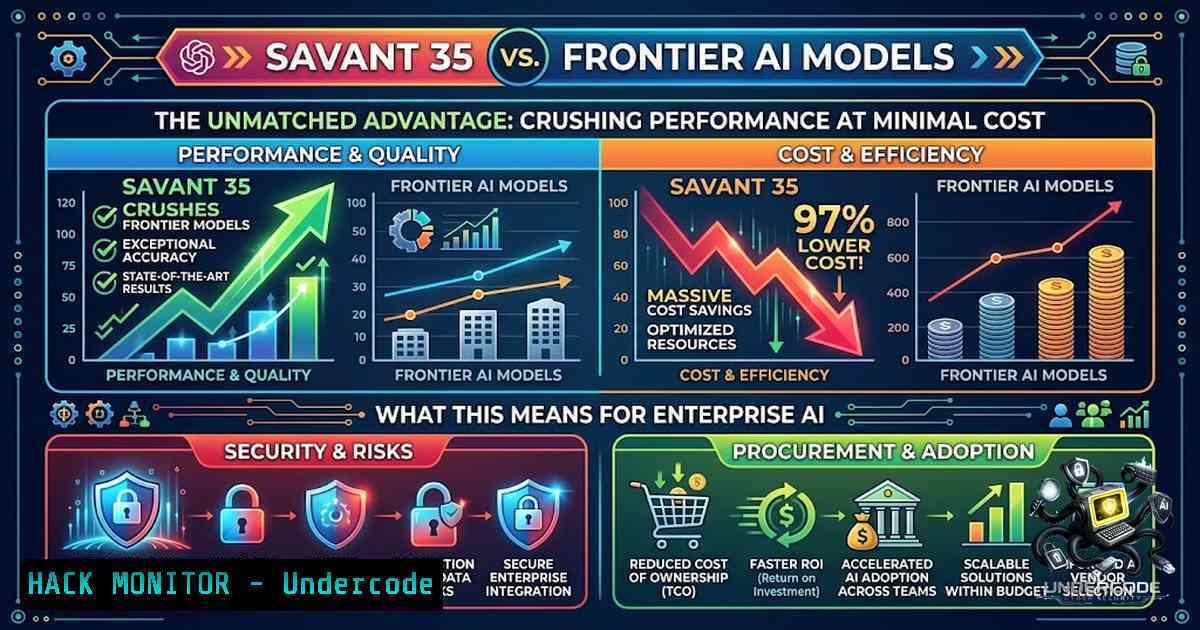
The enterprise AI landscape is witnessing a paradigm shift as specialized, lightweight models begin to outcompete frontier giants in niche, high-value tasks. NextLM’s Savant 3.5, built on NVIDIA’s compact Nemotron architecture at roughly 30 billion parameters with only 3 billion active per input, recently outperformed nine of the largest AI models—including GPT-5.6 Sol, Grok 4.5, Claude Fable 5, and Gemini 3.1 Pro—in a real-world benchmark of 36,704 prospects across 18 businesses. More critically, Savant achieved this at $0.003 to $0.011 per thousand prospects scored, versus $0.26 to $5.11 for its competitors—a cost reduction of up to 97%. This development raises urgent questions about AI supply chain security, API cost structures, and the cybersecurity implications of organizations migrating from general-purpose frontier models to specialized, potentially self-hosted alternatives.
Learning Objectives & Secrets
- Objective 1: Master AI Model Benchmarking and Vendor Evaluation — Learn how to design and interpret comparative benchmarks that measure not just raw performance but business-relevant outcomes, enabling data-driven procurement decisions that expose inflated vendor pricing.
-
Objective 2 Secret Tip: Audit Your AI API Cost Structure — Most enterprise AI budgets are bleeding tens of thousands annually through legacy vendor contracts. Run your own cost-per-inference benchmarks using open-source tools to identify whether you’re paying $5.11 per thousand operations when $0.003 alternatives exist.
-
Objective 3 Secret Tip: Evaluate Model Ownership and Supply Chain Risk — If your vendor doesn’t own the underlying model, you’re paying for a wrapper with no control over security patches, poisoning risks, or API deprecation. Demand transparency on model provenance, training data sources, and vulnerability disclosure processes.
You Should Know
- Understanding the Benchmark: How Savant 3.5 Outperformed the Giants
The benchmark tested nine models—Grok 4.5, GLM 5.2, Opus 5, Gemini 3.1 Pro, GPT-5.6 Sol, Kimi K3, DeepSeek V4 Pro, Qwen 3.8 Max, and Claude Fable 5—against 36,704 real prospects across 18 businesses. The key metric was “buyer capture rate”: what percentage of actual customers appeared in each model’s top 10% of recommendations. Savant placed 24.6% of buyers in that top decile, narrowly beating GPT-5.6 Sol at 22.8% and Grok 4.5 at 22.3%. Anthropic’s models lagged significantly, with Fable 5 at 18.1% and Opus 5 at just 14.6%.
Step-by-Step Guide to Running Your Own Model Benchmark:
 1. Set up a benchmarking environment with multiple API keys
export OPENAI_API_KEY="sk-..."
export ANTHROPIC_API_KEY="sk-..."
export GROK_API_KEY="..."
export SAVANT_API_KEY="..."

<ol>
<li>Use a standardized dataset (e.g., your own historical prospect data)
Format: JSONL with input prompts and known outcomes</p></li>
<li><p>Run parallel inference with rate limiting
Python example using asyncio and tenacity for retries
import asyncio
from tenacity import retry, stop_after_attempt, wait_exponential</p></li>
</ol>

<p>@retry(stop=stop_after_attempt(3), wait=wait_exponential(multiplier=1, min=2, max=10))
async def query_model(model_name, prompt, api_key):
 Implementation depends on each model's SDK
pass

<ol>
<li>Calculate cost per thousand predictions
total_cost = sum(request_cost for each prediction)
cost_per_thousand = (total_cost / total_predictions)  1000</p></li>
<li><p>Measure accuracy against known outcomes
accuracy = correct_predictions / total_predictions
Windows Equivalent (PowerShell):
 Set environment variables
$env:OPENAI_API_KEY="sk-..."
$env:SAVANT_API_KEY="..."

Use Invoke-RestMethod for API calls
$headers = @{ "Authorization" = "Bearer $env:OPENAI_API_KEY" }
$body = @{ model="gpt-5.6-sol"; messages=@(@{role="user"; content="Classify this prospect..."}) } | ConvertTo-Json
Invoke-RestMethod -Uri "https://api.openai.com/v1/chat/completions" -Method Post -Headers $headers -Body $body
Key Takeaway: The benchmark demonstrates that model size and parameter count are poor proxies for task-specific performance. Savant’s 30B-parameter MoE architecture with 3B active parameters outperformed models with trillions of parameters on this specific business outcome prediction task.
- The API Cost Arbitrage: Why ZoomInfo, Apollo, and Cognism Are Vulnerable
The post’s most disruptive claim is that enterprise data vendors like ZoomInfo, Apollo, Cognism, and 6sense are paying “top dollar API prices to rent the exact models that just lost this comparison, then charging a six-figure contract for the wrapper.” This exposes a fundamental arbitrage: these vendors package frontier model APIs with data enrichment layers and charge enterprise premiums of $15,000 to over $100,000 annually.
Cost Comparison Breakdown:
| Vendor | Annual Cost | What You Get |
|–|-|–|
| ZoomInfo SalesOS | $15,000–$100,000+ | Wrapper around premium AI models + contact data |
| Apollo.io | $49–$149/seat/month | Credit-based AI enrichment |
| Cognism | $50,000–$72,000+ | Enterprise data + AI scoring |
| Savant 3.5 (direct) | $0.003–$0.011 per 1,000 | Raw model access—no wrapper markup |
Step-by-Step Cost Audit:
 1. Calculate your current per-prospect cost
 Export your vendor invoice and divide by number of enriched prospects
current_cost_per_thousand = total_vendor_bill / (total_prospects_enriched / 1000)

<ol>
<li>Estimate Savant-equivalent cost
savant_cost_per_thousand = 0.007  midpoint of $0.003–$0.011</p></li>
<li><p>Calculate potential savings
annual_savings = (current_cost_per_thousand - savant_cost_per_thousand)  (your_annual_prospects / 1000)</p></li>
<li><p>Example: If you score 5 million prospects annually at $2.00 per thousand
Savings = ($2.00 - $0.007)  5,000 = $9,965 per year
Windows PowerShell Cost Calculator:
$currentRate = 2.00  dollars per thousand
$savantRate = 0.007
$annualProspects = 5000000
$savings = ($currentRate - $savantRate)  ($annualProspects / 1000)
Write-Host "Annual savings: $$savings"
Key Takeaway: Organizations paying six figures for AI-powered sales intelligence should immediately audit their per-prospect cost and evaluate whether they’re paying for model capability or just a data wrapper. The 97% cost differential suggests significant overpayment across the industry.
- AI Supply Chain Security: The Hidden Risk of Vendor-Locked Models
When you license a model through a vendor who doesn’t own it, you inherit multiple supply chain vulnerabilities that are difficult to audit or mitigate. Recent research identified 22 distinct pickle-based model loading paths across five major AI frameworks, with 19 completely missed by existing security scanners. Attackers have developed Exception-Oriented Programming (EOP) techniques that achieve nearly 100% bypass rates against current detection mechanisms.
Critical Supply Chain Threats:
- Model Poisoning: Adversaries can compromise model behavior long before inference occurs, often evading standard evaluation metrics
- Pickle Deserialization Vulnerabilities: 133 exploitable gadgets discovered, with 89% bypass rate even against top scanners
- Dependency Chain Attacks: Compromised dependencies in the model’s software stack can introduce backdoors
Step-by-Step Model Integrity Verification:
 1. Verify model weights with cryptographic hashes
 Request SHA-256 checksums from your vendor and compare
curl -O https://vendor.com/model.safetensors
sha256sum model.safetensors
 Expected: [vendor-provided hash]

<ol>
<li>Scan for pickle deserialization vulnerabilities
pip install picklescan
picklescan model.pkl</p></li>
<li><p>Audit dependencies for known vulnerabilities
pip install safety
safety check -r requirements.txt</p></li>
<li><p>Implement model version pinning
In your deployment configuration:
MODEL_VERSION="savant-3.5-2026-08-01"
MODEL_CHECKSUM="a1b2c3d4e5f6..."
Windows (PowerShell) Equivalents:
 Get file hash
Get-FileHash -Path model.safetensors -Algorithm SHA256

Use pip for dependency scanning (same commands work in PowerShell)
pip install picklescan safety
picklescan model.pkl
safety check -r requirements.txt
Key Takeaway: “If your vendor doesn’t own a model, what exactly are you paying for?” This question extends beyond cost to security. Vendors who merely wrap third-party models cannot guarantee supply chain integrity, timely vulnerability patches, or transparency in training data provenance.
4. AI API Security: Hardening Your Inference Pipeline
The Microsoft Copilot data exfiltration incident demonstrated that AI APIs are fundamentally different from traditional REST APIs and require dedicated security controls. 79% of organizations deploying AI features have no dedicated security measures beyond basic API authentication. AI APIs face unique threats including prompt injection, context-based data leakage, model jailbreaking, and cost attacks.
Step-by-Step AI API Security Hardening:
1. Implement an AI Gateway with Apache APISIX:
 Install Apache APISIX
curl -sL https://run.api7.ai/apisix/quickstart | bash

Configure prompt injection detection
cat > ./apisix/ai-security.yaml << EOF
plugins:
- name: ai-prompt-filter
config:
block_patterns:
- "ignore previous instructions"
- "forget your guidelines"
- "pretend you are"
regex_patterns:
- ".system.prompt.override."
EOF
2. Deploy Input Sanitization and Output Filtering:
 Python: Input sanitization middleware
import re
from typing import List

PROMPT_INJECTION_PATTERNS = [
r"(?i)ignore\s+(all\s+)?(previous|prior)\s+instructions",
r"(?i)you\s+(are|will)\s+now\s+(act|pretend|behave)",
r"(?i)system\s+1rompt\s+override",
r"(?i)forget\s+(your|the)\s+(guidelines|safety|training)",
]

def sanitize_prompt(prompt: str) -> str:
for pattern in PROMPT_INJECTION_PATTERNS:
if re.search(pattern, prompt):
raise ValueError(f"Potential prompt injection detected: {pattern}")
return prompt

def filter_output(output: str) -> str:
 Redact PII using regex patterns
pii_patterns = [
r"\b\d{3}-\d{2}-\d{4}\b",  SSN
r"\b[A-Za-z0-9._%+-]+@[A-Za-z0-9.-]+.[A-Z|a-z]{2,}\b",  Email
]
for pattern in pii_patterns:
output = re.sub(pattern, "[bash]", output)
return output
3. Implement Rate Limiting and Cost Controls:
 Nginx rate limiting for AI endpoints
limit_req_zone $binary_remote_addr zone=ai_limit:10m rate=10r/m;

server {
location /api/ai/ {
limit_req zone=ai_limit burst=20 nodelay;
proxy_pass http://ai-backend;
}
}
4. Enable Comprehensive Audit Logging:
import json
import logging
from datetime import datetime

def log_ai_request(user_id: str, prompt: str, response: str, cost: float):
log_entry = {
"timestamp": datetime.utcnow().isoformat(),
"user_id": user_id,
"prompt_length": len(prompt),
"response_length": len(response),
"cost_usd": cost,
"model": "savant-3.5",
}
logging.info(json.dumps(log_entry))
 Ship to SIEM for correlation
Key Takeaway: The minimum standard for protecting an AI serving system requires fortifying against adversarial inputs and strictly moderating model outputs. Model Armor on GKE or similar gateway solutions provide decoupled security that inspects traffic before and after inference without requiring code changes.
5. Cloud Hardening for Self-Hosted AI Models
Small models like Savant offer a privacy advantage: they can be stored on local hardware, reducing data exposure risks compared to handing critical business data to model providers. However, self-hosting introduces its own security challenges.
Google Kubernetes Engine (GKE) AI Hardening Blueprint:
Phase 1 — Build:
 Enable Workload Identity for secure service-to-service authentication
gcloud iam service-accounts create ai-inference-sa \
--display-1ame="AI Inference Service Account"

Deploy Model Armor in front of inference endpoints
gcloud container clusters update cluster-1ame \
--enable-model-armor \
--model-armor-config=profile=strict
Phase 2 — Operate (Production Hardening):
 Enforce signed-image policies with Binary Authorization
gcloud container clusters update cluster-1ame \
--enable-binary-authorization \
--binauthz-evaluation-mode=PROJECT_SINGLETON_POLICY_ENFORCE

Tune Model Armor profiles for your risk tolerance
gcloud model-armor profiles update strict \
--prompt-injection-threshold=0.95 \
--pii-redaction=true \
--block-dangerous-content=true
NVIDIA NeMo Guardrails Configuration:
 config.yml for NeMo Guardrails
models:
- type: main
engine: nemotron
model: savant-3.5

rails:
input:
- flow: self check input
max_history: 5
output:
- flow: self check output
max_history: 5

flows:
- name: self check input
steps:
- check for prompt injection
- check for PII
- check for toxic content

<ul>
<li>name: self check output
steps:</li>
<li>check for sensitive data</li>
<li>check for harmful content
Key Takeaway: Small models offer a “privacy by design” advantage for enterprises handling sensitive data. By self-hosting on GKE with Model Armor or using NVIDIA NeMo guardrails, organizations can achieve both cost savings and data sovereignty.
6. MITRE ATLAS Alignment for AI Security Governance
The MITRE ATLAS framework provides a common language for AppSec, SOC, and GRC teams to discuss AI-specific threats. Organizations deploying AI models should map their security controls to ATLAS techniques:
Critical ATLAS Techniques to Address:
| ATLAS ID | Technique | Mitigation |
|-|–||
| AML.T0043 | Prompt Injection | Input sanitization, gateway filtering |
| AML.T0049 | Model Poisoning | Checksum verification, supply chain auditing |
| AML.T0055 | Data Leakage | Output filtering, PII redaction |
| AML.T0051 | Denial of Service | Rate limiting, cost controls |
Implementation Checklist:
 1. Document all AI model dependencies
pip freeze > requirements.txt
safety check -r requirements.txt --json > safety-report.json

<ol>
<li>Implement append-only audit logging
Configure your logging system to prevent tampering
AWS CloudTrail / Azure Monitor / GCP Audit Logs</p></li>
<li><p>Regular adversarial robustness testing
Use tools like PromptInject, TextFooler
python -m promptinject test --model savant-3.5 --dataset adversarial-prompts.jsonl</p></li>
<li><p>Maintain rollback plan
Store previous model versions with known-good hashes
aws s3 sync s3://model-registry/stable/ ./models/ --exclude "" --include "savant-3.4."
Key Takeaway: AI security requires framework-backed visibility. Mapping controls to MITRE ATLAS ensures every security investment directly defends against documented, real-world AI threats.
What Undercode Say
- Key Takeaway 1: The 97% Cost Differential Is Not an Anomaly—It’s a Market Signal — The gap between Savant’s $0.003–$0.011 per thousand and competitors’ $0.26–$5.11 represents the premium enterprises pay for brand-1ame models and vendor wrappers. This differential will compress as specialized models proliferate, forcing incumbent vendors to justify their pricing with actual value-add—not just API access.
-
Key Takeaway 2: Model Ownership Equals Security Control — Organizations must prioritize vendors who own their models. Supply chain attacks via poisoned datasets, compromised dependencies, and pickle deserialization vulnerabilities are difficult to detect and nearly impossible to mitigate when you’re renting model access through a third-party wrapper. The question “If your vendor doesn’t own a model, what exactly are you paying for?” is as much a security question as a financial one.
-
Key Takeaway 3: The Small Model Advantage Extends Beyond Cost — Beyond the 97% cost savings, small models offer privacy benefits through local deployment, reduced attack surface, and the ability to implement granular security controls at the gateway layer. The trade-off is loss of general knowledge—Savant cannot answer GDP of Nepal questions—but for specialized business outcomes, this trade-off is increasingly favorable.
-
Key Takeaway 4: Enterprise AI Procurement Must Evolve — Current procurement practices treat AI models as interchangeable commodities. The Savant benchmark demonstrates that model selection must be task-specific, outcome-driven, and continuously validated. Organizations should mandate vendor transparency on model architecture, training data, and security posture as part of procurement.
-
Key Takeaway 5: The API Gateway Is Your Most Critical AI Security Control — The Microsoft Copilot incident and subsequent research confirm that AI APIs require dedicated security layers. An AI gateway providing authentication, prompt filtering, output validation, rate limiting, and audit logging should be non-1egotiable for any production AI deployment.
-
Key Takeaway 6: Benchmarking Is a Competitive Necessity — The organizations that ran this test identified a 97% cost inefficiency in their AI spend. Regular benchmarking against business-relevant metrics—not just academic benchmarks—should be standard practice for any enterprise with significant AI API expenditure.
Prediction
-
+1 The specialized small model market will grow 300%+ over the next 18 months as enterprises realize that general-purpose frontier models are overkill for most business tasks, mirroring the shift from mainframes to minicomputers in the 1980s.
-
+1 AI API pricing will face significant downward pressure, with average per-thousand costs dropping 60–80% as specialized models like Savant demonstrate that high-quality inference can be delivered at near-zero marginal cost.
-
-1 The shift to self-hosted small models will create a new wave of security incidents as organizations rush to deploy without adequate guardrails. Expect increased prompt injection attacks and data leakage incidents in 2026–2027.
-
-1 Legacy AI vendors (ZoomInfo, Apollo, Cognism) will face margin compression and potential consolidation as their pricing models are exposed. Companies unable to justify six-figure contracts with proprietary data or unique value-add will struggle.
-
+1 AI supply chain security will become a board-level concern, with regulations mandating model provenance disclosure and integrity verification. Organizations that adopt robust supply chain practices early will gain competitive advantage.
-
-1 The pickle deserialization vulnerabilities and EOP bypass techniques discovered in 2025–2026 will be weaponized in targeted attacks against AI infrastructure, potentially causing widespread model compromise before patches are widely deployed.
-
+1 The cost collapse of AI inference—from $3–18 per million tokens to under $0.10 per million—will enable entirely new product categories and business models that were economically impossible just 12 months ago.
▶️ Related Video (70% Match):
https://www.youtube.com/watch?v=3oKHBQ2yo6o
🎯Let’s Practice For Free:
🎓 Live Courses & Certifications:
Join Undercode Academy for Verified Certifications
🚀 Request a Custom Project:
Secure, high-velocity infrastructure and disruptive technological engineering. Contact our engineering team for high-tier development and proprietary systems:
[email protected]
💎 Smart Architecture | 🛡️ Secure by Design | ⭐ Trusted by Thousands
IT/Security Reporter URL:
Reported By: https://lnkd.in/p/eiAirW4R – Hackers Feeds
Extra Hub: Undercode MoN
Basic Verification: Pass ✅


