
Listen to this Post
Introduction:
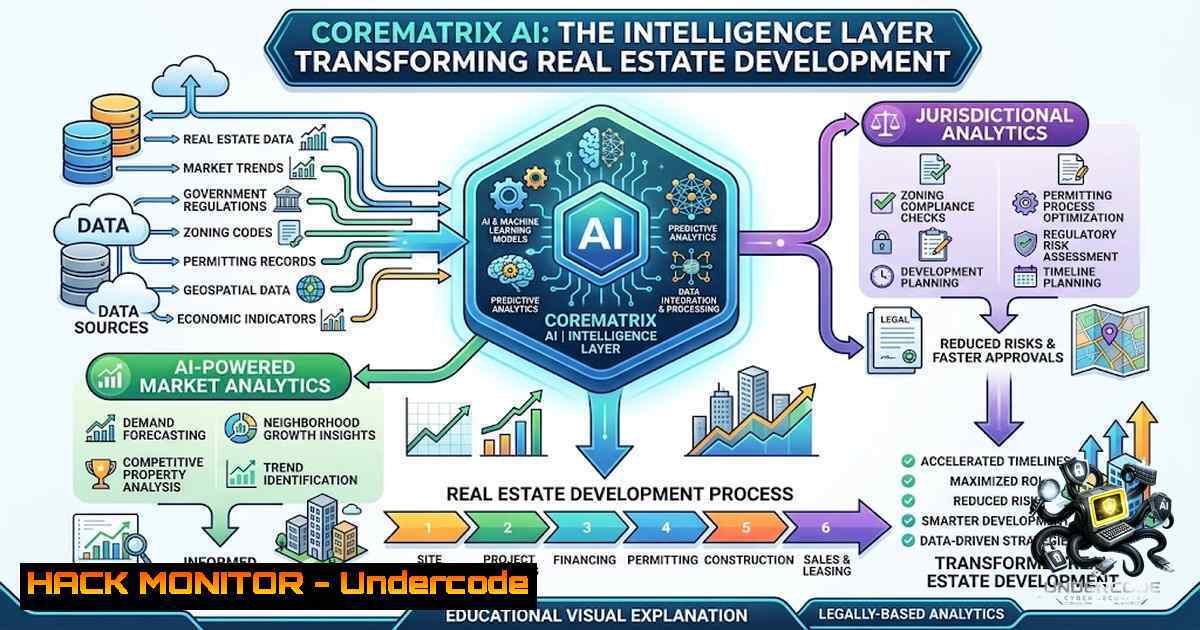
In an era where real estate development decisions hinge on hundreds of interdependent variables, the separation of project analysis from location intelligence has become a critical vulnerability. CoreMatrix AI emerges as an enterprise-grade construction intelligence platform that consolidates cost analysis, market data, financial modeling, and risk assessment into a unified workflow, leveraging artificial intelligence to bridge the gap between project concepts and site-specific realities. By integrating federal data sources including FRED PPI, U.S. Census Building Permits, HUD Fair Market Rents, and BLS wage data, the platform transforms how developers, investors, and lenders evaluate feasibility across 31 U.S. markets and 219 global cities. This technical analysis examines the platform’s architecture, API security considerations, and the broader implications of AI-driven location intelligence in construction technology.
Learning Objectives & Secrets:
- Objective 1: Master the integration of multi-source federal and market data into a unified AI-driven intelligence layer, understanding how platforms like CoreMatrix AI consolidate FRED PPI, U.S. Census, HUD, and BLS data streams for real-time cost estimation and market analysis.
- Objective 2 Secret Tip: Leverage AI-generated sensitivity analysis and Monte Carlo risk simulation to stress-test development assumptions—CoreMatrix AI’s Claude-powered engine generates project theses with built-in sensitivity flags, enabling rapid scenario analysis without manual spreadsheet modeling.
- Objective 3 Secret Tip: Implement governance-first architecture principles that ensure audit-ready reporting and regulatory compliance, a critical capability for enterprise deployments where every data point must be traceable and verifiable.
You Should Know:
1. Understanding the Geospatial Intelligence Architecture
CoreMatrix AI’s fundamental innovation lies in treating geography not as a simple ZIP-code field but as a multidimensional variable that influences nearly every input in development analysis. The platform’s architecture processes location through multiple intelligence layers:
- Regional Cost Conditions: Material costs auto-adjusted via FRED PPI with real-time tariff alerts (e.g., Steel +18–25%, Lumber +7–12%, HVAC +12–18%)
- Market Assumptions: City-level data including rent/SF, RevPAR, cap rates, and vacancy rates across 31 U.S. markets
- Permit Timeline Benchmarks: Jurisdiction-specific approval indicators and zoning intelligence
- Economic Data Integration: Live feeds from U.S. Treasury, Census Building Permits, HUD Fair Market Rents, and BLS Wage Data
Step-by-Step Guide to Geospatial Data Integration:
- Data Source Identification: Map all relevant federal, state, and local data APIs (FRED, Census, HUD, BLS) relevant to your target markets.
- API Authentication Setup: Configure OAuth 2.0 or API key-based authentication for each data source. Example using Python with FRED API:
import requests FRED_API_KEY = "your_api_key" url = f"https://api.stlouisfed.org/fred/series/observations?series_id=PPIACO&api_key={FRED_API_KEY}&file_type=json" response = requests.get(url) - Data Normalization: Create a unified schema that standardizes date formats, geographic identifiers, and measurement units across all sources.
- Geocoding Layer: Implement reverse geocoding to map project ZIP codes to metropolitan statistical areas (MSAs) for market intelligence lookups.
- Caching Strategy: Implement Redis or similar caching for frequently accessed market data with configurable TTL (e.g., 24 hours for PPI data, 7 days for census data).
2. AI-Powered Cost Estimation and Financial Modeling
The platform generates comprehensive project analysis through five streamlined steps: selecting building type, entering project parameters, AI generation of cost breakdowns and market analysis, interactive exploration via Claude AI, and PDF report export. The cost engine computes across six segments—Hard, MEP, Soft, Site, FF&E, and Contingency—while simultaneously calculating KPIs including DSCR, NOI, and Cap Rate.
Step-by-Step Guide to AI Cost Estimation:
- Input Collection: Gather project specifications—building type (21 supported including multifamily, office, retail, data center, healthcare), units, floors, class, amenities, parking, and financing goals.
- Cost Model Selection: The platform maintains asset-class-specific cost models that apply appropriate multipliers based on location and building type.
- AI Processing: Claude processes the inputs against the intelligence database, generating:
– Cost breakdown with Low/Mid/High estimates
– 5-Year Pro Forma including NOI, DSCR, cap rate
– Levered IRR, NPV, cash-on-cash, equity multiple
– Market viability GO/NO-GO scoring
4. Sensitivity Analysis: Run Monte Carlo risk simulations to test variables like construction cost +10% scenarios.
5. Export and Review: Generate 6-page professional reports with CONFIDENTIAL stamping for lender presentations.
Linux/Windows Command for Batch Processing:
 Linux - Batch process multiple project configurations using curl
for project in project1.json project2.json project3.json; do
curl -X POST https://api.corematrixai.us/v1/estimate \
-H "Authorization: Bearer $API_KEY" \
-H "Content-Type: application/json" \
-d @"$project" \
-o "results_${project%.json}.pdf"
done
3. API Security and Data Governance
Enterprise-grade security is paramount when handling sensitive financial and project data. CoreMatrix AI implements governance-first architecture with audit-ready reporting and real-time operational signals.
Step-by-Step Guide to API Security Configuration:
- API Gateway Setup: Implement API key rotation policies (recommended: 90-day rotation) with automatic revocation for inactive keys.
- JWT Token Implementation: Use JSON Web Tokens for session management with short expiration (15-30 minutes) and refresh token patterns.
import jwt import datetime token = jwt.encode({ 'user_id': 'user123', 'exp': datetime.datetime.utcnow() + datetime.timedelta(minutes=15) }, SECRET_KEY, algorithm='HS256') - Rate Limiting: Configure per-user rate limits (e.g., 100 requests/minute) to prevent abuse and ensure fair usage.
- Audit Logging: Enable comprehensive logging for all API calls, including timestamp, user ID, endpoint, and response status.
- Data Encryption: Ensure data-at-rest encryption using AES-256 and data-in-transit encryption via TLS 1.3.
Windows PowerShell Command for API Monitoring:
 Windows - Monitor API health and response times
$apiEndpoint = "https://api.corematrixai.us/v1/health"
while ($true) {
$response = Invoke-WebRequest -Uri $apiEndpoint -UseBasicParsing
$timestamp = Get-Date -Format "yyyy-MM-dd HH:mm:ss"
Write-Host "$timestamp - Status: $($response.StatusCode) - $($response.Content)"
Start-Sleep -Seconds 60
}
4. Construction Management Integration and Module Architecture
Beyond pre-development intelligence, CoreMatrix Universal (coming soon) extends the platform into construction management with 43 integrated modules across six categories.
Step-by-Step Guide to Module Architecture Understanding:
- Command Center (6 Modules): Master Dashboard, Analytics, Portfolio Map, AI Insights Engine, Report Generator, Notification Center
- Preconstruction & Estimating (5 Modules): Pre-Construction Estimator, Bid Management, Drawing Management, Document & BIM, Procurement
- Project Controls (7 Modules): Contract Management, Scheduling & Milestones, RFI & Submittals, Change Orders, Subcontractors, Meeting Management, Risk Management
- Cost & Financials (5 Modules): Budget & Cost, Invoice & Payments, Draw Schedule (AIA G702/G703), Lien Waivers, Owner Portal
- Field, Safety & Quality (11 Modules): Field Reporting, Mobile Field Access (PWA), Photo Documentation, Weather & Site Conditions, Workforce, Equipment, Labor Compliance, Permits, Safety & Compliance, Incident Management, Inspections & QA
- Closeout & System (9 Modules): Punch List & Closeout, Commissioning, Warranty & Defects, Lessons Learned, ESG Reporting, Integration & APIs, Automation Engine, Security & Governance, Platform Settings
5. Regulatory Compliance and Code Review Automation
The platform includes automated IBC/NFPA/ADA code review and zoning entitlement intelligence, reducing manual compliance checking.
Step-by-Step Guide to Automated Code Review:
- Document Upload: Upload PDF blueprints and site plans to the platform.
- AI Extraction: The system performs quantity extraction and cross-validation guardrails.
- Code Mapping: AI maps building elements against IBC, NFPA, and ADA requirements.
- Compliance Scoring: Generate compliance scores with flagged violations and recommended mitigations.
- Zoning Analysis: Cross-reference project parameters with local zoning ordinances and entitlement requirements.
What Undercode Say:
- Key Takeaway 1: CoreMatrix AI demonstrates that AI-driven location intelligence is not merely a convenience but a strategic necessity—treating geography as a complex variable rather than a simple field fundamentally changes how feasibility is assessed, reducing the risk of costly location-based project failures.
- Key Takeaway 2: The platform’s governance-first architecture and integration of federal data sources set a new standard for enterprise-grade AI in construction, proving that AI can be both innovative and auditable when properly architected with security, compliance, and real-time data integration at its core.
Analysis: The emergence of platforms like CoreMatrix AI signals a broader shift in the construction and real estate technology sector toward AI-1ative intelligence layers that unify fragmented data streams. The integration of Claude AI for natural language project summaries represents a paradigm shift from static reporting to dynamic, conversational analysis. However, the platform’s reliance on federal data sources introduces potential single points of failure—if FRED PPI or Census APIs experience downtime, the entire intelligence layer could be compromised. Enterprises adopting such platforms must implement robust fallback mechanisms and data redundancy strategies. Additionally, the governance-first architecture, while admirable, requires significant organizational maturity to fully leverage—audit trails are only as valuable as the processes that enforce their review. The coming CoreMatrix Universal platform, with its 43 modules, suggests an ambitious vision of end-to-end construction lifecycle management, but the challenge will be maintaining coherence and user adoption across such a broad feature set. Ultimately, CoreMatrix AI represents a meaningful step toward institutionalizing AI as the “command layer” for complex operational decisions, but success will depend on how well it balances automation with human oversight, particularly given the platform’s own disclaimer that outputs are “illustrative only” and require human review.
Prediction:
- +1 As AI-powered construction intelligence platforms mature, we will see a 30-40% reduction in pre-development due diligence timelines, enabling faster project pipelines and more efficient capital deployment across the real estate sector.
- -1 The concentration of market intelligence data within a single platform creates systemic risk—if CoreMatrix AI experiences a security breach or data corruption event, it could impact hundreds of concurrent development projects simultaneously, necessitating robust disaster recovery and data redundancy strategies.
- +1 The integration of embodied carbon and ESG reporting modules will accelerate sustainability compliance and reporting, aligning construction development with increasingly stringent environmental regulations.
- -1 The automation of code review and zoning analysis, while efficient, may reduce the depth of human legal and regulatory scrutiny, potentially increasing liability exposure for developers who rely too heavily on AI-generated compliance assessments.
▶️ Related Video (78% Match):
https://www.youtube.com/watch?v=8IQV0ibT4eg
🎯Let’s Practice For Free:
🎓 Live Courses & Certifications:
Join Undercode Academy for Verified Certifications
🚀 Request a Custom Project:
Secure, high-velocity infrastructure and disruptive technological engineering. Contact our engineering team for high-tier development and proprietary systems:
[email protected]
💎 Smart Architecture | 🛡️ Secure by Design | ⭐ Trusted by Thousands
IT/Security Reporter URL:
Reported By: https://lnkd.in/p/eDmKH_fR – Hackers Feeds
Extra Hub: Undercode MoN
Basic Verification: Pass ✅


