
Listen to this Post
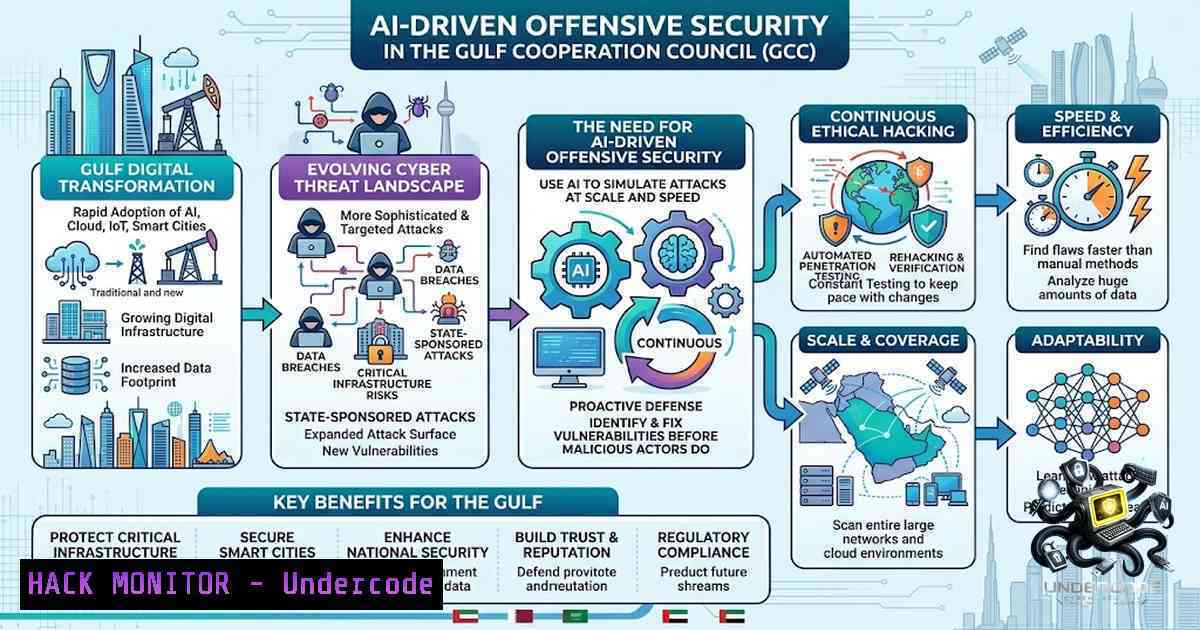
Introduction:
As the UAE and Saudi Arabia accelerate their digital transformations under Vision 2030, they have become prime targets in the cyber arms race. The UAE and Saudi Arabia together face more than half of all dark web threats, with ransomware activity heavily concentrated in the region. At the same time, offensive AI has fundamentally shifted the attacker’s advantage. Threat actors are now using AI frameworks like HexStrike AI to reduce exploitation time from days to under 10 minutes, while LLM-powered malware can dynamically rewrite its own code to evade detection in real time. This new reality renders point-in-time penetration testing structurally insufficient, making continuous, AI-orchestrated ethical hacking a necessity for organizations across the Gulf.
Learning Objectives & Secrets:
- Objective 1: Understand the AI Attack Acceleration Gap – Learn how adversarial AI tools like Villager, HexStrike AI, and LLM-embedded malware have compressed attack timelines from weeks to minutes.
- Objective 2 Secret Tip: Implement Continuous AI-Orchestrated Testing – Move beyond annual pentests by deploying agentic AI frameworks that run reconnaissance, exploitation, and validation continuously, supervised by human experts.
- Objective 3 Secret Tip: Build an Always-On Cyber Resilience Program – Combine AI-driven orchestration with a vetted community of ethical hackers to achieve continuous, measurable testing coverage across your entire attack surface, not just a quarterly snapshot.
You Should Know:
- The New Offensive AI Arsenal – Tools That Are Changing the Game
The cybersecurity landscape has been disrupted by a wave of AI-powered penetration testing tools. Villager, an AI-1ative red-teaming framework, integrates with Kali Linux toolsets and DeepSeek AI models, allowing testers to issue natural language commands that translate into technical instructions for reconnaissance, exploitation, and post-exploitation. Since its July 2025 release on PyPI, Villager has racked up nearly 11,000 downloads. Similarly, HexStrike AI can orchestrate more than 150 security utilities through AI agents. Shortly after its release, threat actors used it to exploit newly disclosed Citrix NetScaler vulnerabilities (CVE-2025-7775, CVE-2025-7776, CVE-2025-8424), reducing exploitation time from several days to under 10 minutes.
For defenders, frameworks like PenTest++ combine automation with generative AI to optimize ethical hacking workflows, while the open-source Cybersecurity AI (CAI) framework helps security teams build and run AI-driven tools for offensive and defensive tasks, supporting over 300 AI models.
Step‑by‑step guide to deploying an AI-assisted reconnaissance pipeline:
- Set up the environment: Install Kali Linux and clone the Villager repository from PyPI (
pip install villager). - Configure AI model integration: Set up API keys for DeepSeek or other supported LLMs within the Villager configuration.
- Launch reconnaissance: Issue natural language commands such as “Scan target domain for subdomains and open ports” – Villager translates this into technical tool execution.
- Automate exploit generation: Use the framework’s database of 4,200+ AI prompts to craft payloads tailored to discovered vulnerabilities.
- Containerize for stealth: Villager automatically spins up isolated Kali Linux containers that are destroyed after 24 hours, with randomized SSH ports to complicate forensic investigation.
- Validate findings: Have human pentesters review AI-generated exploit results before any production testing.
-
Continuous Testing Architecture – Moving from Point-in-Time to Always-On
Traditional penetration testing operates on a periodic model – testers assess an environment, produce a report, and the process repeats months later. In fast-changing cloud and application environments, this approach leaves long gaps where new vulnerabilities appear but remain untested. Attackers are already using AI to probe environments continuously – they are not attacking once a year.
The solution is agentic, continuous security testing. Platforms like Terra Portal act as an execution layer where autonomous AI agents perform testing tasks – reconnaissance, attack surface discovery, code review, test case generation, and reachability analysis – while human pentesters step in when deeper judgment or controlled exploitation is required. Similarly, the Detectify MCP Server brings security testing engines directly into AI-driven development workflows, allowing coding agents to find and validate exploitable vulnerabilities in real time.
Step‑by‑step guide to implementing continuous testing:
- Deploy an agentic testing gateway: Set up a platform like Terra Portal or HackerOne Agentic PTaaS that combines AI agents with human supervision.
- Define continuous scanning scope: Map your entire attack surface – all subdomains, APIs, cloud assets, and third-party integrations.
- Configure ambient AI agents: Allow agents to run reconnaissance and attack surface mapping 24/7 without human intervention.
- Set validation thresholds: When agents identify potential vulnerabilities, automatically flag them for human review.
- Enable Copilot AI for experts: Provide human pentesters with AI-assisted tools for controlled exploitation, report generation, and remediation guidance.
- Integrate with CI/CD: Connect the testing platform to your development pipeline so new code is automatically tested before deployment.
- Monitor continuously: Use built-in logging and tracing (e.g., Phoenix in CAI) to track all agent activities and findings.
3. API Security – The Expanded Attack Surface
As organizations across the Gulf adopt cloud, SaaS, and microservices architectures, APIs have become a primary attack vector. Only 21% of organizations report a high ability to detect attacks at the API layer, and only 13% can prevent more than 50% of API attacks. The vast majority of API attacks come from authenticated sources, meaning attackers bypass login screens and exploit authorization flaws – vulnerabilities that traditional web application firewalls miss.
AI-powered API security testing is now essential. Tools like APIsec automatically map every endpoint, generate thousands of attack simulations, and uncover business logic flaws like BOLA (Broken Object Level Authorization). Open-source tools like OWASP ZAP provide free dynamic testing for APIs supporting OpenAPI and GraphQL specifications. For runtime protection, AI-driven platforms like Salt Security use behavioral analysis to detect and block API attacks in real time.
Step‑by‑step guide to API security hardening:
- Discover all APIs: Use automated discovery tools to identify documented and shadow APIs across your environment.
- Scan OpenAPI specifications: Deploy AutoSwagger, an open-source tool that scans OpenAPI-documented APIs for broken authorization vulnerabilities.
- Implement automated DAST: Integrate OWASP ZAP or Burp Suite into your CI/CD pipeline to run dynamic API security tests on every commit.
- Test for business logic flaws: Use AI-powered platforms like APIsec to simulate attack scenarios targeting authorization and business logic.
- Deploy runtime protection: Implement AI-driven behavioral analysis (e.g., Salt Security) to detect credential stuffing, account takeover, and business logic abuse in real time.
- Scan for secrets: Use GitGuardian to scan repositories for exposed API keys, tokens, and credentials.
- Rotate credentials frequently: Enforce short-lived tokens and frequent rotation so credentials do not linger open for attackers to reuse.
-
Cloud Infrastructure Hardening – Defending Against AI-Accelerated Attacks
With AI attackers able to move from initial entry to full domain access in under 30 minutes, cloud infrastructure hardening is no longer optional. Organizations across the Gulf must implement defense-in-depth measures that can withstand AI-automated attacks.
Step‑by‑step guide to Linux cloud server hardening (Ubuntu/Debian):
- Disable root login via SSH and enforce key-based authentication:
sudo sed -i 's/PermitRootLogin yes/PermitRootLogin no/' /etc/ssh/sshd_config
sudo systemctl restart sshd
- Configure UFW firewall to allow only necessary ports:
sudo ufw default deny incoming
sudo ufw default allow outgoing
sudo ufw allow OpenSSH
sudo ufw enable
-
Install and configure Fail2ban to block brute-force attacks:
sudo apt-get install -y fail2ban
sudo systemctl enable fail2ban
sudo systemctl start fail2ban
4. Enable automatic security updates:
sudo apt-get install -y unattended-upgrades
sudo dpkg-reconfigure -plow unattended-upgrades
5. Harden SSH configuration with strong ciphers and protocol settings:
sudo chmod 600 /etc/ssh/sshd_config
- Implement egress controls to monitor outbound traffic to external AI services – a critical measure as LLM-powered malware increasingly communicates with external AI models.
-
Vulnerability Exploitation and Mitigation – The New Timeline
The window between vulnerability disclosure and exploitation has collapsed. When Citrix NetScaler vulnerabilities (CVE-2025-7775, CVE-2025-7776, CVE-2025-8424) were announced on August 26, 2025, threat actors using HexStrike AI reduced exploitation from days to under 10 minutes. Some even began selling access to vulnerable instances on the dark web.
This represents a “critical turning point” in cybersecurity. Attacks that once required advanced skills and weeks of preparation can now be executed within minutes. Organizations must shift from reactive patching to proactive, continuous vulnerability management:
Step‑by‑step guide to accelerated vulnerability response:
- Implement continuous vulnerability scanning using AI-powered tools that scan your environment 24/7.
- Prioritize based on exploitability – not all CVEs are equal. Use AI to analyze which vulnerabilities are most likely to be exploited.
- Deploy virtual patching for critical vulnerabilities where immediate patching is not possible.
- Monitor dark web and threat intelligence feeds for early warnings of active exploitation campaigns.
- Test your incident response against AI-accelerated attack scenarios – run tabletop exercises simulating a 10-minute exploitation window.
-
Building a Cyber Resilience Program for the AI Era
The Gulf region faces intensifying cyber risks driven by financially motivated threat actors, large-scale data leaks, and concentrated ransomware and phishing activity. The UAE Cyber Security Council has reported 200,000 daily attacks on strategic sectors. Against this backdrop, point-in-time testing becomes structurally insufficient.
Bug Bounty Switzerland’s Cyber Resilience Shield offers a model for the future: combining AI-driven orchestration, years of learned testing context, a vetted global community of over 16,000 ethical hackers, and offensive AI agents – delivered as a subscription that activates in 24 hours. This approach moves from selling tools to selling outcomes: continuous, measurable testing coverage across the entire exposed attack surface.
Key components of a cyber resilience program:
- Continuous testing – not annual or quarterly, but always-on
- AI-human collaboration – agents handle scale and repetition; experts handle judgment and complex exploitation
- Outcome-based metrics – measure testing coverage and risk reduction, not just number of findings
- Board-ready reporting – provide real-time visibility into cyber risk, not a quarterly snapshot
- Rapid activation – ability to deploy security testing within 24 hours, not weeks or months
What Undercode Say:
- Key Takeaway 1: The attacker’s advantage has fundamentally changed. AI tools like Villager and HexStrike have compressed attack timelines from weeks to minutes. Organizations still relying on last year’s penetration test are operating with a false sense of security.
-
Key Takeaway 2: Continuous, AI-orchestrated ethical hacking is no longer optional – it is a necessity. The Gulf’s rapid digital transformation, combined with its status as a prime target for cyberattacks, demands an always-on security testing model that combines AI agents with human expertise.
-
Analysis: The cybersecurity industry is at an inflection point. Traditional penetration testing – a point-in-time snapshot of security posture – was designed for a slower era. Today, attackers use AI to probe continuously, adapt in real time, and exploit vulnerabilities within hours of disclosure. Defenders must adopt the same AI-driven, continuous approach. This does not mean replacing human hackers – AI alone cannot match the creativity and judgment of skilled ethical hackers. Instead, the future lies in AI-human collaboration: AI agents handle scale, speed, and repetition, while human experts provide strategic oversight, complex exploitation, and contextual judgment. Organizations that fail to make this transition will find themselves perpetually one step behind. The Gulf region, with its ambitious digital transformation agendas, has both the most to gain and the most to lose – making it the ideal proving ground for next-generation cyber resilience.
Prediction:
- +1 The Gulf region will become a global leader in AI-driven cybersecurity innovation, with UAE and Saudi organizations deploying continuous testing frameworks that set new standards for cyber resilience.
- +1 The integration of AI agents with human ethical hackers will create a new category of cybersecurity professionals – “AI-Orchestrated Security Analysts” – who manage and supervise autonomous security testing at scale.
- -1 The democratization of offensive AI tools like Villager will lead to a surge in attacks against Gulf organizations, particularly in the financial and public administration sectors.
- -1 The window between vulnerability disclosure and exploitation will continue to shrink, potentially reaching minutes rather than hours, forcing organizations to adopt real-time patching and virtual patching as standard practice.
- +1 Regulatory frameworks across the Gulf will evolve to mandate continuous, scenario-based security testing, driving widespread adoption of AI-orchestrated ethical hacking platforms.
- -1 Organizations that fail to transition from periodic to continuous testing will experience increasingly severe breaches, as attackers leverage AI to find and exploit gaps between testing cycles.
- +1 The bug bounty and ethical hacking industry will consolidate around AI-powered platforms, with firms like Bug Bounty Switzerland leading the transition from consulting-heavy models to outcome-based, always-on security subscriptions.
▶️ Related Video (84% Match):
https://www.youtube.com/watch?v=0hzimKBnaYk
🎯Let’s Practice For Free:
🎓 Live Courses & Certifications:
Join Undercode Academy for Verified Certifications
🚀 Request a Custom Project:
Secure, high-velocity infrastructure and disruptive technological engineering. Contact our engineering team for high-tier development and proprietary systems:
[email protected]
💎 Smart Architecture | 🛡️ Secure by Design | ⭐ Trusted by Thousands
IT/Security Reporter URL:
Reported By: https://lnkd.in/p/e9xW9Yak – Hackers Feeds
Extra Hub: Undercode MoN
Basic Verification: Pass ✅


