
Listen to this Post
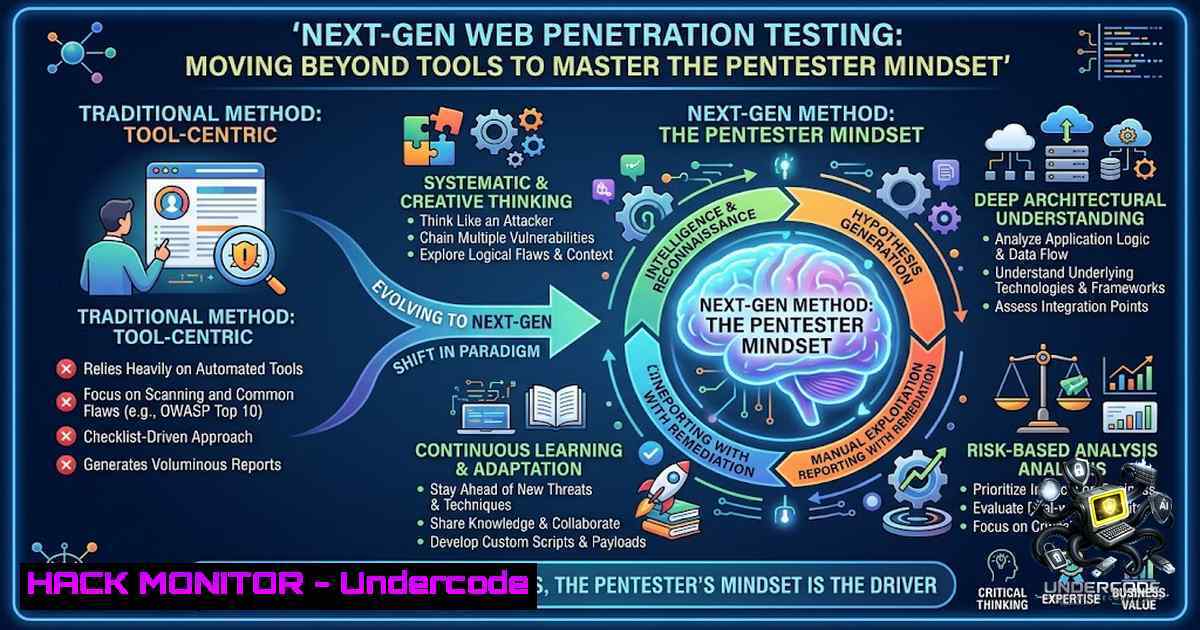
Introduction:
The cybersecurity industry is saturated with individuals who can run a vulnerability scanner but struggle to interpret the results or explain the business impact of a finding. True offensive security professionals distinguish themselves not by their toolset, but by their ability to think critically, analyze root causes, and translate technical flaws into actionable risk for stakeholders. This article explores the core competencies required for modern web penetration testing, bridging the gap between basic tool usage and professional-grade vulnerability assessment and exploitation.
Learning Objectives & Secrets:
- Objective 1: Master the Reconnaissance & Enumeration Process. Effective testing begins long before a single request is sent to an application. Understand that active scanning (like Nmap or Dirb) is only the surface; secret tip: leverage passive reconnaissance techniques, such as OSINT gathering via Shodan, Censys, and Google Dorks, to map the external attack surface without directly alerting the target’s intrusion detection systems. Combine this with analyzing JavaScript files for hardcoded endpoints.
- Objective 2: Validate and Exploit Vulnerabilities with Context. Running a scanner like Burp Suite or OWASP ZAP is not enough. Secret tip: learn to manually craft payloads to confirm a vulnerability is actually exploitable. For instance, when testing for SQL injection, replace a URL parameter with `’ OR ‘1’=’1` to test logic, but also utilize time-based payloads like `’ WAITFOR DELAY ‘0:0:5’–` in SQL Server to confirm blind injection without returning data. Always determine if the vulnerability is a false positive.
- Objective 3: Develop Professional Reporting and Risk Analysis. A exploit is useless without clear communication. Secret tip: structure your findings using a CVSS (Common Vulnerability Scoring System) vector to objectively score severity. When writing an executive summary, avoid technical jargon and focus on the business risk, using phrases like “potential data exfiltration” or “denial of service impact” rather than “exploitable buffer overflow.”
You Should Know:
1. The Foundations: Web, Networking, and Linux Hardening
Understanding the underlying infrastructure is paramount. A web application doesn’t exist in a vacuum; it interacts with servers, databases, and network layers. For Linux systems, a common misconfiguration is weak file permissions. An attacker with low-level access can exploit this for privilege escalation.
– Step‑by‑step guide: To identify writable files that are owned by a user or group with higher privileges, use the Linux command:
find / -writable -user $(whoami) 2>/dev/null
This command searches the entire filesystem for files writable by the current user.
– Key Tools & Commands: To enumerate network services, Nmap is essential. Use the following to detect service versions and run default scripts on a target:
nmap -sV -sC -p- -T4 target_ip
On Windows, securing IIS involves removing unnecessary application mappings. Use the `appcmd` command to list currently installed features:
appcmd list apppool /config
2. Reconnaissance & Advanced Enumeration
Reconnaissance is often where the first critical vulnerabilities are discovered. Modern web applications often expose APIs and microservices.
– Step‑by‑step guide: For API reconnaissance, utilize the `ffuf` tool for fuzzing hidden endpoints. Use a wordlist like `raft-medium-words.txt` to discover unexpected directories or API versions.
ffuf -u https://target.com/api/v1/FUZZ -w /usr/share/wordlists/raft-medium-words.txt -fc 404
This command filters out 404 responses, revealing existing API endpoints.
– Deep Dive into “Secrets”: Configuration files such as `.env` or `.git/config` often contain hardcoded credentials. Use a tool like `truffleHog` to scan for high-entropy strings in git repositories, but for manual verification, inspect the JavaScript source:
curl -s https://target.com/js/main.js | grep -E "https://|api|secret|token|key"
This one-liner extracts likely API keys or internal URLs inadvertently exposed in client-side code.
3. Vulnerability Analysis: Understanding the OWASP Top 10
Vulnerability analysis involves correlating the data gathered during enumeration with known security flaws. The OWASP Top 10 provides a framework, but modern testing must include logic flaws and business-level exploits.
– Step‑by‑step guide:
– Testing for IDOR (Insecure Direct Object References): Intercept a request that uses a sequential ID, e.g., GET /profile.php?user_id=123. Log out, log in as another user, and change the parameter to 124. If the profile loads, the application is vulnerable.
– Command Injection: Input a command into a form field that interfaces with the OS. For Linux targets, try: 127.0.0.1; whoami. For Windows, try: 127.0.0.1 & whoami.
– Mitigation: Input validation should be strict. Use allowlists over denylists. In code, sanitize input using prepared statements (SQL) and context-aware escaping (XSS).
- Validation & Exploitation: The Art of the Proof of Concept
Validation confirms a vulnerability is genuine and not a false positive. A Proof of Concept (PoC) demonstrates the impact.
– Step‑by‑step guide: When exploiting SQL Injection manually, use a UNION-based payload to extract database names:
' UNION SELECT null, database(), version()-- -
This returns the database name and version, validating the exploit. For authenticated sessions, use the `xss` payload `` to test if the application is vulnerable to Cross-Site Scripting (XSS) without actually deploying a malicious server; just check if the browser executes the payload.
5. Professional Reporting and Risk Impact Analysis
A report is the final deliverable and must be clear, concise, and technical. The language should be objective and data-driven.
– How to Craft a Vulnerable Finding:
1. SQL Injection in `login.php`.
2. Severity: High (CVSS 8.1).
- Description: The `id` parameter is unsanitized, allowing arbitrary SQL execution.
- PoC: `GET /product?id=1 AND 1=1` yields full database results.
- Impact: Potential for full database compromise and data theft.
- Remediation: Use parameterized queries (prepared statements). For Java, use
PreparedStatement; for Python, usecursor.execute("SELECT ... WHERE id=%s", (id,)).
– Risk Analysis: Never rate a vulnerability solely on technical severity. Consider the business context. A “Low” severity information disclosure on a public page is less critical than an “Medium” vulnerability that exposes internal IP addresses on a production server, which could be used in a pivot attack.
6. AI-Assisted Pentesting and Continuous Learning
The landscape is evolving with AI-assisted tools that generate payloads and automate repetitive tasks. However, AI is a force multiplier, not a replacement.
– Step‑by‑step guide to integrating AI: Use AI to generate context-aware payloads for complex vulnerabilities like SSTI (Server-Side Template Injection). For example, prompt a model to generate Jinja2 payloads to read a file ({{ ''.__class__.__mro__
.__subclasses__() }}</code>). While AI can formulate this, a human pentester must understand the Python environment to execute it safely. Practice by setting up a local lab like "Ghostlamp" or "DVWA" to safely test these advanced techniques.

<h2 style="color: yellow;">7. Setting Up a Professional Practice Lab</h2>

Continuous practice is non-1egotiable. A dedicated lab environment allows you to test configurations and write exploits without legal repercussions.
- Environment Setup (Linux):
[bash]
sudo apt update && sudo apt install docker.io
docker pull vulnerables/web-dvwa
docker run -d -p 8080:80 vulnerables/web-dvwa
This sets up a vulnerable web application on your localhost.
- Environment Setup (Windows - WSL2): Enable WSL and install Kali Linux. Use the native Nmap and Burp Suite Community Edition to scan localhost.
What Undercode Say:
- Key Takeaway 1: The path to becoming a Junior Pentester hinges on understanding the "why" behind a vulnerability, not just the "how" of exploiting it. This investigative mindset is what separates script-kiddies from professionals.
- Key Takeaway 2: Practical, hands-on experience is irreplaceable. Watching tutorials provides a false sense of competence. Real growth occurs through lab work, live bug bounty practice, and writing professional reports, which forces a deeper understanding of the root cause.
- Key Takeaway 3: As AI augments the pentesting process, the ability to validate results and communicate technical impact to non-technical stakeholders becomes the most valuable skill. The industry needs security professionals who can bridge the gap between raw technical data and business decisions.
Prediction:
- +1 The integration of AI into pentesting frameworks will significantly reduce the barrier to entry for junior testers, allowing them to generate complex exploits faster and focus on logic and business flow flaws that AI struggles with.
- -1 This ease of use will lead to a surge in automated, low-quality scanning attempts across the internet, increasing noise in security monitoring and potentially desensitizing organizations to genuine threats.
- +1 By 2026, we will see a distinct market for "AI Prompt Engineers" within security teams, dedicated to training and validating AI-generated payloads.
- -1 The reliance on automated tools may atrophy the manual testing skills of junior pentesters, making them less effective in bespoke, enterprise environments where automation fails.
- +1 The demand for robust, professional reporting will skyrocket, as decision-makers need clear, actionable insights to justify security budgets.
- -1 Vulnerabilities related to AI model poisoning and prompt injection will become a primary attack vector in Web 3.0, requiring pentesters to learn entirely new attack chains.
- +1 The Bootcamp model, offering live sessions and hands-on labs, will become the gold standard for cybersecurity education, replacing purely theoretical certifications.
- -1 Organizations that fail to adopt "Shift-Left" security practices (moving testing earlier in the SDLC) will face an unsustainable backlog of high-severity findings, as manual testers cannot keep pace with rapid development cycles.
▶️ Related Video (84% Match):
🎯Let’s Practice For Free:
🎓 Live Courses & Certifications:
Join Undercode Academy for Verified Certifications
🚀 Request a Custom Project:
Secure, high-velocity infrastructure and disruptive technological engineering. Contact our engineering team for high-tier development and proprietary systems:
[email protected]
💎 Smart Architecture | 🛡️ Secure by Design | ⭐ Trusted by Thousands
IT/Security Reporter URL:
Reported By: https://lnkd.in/p/eH9cYGqG - Hackers Feeds
Extra Hub: Undercode MoN
Basic Verification: Pass ✅


