
Listen to this Post
Introduction:
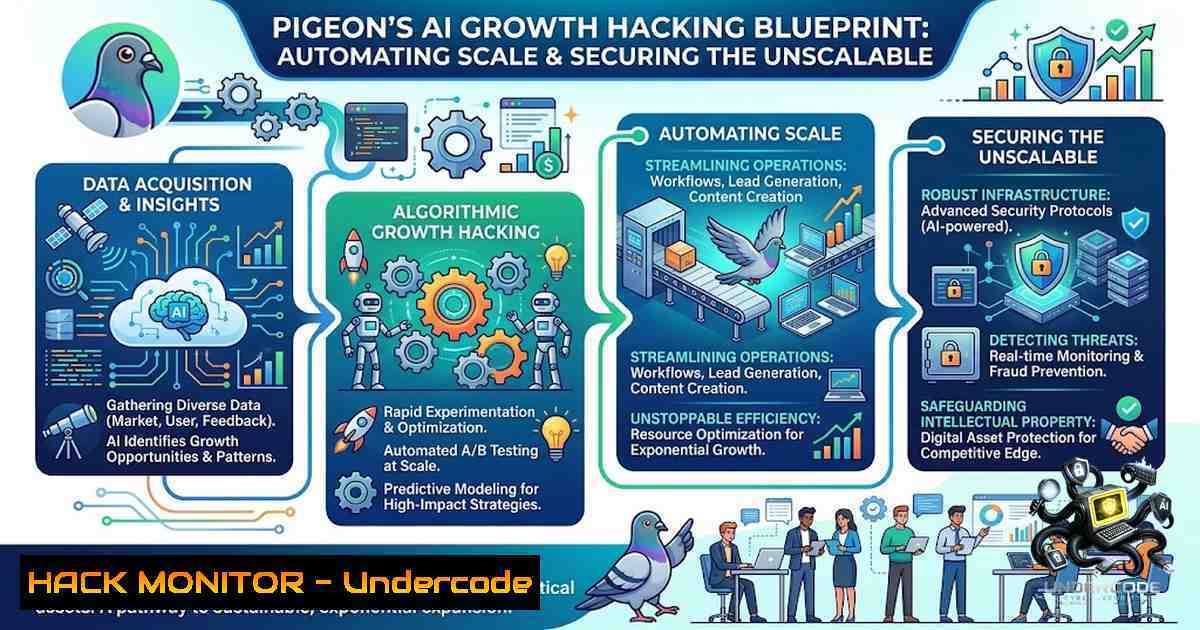
In the hyper-competitive landscape of SaaS, the concept of “doing things that don’t scale” has long been a mantra for early-stage startups. However, the emergence of autonomous AI agents like Pigeon is automating this manual grind, allowing founders to code during lectures and manage support on the metro. This shift introduces a critical cybersecurity and IT paradigm: how to securely deploy AI agents capable of interacting with APIs, handling customer data, and automating marketing logic without exposing sensitive infrastructure or violating privacy regulations. The narrative of achieving $XX,XXX ARR in under a week must be tempered with a robust framework for securing the automation pipelines that make such rapid growth possible.
Learning Objectives & Secrets:
- Objective 1: Master the automation of customer support and outreach through AI while implementing strict data sanitization protocols.
- Objective 2 Secret Tips: Leverage “Growth Scripts” that utilize multi-threading and session management to bypass rate limiting without sacrificing account integrity.
- Objective 3 Secret Tips: Implement a “Failure-First” audit trail for your AI’s actions, ensuring every API call and data mutation is reversible and logged for security compliance.
You Should Know:
- Automating the Unscalable: Secure API Orchestration & Logging
While Lakshya Modi builds growth through manual intervention and support tickets, the underlying architecture relies heavily on API orchestration. To replicate the “Pigeon” workflow, developers often rely on Python scripts that interact with CRM tools and social media platforms. The risk lies in credential exposure and the execution of unintended actions.
- Step‑by‑step guide for Linux (Python script security):
- Environment Isolation: Never hardcode API keys. Use a `.env` file and load them via
python-dotenv.
– `pip install python-dotenv`
– `echo “API_KEY=your_actual_key” > .env` (Ensure this file is in.gitignore). - Secure Session Management: Use the `requests` library with a persistent session to handle cookies and tokens.
– `session = requests.Session()`
– `session.headers.update({‘Authorization’: f’Bearer {API_KEY}’})`
3. Action Logging: Implement a logging module that records every API mutation (POST/PUT/DELETE).
– logging.basicConfig(filename='growth_audit.log', level=logging.INFO).
4. Windows Alternative: For Windows-based development, use Windows Subsystem for Linux (WSL) to maintain the same environment consistency, ensuring scripts behave similarly in production.
2. Bypassing Restrictions: VPNs, Proxies, and IP Rotation
Building while “unallowed to use MacBook” means using network tunnels to access restricted resources. For growth hacking tools that scrape or interact with social media from a single location, IP rotation is non-1egotiable to avoid shadow bans.
- Step‑by‑step guide (Terminal/Tool Setup):
- Proxy Setup in Linux: Export environment variables to route traffic through a rotating proxy service.
– `export HTTP_PROXY=”http://user:[email protected]:8080″`
– `export HTTPS_PROXY=”http://user:[email protected]:8080″`
2. Testing Connectivity: Validate the IP address before executing scripts.
– `curl -s ifconfig.me` (Check if your IP has changed).
3. Windows PowerShell Equivalent:
– `$env:HTTP_PROXY=”http://user:[email protected]:8080″`
4. VPN Kill Switch: Utilize `ufw` (Uncomplicated Firewall) to block non-VPN traffic.
– `sudo ufw default deny outgoing` (Only allow traffic to the VPN IP).
3. Database Hardening for Pigeon’s ARR Data
With a focus on hitting $100K ARR and tracking metrics like “burnt fees” (as seen in the post’s comments regarding Stripe), securing the financial and user datastore is paramount. Encrypting sensitive financial data at rest and in transit prevents a catastrophic data breach that could wipe out early revenue.
- Step‑by‑step guide (PostgreSQL/MongoDB Security):
- Enable TLS/SSL: Force your database connections to use SSL.
– PostgreSQL: Add `sslmode=require` to the connection string.
2. Encrypt Columns: Use pgcrypto to encrypt specific columns like “Email” or “Stripe ID”.
– `CREATE EXTENSION pgcrypto;`
– `UPDATE users SET email = encrypt(email, ‘my_secret_key’, ‘aes’);`
3. Network Restriction: Bind the database to localhost only (or specific internal IPs) to prevent exposure.
– Edit postgresql.conf: listen_addresses = 'localhost'.
4. CI/CD Pipeline and Security Scanning
When “coding during classes,” the risk of pushing vulnerable code increases. Integrating a CI/CD pipeline with automated security scanning is crucial.
- Step‑by‑step guide (GitHub Actions):
1. Create a `.github/workflows/security-scan.yml` file.
- Include steps for dependency scanning using `npm audit` or
safety check.
– For Python: safety check -r requirements.txt.
3. Secrets Scanning: Use `trufflehog` to scan for secrets accidentally committed to the repo.
– docker run --rm -v $(pwd):/repo trufflesecurity/trufflehog git file:///repo.
5. DDoS Protection and Cloud Hardening
If Pigeon experiences a viral surge, the backend must hold up. Implementing a Web Application Firewall (WAF) and load balancing prevents service interruptions.
- Step‑by‑step guide (AWS & Linux):
- Enable AWS WAF: Attach a WAF to your CloudFront or Application Load Balancer to filter out malicious traffic.
- Rate Limiting at the Reverse Proxy: Use `Nginx` to limit the number of requests from a single IP.
– `limit_req_zone $binary_remote_addr zone=mylimit:10m rate=10r/s;`
3. Linux Kernel Tuning: Increase TCP buffer sizes to handle high traffic.
– `sysctl -w net.core.somaxconn=1024` &sysctl -w net.ipv4.tcp_tw_reuse=1.
What Undercode Say:
- Key Takeaway 1: Automation is the ultimate growth lever, but automated systems are often easier to compromise. Implement strict “Principle of Least Privilege” for the AI’s API tokens.
- Key Takeaway 2: Scaling revenue without scaling infrastructure leads to fatality; lean on managed services (like AWS Lambda) to ensure high availability during traffic spikes.
Analysis: Lakshya’s journey highlights a generational shift in entrepreneurship: “Moving fast and breaking things” is now code-based. For a founder, the line between a growth hack and a security vulnerability is thin. The focus on hitting revenue goals often overshadows the need for SOC-2 compliance or GDPR considerations. As autonomous AI agents become prevalent, the ability to audit AI decisions becomes a competitive advantage, mitigating reputational damage. The real “unicorn” trajectory will belong to those who can automate aggressively while maintaining a fortress of cloud security practices, ensuring that the “burned fees” remain strictly operational, not a result of a breach.
Prediction:
- -1: Increased reliance on AI growth agents will lead to a spike in API-key leakage incidents over the next 12 months, as developers prioritize functionality over security due to speed-to-market pressures.
- +1: We will see the rise of “Security-as-Code” platforms specifically designed for AI agents, enabling real-time monitoring and automatic rollback of unintended actions, turning security into a growth enabler rather than a hindrance.
▶️ Related Video (86% Match):
🎯Let’s Practice For Free:
🎓 Live Courses & Certifications:
Join Undercode Academy for Verified Certifications
🚀 Request a Custom Project:
Secure, high-velocity infrastructure and disruptive technological engineering. Contact our engineering team for high-tier development and proprietary systems:
[email protected]
💎 Smart Architecture | 🛡️ Secure by Design | ⭐ Trusted by Thousands
IT/Security Reporter URL:
Reported By: https://lnkd.in/p/e9PEPdEv – Hackers Feeds
Extra Hub: Undercode MoN
Basic Verification: Pass ✅


